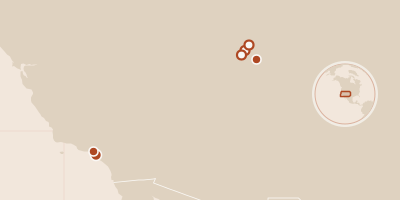
Max Caulfield comes back to the Oregon coast and finds a missing girl and a storm only she can see. In a Colorado mining town, Alex Chen arrives to meet the brother she barely knows, then stays to solve his death. Two Life is Strange games, two invented towns, and the real places their artists borrowed: a lighthouse, a main street, storefronts and a mountain valley.
The route follows the games in order, from Cape Meares and the Oregon towns behind Arcadia Bay to Idaho Springs, Georgetown, Nederland and Marble, the Colorado towns behind Haven Springs.
A thousand years after the old world fell to Faro's machines, the American West is a land of scattered tribes and robotic machines. Aloy, a Nora outcast, travels from Colorado Springs to the California coast to uncover what destroyed the old world.
This route follows both Horizon games from the red rocks above Colorado Springs to the drowned streets of San Francisco, pairing each stop with the real landmark behind it. Guerrilla compresses the map — in-game locations are not exactly where they are in the real world — so the pins mark real stand-ins, not exact game coordinates.
In the spring of 1989, Henry leaves Boulder for a summer job as a fire lookout in Wyoming's Shoshone National Forest. His only company is Delilah, the voice on the other end of a walkie-talkie, until fireworks at a lake, a ransacked tower and a fenced research camp turn the job into a mystery.
The route follows the game's places and the real Wyoming behind them: the bar where Henry meets Julia, the Cody rodeo the characters talk about, the Shoshone forest still marked by the 1988 Yellowstone fires, and stand-ins for the fictional Two Forks tower, Jonesy Lake, Wapiti Station, Cave 452 and Thorofare Lookout.
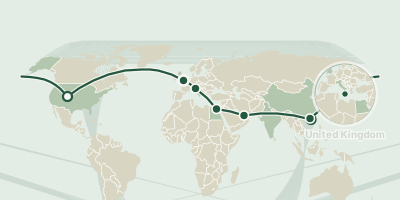
In autumn 1988 the BBC sent Michael Palin round the globe in the footsteps of Jules Verne's Phileas Fogg, with no aircraft allowed. It began and ended at the Reform Club in London and ran from 25 September to 12 December.
The route follows nine moments from his own day-by-day captions and diary excerpts: Venice, the Pyramids, a dhow from Dubai to Bombay, Hong Kong, a train to Shanghai, the Pacific, an Aspen balloon and a locked door in Pall Mall. Pins mark cities and landmarks; the real line of travel ran between them.
Two friends set out for a weekend at a fishing cabin, and one violent night at a roadhouse bar turns the trip into a run for Mexico across the American West. Ridley Scott's 1991 film is set on a route from Arkansas to the Grand Canyon, but it was filmed almost entirely in California and Utah, around Bakersfield and Moab, between June and August 1990.
This route follows the story in film order through six real places: a Long Beach bar, a Los Angeles motel, a Colorado general store, the desert at Arches, the ghost town of Cisco and the cliff edge at Dead Horse Point. Almost all of them stand in for somewhere else, and each stop says where.
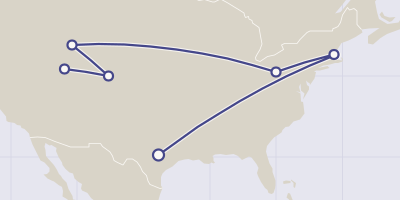
A smuggler named Joel is hired to carry fourteen-year-old Ellie — possibly immune to the fungus that ended the world — across a ruined America, from the Boston quarantine zone to a hospital in Salt Lake City. What starts as a delivery job becomes the closest thing either of them has left to family, ending in a hospital corridor with an impossible choice.
This route follows their road west in story order: outbreak night in Austin, the Boston handoff, Bill's trapped town, the Pittsburgh ambush, Tommy's dam settlement at Jackson, the deserted university in Colorado and the Salt Lake City hospital. The cities are real but the story sites are placed approximately, with real landmarks as pins.
Los Santos feels like Los Angeles because it is Los Angeles, compressed. Grand Theft Auto V squeezes the city's most famous miles into one playable map, from a hillside sign to a Venice boardwalk.
This tour visits seven real stand-ins behind the fiction: the hillside sign, a movie palace, a luxury shopping street, an observatory, a pier, a beach and a towered folk-art park. Every pin marks the real place, and each stop names the game location it doubles for. Expect crowds at the beach and on Hollywood Boulevard, and quiet at the towers.
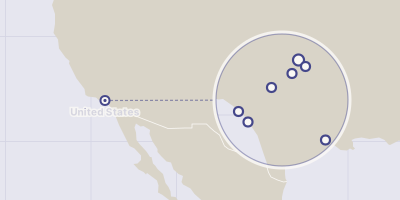
The year is 2281, two centuries after a nuclear war. A courier carrying a mysterious platinum poker chip to New Vegas is shot in the head and left in a shallow grave — and survives. Obsidian's 2010 role-playing game follows the courier's hunt for the man who did it, into a war for the Mojave between the New California Republic, Caesar's slaver Legion and Mr. House, the hidden ruler of the Strip.
The designers built the map from US Geological Survey data and photographs of the real desert, so the game's road south from Goodsprings and back up to Las Vegas runs through real towns. The route follows that road. The towns' massacres, radiation and battles are fiction; their saloons, roller coasters and dam are not.
In 1990 Christopher McCandless graduated from Emory University, gave his savings to charity and vanished from his family's life. For two years he drifted across America under the name "Alexander Supertramp" — working odd jobs, living in camps, paddling a canoe down the Colorado River into Mexico. In April 1992 he hitchhiked to Alaska and walked into the bush with very little food. He died there that summer, aged 24. Jon Krakauer told his story in the book Into the Wild (1996), filmed by Sean Penn in 2007.
The route follows his documented trail. The Stampede Trail is dangerous, and this route is not an invitation to retrace the last part of it.