Age of Empires II follows Joan of Arc from a French army camp at Vaucouleurs to the stake at Rouen. The designers said they deferred to history wherever it did not interfere with gameplay, and the campaign's spine — Orléans, Patay, Reims, Paris — is close to the record. But the game also bends the story, placing Joan at a battle she missed and turning a failed assault on Paris into a betrayal. This route follows the campaign's stops in order and sets each one beside what the sources say happened there.
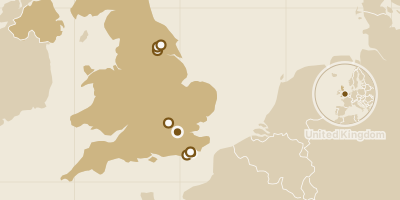
Thomas Cromwell rises from a Putney childhood to become Henry VIII's most trusted minister, then falls in the same Tudor politics he mastered. Hilary Mantel's trilogy follows him from Cardinal Wolsey's household through the Reformation, Anne Boleyn's rise and execution, and his own last years.
This route traces the places that anchor the story: Cromwell's birthplace and London house, Wolsey's palaces at York Place and Esher, the abbey where Wolsey died, Westminster Abbey for Anne's coronation, the Seymour seat that gives the novels their title, Hampton Court, and the Tower. The 2015 television adaptation used Dover Castle for the Tower of London and Penshurst Place for Whitehall.
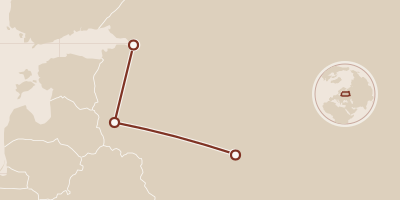
Pushkin's novel in verse follows a bored St. Petersburg dandy who inherits a country estate, rejects a girl's love letter, kills his friend in a duel, and years later finds her transformed into the star of Petersburg society.
The route runs from the capital's garden walks to the road into Moscow and the exile estate where he wrote part of the book. Most places in the verse are glimpsed rather than described, so several pins are approximate or stand-ins.
At 11:30 a.m. on 29 May 1953 Edmund Hillary and Tenzing Norgay stood on the summit of Mount Everest, the first people confirmed to have done so. They were part of a British expedition led by Colonel John Hunt, which in the end amounted to over four hundred men, including twenty Sherpa guides and 362 porters.
The route follows that expedition from winter training in Wales through Kathmandu, Thyangboche, Base Camp, the Khumbu Icefall, the Western Cwm and the South Col to the summit, then to the telegraph runner's stop at Namche Bazaar. Pins above Base Camp mark the terrain, not the exact camps of 1953.
Edward the Confessor died childless in January 1066, and by the end of the year the crown had passed through Harold Godwinson to William of Normandy. Between the two coronations lie three battles in three weeks, fought at opposite ends of England by a king who marched his army the length of the country twice.
The route follows the crown from Westminster to the Yorkshire landing of Harald Hardrada, Fulford and Stamford Bridge, then to Pevensey, Hastings and the field at Battle, and back to Westminster on Christmas Day. The exact ground of several battles is debated, so those pins mark the best-known sites.
A peasant girl from a Meuse valley village persuades a doubting captain, then a doubting prince, to give her an army. Within weeks of reaching Orléans in 1429 she has lifted a siege, and by July she stands beside Charles at his coronation. Barely a year later she is a prisoner, and by May 1431 she is dead.
The route follows her through nine places, from her family's house in Domrémy to the square in Rouen where she was burned. Where a building was rebuilt or the exact spot is unrecorded, the stop says so.
King Arthur belongs to no single place. His story was built up by Geoffrey of Monmouth, Thomas Malory and many others, and this route follows it in the legend's own order: Merlin's dragons, Arthur's conception and coronation, his battles and court, the last fight, the sword in the water and Avalon.
Every pin marks a real place that tradition has attached to an episode, not a site proven by history, and each stop says where the link is doubted.
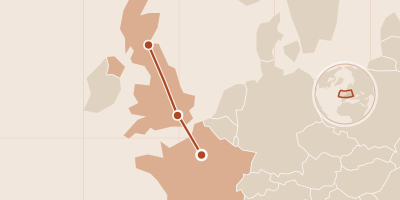
Ron Howard's 2006 thriller, based on Dan Brown's 2003 novel, sends symbologist Robert Langdon and cryptologist Sophie Neveu from a murdered curator in the Louvre on a quest for the legendary Holy Grail — through a Paris church, a London Templar church and Newton's tomb to a Scottish chapel.
The route follows the film's trail in story order, from the Vitruvian-Man murder and the Saint-Sulpice marker to the Temple Church dead end, the APPLE cryptex at Westminster Abbey and the 'neath-the-rose finale at Rosslyn Chapel. Note the abbey scenes were filmed at Lincoln and Winchester cathedrals.
On the eve of his coronation, Prince Rama of Ayodhya is sent into the forest for fourteen years, so that his stepmother's son can rule. His wife Sita and brother Lakshmana go with him. In the forest Sita is carried off by Ravana, the demon king of Lanka, and Rama, helped by Hanuman and an army of vanaras, monkey-like forest people, crosses the sea to win her back. The Sanskrit epic attributed to Valmiki runs to some 24,000 verses and is still retold, staged and worshipped across South and Southeast Asia.
For centuries pilgrims have tied its episodes to real places, from Ayodhya to the hills of Sri Lanka. This route follows those traditional identifications, which are matters of faith and local memory rather than archaeology. Most of the stops are living temples.