In 1612 a Nizhny Novgorod merchant, Kuzma Minin, and Dmitry Pozharsky raised the volunteer army that cleared Polish forces from the Moscow Kremlin. The route follows it from the Nizhny Novgorod Kremlin through Yaroslavl and the Trinity Lavra to Red Square.
The five stops trace the militia's march and the monuments to its leaders. The Yaroslavl pin marks the city, as the sources name no building.
The California Gold Rush began at Sutter's Mill in Coloma in January 1848 and spread to Sacramento, San Francisco, Placerville and the boomtown of Columbia.
The route follows the news from a sawmill tailrace to a crowd in a San Francisco square, then to two mining towns where the rush turned into streets, aqueducts and brick buildings. Most stops can still be visited, though the Placerville pin is only the main street.
The Adventures of Priscilla, Queen of the Desert starts at Sydney's Imperial Hotel in Erskineville, crosses the outback through Broken Hill's Palace Hotel and Coober Pedy, and ends at a casino in Alice Springs and the cliffs of Kings Canyon.
Three performers ride a bus named Priscilla to a four-week booking, and the film was shot at many of the places on the road. This route follows their trip in story order. The exact spot of the breakdown is approximate, and the Coober Pedy and Kings Canyon pins mark the town and the park.
Radiator Springs is Route 66: Pixar's Cars town borrows its shape from Seligman, Arizona, the Wigwam Motel in Holbrook and the U-Drop Inn in Shamrock.
The route follows the old highway west from Galena, Kansas — where the truck that became Mater still stands outside a restored service station — through a stone café in Stroud, Oklahoma, the Cadillac Ranch in Texas, and the Arizona motels that gave Radiator Springs its look. The town itself is fictional; every stop is a real Route 66 landmark the Pixar team used.
Poldark's Cornwall is real Cornwall: the 2015 adaptation filmed Nampara, Wheal Leisure and Truro at St Agnes Head, Botallack and Charlestown, with Trenwith played by Chavenage House near Tetbury.
This route follows eight locations from the 2015 adaptation, from the cliffs above St Agnes and the engine houses of Botallack to the beaches of the Lizard and the north coast. Most are open to the public, but they are working landscapes and nature reserves as much as film sets, so expect footpaths, tides and weather.
Life is Strange is set on the Oregon coast and True Colors in Colorado: Arcadia Bay draws on Astoria and Garibaldi, Haven Springs on Idaho Springs and Georgetown. Max Caulfield comes home to a missing girl and a storm only she can see; Alex Chen arrives to meet the brother she barely knows, then stays to solve his death.
The route follows the games in order, from Cape Meares and the Oregon towns behind Arcadia Bay to Idaho Springs, Georgetown, Nederland and Marble, the Colorado towns behind Haven Springs.
At 21, Jack London sailed north in July 1897 to join the Klondike gold rush. He came home without gold but with scurvy and the stories that made his name: The Call of the Wild, "To Build a Fire" and more.
This route follows him from the beach at Dyea over the Chilkoot Pass, down the lakes and rapids of the Yukon, through a winter at the Stewart River to Dawson City, where his cabin still stands.
Alexander von Humboldt in the Americas, 1799–1804: Cumaná in Venezuela, the electric eels of Calabozo, Chimborazo in Ecuador, Callao in Peru, the silver mine at Guanajuato and Jefferson's White House. He and Aimé Bonpland spent five years measuring, collecting and climbing.
This route follows eight stops from the landing at Cumaná to Washington in 1804. Several pins are approximate because the sources name a region or river rather than one spot.
In January 1959 a group of ten experienced hikers from the Ural Polytechnical Institute set out on a ski trek into the northern Urals. Nine never came back: they cut their way out of their tent on a mountain slope one February night and died in the snow, and the cause is still discussed.
This route follows the group from the institute in Sverdlovsk by train and lorry to the last village, then up to the mountain and the pass now named after them, and ends with the survivor's memorial. It sticks to the record; the explanations are left to the reader. The exact tent site is approximate.
Studio Ghibli's worlds feel lived-in because Miyazaki went to look at real places: a Welsh mining museum for the village in Castle in the Sky, Visby for the town of Kiki's Delivery Service, the harbour of Tomonoura before Ponyo. Other links are only rumoured, and he has denied at least one, the town of Jiufen in Taiwan for Spirited Away.
This route follows eight films in release order, from 1986 to 2008, and pairs each with the real place reported as its inspiration. Only some of these identifications come from Miyazaki himself, so every stop says whose claim it is, and none of them is a filming location.
Bond is shot off a train in Turkey and left for dead, while a former agent with a grudge against M attacks MI6 from within. Sam Mendes's 2012 film — the 23rd Bond and the highest-grossing of them all — was shot between November 2011 and May 2012 in London, Turkey and Scotland, with much of "Shanghai" and "Macau" faked in England.
The route follows the story from the rooftops of the Grand Bazaar to the railway viaduct where Bond falls, a beach bar in Fethiye, MI6's real headquarters, a Turner in the National Gallery, an abandoned Japanese island, a disused Tube platform and the glen where Bond takes M home. Skyfall Lodge itself was a set in Surrey.
Bohemia, 1403. King Wenceslaus IV has been kidnapped by his half-brother Sigismund, whose mercenaries burn the silver-mining village of Skalitz. Henry, the blacksmith's son, survives, and the rest of the 2018 role-playing game by Prague's Warhorse Studios follows his hunt for justice and his father's sword across a small stretch of the Sázava valley in Central Bohemia.
Almost every place in the game is real and still on the map: Stříbrná Skalice, the ruins of Talmberk, the town of Rataje with its castle Pirkštejn, the monastery at Sázava. Many of the lords Henry serves were real people too. The route follows the main story; the sequel's opening at Trosky closes it.
Fallout: New Vegas rebuilds the real Mojave: Goodsprings, Primm, Nipton, Searchlight, Boulder City and Hoover Dam are all on its map. In 2281 a courier carrying a platinum poker chip is shot and left in a shallow grave, survives and hunts the man who did it, into a war for the desert between the New California Republic, Caesar's Legion and Mr. House.
The designers built the map from US Geological Survey data and photographs of the real desert, so the game's road south from Goodsprings and back up to Las Vegas runs through real towns. The route follows that road. The towns' massacres, radiation and battles are fiction; their saloons, roller coasters and dam are not.
The Motorcycle Diaries follows Ernesto Guevara and Alberto Granado's 1952 journey from Buenos Aires across South America — Valparaíso, the Chuquicamata copper mine, Machu Picchu, the San Pablo leper colony on the Amazon — to Caracas. Their overloaded Norton died in Chile; the poverty they saw on the way changed Guevara.
Guevara's diary of the trip, published decades later as The Motorcycle Diaries, records how poverty, exploited miners and the lepers they worked with changed him; within a few years he was "Che", a leader of the Cuban Revolution. The route follows the journey from both men's accounts as summarised by historians.
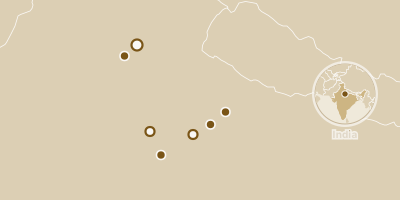
On a Sunday evening in May 1857 Indian soldiers of the East India Company's army mutinied at Meerut and rode for Delhi. Within weeks much of northern India was in revolt — soldiers, princes dispossessed by the Company, and villagers with their own grievances. It took the British more than a year to crush it, and afterwards the Company itself was abolished and India placed under the Crown.
The rebellion goes by many names, from the Sepoy Mutiny to the First War of Independence. It was not one army on one road but a chain of uprisings, and the route visits its main centres in order: Meerut, Delhi, Kanpur, Lucknow, Jhansi, Kalpi and Gwalior. Both sides committed atrocities against civilians, and the texts name them plainly.
Peter Jackson shot all three Lord of the Rings films at once, in 438 days between October 1999 and December 2000, at more than 150 locations across New Zealand's North and South Islands. Farmland became the Shire, a regional park became Rivendell, a lonely hill in Canterbury became the capital of Rohan, and a volcano in Tongariro National Park stood in for Mount Doom.
This route follows Frodo's story through eight of those places, most of them easy to visit. Some sets were rebuilt for visitors; others were removed and the land returned to how it was. The mountains of Tongariro are sacred to local Māori, so please admire the summits from below.