Yoon Se-ri, a South Korean chaebol heiress, is paragliding when a tornado carries her across the border into North Korea. Ri Jeong-hyeok hides her, and the two fall in love despite the division between their countries. The series' Switzerland is the real thing: a mountain pass, a lake pier, a gorge bridge and a cable-car station, all shot on location. The series was pieced together from stand-ins: a Jeju forest for the DMZ, a Chungju park for a South Korean reunion, and sets in Hoengseong and Chungju for the northern village.
This route follows the story in episode order, from Se-ri's landing in a Jeju forest to the reunion above Grindelwald. Nothing was filmed in North Korea: the Pyongyang and Kaesong stations were played by Ulaanbaatar, and the DMZ scenes by several of Jeju's oreums.
In 1327 a Franciscan detective and his young novice arrive at a Benedictine abbey in northern Italy, and monks begin to die. Umberto Eco's abbey is invented, but it was assembled from real places, and Jean-Jacques Annaud's 1986 film built another one from sets and a German monastery.
This route follows the borrowed pieces of the book, from the Sacra di San Michele to the portal at Moissac, then the places that played the abbey on screen. Pins for the book's models are traditional identifications, not locations named in the novel.
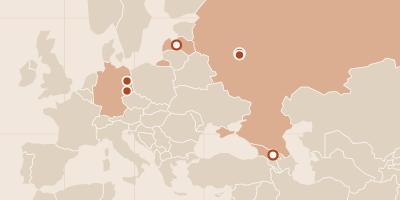
In the Soviet series Seventeen Moments of Spring, a spy named Stierlitz serves in the SS in Berlin in the last weeks of the Second World War. Very little of it was filmed in the Berlin of 1945.
This route follows the story through the places that played its settings, from a Moscow-region park posing as the Bavarian Forest to Riga, Meissen and the hills of Georgia standing in for Bern and the Alps. Every pin marks a stand-in, not a place from the plot.
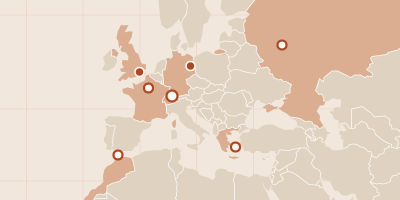
A man with no memory, a safe deposit box and a CIA programme that wants him gone: Jason Bourne runs across Europe and beyond, and the films keep him on real streets, stations and squares.
The route follows the three films in order, from Zurich and Paris through Mykonos, Berlin and Moscow to London and Tangier. Several cities were stand-ins for others, so the pins mark the story's places or honest approximations.
A five-year-old orphan is led up a Swiss mountain path to live with a grandfather the whole village avoids. Johanna Spyri's 1881 novel follows Heidi from the alm to a grand house in Frankfurt, where homesickness sends her sleepwalking, and back to the mountain, where her friend Klara finally comes to visit.
The route runs from Ragaz, where Spyri wrote the book, through Maienfeld and the alm above it to Frankfurt and the tourist Heididorf. Spyri never names the exact hamlet or house, so most pins mark an area or a tradition.
In September 1799 the Russian field marshal Suvorov led his army into Switzerland to join the Allied forces, only to find his allies failing him. He fought through the Alps, crossed high passes and ended in Chur.
The route follows the march from Taverne to Chur. Dates are Gregorian (New Style), and pins mark villages or passes rather than battlefields.
Victor Frankenstein grows up on the shore of Lake Geneva, builds his creature in the university town of Ingolstadt, and spends the rest of the book running from it, across a glacier above Chamonix, to a rock in the Orkneys and back to the lake. Mary Shelley's novel is a chain of scenes scattered over several countries rather than one trip.
This route visits six of them in story order, quoting the novel's Project Gutenberg text. The novel names towns and a glacier but rarely a building, so most pins mark a town or area.