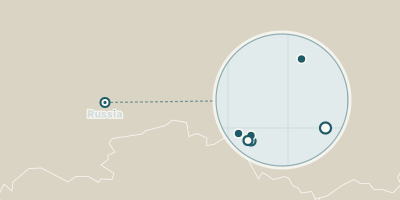
The Mistress of the Copper Mountain lives in the Gumeshevsky mine in Polevskoy, in the Urals, and Pavel Bazhov wrote her tales in Yekaterinburg after hearing them as a boy on Dumnaya Gora. Her story, from The Malachite Box (1939), is told here with Azov-gora and the Stone Flower town.
The route runs from Bazhov's birthplace in Sysert through the Polevskoy hills where the legends were told to the Yekaterinburg house where he wrote them down.
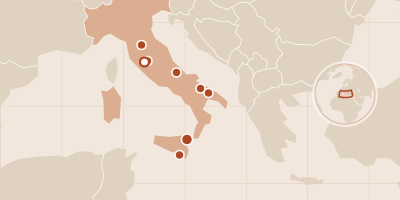
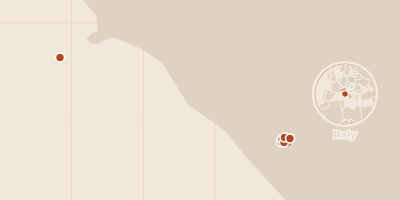
Matteo Garrone's Tale of Tales (Il racconto dei racconti, 2015) was shot entirely in Italy: Castel del Monte in Apulia, Donnafugata Castle in Sicily, Sammezzano Castle in Tuscany, Roccascalegna in Abruzzo and the Alcantara Gorge all play fairy-tale kingdoms.
The route follows the film's three tales through eight real locations, from the gorge where the sea dragon lives to the tuff lanes where an ogre chases a runaway princess. Several castles are used only for exteriors or interiors, and the notes say which.
Washington Irving came to Granada in 1829 and ended up living in a palace of the Moorish kings. With a 17-year-old local guide named Mateo Ximenes at his elbow, he gathered the legends that became Tales of the Alhambra in 1832.
This route follows the book through six places: the gate with the magic hand and key, Irving's rooms, the Hall of Ambassadors, the Court of Lions, the Generalife and the Tower of the Princesses. Several tales are legend as much as history, so the pins mark the places where Irving tells them.
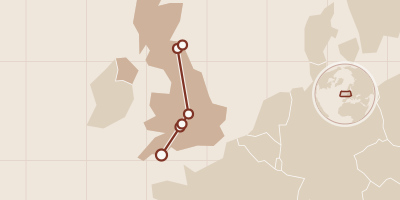
In Rachel Joyce's The Unlikely Pilgrimage of Harold Fry, a retired man walks from Kingsbridge in Devon to Berwick-upon-Tweed, passing Stroud, Cheltenham, Coventry and the Scottish border town of Kelso to reach a dying friend.
The route follows the walk stage by stage, from a post box in Devon to the hospice at the far end of England, and the reasons Harold gives, and withholds, for going. The novel names towns rather than streets, so every pin marks a town.
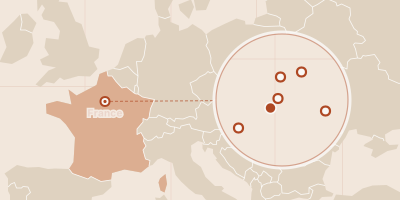
Miraculous: Tales of Ladybug & Cat Noir is set in Paris, and the real places behind it are the Eiffel Tower, the Place des Vosges, a bakery on Rue Caulaincourt, the Lycée Carnot, the Plaza Athénée and the Parc des Princes.
The series mixes real monuments with places it renames or reshapes. This route follows six places, from the tower on the skyline to the real bakery behind Marinette's family shop.
Several places are inspirations rather than filming sites, so each one says what the show changed.
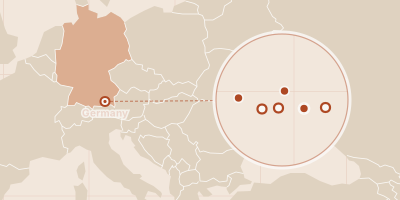
Die Rosenheim-Cops is set in Rosenheim and the Chiemgau, but the town hall, Max-Josefs-Platz, the Chiemsee, Weyarn and Dietramszell are only part of where it was shot.
This route follows seven places where the crime series was set or filmed, from the police headquarters in Rosenheim's town hall to villas near Lake Starnberg. Several stops are marked by area, because the sources name the place but not the exact spot.
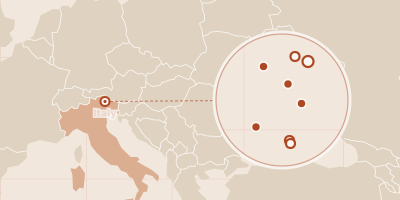
Un passo dal cielo, the Rai 1 series, is set in San Candido in South Tyrol and later in San Vito di Cadore in the Belluno Dolomites, but it was mostly filmed around Lago di Braies, Prato Piazza, Dobbiaco, Lago di Mosigo and Misurina.
This route follows the series from its South Tyrol seasons to its Cadore seasons, with eight places where scenes were set or shot. Where the sources only name a place, the pin marks the area.
The Great Beauty (La grande bellezza) was filmed in Rome, from the Fontana dell'Acqua Paola on the Janiculum and Palazzo Sacchetti on Via Giulia to Santa Maria del Priorato on the Aventine, Villa Medici and the Verano Cemetery, with a last scene on Giglio Island.
Shooting began on 9 August 2012 and lasted about eight weeks. This route follows Jep Gambardella's story through seven of those places, and says where you can still go.
Jamestown to Yorktown is the best-known stretch of Virginia's early American history: from the 1607 James Fort at Historic Jamestowne, via the Capitol in Williamsburg and St. John's Church in Richmond, to the Moore House and surrender field at Yorktown.
The route follows 174 years from England's first lasting colony to Cornwallis's surrender in 1781, with Patrick Henry's speeches along the way. Most stops can be visited; the Williamsburg Capitol is a reconstruction.
Bluey is set in Brisbane, Queensland: the show draws on Queen Street Mall, South Bank and the city's Queenslander houses, with a trip to the Big Pelican on the Noosa River.
The route follows the series from Ludo Studio in Fortitude Valley to the real places it draws, ending at Bluey's World in Hamilton. The Heeler house is fictional, so it is not pinned.
The Via Francigena is the medieval pilgrim road from Canterbury Cathedral through France and Switzerland to St Peter's in Rome, recorded by Archbishop Sigeric around 990. This route follows it from Canterbury over the Great St Bernard Pass to Lucca, Siena and Viterbo.
Sigeric's return trip ran to 80 stages of about 20 km each, some 1,700 km in all. Pilgrims still walk it today. Stops are landmarks on the route, not proven overnight stays.
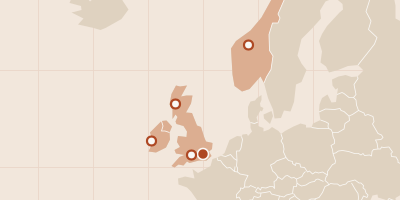
Harry Potter and the Half-Blood Prince was filmed at London's Millennium Bridge, Lacock Abbey in Wiltshire, Fort William in Scotland, Norway's Rauma Line and the Cliffs of Moher in Ireland.
The route follows the 2009 film's scenes in order, from the bridge collapse that opens it to the sea cave where Harry and Dumbledore hunt a Horcrux. Hogwarts Express shots even left the UK for snow in Norway.
Most spots are real places you can visit; the cave interior itself was computer-generated.
Washington Irving's The Legend of Sleepy Hollow is set around 1790 near Tarrytown, New York, and you can visit its places today: Philipsburg Manor, Patriot's Park, the Old Dutch Church and Sleepy Hollow Cemetery.
Ichabod rides to a party at the Van Tassel farm, then home through a haunted glen and over a bridge by the church. The route follows his night, with Raven Rock first. Some places are only visitor tradition, and each stop says so.
The Great Buddha of Nara at Tōdai-ji was the work of Emperor Shōmu, who also ordered a temple in every province and moved his capital from Heijō Palace to Kuni-kyō and Shigaraki.
After smallpox, rebellion and poor harvests, Shōmu turned to Buddhism for protection. This route follows him from Nara through two short-lived capitals and a provincial temple in today's Tokyo, back to the Eye-opening Ceremony of 752. Some sites are only ruins or remain approximate.
The Battle of Okinawa, fought from March to June 1945, ran from the Kerama Islands and the Kadena landing beaches to Shuri Castle and Mabuni Hill in the south of the island.
This route follows the land campaign through six places you can find on a map today, from the first landing to the Cornerstone of Peace, where the names of those who died on all sides are inscribed. Several sites are memorials, and the pins for the Kerama Islands and Kakazu Ridge are approximate.
Sanada Yukimura's story runs from Ueda Castle to exile in Kudoyama and a last stand at Osaka Castle, Sanada Maru and Tennōji. He held Ueda against a far larger Tokugawa army in 1600, then died in 1615.
The route follows him from the Sekigahara campaign through exile below Mount Kōya to the Winter and Summer sieges of Osaka. Some sites are marked approximately, because the sources do not give exact spots.
Sugawara no Michizane, the scholar-poet worshipped today as Tenjin, rose at the Heian Palace in Kyoto, was exiled to Dazaifu in Kyushu and is buried at Dazaifu Tenmangū. Kitano Tenmangū in Kyoto was built for him.
The route follows his career from court professor to governor of Sanuki, then to exile in 901, death in 903 and the shrines that turned a feared spirit into the god of scholarship. Both shrines can be visited; the palace and the exile site are approximate.
Taira no Masakado, the rebel who declared himself New Emperor, is remembered at Masakado's Mound in Ōtemachi and at Kanda Shrine in Tokyo, with battle sites in Ibaraki and a head legend in Gifu.
The route follows his feud and rebellion, his death in 940, the story of his flying head and the Tokyo mound that is said to punish neglect. Some places are traditional identifications, marked as such.
The Iwakura Mission was a Japanese embassy that sailed from Yokohama in 1871 and travelled through San Francisco, Liverpool, Sheffield and Windsor Castle on a two-year tour of the West.
From 1871 to 1873, about 50 government officials of the newly established Meiji government studied the political, military, economic and educational institutions of the United States and Europe. This route follows the British leg in detail: a textile mill near Bradford, a country house in Sheffield, Chatsworth, and an audience with Queen Victoria. The Yokohama, San Francisco and Liverpool pins mark the port or station area, not an exact landing spot.
The legend of Benkei, Japan's warrior monk, runs from Gojō Bridge and Kiyomizu-dera in Kyoto to the Ataka Barrier in Ishikawa and the Koromogawa battle site at Hiraizumi.
Benkei is said to have lost a duel to the young Minamoto no Yoshitsune on a Kyoto bridge, then served him to the end. The route follows that story through five places, from the duel to the famous "Standing Death of Benkei". Most tales come from later writings, and no records from Benkei's own time survive.
Tōno Monogatari, Kunio Yanagita's 1910 book of folk legends, is set in Tōno, Iwate: Kappabuchi, Denshoen, Mount Hayachine and Yamaguchi village carry its kappa, zashiki-warashi and Oshira-sama stories.
The route follows five places in the order of the tales, from the mountain goddess of Hayachine to the Oshira-sama gods and the kappa pool. Two stops are only approximate, and one is a traditional identification.
The Tale of the Bamboo Cutter (Kaguya-hime) never names its setting, but Japanese towns from Kōryō and Takatori in Nara to Fuji City and Lake Yogo claim a link, and the tale ends on Mount Fuji.
The route follows the story from the shining bamboo stalk, through the Moon princess's farewell, to the Emperor burning her letter on the summit. Four of the five stops are rival local claims, not proven sites.
Engelbert Kaempfer travelled from Dejima in Nagasaki to the shogun's court in Edo in 1691, via Shimonoseki, Osaka and the Tokaido road near Lake Ashi. He was a German physician with the Dutch trading post.
The route follows his 1691 trip in five stops, from the island of Dejima to his audience with the shogun Tokugawa Tsunayoshi. The exact spots in Shimonoseki, Osaka and Hakone are not known, so those pins are approximate.
Urashima Tarō, Japan's fisherman who visits the Dragon Palace, is tied to the Tango Peninsula in Kyoto Prefecture, where Urashima Shrine in Ine keeps his story, and to rival claims in Okinawa, Yokohama and the Kiso Valley.
The route follows the tale from its 8th-century Tango roots through the undersea palace to the opened box, then visits the places that say he lived or ended up there. Most links are local legend, and each stop says how firm it is.