Mythology
The Mistress of the Copper Mountain: Bazhov's Ural Tales
The Mistress of the Copper Mountain lives in the Gumeshevsky mine in Polevskoy, in the Urals, and Pavel Bazhov wrote her tales in Yekaterinburg after hearing them as a boy on Dumnaya Gora. Her story, from The Malachite Box (1939), is told here with Azov-gora and the Stone Flower town.
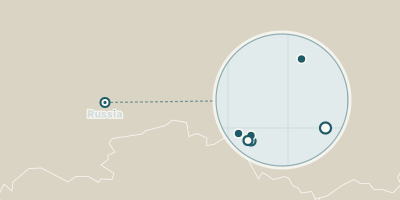
The route runs from Bazhov's birthplace in Sysert through the Polevskoy hills where the legends were told to the Yekaterinburg house where he wrote them down.
Timeline & locations
What do the location labels mean?
- Exact
- The pin marks the actual place where it happened or was filmed.
- Approximate
- The right area — a town, park or district — but not a precise spot.
Pavel Bazhov was born on 27 January 1879 in the Sysert works settlement, where his father was master of the welding shop at the steel plant. Decades later, folklorists collecting tales near Sysert "have not met a single person who did not hear about the Mistress" of the Copper Mountain. Most knew her from Bazhov's book, answering, "Read some Bazhov, he wrote it down."
Open area inGoogle MapsApple MapsOrganic MapsOpenStreetMap56.50000, 60.81667Visitability not confirmedLocation precision: The pin marks the centre of Sysert, not a particular building.
Sources
- Mistress of the Copper Mountain
- Locator:
- Origin; popular culture
- Pavel Bazhov
- Locator:
- Early life
- Mistress of the Copper Mountain
In 1892–1895 Bazhov lived in Polevskoy and, as a boy, listened on Dumnaya Gora to old miner Vasily Khmelinin, known as Grandpa Slyshko. The hill lies in the south of the town. Khmelinin told local legends and factory stories there, among them miners' folklore about the Mistress of the Copper Mountain, and the famous tales later grew out of them.
Open area inGoogle MapsApple MapsOrganic MapsOpenStreetMap56.43888, 60.18999Visitability not confirmedLocation precision: The storytelling is placed on Dumnaya Gora in the south of Polevskoy; the pin marks the hill, not a spot on it.
Sources
- Mistress of the Copper Mountain
- Locator:
- Origin; popular culture
- Полевской
- Locator:
- History; Sights
- Бажов, Павел Петрович
- Locator:
- Biography; commemoration
- Mistress of the Copper Mountain
The "Copper Mountain" is the Gumeshevsky mine, home of the Mistress in The Malachite Box. In the tale, the factory lad Stepan meets a girl in a malachite dress, who tells him to make his master leave the Krasnogorsky mine and promises to marry him if he does. In the 18th century the mine was the main supplier of green malachite; it was rediscovered in 1702. Bazhov himself expected a mountain and found only a bleak field.
Sources
- Хозяйка Медной горы (сказ)
- Locator:
- Plot
- Гумёшевский рудник
- Locator:
- History; In literature
- Хозяйка Медной горы (сказ)
This two-peaked mountain, 588 m high and 8 km from Polevskoy, appears in Bazhov's tale Dorogoe imyachko, built on folk legends of the Azov girl; one version says the mountain was named after her. The tale describes a huge cave running under the whole mountain, and many treasure hunters trying to get in. Bazhov's first published tale, in 1936, was The Azov Girl.
Sources
- Азов-гора
- Locator:
- In folklore and literature
- Полевской
- Locator:
- History; Sights
- Бажов, Павел Петрович
- Locator:
- Biography; commemoration
- Азов-гора
The Stone Flower and the Mistress, shown as a crowned lizard, are on Polevskoy's coat of arms, and a monument to Bazhov was put up here in 1983. Most of his tales are linked to the town's surroundings. In The Stone Flower, the orphan Danila first hears of the flower from old Vikhorikha, then goes to Zmeinaya Gora to find the Mistress. Whoever sees it understands the beauty of stone, but becomes her mountain master.
Open area inGoogle MapsApple MapsOrganic MapsOpenStreetMap56.44197, 60.16563Visitability not confirmedLocation precision: The pin marks the Bazhov monument area in Polevskoy; the tale names no exact place for the flower.
Sources
- Полевской
- Locator:
- History; Sights
- Каменный цветок (сказ)
- Locator:
- Plot
- Бажов, Павел Петрович
- Locator:
- Biography; commemoration
- Полевской
Bazhov wrote his works, including The Malachite Box, in this house, built on the corner of today's Chapaeva and Bolshakova streets. It is a one-storey log house on a brick base. The first edition of the Ural tales came out in 1939, and the museum opened in 1967. The house still stands as it was in the owner's lifetime, and a garden planted by the Bazhovs survives beside it.
Visitor guidance: A memorial house museum at the corner of Chapaeva and Bolshakova streets.
Sources
- Бажов, Павел Петрович
- Locator:
- Biography; commemoration
- Мемориальный дом-музей П. П. Бажова
- Locator:
- History and description
- Бажов, Павел Петрович