Hemingway wrote A Moveable Feast about his poor, happy early years in 1920s Paris, working from notebooks he had left in trunks at the Ritz in 1928. It was published in 1964, after his death.
This route walks the memoir's Paris: the flat on the rue du Cardinal-Lemoine, Gertrude Stein's salon, Sylvia Beach's bookshop, the cafés of Montparnasse and Saint-Germain, and the Ritz where the notebooks resurfaced. Hemingway himself said the book may be read as imagination, so treat its scenes as a memory, not a record.
Arno Dorian is a nobleman who walks into a trap: framed for the murder of the man who adopted him, he spends the opening hours of Unity's Paris of 1789 in a prison cell, and walks out of it an Assassin. From there he is off across the capital hunting the true powers behind the Revolution, while Napoleon, Robespierre and an Apple of Eden keep arriving before he can finish the job.
Unity rebuilds late 18th-century Paris at roughly 1:1 scale across seven districts, plus Versailles, so almost every stop here is a building you can walk to: the Bastille site, the Assassins' hideout under the Île Saint-Louis, Notre-Dame's towers, the storming of the Tuileries, the execution square that is now the Place de la Concorde, Robespierre at the Hôtel de Ville, and — with the Dead Kings expansion — a Precursor temple under the basilica at Saint-Denis. Two stops are places the game invented rather than built: that hideout and that temple.
A shy waitress at a Montmartre café staffed and frequented by eccentrics finds a metal box of childhood memorabilia hidden behind a bathroom tile and gets drawn into the lives around her: practical jokes on the nasty greengrocer Collignon, street scenes described aloud to a blind man, and a dropped photo album belonging to Nino, a collector of discarded photo-booth pictures.
The route follows her Paris from the café on Rue Lepic to the photo booths of the Gare de l'Est and the blue arrows on the steps of the Sacré-Cœur, taking in skipping stones on the Canal Saint-Martin and a surge of love on the Pont des Arts along the way. Nearly every stop is a real place you can visit.
Nine years after a night in Vienna, Jesse is on a book tour in Europe when Céline walks into his reading in a Paris bookshop. He has an hour before his flight, and they spend it wandering the city. Richard Linklater's 2004 film plays in real time: the story lasts about as long as the film, roughly eighty minutes.
It was shot in 15 days across Paris, and its locations jump about more than the dialogue admits. This route follows the film's order from the Left Bank bookshop through the Marais and the east of the city to the Seine and a gated courtyard in the Faubourg Saint-Antoine.
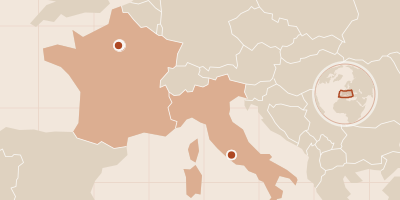
Emily, a young marketing executive, is posted to Paris to give a French agency a social-media voice, and the show follows her across the city: the little square where she lives, her office by the Palais-Royal, a Left Bank café and the gardens and monuments she drifts through. In its fourth season the story reaches Rome, where Marcello shows her the Colosseum and the Trevi Fountain.
This route gathers the places that define Emily's Paris, from the Place de l'Estrapade — where her apartment faces Gabriel's restaurant across the square — to the Café de Flore, the Jardin du Luxembourg, the Palais Garnier, Montmartre's Sacré-Cœur and the French Open at Stade Roland Garros. It ends in Rome, at the two sights that seal her move to Italy.
Gil Pender is a screenwriter with a nostalgia problem, in Paris with a fiancée and her wealthy parents. Every night at midnight a 1920s car pulls up and carries him back to the 1920s, among the Fitzgeralds, Hemingway and the surrealists. By day he is stuck in 2010.
This route follows the film from Monet's garden at Giverny to Pont Alexandre III, with the stops placed from a film-locations guide: where the 1920s scenes are shot you can still sit, eat and shop today. The party and flea-market scenes are approximate.
On 6 January 1482, a poet, a gypsy dancer, a deaf bellringer and a tormented priest cross paths in the Paris of Victor Hugo's imagination. It is a city of crowds, bonfires, gibbets and a cathedral that is almost a character in its own right.
This route follows the story from the Palais de Justice to the square where punishments were held, the beggars' court, the Seine bridge, Notre-Dame itself and the hilltop gibbet. Much of medieval Paris is gone, so most pins mark an area rather than a surviving building.
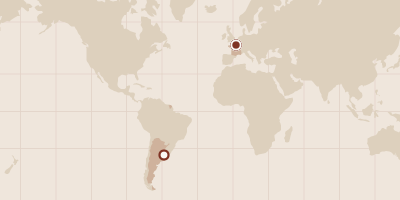
Horacio Oliveira, in Paris, spends his nights walking the city with the Maga and the Club de la Serpiente, until a baby's death breaks the group apart. Then the novel moves to Buenos Aires: a circus, a psychiatric clinic and a window over a courtyard.
The route follows the book's real Paris places, from the Pont des Arts to the Montparnasse cemetery, then its Buenos Aires scenes. Most Paris stops come from the Rutas Cervantes literary route; the Buenos Aires ones are invented and unpinned.
Victor Hugo's 1862 novel follows the convict Jean Valjean from the night a bishop's kindness turns him towards good, through years as a respected factory owner and the rescuer of a child, to the street fighting of June 1832. This route follows that path from a bishop's town in the south to the sewers and bridges of Paris.
Hugo hid two of the towns behind initials and the wine-shop barricade has been built over, so only the Luxembourg Garden is pinned exactly; the other stops mark real places standing in for the book's.
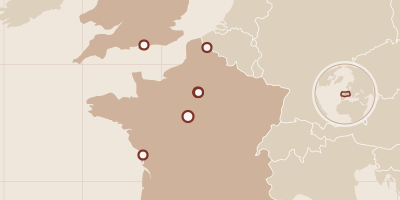
In April 1625 an eighteen-year-old Gascon rides into the market town of Meung on a yellow pony, bound for Paris and the King's Musketeers. Dumas's novel follows D'Artagnan from that first quarrel through duels, a secret night in the Louvre, a bet made during a siege and a midnight ending on a river bank.
The route runs from the Loire to Paris, on to La Rochelle and Portsmouth, and back to the banks of the Lys. The streets, squares and palaces are real; most inns, houses and bastions are Dumas's, so several pins mark a town or a street rather than a building.
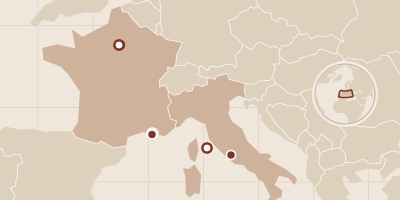
A young sailor is arrested at his own engagement party, thrown into a prison island, escapes in a dead man's burial sack, finds a hidden treasure and comes back as a count to settle accounts. This route follows Dumas's novel in order, from the Marseille lookout to the island where it ends.
Most of the stops can be visited; the island of Monte Cristo is a nature reserve with a years-long waiting list, and several scenes happen in places Dumas invented, so those pins mark the real landmark nearby.
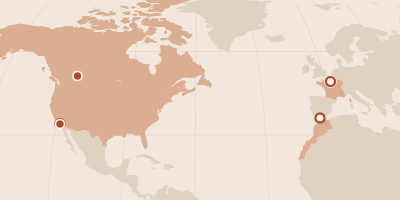
Dom Cobb is offered a clean slate — his criminal history erased as payment for implanting an idea into a target's subconscious. To pull it off he recruits a forger, a chemist and an architecture student, then takes the team down through layered dreams, from a raining city to an alpine fortress.
This route follows the 2009 shoot across four countries: the Paris bridge that folds, a fictional bistro corner, Tangier standing in for Mombasa, two Los Angeles action sites and the closed Alberta ski resort that became the snow fortress. Two stops look different today: the bistro was a temporary set and the Heim Bridge has been replaced.
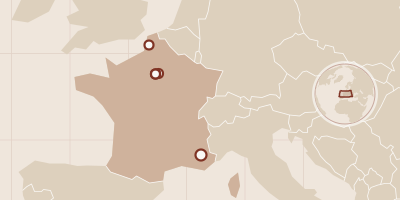
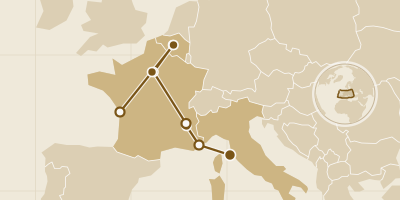
On 26 February 1815 Napoleon slipped away from Elba with some 1,000 men. Within a month he was back in the Tuileries, and by mid-July he had surrendered to the Royal Navy.
The route follows him stop by stop: his villa on Elba, the landing at Golfe-Juan, the meeting at Laffrey and the entry into Grenoble on the Route Napoléon, the Tuileries, the farms of Hougoumont and La Haye Sainte at Waterloo, then Malmaison and Île d'Aix, where his journey ended. The pins at Golfe-Juan and Grenoble mark the towns, not exact spots.
Patrick Süskind's Perfume follows Jean-Baptiste Grenouille, born in Paris in 1738, with a gift for scent and no scent of his own. His path runs from the Innocents cemetery to a mountain cave, and then to Grasse, where his craft turns murderous.
The route follows the book from Paris to the Plomb du Cantal, Montpellier and Grasse, and ends in Barcelona, where Tom Tykwer's film rebuilt Paris. Only a few places are named exactly; the rest are approximate.
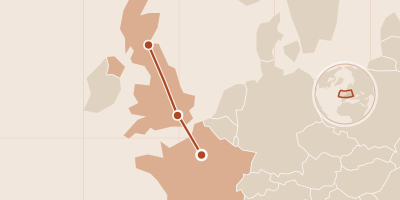
Ron Howard's 2006 thriller, based on Dan Brown's 2003 novel, sends symbologist Robert Langdon and cryptologist Sophie Neveu from a murdered curator in the Louvre on a quest for the legendary Holy Grail — through a Paris church, a London Templar church and Newton's tomb to a Scottish chapel.
The route follows the film's trail in story order, from the Vitruvian-Man murder and the Saint-Sulpice marker to the Temple Church dead end, the APPLE cryptex at Westminster Abbey and the 'neath-the-rose finale at Rosslyn Chapel. Note the abbey scenes were filmed at Lincoln and Winchester cathedrals.
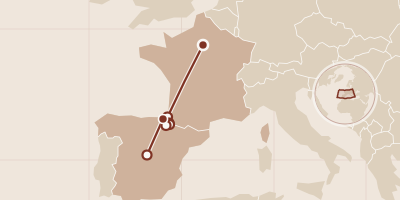
Jake Barnes, an American newspaperman wounded in the war, spends his Paris nights in the cafés of Montparnasse with Lady Brett Ashley — the woman he loves and cannot have. Then the whole crowd heads south: trout fishing in the Pyrenees, then a week of San Fermín in Pamplona, where drink, jealousy and a nineteen-year-old matador break everything open.
Hemingway built the novel from his own trips of 1924 and 1925, and almost every stop can still be visited: the café on the Boulevard du Montparnasse, the inn at Burguete, the arcade café on Pamplona's main square, the bullring, the beach at San Sebastián and the Madrid restaurant where the book's last meal is eaten.
Agent 47 has killed his way across the world in the Hitman trilogy, from a Paris fashion show to a skyscraper in Dubai. Behind the levels stand real cities, a real tower and a few real places that inspired invented ones.
This route follows nine missions from the 2016 game to Hitman 3. Most venues are fictional, so the pins mark the city or the real place the designers named as a model, and each stop says which.
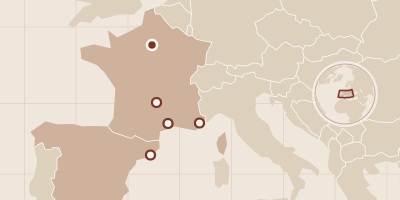
Kalos is Metropolitan France turned into a star-shaped Pokémon region. Lumiose City is inspired by Paris, its Prism Tower by the Eiffel Tower and its art museum by the Louvre; the Battle Château recalls Chenonceau on the Loire, the palais Chaydeuvre is the château de Versailles, and the stones outside Geosenge Town are the Carnac stones. The games never confirm their models — these are fan and encyclopaedia identifications — so every pin on this route is speculative.
The route follows the story across the real France behind Kalos: the town where the adventure begins, Lumiose's iron tower, two châteaux and a royal palace, a coastal aquarium, the island tower where Mega Evolution is learned, the cathedral clock behind Anistar's sundial, the Breton megalith field where Team Flare hides its ultimate weapon, and an abandoned mine where the legendary Zygarde sleeps.
A man with no memory, a safe deposit box and a CIA programme that wants him gone: Jason Bourne runs across Europe and beyond, and the films keep him on real streets, stations and squares.
The route follows the three films in order, from Zurich and Paris through Mykonos, Berlin and Moscow to London and Tangier. Several cities were stand-ins for others, so the pins mark the story's places or honest approximations.
Ragnar Lothbrok goes from farmer to king in History's Vikings, a series that sprints through more than a century of Viking Age history and the sagas. This route follows the places of its events in story order, setting what the show does against what history and the sagas say. The series itself was filmed in Ireland.
From a raid on Lindisfarne to Paris under siege, a snake pit near York, a Mediterranean raid, a colony in Iceland and a court in Kiev and a voyage west, with the fictional village of Kattegat left unpinned.