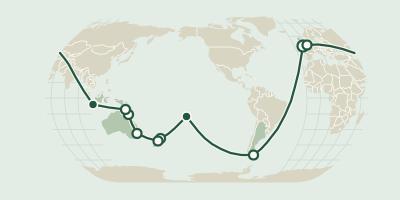
On 26 August 1768 the Endeavour left Plymouth with 94 people aboard, bound for Tahiti to watch Venus cross the Sun. Almost three years later she anchored off the Kent coast again, having reached New Zealand and the east coast of Australia, and with many of her people lost to disease on the way home.
The route follows James Cook's own journal and modern accounts through ten stops, from the anchorage at Plymouth to the Great Barrier Reef and Batavia. Dates follow modern accounts, which sometimes differ by a day from the journal.
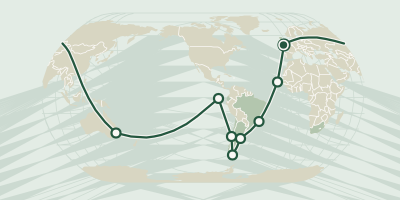
In December 1831 a 22-year-old Cambridge graduate with a passion for beetles and rocks sailed from Plymouth as an unpaid naturalist on HMS Beagle, a ten-gun survey brig. The voyage was meant to take two years and took five. Charles Darwin came home with crates of fossils, skins and notebooks — and with questions about the islands that would lead him, two decades later, to On the Origin of Species.
The route follows the ship around the world in order, using Darwin's own Journal of Researches for dates and details: the volcanic Cape Verde islands, the Brazilian forest, the fossil beds of Argentina, Tierra del Fuego, a great Chilean earthquake, the Galápagos, Cape Town and home to Falmouth.
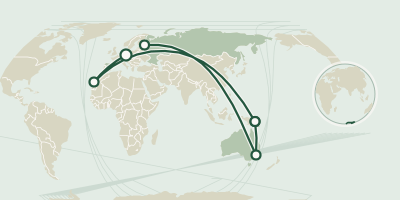
A Russian student expelled from university in 1864 ends up living among people in north-eastern New Guinea who had never seen a European. Nikolai Miklouho-Maclay was a zoologist and anthropologist, an early follower of Darwin who refuted the view that human races were different species.
The route follows him from Haeckel's Jena and the Canary Islands to Astrolabe Bay, the Sydney research station he founded, and his grave in St Petersburg. Most pins are approximate: the sources name regions, not camps.