Between 1180 and 1185 Japan's two great warrior clans, Taira and Minamoto, fought over the realm, and the war ended with a child emperor, a fleet and the tide at Dan-no-ura. It was the war that led to the first shogun.
This route visits seven battlefield sites in date order, from the bridge at Uji to the Kanmon Straits. Documented events are kept apart from the Heike Monogatari's legends, which the text attributes to the tale. Most battle areas are approximate.
Girls und Panzer sends high-school girls into tank tournaments, and its home port is a real Japanese town. Ōarai in Ibaraki appears in the series so faithfully that fans flocked to it as soon as the anime aired.
This route follows the story through six places: the harbour of the school ship, the mall and the inn of the episode 4 street battle, the station where the tank trains roll in, and the shrine steps and coast of the film's exhibition match. The series does not name every street, so some pins are approximate.
In January 1817 General José de San Martín led an army out of Mendoza and over the Andes to free Chile from Spanish rule. The crossing took 21 days, and the feat has been compared to Hannibal's and Napoleon's crossings of the Alps.
The route follows the campaign from the hill monument in Mendoza and the El Plumerillo camp, over the two passes the columns used, to the victories at Chacabuco and Maipú. The mountain stops are pinned approximately; the passes are long, and the army's exact tracks are not.
On 19 October 1812 the Grande Armée walked out of Moscow after five weeks of occupation. Six weeks later, what was left of it scrambled across the Berezina on two hastily built bridges. In between lay a blocked road, a burning town, a depleted depot, a blizzard and a river full of ice.
The route follows six places on that march, from the mined Kremlin through Maloyaroslavets, Vyazma, Smolensk and Krasny to the crossing at Studienka. Most pins mark a town or village, not a battlefield.
In 1960 the novelist John Steinbeck fitted a pickup truck with a camper shell, named it Rocinante and set out from Long Island with his poodle, Charley. He wanted to see his country because he made his living writing about it, and his main question was what Americans are like today.
This route follows eight stops of the outer loop, from Sag Harbor through Maine, Niagara Falls and Minnesota to Montana, Yellowstone and Steinbeck's native Salinas Valley, then down to New Orleans. The book is a novelist's account: it has been challenged as partly fictionalised, so read the encounters as stories and the places as real.
War and Peace travels from the Rostovs' house on Moscow's Povarskaya and Bald Hills, modelled on Yasnaya Polyana, through Schöngrabern and Austerlitz to Borodino, Fili and Poklonnaya Hill in 1812. Prince Andrew falls under the lofty sky at Austerlitz; Pierre, a civilian in a white hat, climbs the Raevsky redoubt.
The route follows the book from a Moscow house and a country estate through Schöngrabern and Austerlitz to 1812: Borodino, the council at Fili and Napoleon waiting on Poklonnaya Hill. Some stops are real places Tolstoy wrote about, others are real stand-ins for places that exist only in the novel; each says which. Dates follow the modern calendar, with Tolstoy's Old Style date noted where it differs.
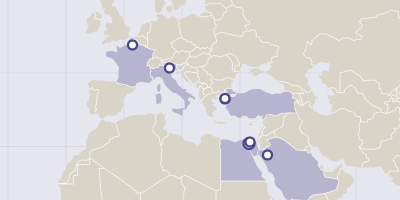
Battlefield 1 sends its soldiers across the Western Front, the Italian Front, Gallipoli and Arabia. This route follows the War Stories and multiplayer maps that go with them, from the Suez Canal in 1915 to Monte Grappa in October 1918.
Stops run in the order of the real battles, not the game's menu. The maps are the game's own reconstructions, so each pin marks the real ground behind a level, and one stop is a village the game invented.
Vlad III ruled Wallachia in three separate reigns and earned his nickname from impalement, his favorite method of execution. His patronymic, Dracula, is thought to have inspired the name of Bram Stoker's vampire, but the man himself spent his life between the Ottoman sultans and the king of Hungary.
Nine places follow his life in order, from the Transylvanian house named as his birthplace to the battlefield near Snagov: hostage years, exile, raids, a war with the sultan and a long imprisonment. Bran Castle is left out on purpose, since it is often, but incorrectly, said to have been his home.
Assassin's Creed III crosses the American Revolution from London's Covent Garden opera house to Boston's Old State House, Bunker Hill and the Battery in Manhattan. In 1754 the Templar Haytham Kenway carries a stolen key to the colonies; his son Connor becomes the Assassin who hunts him through the war.
Assassin's Creed III builds its America from real maps, and almost every stop can still be walked: the opera house in Covent Garden, the Old State House and Boston Harbor, the green at Lexington and the bridge at Concord, the Bunker Hill battlefield, the Valley Forge encampment, the Monmouth battlefield, and the Battery at the foot of Manhattan, where the war ends.
Tatooine is the Star Wars desert everyone knows, but the films kept finding other corners of the Earth for their galaxy: redwoods in northern California, a villa on Lake Como, a plaza in Seville, the desert around an oasis in Abu Dhabi, a monastery island off County Kerry and the largest salt flat in the world, in Bolivia.
This route follows the shooting in the order the films were made, from the Endor forest of Return of the Jedi to the Crait battle of The Last Jedi. Two stops mark an area rather than a spot: the Endor scenes were partly shot on private land, and no source names the stretch of desert that stood in for Jakku.
Greece, 431 BC: Athens and Sparta are tearing the Greek world apart, and you are a Spartan mercenary caught between them. Assassin's Creed Odyssey sends you across the Aegean with a broken spear and an eagle at your side, hunting your lost family and the masked Cult of Kosmos that destroyed it.
This route follows the Eagle Bearer's trail from the hot gates of Thermopylae to the oracle at Delphi, the Acropolis of Athens, the sanctuary at Olympia, warrior Sparta and finally Mount Taygetos. Every stop is a real place you can visit, recreated in the game's vast open world.
In August 1914 France expels its German residents, and Karl is torn from his French wife Marie and their baby on a farm near Saint-Mihiel and drafted into the German army. Marie's father Emile is called up on the other side. Ubisoft Montpellier's hand-drawn 2014 game, made for the war's centenary, follows them, an American volunteer called Freddie, a Belgian nurse, Anna, and Walt the medic dog across four years of the Western Front.
The heroes are invented, but the battles are not, and every chapter is full of real objects and short historical notes. This route visits the places the story passes through, from the Marne in 1914 to the Chemin des Dames in 1917. Most are now memorials, museums or preserved battlefields.
In spring 1689 the poet Matsuo Bashō gave up his hut in Edo and set off on foot with his friend and disciple Kawai Sora into Oku, the remote north of Japan. For about 156 days and some 2,400 kilometres they walked to the places the old poets had made famous — a barrier gate, a bay of pine islands, a battlefield, a mountain temple — and Bashō answered them with haiku.
The travel diary he made of it, Oku no Hosomichi, published in 1702, is one of the classics of Japanese literature, and its stops are still pilgrimage sites. Bashō polished the facts for art; Sora's own diary shows where. Dates follow the old lunar calendar, so they are given here by season.
The Boshin War ran from Kyoto to Hakodate in eighteen months: the battlefield at Toba, Edo Castle, the hill of Ueno, Aizu's castle and Goryōkaku. In January 1868 the young emperor was declared ruler in fact as well as name, ending more than 250 years of Tokugawa rule, and the last shogun's supporters fought on until a breakaway republic made its last stand.
The route follows that war in six places, all of them visitable: the battlefield at Toba, Edo Castle, the hill of Ueno, Aizu's castle and the hill where its teenage soldiers died, and Goryōkaku. Dates are given in the Western calendar, converted from the Japanese lunar dates used at the time.
Alexander the Great's route runs from Troy and the Granicus in Turkey to Tyre, Alexandria and Persepolis, and on to the Jhelum in the Punjab. He crossed into Asia at 22, and eleven years later died in Babylon at 32, his empire stretching from Greece to India.
The route follows the campaign through its turning points, with Arrian's Anabasis, written four centuries later from earlier accounts, as the main guide. Several battlefields can only be placed approximately; their pins are marked as such.