In 1961 Yuri Gagarin trained at Moscow's Khodynka Airfield, launched from Baikonur and came down near Engels. Less than two hours in space made the pilot a worldwide celebrity; his capsule is kept in a museum in Korolev City.
This route follows Yuri Gagarin from the training ground at Moscow's Khodynka Airfield to the launch pad at Baikonur, the field in the Saratov region where he came down, the Kremlin ceremony and the museum that keeps his capsule. The museum pin marks the Energia company site rather than the museum itself.
Pushkin's only completed novel follows Pyotr Grinev, a young officer sent to a log-fenced fortress on the Orenburg steppe, where he falls in love with the captain's daughter Masha and crosses paths with Pugachev, the rebel who claims to be Emperor Peter III. The book is a romanticized account of Pugachev's Rebellion of 1773-1774, not a record of it.
The route follows the novel from besieged Orenburg through the Belogorsk fortress, Berda, Kazan, Tsarskoye Selo and Moscow. Each stop separates what Pushkin invented from what history records; Belogorsk exists only on the page, with the real fortress of Tatishchevo as its stand-in.
In Gogol's Petersburg nothing is what it seems: the grandest street is a liar, a nose walks about in a state councillor's uniform, and a dead clerk tears coats off passers-by. Three of his stories share one city, and most of their stops can still be walked.
The route runs along Nevsky Prospekt and its neighbouring streets, from the painter's and the lieutenant's chases in Nevsky Prospekt, through The Nose's barber, cathedral, bridge, garden and shop, to the Kalinkin Bridge where the ghost of The Overcoat is said to prowl. A few stops are approximate, since Gogol seldom gives house numbers.
Assassin's Creed (2007) recreates the Holy Land of 1191: Masyaf, Damascus, Acre and Jerusalem, with Solomon's Temple and Richard's camp at Arsuf. Altaïr loses his rank after a botched mission and wins it back one target at a time: nine men in three cities, all secretly Templars.
The route follows the story from the Temple in Jerusalem to the Assassins' fortress of Masyaf, through Damascus, Acre and Jerusalem, to a duel in King Richard's camp. The game's cities are rebuilt for play, so every pin marks the real place the scene is anchored to.
For eighteen months in 1860 and 1861, relays of light riders on fast horses carried letters 1,900 miles from the Missouri River to California. It took about ten days, was never profitable, and was made obsolete by the telegraph within a year and a half — yet it became one of the great legends of the Old West.
The route follows the mail west through eight places: the stables where the first rider set out, a surviving station in Kansas, Fort Kearny, Julesburg, the plains where Mark Twain saw a rider flash past his stagecoach, Utah, the Nevada desert and the terminus in Sacramento. Where legend (Buffalo Bill, Twain's eight days) outruns the record, the text says so.
On 16 July 1969 a Saturn V lifted the Apollo 11 crew off a Florida launch pad; eight days later their capsule dropped into the Pacific. In between, the first people walked on another world while an estimated 600 million watched on Earth.
The route follows the mission through six stops: the launch pad in Florida, Mission Control in Houston, Tranquility Base on the Moon, the Australian dish that carried the moonwalk pictures, the splashdown and the capsule's museum home. The Moon stop has no pin because the map shows Earth only; its lunar coordinates are given in the text.
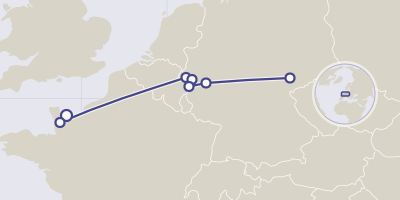
In December 1933, eighteen-year-old Patrick Leigh Fermor set off from the Hook of Holland to walk to Constantinople, carrying a few clothes, some letters of introduction, an anthology of English verse and a volume of Horace. He slept in barns and shepherds' huts, but gentry and aristocracy kept inviting him into their country houses. He wrote the journey up decades later in A Time of Gifts, Between the Woods and the Water and The Broken Road.
The route follows him through ten places the sources let us pin, from the Hook and a Stuttgart apartment to Melk, Vienna, Prague, the bridge into Hungary, an island on the Danube that now lies under water, Plovdiv and Istanbul. Many pins are approximate: the sources name a town, not the exact spot where he stood.
In June 1995 Cheryl Strayed, 26 and with no hiking experience, set out alone to walk 1,100 miles of the Pacific Crest Trail. Her memoir Wild reached No. 1 on the New York Times Best Seller list, and Reese Witherspoon played her in the 2014 film.
This route follows the hike north from the Mojave Desert to the Columbia River, using the memoir's outline and the film's best-known scenes. The film compresses and dramatises, so stops drawn from it say so, and pins mark areas rather than campsites.
At 11:30 a.m. on 29 May 1953 Edmund Hillary and Tenzing Norgay stood on the summit of Mount Everest, the first people confirmed to have done so. They were part of a British expedition led by Colonel John Hunt, which in the end amounted to over four hundred men, including twenty Sherpa guides and 362 porters.
The route follows that expedition from winter training in Wales through Kathmandu, Thyangboche, Base Camp, the Khumbu Icefall, the Western Cwm and the South Col to the summit, then to the telegraph runner's stop at Namche Bazaar. Pins above Base Camp mark the terrain, not the exact camps of 1953.
Toru Watanabe, a drama student in late-1960s Tokyo, looks back on the years he spent between two women: Naoko, the fragile girlfriend of his dead best friend, and Midori, a classmate who is everything Naoko is not. Haruki Murakami's 1987 novel made him a superstar in Japan.
The route follows Watanabe across the city: his dormitory, a long Sunday walk by the moat, Naoko's apartment in Kokubunji, the campus, the streetcar to Midori's neighbourhood, a house at the edge of Kichijōji and the platform at Ueno. Murakami drew on his own student years, but the novel's dormitory and university are invented, so those two pins mark real stand-ins.
In 1910 two expeditions set out for the bottom of the world. Roald Amundsen's Norwegians, masters of skis and sled dogs, reached the South Pole on 14 December 1911. Robert Falcon Scott's party arrived on 17 January 1912, 34 days later, to find a Norwegian tent already standing. Amundsen sent his news from Hobart; Scott's party of five died on the return journey.
The route follows both men from Cardiff and Madeira to their bases, up their two glaciers, to the Pole and to the endings: Amundsen's cables from Hobart and Scott's last camp. Antarctic pins mark glaciers and bays, not camps, and the ice has moved since.
Huck Finn fakes his own murder and, with Jim, who has run away from slavery, takes a raft down the Mississippi. Their goal is Cairo, where Jim would be a free man the minute he saw it. They miss it in the fog and drift on into slave country, past a feud, two con men and a farm with the book's last twist.
Twain built St. Petersburg from his boyhood town of Hannibal. Most places in the novel are invented, so each pin marks a real landmark or stand-in, and the Grangerfords' country and Bricksville stay off the map.
Santiago, a shepherd boy from Andalusia, keeps dreaming of treasure at the Egyptian pyramids. A fortune-teller and a mysterious old king send him across the strait to Africa, where he is robbed in Tangier, falls in love at an oasis and crosses a desert of warring tribes. Paulo Coelho's 1988 fable has sold more than 150 million copies.
The route follows the boy from a ruined church to the Giza plateau and back again. The book keeps its geography loose, so most pins mark the best-known place for a scene rather than a spot the author names.
A retired detective with a fear of heights is hired to follow a friend's wife around San Francisco, because her husband fears she is possessed by Carlotta Valdes, a woman who died in 1857. Hitchcock's 1958 thriller was shot on location in San Francisco, at Mission San Juan Bautista, in Big Basin Redwoods State Park, at Cypress Point on 17-Mile Drive and at Paramount Studios in Hollywood.
This route follows the story in film order through nine places: a vanished restaurant, a Nob Hill apartment block, a mission cemetery and an art museum, a fort under the Golden Gate Bridge, a coastal kiss, a mission bell tower and a hotel with a green neon sign.
A young bear stows away from Peru, turns up at Paddington station and is taken in by the Brown family. Paul King's 2014 film follows him through a cosy London of antique shops and a gentlemen's club, while a taxidermist closes in.
Most of it was shot on real London streets. This route runs from the station to Primrose Hill, Portobello Road, Pall Mall and the Natural History Museum, with one caveat: the film's station front door is borrowed from Marylebone.
Jesse and Céline are now a couple with twin daughters, on a summer holiday in southern Greece. Before Midnight, the third and final film of Richard Linklater's Before trilogy, was shot in 15 days on the Peloponnese coast and turns one last night into a long, honest argument about love.
The route follows the film from an airport farewell to a writer's house, a castle, a harbour town and a resort hotel. The filmmakers have named few exact addresses, so the Pylos and hotel stops are approximate.
Nine years after a night in Vienna, Jesse is on a book tour in Europe when Céline walks into his reading in a Paris bookshop. He has an hour before his flight, and they spend it wandering the city. Richard Linklater's 2004 film plays in real time: the story lasts about as long as the film, roughly eighty minutes.
It was shot in 15 days across Paris, and its locations jump about more than the dialogue admits. This route follows the film's order from the Left Bank bookshop through the Marais and the east of the city to the Seine and a gated courtyard in the Faubourg Saint-Antoine.
Gil Pender is a screenwriter with a nostalgia problem, in Paris with a fiancée and her wealthy parents. Every night at midnight a 1920s car pulls up and carries him back to the 1920s, among the Fitzgeralds, Hemingway and the surrealists. By day he is stuck in 2010.
This route follows the film from Monet's garden at Giverny to Pont Alexandre III, with the stops placed from a film-locations guide: where the 1920s scenes are shot you can still sit, eat and shop today. The party and flea-market scenes are approximate.
Private First Class Ronald "Red" Daniels lands on Omaha Beach on D-Day with the 1st Infantry Division and fights his way into Germany with one squad, until a friend is captured and the search for him ends at a concentration camp. Call of Duty: WWII is a 2017 game by Sledgehammer Games, and its campaign is set among real battles.
The route follows the missions in order: Omaha Beach, Marigny, Aachen, the Hürtgen Forest, the Ardennes, the bridge at Remagen and Berga, with the real battle each one echoes. Pins mark battle areas, not a mission's exact street.
Forza Horizon 5 drops the Horizon Festival into a fictionalised Mexico, on a map 50% larger than Forza Horizon 4's. Creative director Mike Brown calls Mexico almost the whole world in one country: snowy peaks, tropical jungles, epic canyons, beautiful beaches, ancient architecture and modern cities.
This route visits seven real places the game recreates, from a sea arch at the tip of Baja to a canyon with a train, and says what the game does at each. The map is a condensed Mexico, so the pins mark the real sites, not their positions in the game.
The Kanto of Pokémon Red and Blue is based on the real Kantō region of Japan: fans match Pallet Town to Machida, Vermilion City to Yokohama, Celadon City to Shinjuku and Lavender Town to Narita. You start in a quiet town, beat eight gym leaders and take on Team Rocket.
This route follows the game's journey from Pallet Town to the final gym and sets each stop beside the real place it is said to resemble. The game's Kanto is inspired by the real one, not a copy of it, so every pin is an outside reading of the map, not an official location.
Rachel Chu, a Chinese American economics professor, flies to Singapore with her boyfriend Nick for his best friend's wedding and learns that Nick's family is among the richest in the country. Jon M. Chu's 2018 film follows her from the airport to a mahjong table where she faces down his mother.
This route visits nine places from the film, in story order. Several of the story's places were filmed in Malaysia instead of Singapore: the Young family estate in Kuala Lumpur, the island parties on Langkawi and the mahjong parlor in Penang.
Downton Abbey is set on a fictional Yorkshire estate between 1912 and 1925, but its great house stands in Hampshire and its village in Oxfordshire. This route follows the story, from the Titanic news of series 1 to the royal visit of the 2019 film, to the real places behind it.
It takes in Highclere Castle, Bampton's church and library, a prison in Lincoln, castles in Scotland and Northumberland, the Ealing stage where the kitchen was built, and the film's parade village and York streets. Lacock's pin marks the village, as the sources name no exact spot.
Vlad III ruled Wallachia in three separate reigns and earned his nickname from impalement, his favorite method of execution. His patronymic, Dracula, is thought to have inspired the name of Bram Stoker's vampire, but the man himself spent his life between the Ottoman sultans and the king of Hungary.
Nine places follow his life in order, from the Transylvanian house named as his birthplace to the battlefield near Snagov: hostage years, exile, raids, a war with the sultan and a long imprisonment. Bran Castle is left out on purpose, since it is often, but incorrectly, said to have been his home.