Mapped Chronicles

Catalog

All routes

More filters
Real JourneysExact

The Camino de Santiago: The French Way

The French Way is the most popular route of the ancient pilgrimage to Santiago de Compostela, It starts at Saint-Jean-Pied-de-Port, crosses the Pyrenees, and from Roncesvalles on the Spanish side still runs about 780 kilometres west to Galicia. It is on the UNESCO World Heritage List. This route follows it through seven landmarks: a mountain gate, a village of legend, a pilgrims' bridge, a great cathedral, a knights' tournament, a Galician hilltop and the tomb of St James.

7 locations7/7 visitable
BooksFictional

La Regenta: Oviedo as Vetusta

Clarín's novel hides Oviedo behind the name Vetusta, a provincial capital of gossip, piety and boredom where Ana Ozores, the Regenta, is slowly worn down. It begins with the Magistral watching the town through a telescope and ends with Ana fainting in his chapel. The route follows seven scenes from the tower to the duel and the confessional, and ends at the modern statue of Ana. Spanish guides tie some scenes to real Oviedo; where they do not, the pin is approximate or absent.

7 locations5/7 visitable
BooksSpeculative

The Song of My Cid: From Burgos to Valencia

Spain's oldest surviving epic poem follows Rodrigo Díaz, the Cid, from a humiliating exile out of Castile to the conquest of Valencia, and then to a trial in Toledo after his sons-in-law abandon his daughters. The route runs from Vivar and Burgos through Cardeña and Valencia to Corpes and Toledo. The poem and the historical Cid differ in many details, and the site of Corpes is disputed.

6 locations4/6 visitable
MythologySpeculative

Kitezh: The Invisible City of Lake Svetloyar

The legend of Kitezh, the Russian Atlantis, says the city sank into Lake Svetloyar rather than fall to the Mongols. The route also visits Gorodets on the Volga, said to be Little Kitezh, and Kideksha near Suzdal, the name's folk origin. On calm days, they say, its bells can still be heard. The route follows the story from the folk etymology of the name, through the town said to be Little Kitezh and the forests of the Kerzhenets, to the lake itself and the St Petersburg stage where the opera first sounded. Kitezh is a legend: the places are traditional identifications, not proof.

5 locations3/5 visitable
MoviesExact

Sherlock Holmes and Dr. Watson: Riga as Victorian London

Vasily Livanov and Vitaly Solomin's Soviet Holmes and Watson were made when filming abroad was impossible, so a Riga lane became Baker Street, a Petersburg station became Victoria and a waterfall in Abkhazia became the Reichenbach Falls. The route follows the Lenfilm television films of 1979 to 1986 from the Riga street with the screen 221b to Peterhof, Saint Petersburg, the Gega Waterfall and Tallinn.

6 locations5/6 visitable
HistoryApproximate

Napoleon's Retreat from Moscow: Maloyaroslavets to the Berezina

On 19 October 1812 the Grande Armée walked out of Moscow after five weeks of occupation. Six weeks later, what was left of it scrambled across the Berezina on two hastily built bridges. In between lay a blocked road, a burning town, a depleted depot, a blizzard and a river full of ice. The route follows six places on that march, from the mined Kremlin through Maloyaroslavets, Vyazma, Smolensk and Krasny to the crossing at Studienka. Most pins mark a town or village, not a battlefield.

6 locations3/6 visitable
BooksSpeculative

Gogol's Petersburg: Nevsky Prospekt, The Nose, The Overcoat

In Gogol's Petersburg nothing is what it seems: the grandest street is a liar, a nose walks about in a state councillor's uniform, and a dead clerk tears coats off passers-by. Three of his stories share one city, and most of their stops can still be walked. The route runs along Nevsky Prospekt and its neighbouring streets, from the painter's and the lieutenant's chases in Nevsky Prospekt, through The Nose's barber, cathedral, bridge, garden and shop, to the Kalinkin Bridge where the ghost of The Overcoat is said to prowl. A few stops are approximate, since Gogol seldom gives house numbers.

8 locations8/8 visitable
MythologySpeculative

The Nibelungenlied: From Worms to the Danube

The Nibelungenlied on the map: Xanten, Siegfried's home; Worms, where two queens quarrel at the cathedral door; and the Danube towns of Tulln and Pöchlarn. It tells of a dragon-slayer's hoard, a murder at a spring and a revenge thirteen years in the making. This route follows the story from Siegfried's home in Xanten to Worms, to the Odenwald, and then east along the Danube to Tulln and Pöchlarn. Several sites are local traditions, not proof; the poem itself is vague about most places.

6 locations5/6 visitable
HistoryApproximate

The Great Fire of London: Pudding Lane to Pye Corner

A baker's oven in Pudding Lane, a gale from the east and a city of timber and pitch: in four days in September 1666 the fire destroyed medieval London, including Old St Paul's. Samuel Pepys watched it from the Tower, from the river and from a church tower, and wrote it all down. The route follows the fire from its first spark on Sunday morning to its end on Wednesday, then to the Monument and the Golden Boy that remember it. Where the sources give only an area, such as the refugee camps at Moorfields, the pin marks it loosely.

9 locations9/9 visitable
Real JourneysApproximate

The Innocents Abroad: Twain's Quaker City Cruise

In June 1867 the steamship Quaker City left New York on what Mark Twain called his "Great Pleasure Excursion", a chartered trip to Europe and the Holy Land. A newspaper, the Alta California, paid for his place in exchange for fifty articles, and those letters grew into The Innocents Abroad. This route follows eight stops: the Wall Street pier, the Azores, Tangier, Milan, Athens, a palace garden near Yalta, Jerusalem and the Sphinx. Each is told through Twain's own scenes, from donkey rides and hotel bills to the places that stopped his jokes. Where he does not name a spot, the pin marks the nearest known place.

8 locations7/8 visitable
BooksSpeculative

Crime and Punishment: Raskolnikov's St Petersburg

Raskolnikov's St Petersburg on a map: his garret, the pawnbroker's house, Sennaya Square, the canal and the bridges of the Neva. On an exceptionally hot July evening he counts exactly 730 steps to her door, and Dostoevsky hid many addresses behind initials such as "S. Place" and "K. bridge". This route follows Raskolnikov and Svidrigailov from the garret to the police office. The garret, the pawnbroker's house and the police office are researchers' identifications rather than facts, and are marked as such.

7 locations5/7 visitable
BooksFictional

War and Peace: Austerlitz, Borodino, Moscow

War and Peace travels from the Rostovs' house on Moscow's Povarskaya and Bald Hills, modelled on Yasnaya Polyana, through Schöngrabern and Austerlitz to Borodino, Fili and Poklonnaya Hill in 1812. Prince Andrew falls under the lofty sky at Austerlitz; Pierre, a civilian in a white hat, climbs the Raevsky redoubt. The route follows the book from a Moscow house and a country estate through Schöngrabern and Austerlitz to 1812: Borodino, the council at Fili and Napoleon waiting on Poklonnaya Hill. Some stops are real places Tolstoy wrote about, others are real stand-ins for places that exist only in the novel; each says which. Dates follow the modern calendar, with Tolstoy's Old Style date noted where it differs.

8 locations6/8 visitable
MoviesApproximate

Vertigo: Hitchcock's San Francisco

A retired detective with a fear of heights is hired to follow a friend's wife around San Francisco, because her husband fears she is possessed by Carlotta Valdes, a woman who died in 1857. Hitchcock's 1958 thriller was shot on location in San Francisco, at Mission San Juan Bautista, in Big Basin Redwoods State Park, at Cypress Point on 17-Mile Drive and at Paramount Studios in Hollywood. This route follows the story in film order through nine places: a vanished restaurant, a Nob Hill apartment block, a mission cemetery and an art museum, a fort under the Golden Gate Bridge, a coastal kiss, a mission bell tower and a hotel with a green neon sign.

9 locations7/9 visitable
HistoryApproximate

Joan of Arc: From Domrémy to Rouen

Joan of Arc’s road runs from her family’s house in Domrémy, through Vaucouleurs, Chinon, Orléans and Reims, to Rouen, where she was burned in 1431. A peasant girl, she persuaded a doubting captain and then a doubting prince to give her an army, lifted the siege of Orléans in 1429 and stood beside Charles at his coronation. The route follows her through nine places, from her family's house in Domrémy to the square in Rouen where she was burned. Where a building was rebuilt or the exact spot is unrecorded, the stop says so.

9 locations5/9 visitable
BooksApproximate

Les Misérables: From Digne to the Barricades

Les Misérables on a map: Jean Valjean's road from the bishop's house at Digne to Montreuil-sur-Mer, the Thénardiers' inn at Montfermeil, Marius's bench in the Luxembourg, the barricade of June 1832 and the sewers and bridges of Paris. Victor Hugo's 1862 novel follows the convict from the night a bishop's kindness turns him towards good to the street fighting in the capital. Hugo hid two of the towns behind initials and the wine-shop barricade has been built over, so only the Luxembourg Garden is pinned exactly; the other stops mark real places standing in for the book's.

7 locations6/7 visitable
GamesSpeculative

Pokémon X and Y: The France Behind Kalos

Kalos is Metropolitan France turned into a star-shaped Pokémon region. Lumiose City is inspired by Paris, its Prism Tower by the Eiffel Tower and its art museum by the Louvre; the Battle Château recalls Chenonceau on the Loire, the palais Chaydeuvre is the château de Versailles, and the stones outside Geosenge Town are the Carnac stones. The games never confirm their models — these are fan and encyclopaedia identifications — so every pin on this route is speculative. The route follows the story across the real France behind Kalos: the town where the adventure begins, Lumiose's iron tower, two châteaux and a royal palace, a coastal aquarium, the island tower where Mega Evolution is learned, the cathedral clock behind Anistar's sundial, the Breton megalith field where Team Flare hides its ultimate weapon, and an abandoned mine where the legendary Zygarde sleeps.

9 locations9/9 visitable
GamesSpeculative

Pokémon Sword and Shield: The Britain Behind Galar

The Galar region is Britain played back as a game: a fictional land inspired by the United Kingdom, dotted with landmarks that recall Bath and York, crowned by a London of clock towers and football-stadium gyms. Eight gym cities, eight badges, and then the Champion's Cup in Wyndon, where Leon waits and the Darkest Day breaks. This route walks the real Britain behind that map, south to north and then beyond: a chalk giant, a lighthouse, Roman baths, a minster, a national stadium and a clock tower, plus the two downloadable lands, the Isle of Man and the snows of Scotland. Every identification is a fan or developer reading, never confirmed in the games, so every pin here is speculative.

8 locations8/8 visitable
GamesApproximate

Assassin's Creed Syndicate: Victorian London

In 1868, at the onset of the Second Industrial Revolution, twin Assassins Jacob and Evie Frye come to a London controlled by the Templars under Crawford Starrick, and set out to take the city back: building their street gang, the Rooks, across an open world of seven Victorian boroughs. Jacob works through Starrick's lieutenants while Evie hunts a Piece of Eden, the Shroud, from St Paul's to the Tower to a vault under Buckingham Palace. This route follows both threads across the capital, then jumps forward: to Whitechapel in 1888, where Evie hunts Jack the Ripper in the expansion, and to Tower Bridge in 1916, where Jacob's granddaughter Lydia clears a German spy nest at Churchill's request. Every stop is a real building or district you can walk to.

6 locations4/6 visitable
MoviesApproximate

The White Lotus: A Sicilian Week of Suspicion

The second season of The White Lotus moves to a luxury resort in Sicily, following the staff and wealthy guests through a week of sightseeing days, villa parties and opera nights. Guests explore Taormina's Greek theatre, Daphne drags Harper down to Baroque Noto, and Tanya falls in with a wealthy Brit whose Palermo villa hides an ugly twist. This route visits the real filming locations in episode order, from the San Domenico Palace hotel to the island beach of the finale. The show swaps two villas across the island: its Noto palace is really Villa Tasca outside Palermo, and Quentin's Palermo villa is Villa Elena near Noto.

7 locations1/7 visitable
MoviesApproximate

Indiana Jones and the Last Crusade: From Utah to the Grail

Indiana Jones and the Last Crusade (1989) sends Indy from a Boy Scout outing in the Utah desert to the rock-cut façade of Petra, chasing the Holy Grail and his missing father. Three trials guard the cup at the end. The film borrows its scenery from half of Europe, the Middle East and the American West. Nine stops, most of them still standing: the Arches canyons of the opening, the church façade in Venice's Campo San Barnaba that plays the library, an Eifel castle dressed as Brunwald, a San Francisco building that played Berlin's Tempelhof airport, the Almería beach where Henry brings down a fighter with an umbrella, a Granada station playing Alexandretta, the Tabernas tank chase, the Treasury that fronts the Grail's temple, and the Texas sunset the film ends on. Dates are story time; filming ran from May 1988 to early 1989.

9 locations8/9 visitable
MoviesExact

Game of Thrones: Spain and Morocco

The journey south ran through Morocco first. For the third season the Atlantic ramparts of Essaouira stood in for Astapor, the slaver city where Daenerys buys an army of eunuch soldiers, and the earthen ksar of Aït Benhaddou stood in for Yunkai, whose two hundred thousand slaves she promises to free. When the story turned to Dorne, Spain answered: the Alcázar of Seville became the Water Gardens of House Martell, and the bullring at Osuna the fighting pits of Meereen. Six stops in the order the episodes aired — two in Morocco, four in Spain. The last two are the biggest set-pieces of the sixth and seventh seasons: Girona's cathedral and steps as the Sept of Baelor, and the Roman ruins at Itálica as the ruined Dragonpit.

6 locations6/6 visitable
MoviesApproximate

Call Me by Your Name: From the Perlmans' Villa to the Serio Falls

In the summer of 1983 a seventeen-year-old boy and a twenty-four-year-old American share a house in rural Lombardy: Elio Perlman, who reads too much and plays the piano too well, and Oliver, the graduate student his father hired for the summer. One long, hot, awkward season, and neither of them handles it gracefully. It ends with a telephone call and a boy by a fireplace; it was shot, almost scene by scene, in real places you can still stand in. This route follows the filming from the Perlmans' villa at Moscazzano through Crema's piazza, a Roman villa on Lake Garda and a war memorial at Pandino, out to the meadow at Capralba where Elio makes his move, and then north for the last three days in Bergamo — the country's tallest waterfall, a pensione in the upper town, a drunken night outside Santa Maria Maggiore, and the small station south of Crema that stands in for Clusone. Principal photography ran from 9 May to the end of June 2016, and the villa is a private home, so a few stops are best seen from the street.

9 locations8/9 visitable
MoviesApproximate

The Godfather: From Staten Island to Sicily

The Godfather was filmed on Staten Island, on Mott Street and in Sicily, where Savoca and Forza d'Agrò play Corleone. Michael is pulled into the family war, flees to Sicily, loses Apollonia to a car bomb and settles every score during his nephew's baptism. Coppola shot the film on real locations around New York City and Sicily: the Staten Island house that played the compound, the Mott Street block of the Genco Olive Oil front, the villages of Savoca and Forza d'Agrò that play Corleone, the bar and church of Michael's courtship, the villa of the bombing, and the Little Italy cathedral of the baptism climax.

7 locations5/7 visitable
MoviesExact

Harry Potter: From Diagon Alley to Glenfinnan

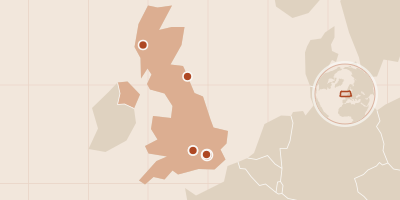
Before Hogwarts there is London: a market alley off Gracechurch Street, a barrier between platforms, a staircase in Oxford, a castle in Northumberland and a steam train crossing a Highland viaduct. This route visits six real places that built the Harry Potter films, shot from September 2000 to March 2001 and returned to in the sequels. You start where Harry buys his school supplies, run through the wall at King's Cross, climb the stairs down which McGonagall comes to meet him, wake in the hospital wing, take your first flying lesson at Alnwick and ride out over Glenfinnan — six real places, each tied to the scene it created.

6 locations4/6 visitable