The Count of Monte Cristo on a map: from Notre-Dame de la Garde in Marseille to the Château d'If, the island of Monte Cristo and its treasure, Rome's catacombs and the Paris of the count's revenge. A young sailor is arrested at his own engagement party, escapes in a dead man's burial sack and comes back as a count to settle accounts.
Most of the stops can be visited; the island of Monte Cristo is a nature reserve with a years-long waiting list, and several scenes happen in places Dumas invented, so those pins mark the real landmark nearby.
In 1581 the African slave Diogo comes to Kyoto with a Jesuit delegation and is handed to the warlord Oda Nobunaga, who renames him Yasuke and makes him a samurai. That year Nobunaga's army crushes the ninja province of Iga, where the young shinobi Naoe loses her father and inherits his Hidden Blade.
From there the two hunt the same conspiracy across Kansai: the port of Sakai, the temple at Honnō-ji where Nobunaga dies, a kofun in Settsu, the castle of Shōryūji at Yamazaki, the shrines of Yamato, and the Templar recruiting ground of Kii. Most stops are real castles, temples and tombs that the game rebuilds.
Ezio Auditore da Firenze comes to Constantinople in 1511, an old Assassin chasing five keys that unlock a library sealed beneath Masyaf by Altaïr two and a half centuries earlier. The keys lie scattered across an Ottoman capital caught between the succession claims of the princes Ahmet and Selim, with Byzantine Templars working against the city; the search runs from the Galata Tower and Hagia Sophia to the palace at Topkapı, out to the Maiden's Tower in the Bosphorus and, at the end, into a stronghold of the Byzantine Templars under Cappadocia.
This route starts at Masyaf in Syria and follows Ezio through the real Istanbul of the game, the tower, church, palace and islet that can still be visited, before ending underground in Cappadocia.
Watch Dogs 2 recreates the Bay Area: San Francisco, Oakland, Marin County and Silicon Valley, from Coit Tower and the Golden Gate Bridge to Alcatraz and a parody of the Googleplex, where the hacker Marcus Holloway and his crew DedSec set out to bring down the Blume corporation's surveillance network.
This route follows the places where the story's operations happen, from Coit Tower and Embarcadero Center to Sutro Tower, the Googleplex, Ubisoft's own studio, the Golden Gate Bridge and Alcatraz.
Bond's final outing opens beside a lake in Norway and closes on an island in the Faroe Islands, with a long detour through southern Italy and a retirement in Jamaica in between. The story's geography is real: Matera's cave lanes, a bridge over the Gravina gorge, a railway station at Sapri, a waterfront house at Port Antonio, the Atlantic Ocean Road and the cliffs of Kalsoy.
The route follows the film's order — the frozen-lake flashback, the grave and the bridge, the Matera car chase, the farewell at Sapri, five quiet years in Jamaica and the 'Cuban' harbour that is really Port Antonio, then the Norway drive and the villain's island in the Faroe Islands. The beach house in Jamaica and the lake house in Norway were sets, both since dismantled.
In 1984 Ghostbusters turned real New York addresses into a haunted city: the New York Public Library's marble reading room, the Hook & Ladder 8 firehouse in Tribeca and 55 Central Park West, the apartment block that becomes Spook Central. The Sedgewick Hotel was filmed at the Millennium Biltmore in downtown Los Angeles.
Most of the exterior landmarks survive and can be visited, though the Sedgewick Hotel's interiors were filmed on the other side of the country, at a grand downtown Los Angeles hotel. This route follows the film's story from the first library ghost to the rooftop battle with Gozer.
Kalos is Metropolitan France turned into a star-shaped Pokémon region. Lumiose City is inspired by Paris, its Prism Tower by the Eiffel Tower and its art museum by the Louvre; the Battle Château recalls Chenonceau on the Loire, the palais Chaydeuvre is the château de Versailles, and the stones outside Geosenge Town are the Carnac stones. The games never confirm their models — these are fan and encyclopaedia identifications — so every pin on this route is speculative.
The route follows the story across the real France behind Kalos: the town where the adventure begins, Lumiose's iron tower, two châteaux and a royal palace, a coastal aquarium, the island tower where Mega Evolution is learned, the cathedral clock behind Anistar's sundial, the Breton megalith field where Team Flare hides its ultimate weapon, and an abandoned mine where the legendary Zygarde sleeps.
December 1499: Cesare Borgia's army has struck the Auditore villa at Monteriggioni, killing Mario and seizing the Apple of Eden. Assassin's Creed Brotherhood sends Ezio to Rome, the center of Templar power, to take the fight to the Borgia-led Templars, and the hunt for the Apple runs from St Peter's Basilica to a temple hidden underneath the Colosseum.
This route follows Ezio from the villa at Monteriggioni through Borgia Rome — the Castel Sant'Angelo fortress, the Pantheon, St Peter's and the Colosseum — to Viana in Navarre, Spain, where his fight with Cesare ends on the battlements. Every stop is a real place you can visit.
Vice City is Miami with the labels peeled off. The 2002 game, set in 1986, follows gangster Tommy Vercetti's rise to power after prison, from an ambushed drug deal to the takeover of a drug lord's mansion. The developers built the world from extensive field research in Miami, and the plot draws on the city's real Cubans, Haitians and biker gangs.
This route pins six real places behind the fiction: the port of the opening ambush, the Ocean Drive strip behind Ocean Beach, Little Havana and Little Haiti with their warring gangs, Downtown's biker ground, and the private island behind the Starfish Island mansion. Every pin marks the real stand-in, and each stop names the game location it doubles for. One caveat: Vice City itself is fictional, so expect the flavour of 1980s Miami rather than a street-by-street copy.
The 1965 film of Maria von Trapp's life was shot on real locations around Salzburg between March and September 1964, and almost all of them can still be visited. This route follows Maria from the mountain meadow and her abbey through the fountains and gardens of the song sequences to the villa terrace, the wedding church and the festival hall where the family sings its way to freedom.
The stops run in story order, from the Bavarian opening to the festival escape. One caveat: the famous cemetery hiding place never existed; it was a Hollywood studio set modelled on St Peter's Graveyard.
Assassin's Creed IV Black Flag sets its pirate Caribbean in Havana, Nassau, Kingston and Port Royal. Edward Kenway steals a dead Assassin's name, takes the Jackdaw, builds a brotherhood in Nassau, loses his friends and chases the Observatory, a device that can watch anyone on earth.
Black Flag sets all of it in real ports — Havana, Nassau, Kingston, Port Royal — and then leaves the Caribbean for the Maya ruins of Tulum, an island in the Gulf of Guinea and a final scene in London. The route follows Edward from the harbour where Torres's plot starts, through the pirate republic and the governor who ends it, to the Kingston house where Mary Read drops the disguise, the jail at Port Royal, Príncipe, where the Sage is waiting, and Covent Garden. Most stops mark a real landmark in the town the game rebuilds.
Angels & Demons, Ron Howard's 2009 film, is set across Rome: the Pantheon, Santa Maria del Popolo, Piazza Navona and Castel Sant'Angelo. Four cardinals are kidnapped, one dies each hour on the Path of Illumination, and Robert Langdon must stop antimatter from destroying the Vatican at midnight.
This route follows Ron Howard's 2009 film rather than Dan Brown's novel: the Pantheon and Raphael's tomb, the Chigi Chapel in Santa Maria del Popolo, the obelisk in St Peter's Square, Bernini's Ecstasy of Saint Teresa, the Fountain of the Four Rivers, the assassin's lair at Castel Sant'Angelo, and the midnight finale beneath St Peter's. All of it still stands; the caveat is that Rome's diocese refused the crew access to the churches, so several interiors in the film are studio sets.
Tatooine is the Star Wars desert everyone knows, but the films kept finding other corners of the Earth for their galaxy: redwoods in northern California, a villa on Lake Como, a plaza in Seville, the desert around an oasis in Abu Dhabi, a monastery island off County Kerry and the largest salt flat in the world, in Bolivia.
This route follows the shooting in the order the films were made, from the Endor forest of Return of the Jedi to the Crait battle of The Last Jedi. Two stops mark an area rather than a spot: the Endor scenes were partly shot on private land, and no source names the stretch of desert that stood in for Jakku.
Much of Game of Thrones' North was filmed in Northern Ireland. Winterfell, its godswood, Castle Black, the Kingsroad and a fishing harbour that played Pyke were all real ground dressed as Westeros, and a basalt hillside above a small Antrim village hosts the first execution of the series.
The route runs in the order the episodes aired: the deserter's beheading above Cairncastle and the Winterfell of Castle Ward, then the quarry that held Castle Black and the Wall, the godswood, the Kingsroad beech avenue and the harbour where Theon Greyjoy comes home. The last stop is the Moneyglass estate, where a bigger Winterfell was built for the second season and used again for the eighth season's battle. Almost everything here is exterior: Winterfell's great hall was a soundstage set.
After a first season in Malta, the show crossed the Adriatic to a walled city. Dubrovnik's two-kilometre ramparts, the fortress above its western gate and its late-medieval streets played King's Landing for everything the effects departments could not invent: the name-day combats, the riot at the gate, Cersei's walk of atonement.
Eight stops run in the order the episodes aired — Lovrijenac and the Pile Gate in the second season, the Rector's Palace when Dubrovnik doubled as Qarth, the Red Keep's gardens at Trsteno and the Meereen stand-in at Klis in the third and fourth, and the Jesuit stairs where the fifth-season finale was shot in October 2014. Only the exteriors live here: the Red Keep and the Sept of Baelor were computer-generated.
Ron Howard's 2006 thriller, based on Dan Brown's 2003 novel, sends symbologist Robert Langdon and cryptologist Sophie Neveu from a murdered curator in the Louvre on a quest for the legendary Holy Grail — through a Paris church, a London Templar church and Newton's tomb to a Scottish chapel.
The route follows the film's trail in story order, from the Vitruvian-Man murder and the Saint-Sulpice marker to the Temple Church dead end, the APPLE cryptex at Westminster Abbey and the 'neath-the-rose finale at Rosslyn Chapel. Note the abbey scenes were filmed at Lincoln and Winchester cathedrals.
In March 1976 a film crew came to southern Tunisia and turned it into another planet. George Lucas had selected Tunisia to provide the desert planet setting for Star Wars, and filming in Tunisia began on March 22, 1976: a troglodyte hotel became the Lars homestead, the salt flats became a moisture farm, and the streets of Ajim on Djerba became the Mos Eisley spaceport.
When the prequels called, the crews came back: locations at Onk Jemal in Tozeur, Ksar Ouled Soltane and Ksar Hadada were used for Tatooine scenes in the 1998 shoot, from the Boonta Eve podrace track to the slave quarters where the boy Anakin lived. Abandoned sets for the filming have been left in the desert but can be visited — this route links all eight sites, from the droids' landing dunes to the granary-courtyard slave quarters.
A smuggler named Joel is hired to carry fourteen-year-old Ellie — possibly immune to the fungus that ended the world — across a ruined America, from the Boston quarantine zone to a hospital in Salt Lake City. What starts as a delivery job becomes the closest thing either of them has left to family, ending in a hospital corridor with an impossible choice.
This route follows their road west in story order: outbreak night in Austin, the Boston handoff, Bill's trapped town, the Pittsburgh ambush, Tommy's dam settlement at Jackson, the deserted university in Colorado and the Salt Lake City hospital. The cities are real but the story sites are placed approximately, with real landmarks as pins.
Bond is shot off a train in Turkey and left for dead, while a former agent with a grudge against M attacks MI6 from within. Sam Mendes's 2012 film — the 23rd Bond and the highest-grossing of them all — was shot between November 2011 and May 2012 in London, Turkey and Scotland, with much of "Shanghai" and "Macau" faked in England.
The route follows the story from the rooftops of the Grand Bazaar to the railway viaduct where Bond falls, a beach bar in Fethiye, MI6's real headquarters, a Turner in the National Gallery, an abandoned Japanese island, a disused Tube platform and the glen where Bond takes M home. Skyfall Lodge itself was a set in Surrey.
In August 1914 France expels its German residents, and Karl is torn from his French wife Marie and their baby on a farm near Saint-Mihiel and drafted into the German army. Marie's father Emile is called up on the other side. Ubisoft Montpellier's hand-drawn 2014 game, made for the war's centenary, follows them, an American volunteer called Freddie, a Belgian nurse, Anna, and Walt the medic dog across four years of the Western Front.
The heroes are invented, but the battles are not, and every chapter is full of real objects and short historical notes. This route visits the places the story passes through, from the Marne in 1914 to the Chemin des Dames in 1917. Most are now memorials, museums or preserved battlefields.
In Indiana Jones and the Great Circle (MachineGames, 2024), set in 1937, the trail of a stolen mummified cat runs from the Vatican and Giza to Shanghai and Sukhothai. Indy races the Nazi archaeologist Emmerich Voss around this "Great Circle" of sacred sites — a story Todd Howard conceived for the game.
The circle and its secret are pure adventure fiction, but its stops are real: the Vatican, Giza, wartime Shanghai, the ruined Thai capital of Sukhothai and the ziggurat of Ur. The designers rebuilt them from books and photographs as they would have looked in the 1930s. This route follows the main story.
Bohemia, 1403. King Wenceslaus IV has been kidnapped by his half-brother Sigismund, whose mercenaries burn the silver-mining village of Skalitz. Henry, the blacksmith's son, survives, and the rest of the 2018 role-playing game by Prague's Warhorse Studios follows his hunt for justice and his father's sword across a small stretch of the Sázava valley in Central Bohemia.
Almost every place in the game is real and still on the map: Stříbrná Skalice, the ruins of Talmberk, the town of Rataje with its castle Pirkštejn, the monastery at Sázava. Many of the lords Henry serves were real people too. The route follows the main story; the sequel's opening at Trosky closes it.
Fallout: New Vegas rebuilds the real Mojave: Goodsprings, Primm, Nipton, Searchlight, Boulder City and Hoover Dam are all on its map. In 2281 a courier carrying a platinum poker chip is shot and left in a shallow grave, survives and hunts the man who did it, into a war for the desert between the New California Republic, Caesar's Legion and Mr. House.
The designers built the map from US Geological Survey data and photographs of the real desert, so the game's road south from Goodsprings and back up to Las Vegas runs through real towns. The route follows that road. The towns' massacres, radiation and battles are fiction; their saloons, roller coasters and dam are not.
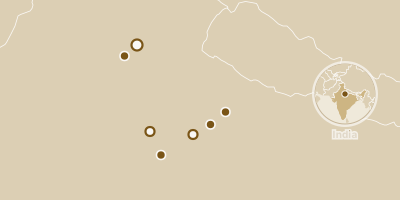
On a Sunday evening in May 1857 Indian soldiers of the East India Company's army mutinied at Meerut and rode for Delhi. Within weeks much of northern India was in revolt — soldiers, princes dispossessed by the Company, and villagers with their own grievances. It took the British more than a year to crush it, and afterwards the Company itself was abolished and India placed under the Crown.
The rebellion goes by many names, from the Sepoy Mutiny to the First War of Independence. It was not one army on one road but a chain of uprisings, and the route visits its main centres in order: Meerut, Delhi, Kanpur, Lucknow, Jhansi, Kalpi and Gwalior. Both sides committed atrocities against civilians, and the texts name them plainly.