Two Naughty Dog adventures, two treasure hunts: Nathan Drake chases Marco Polo's Cintamani Stone from an Istanbul museum through Borneo and Nepal to the legend of Shambhala, then follows Francis Drake's secret to a lost city in the Arabian sands.
The route follows both games in order. The legendary cities are invented or borrowed, and the game rarely names a real site, so every pin marks the country, city or region behind the chapter.
The Driver series began in 1999 as a car-chase game and grew into a tour of real cities: Miami, Los Angeles and New York in the first game, Havana, Las Vegas and Rio de Janeiro in Driver 2, Nice and Istanbul in Driver 3, and a fictionalised San Francisco in the 2011 sequel. Tanner's undercover work runs from a Miami parking garage to a presidential car, a Rio climax beneath Christ the Redeemer and the Golden Gate Bridge.
This route follows the series city by city, from Ocean Drive's Art Deco hotels to the Las Vegas Strip and the Bosphorus. Some stops are city-level pins because the games recreate whole urban areas rather than single buildings; only Christ the Redeemer and the Golden Gate Bridge are pinned exactly.
A man with no memory, a safe deposit box and a CIA programme that wants him gone: Jason Bourne runs across Europe and beyond, and the films keep him on real streets, stations and squares.
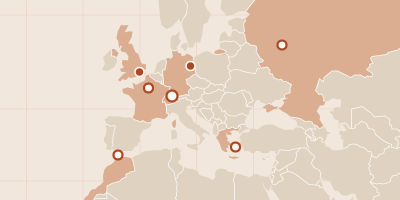
The route follows the three films in order, from Zurich and Paris through Mykonos, Berlin and Moscow to London and Tangier. Several cities were stand-ins for others, so the pins mark the story's places or honest approximations.
In Gogol's Petersburg nothing is what it seems: the grandest street is a liar, a nose walks about in a state councillor's uniform, and a dead clerk tears coats off passers-by. Three of his stories share one city, and most of their stops can still be walked.
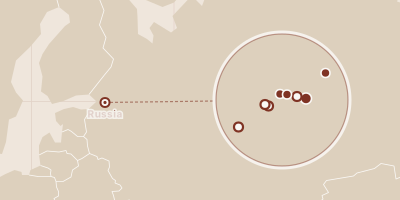
The route runs along Nevsky Prospekt and its neighbouring streets, from the painter's and the lieutenant's chases in Nevsky Prospekt, through The Nose's barber, cathedral, bridge, garden and shop, to the Kalinkin Bridge where the ghost of The Overcoat is said to prowl. A few stops are approximate, since Gogol seldom gives house numbers.
A young bear stows away from Peru, turns up at Paddington station and is taken in by the Brown family. Paul King's 2014 film follows him through a cosy London of antique shops and a gentlemen's club, while a taxidermist closes in.
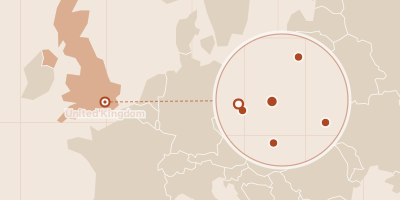
Most of it was shot on real London streets. This route runs from the station to Primrose Hill, Portobello Road, Pall Mall and the Natural History Museum, with one caveat: the film's station front door is borrowed from Marylebone.
King Arthur belongs to no single place. His story was built up by Geoffrey of Monmouth, Thomas Malory and many others, and this route follows it in the legend's own order: Merlin's dragons, Arthur's conception and coronation, his battles and court, the last fight, the sword in the water and Avalon.
Every pin marks a real place that tradition has attached to an episode, not a site proven by history, and each stop says where the link is doubted.
Bond is shot off a train in Turkey and left for dead, while a former agent with a grudge against M attacks MI6 from within. Sam Mendes's 2012 film — the 23rd Bond and the highest-grossing of them all — was shot between November 2011 and May 2012 in London, Turkey and Scotland, with much of "Shanghai" and "Macau" faked in England.
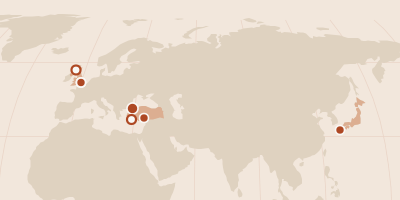
The route follows the story from the rooftops of the Grand Bazaar to the railway viaduct where Bond falls, a beach bar in Fethiye, MI6's real headquarters, a Turner in the National Gallery, an abandoned Japanese island, a disused Tube platform and the glen where Bond takes M home. Skyfall Lodge itself was a set in Surrey.
On the eve of his coronation, Prince Rama of Ayodhya is sent into the forest for fourteen years, so that his stepmother's son can rule. His wife Sita and brother Lakshmana go with him. In the forest Sita is carried off by Ravana, the demon king of Lanka, and Rama, helped by Hanuman and an army of vanaras, monkey-like forest people, crosses the sea to win her back. The Sanskrit epic attributed to Valmiki runs to some 24,000 verses and is still retold, staged and worshipped across South and Southeast Asia.
For centuries pilgrims have tied its episodes to real places, from Ayodhya to the hills of Sri Lanka. This route follows those traditional identifications, which are matters of faith and local memory rather than archaeology. Most of the stops are living temples.
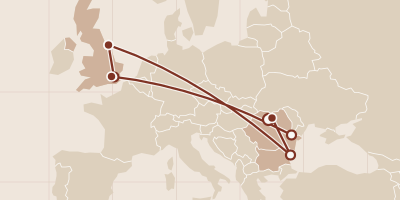
A young English solicitor travels to the Carpathians to sell a London house to a nobleman — and becomes his prisoner. The Count then ships himself to England in fifty boxes of earth, comes ashore in a Yorkshire storm and starts hunting in London, until a small band led by Professor Van Helsing chases him all the way back to his mountains.
Stoker never visited Transylvania; he built its geography from books and maps, and the English half from places he knew. The route follows the novel's diaries and letters stop by stop: the inn at Bistritz, the Borgo Pass, the Black Sea port of Varna, the harbour, steps and churchyard of Whitby, Purfleet on the Thames, London Zoo and the final race up the Danube at Galatz.