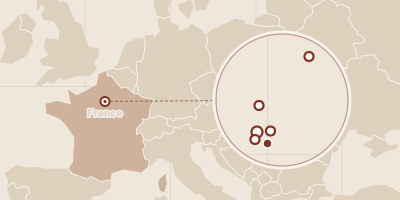
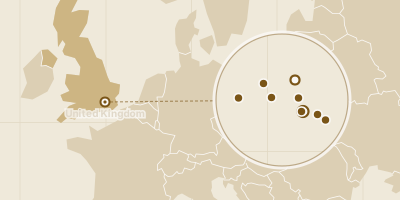
Every Far Cry game drops you into a country that does not exist, and almost every one was built from a real place. The developers camped on the savanna, sent a team to Nepal, spent two weeks in Montana and a month in Cuba.
This route follows the series in release order, one stop per game. Pins mark whole countries or regions, not scenes: they show where each fictional setting came from, and one entry has no sourced real model.
On 16 September 1810 a parish priest in a small Mexican town called his parishioners to arms, and within weeks a vast, ill-armed army was marching on the capital. Miguel Hidalgo's revolt began Mexico's war of independence.
The route follows it from the plot in Querétaro and the Cry of Dolores through the storming of the Alhóndiga in Guanajuato, the near-miss at Mexico City and the defeat at Calderón Bridge, to the ambush in Coahuila and the execution in Chihuahua. Violence is part of the story and is named plainly.
On 6 January 1482, a poet, a gypsy dancer, a deaf bellringer and a tormented priest cross paths in the Paris of Victor Hugo's imagination. It is a city of crowds, bonfires, gibbets and a cathedral that is almost a character in its own right.
This route follows the story from the Palais de Justice to the square where punishments were held, the beggars' court, the Seine bridge, Notre-Dame itself and the hilltop gibbet. Much of medieval Paris is gone, so most pins mark an area rather than a surviving building.
A baker's oven in Pudding Lane, a gale from the east and a city of timber and pitch: in four days in September 1666 the fire destroyed medieval London, including Old St Paul's. Samuel Pepys watched it from the Tower, from the river and from a church tower, and wrote it all down.
The route follows the fire from its first spark on Sunday morning to its end on Wednesday, then to the Monument and the Golden Boy that remember it. Where the sources give only an area, such as the refugee camps at Moorfields, the pin marks it loosely.
In the summer of 1588 a Spanish fleet appeared off Cornwall with a plan to join Parma's army. Beacons carried the news to London, the English fleet came out of Plymouth, and within weeks fireships, a day of heavy gunnery and autumn storms had ended the plan.
The route follows the campaign through seven places, from the first sighting to a beach in County Sligo where three ships broke up. Most of the fighting was at sea, so the pins mark the nearest coast landmark, and the story of Drake and his game of bowls at Plymouth is labelled as legend.
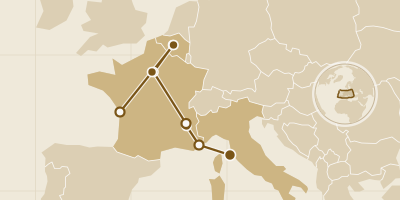
On 26 February 1815 Napoleon slipped away from Elba with some 1,000 men. Within a month he was back in the Tuileries, and by mid-July he had surrendered to the Royal Navy.
The route follows him stop by stop: his villa on Elba, the landing at Golfe-Juan, the meeting at Laffrey and the entry into Grenoble on the Route Napoléon, the Tuileries, the farms of Hougoumont and La Haye Sainte at Waterloo, then Malmaison and Île d'Aix, where his journey ended. The pins at Golfe-Juan and Grenoble mark the towns, not exact spots.
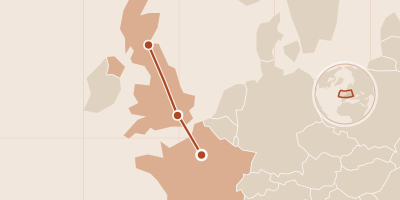
Ron Howard's 2006 thriller, based on Dan Brown's 2003 novel, sends symbologist Robert Langdon and cryptologist Sophie Neveu from a murdered curator in the Louvre on a quest for the legendary Holy Grail — through a Paris church, a London Templar church and Newton's tomb to a Scottish chapel.
The route follows the film's trail in story order, from the Vitruvian-Man murder and the Saint-Sulpice marker to the Temple Church dead end, the APPLE cryptex at Westminster Abbey and the 'neath-the-rose finale at Rosslyn Chapel. Note the abbey scenes were filmed at Lincoln and Winchester cathedrals.
In spring 1689 the poet Matsuo Bashō gave up his hut in Edo and set off on foot with his friend and disciple Kawai Sora into Oku, the remote north of Japan. For about 156 days and some 2,400 kilometres they walked to the places the old poets had made famous — a barrier gate, a bay of pine islands, a battlefield, a mountain temple — and Bashō answered them with haiku.
The travel diary he made of it, Oku no Hosomichi, published in 1702, is one of the classics of Japanese literature, and its stops are still pilgrimage sites. Bashō polished the facts for art; Sora's own diary shows where. Dates follow the old lunar calendar, so they are given here by season.