The Driver series began in 1999 as a car-chase game and grew into a tour of real cities: Miami, Los Angeles and New York in the first game, Havana, Las Vegas and Rio de Janeiro in Driver 2, Nice and Istanbul in Driver 3, and a fictionalised San Francisco in the 2011 sequel. Tanner's undercover work runs from a Miami parking garage to a presidential car, a Rio climax beneath Christ the Redeemer and the Golden Gate Bridge.
This route follows the series city by city, from Ocean Drive's Art Deco hotels to the Las Vegas Strip and the Bosphorus. Some stops are city-level pins because the games recreate whole urban areas rather than single buildings; only Christ the Redeemer and the Golden Gate Bridge are pinned exactly.
Max Caulfield comes back to the Oregon coast and finds a missing girl and a storm only she can see. In a Colorado mining town, Alex Chen arrives to meet the brother she barely knows, then stays to solve his death. Two Life is Strange games, two invented towns, and the real places their artists borrowed: a lighthouse, a main street, storefronts and a mountain valley.
The route follows the games in order, from Cape Meares and the Oregon towns behind Arcadia Bay to Idaho Springs, Georgetown, Nederland and Marble, the Colorado towns behind Haven Springs.
Haikyu!! is set in Miyagi Prefecture, but its creator Haruichi Furudate grew up in Karumai, a small town in Iwate, and much of the manga's school and streetscape is drawn from it. Fans turned the town into a pilgrimage stop, and a town-made walking map marks the spots that "look just like" the story.
This route follows the real places behind Karasuno in story order: the electronics shop where Hinata first sees volleyball on television, the gymnasium where he loses to Kageyama and vows revenge, the school that became Karasuno High, the shop where coach Ukai minds the counter, the running-course slope, the supermarket behind Shimada Mart, the Sendai arena that hosts the Miyagi qualifiers, the junior high whose staircase became Shinzen High, and the diner behind the Karasuno canteen.
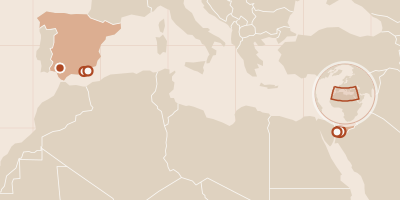
David Lean's 1962 epic follows T. E. Lawrence through the Arab Revolt, but most of its Arabia was built in Spain. Seville played Cairo, Jerusalem and Damascus, while Almería and a beach near Carboneras supplied the desert and a whole replica of Aqaba.
The route follows the story's order and keeps history apart from the film's shooting locations. Stops say plainly whether they show what happened in 1917 or where the cameras stood.
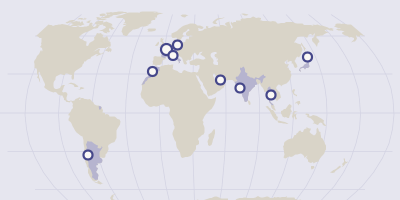
Hitori Goto is a guitarist who loves music and can hardly talk to anyone. Her band, Kessoku Band, plays at a small live house in Shimokitazawa, and the story stays close to real music towns in Tokyo and Kanagawa.
This route follows the band from the stage that inspired STARRY to Hitori's home station and a summer day on Enoshima. Two venues are invented and modelled on real live houses; the pins mark those models.
Agent 47 has killed his way across the world in the Hitman trilogy, from a Paris fashion show to a skyscraper in Dubai. Behind the levels stand real cities, a real tower and a few real places that inspired invented ones.
This route follows nine missions from the 2016 game to Hitman 3. Most venues are fictional, so the pins mark the city or the real place the designers named as a model, and each stop says which.
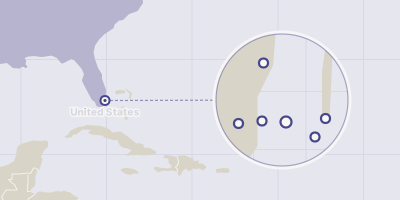
Vice City is Miami with the labels peeled off. The 2002 game, set in 1986, follows gangster Tommy Vercetti's rise to power after prison, from an ambushed drug deal to the takeover of a drug lord's mansion. The developers built the world from extensive field research in Miami, and the plot draws on the city's real Cubans, Haitians and biker gangs.
This route pins six real places behind the fiction: the port of the opening ambush, the Ocean Drive strip behind Ocean Beach, Little Havana and Little Haiti with their warring gangs, Downtown's biker ground, and the private island behind the Starfish Island mansion. Every pin marks the real stand-in, and each stop names the game location it doubles for. One caveat: Vice City itself is fictional, so expect the flavour of 1980s Miami rather than a street-by-street copy.
Taki, a Tokyo schoolboy who waits tables in Shinjuku, keeps waking up in the body of Mitsuha, a shrine maiden in a mountain town who has never left it. They leave notes on each other's skin, fall for each other from a distance — and then the switching stops dead. Taki rides west with two friends to find the town he can only draw from memory, and finds it gone: a fragment of a comet took Itomori and five hundred people three years before his visit.
The town was invented, but the film stands on real ground: the Shinjuku where Taki lives and works, the Hida valley that lent Itomori its backdrop, the lake generally credited with the crater pool, and the stone staircase where the story ends. One caveat: Itomori was never filmed, so its crater is the one stop here without a pin.
Michael Corleone brings his girlfriend Kay to his sister Connie's wedding at the family compound — and is pulled into a war that ends with him shooting Sollozzo and McCluskey, hiding out in Sicily, losing his Sicilian bride to a car bomb, and settling every score during his nephew's baptism.
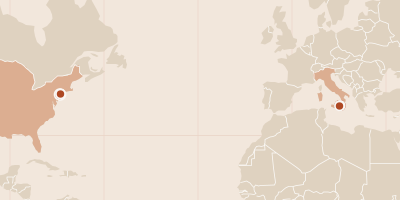
Coppola shot the film on real locations around New York City and Sicily: the Staten Island house that played the compound, the Mott Street block of the Genco Olive Oil front, the villages of Savoca and Forza d'Agrò that play Corleone, the bar and church of Michael's courtship, the villa of the bombing, and the Little Italy cathedral of the baptism climax.
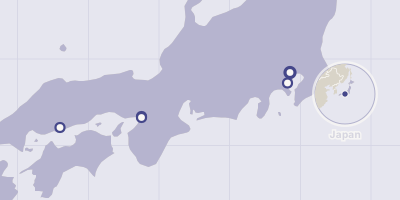
Kazuma Kiryu's Kamurocho feels like a real Tokyo night out because it nearly is: Sega modelled it on Kabukicho, then did the same with Dotonbori, Shinsekai, Yokohama and the port town of Onomichi. Every district in the series is based on its real location as it looked in the year its game came out, and later games remodel them again.
This route walks the six real stand-ins behind the fiction in the order the games introduced them: Kabukicho's sleepless streets, the theater square, Dotonbori's neon canal, Shinsekai's tower, Onomichi's temple slopes and Yokohama's Isezaki Mall. All six are ordinary public places you can visit today.
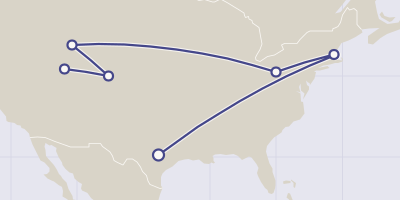
A smuggler named Joel is hired to carry fourteen-year-old Ellie — possibly immune to the fungus that ended the world — across a ruined America, from the Boston quarantine zone to a hospital in Salt Lake City. What starts as a delivery job becomes the closest thing either of them has left to family, ending in a hospital corridor with an impossible choice.
This route follows their road west in story order: outbreak night in Austin, the Boston handoff, Bill's trapped town, the Pittsburgh ambush, Tommy's dam settlement at Jackson, the deserted university in Colorado and the Salt Lake City hospital. The cities are real but the story sites are placed approximately, with real landmarks as pins.
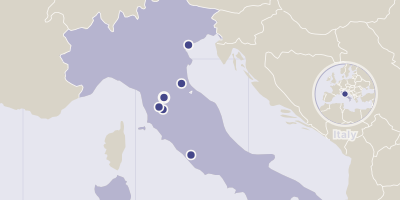
Florence, 1476: young Ezio Auditore watches his father and brothers hanged on false charges, and spends the next quarter-century hunting the men responsible across Tuscany, Romagna and Venice, all the way to the Vatican. Ubisoft's 2009 game rebuilt Renaissance Italy for climbing and running across rooftops, and mixed its invented feud between Assassins and Templars with real people — the Medici and Pazzi, Leonardo da Vinci, Caterina Sforza and the Borgia pope.
The route visits the real buildings and towns of the game. The Auditore family and their villa are fictional; most of the events around them are invented or rearranged from history.