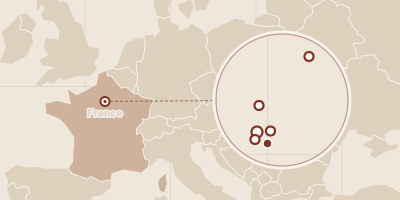
Age of Empires II follows Joan of Arc from a French army camp at Vaucouleurs to the stake at Rouen. The designers said they deferred to history wherever it did not interfere with gameplay, and the campaign's spine — Orléans, Patay, Reims, Paris — is close to the record. But the game also bends the story, placing Joan at a battle she missed and turning a failed assault on Paris into a betrayal. This route follows the campaign's stops in order and sets each one beside what the sources say happened there.
Sean Devlin, an Irish race car driver, joins the French Resistance after the Nazis murder his best friend and turn occupied Paris black and white. Pandemic Studios' 2009 open-world game sends him across the city's landmarks on a campaign of sabotage and revenge, hunting the SS commander Kurt Dierker.
The five stops follow the landmarks the story uses, from the Arc de Triomphe and the Champs-Élysées to Notre-Dame, the Catacombs and the Eiffel Tower. Each carries the real occupation history of the site between 1940 and 1944, and what a visitor finds there today.
Jacob and Wilhelm Grimm grew up poor, studied law, became librarians and gave the world its best-known fairy tales. Their lives and their stories run along one road across Germany.
The route follows the Fairy Tale Route from Hanau, where they were born, through the places they lived and worked, to Sleeping Beauty's castle and the Pied Piper's Hamelin, ending in Bremen with the animals' statue. The tale places are traditional associations, not the Grimms' own claims.
In 1327 a Franciscan detective and his young novice arrive at a Benedictine abbey in northern Italy, and monks begin to die. Umberto Eco's abbey is invented, but it was assembled from real places, and Jean-Jacques Annaud's 1986 film built another one from sets and a German monastery.
This route follows the borrowed pieces of the book, from the Sacra di San Michele to the portal at Moissac, then the places that played the abbey on screen. Pins for the book's models are traditional identifications, not locations named in the novel.
Dante wrote the Divine Comedy while banished from Florence. This route follows both the man and the people he put in the poem who were real: Francesca, Ugolino and Pia.
It runs from the Baptistery and the sentence of 1302, through the places tied to the poem's souls and the court of Verona, to Ravenna, where he died in 1321, and the empty tomb Florence built for him.
On 6 January 1482, a poet, a gypsy dancer, a deaf bellringer and a tormented priest cross paths in the Paris of Victor Hugo's imagination. It is a city of crowds, bonfires, gibbets and a cathedral that is almost a character in its own right.
This route follows the story from the Palais de Justice to the square where punishments were held, the beggars' court, the Seine bridge, Notre-Dame itself and the hilltop gibbet. Much of medieval Paris is gone, so most pins mark an area rather than a surviving building.
The French Way is the most popular route of the ancient pilgrimage to Santiago de Compostela, It starts at Saint-Jean-Pied-de-Port, crosses the Pyrenees, and from Roncesvalles on the Spanish side still runs about 780 kilometres west to Galicia. It is on the UNESCO World Heritage List.
This route follows it through seven landmarks: a mountain gate, a village of legend, a pilgrims' bridge, a great cathedral, a knights' tournament, a Galician hilltop and the tomb of St James.
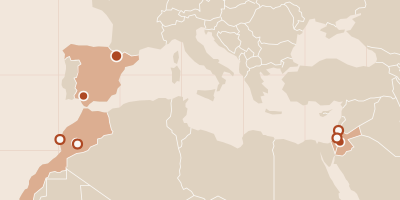
Ridley Scott's 2005 epic follows Balian, a French blacksmith turned Baron of Ibelin, from his village to Messina, Jerusalem, Kerak, the desert defeat at Hattin and the siege that ends the film. Every stop pairs a scene with the place where it was shot, or with the real place the scene stands for.
The film was made in Spain and Morocco, not the Holy Land, so the route moves between sets and history. Where the film departs from the record, the stop says so: the historical Balian was a prominent lord of the Kingdom of Jerusalem, not a French artisan.
A Cornish knight fetches an Irish princess for his uncle the king, and a love potion on the ship ruins everything. Tristan and Iseult is a medieval legend told in many versions since the 12th century, and every retelling sets it on a slightly different map.
This route follows the lovers from Tristan's drowned homeland to Dublin, Cornwall and Brittany, ending on the island that carries his name. Almost every site is a tradition rather than a fact, so each pin says how sure it is.
A baker's oven in Pudding Lane, a gale from the east and a city of timber and pitch: in four days in September 1666 the fire destroyed medieval London, including Old St Paul's. Samuel Pepys watched it from the Tower, from the river and from a church tower, and wrote it all down.
The route follows the fire from its first spark on Sunday morning to its end on Wednesday, then to the Monument and the Golden Boy that remember it. Where the sources give only an area, such as the refugee camps at Moorfields, the pin marks it loosely.
Nine years after a night in Vienna, Jesse is on a book tour in Europe when Céline walks into his reading in a Paris bookshop. He has an hour before his flight, and they spend it wandering the city. Richard Linklater's 2004 film plays in real time: the story lasts about as long as the film, roughly eighty minutes.
It was shot in 15 days across Paris, and its locations jump about more than the dialogue admits. This route follows the film's order from the Left Bank bookshop through the Marais and the east of the city to the Seine and a gated courtyard in the Faubourg Saint-Antoine.
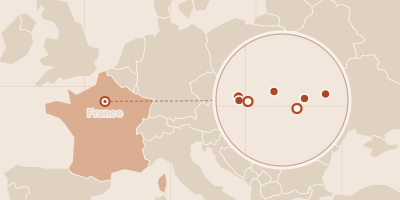
A peasant girl from a Meuse valley village persuades a doubting captain, then a doubting prince, to give her an army. Within weeks of reaching Orléans in 1429 she has lifted a siege, and by July she stands beside Charles at his coronation. Barely a year later she is a prisoner, and by May 1431 she is dead.
The route follows her through nine places, from her family's house in Domrémy to the square in Rouen where she was burned. Where a building was rebuilt or the exact spot is unrecorded, the stop says so.
King Arthur belongs to no single place. His story was built up by Geoffrey of Monmouth, Thomas Malory and many others, and this route follows it in the legend's own order: Merlin's dragons, Arthur's conception and coronation, his battles and court, the last fight, the sword in the water and Avalon.
Every pin marks a real place that tradition has attached to an episode, not a site proven by history, and each stop says where the link is doubted.