Haikyu!! is set in Miyagi Prefecture, but its creator Haruichi Furudate grew up in Karumai, a small town in Iwate, and much of the manga's school and streetscape is drawn from it. Fans turned the town into a pilgrimage stop, and a town-made walking map marks the spots that "look just like" the story.
This route follows the real places behind Karasuno in story order: the electronics shop where Hinata first sees volleyball on television, the gymnasium where he loses to Kageyama and vows revenge, the school that became Karasuno High, the shop where coach Ukai minds the counter, the running-course slope, the supermarket behind Shimada Mart, the Sendai arena that hosts the Miyagi qualifiers, the junior high whose staircase became Shinzen High, and the diner behind the Karasuno canteen.
Thomas Cromwell rises from a Putney childhood to become Henry VIII's most trusted minister, then falls in the same Tudor politics he mastered. Hilary Mantel's trilogy follows him from Cardinal Wolsey's household through the Reformation, Anne Boleyn's rise and execution, and his own last years.
This route traces the places that anchor the story: Cromwell's birthplace and London house, Wolsey's palaces at York Place and Esher, the abbey where Wolsey died, Westminster Abbey for Anne's coronation, the Seymour seat that gives the novels their title, Hampton Court, and the Tower. The 2015 television adaptation used Dover Castle for the Tower of London and Penshurst Place for Whitehall.
Uhtred of Bebbanburg is a Saxon boy raised by Danish Vikings, and The Last Kingdom follows him through the wars that made England. This route takes the places of the story in order, from the fortress on the Northumberland coast to the marshes of Somerset, the field at Ethandun and the last battle at Brunanburh, setting each against what history records.
The television series adapts Bernard Cornwell's Saxon Stories; where a stop follows a particular novel or series, the point says so. The show was filmed mainly in Hungary, so the places below are the real settings of the events, not the filming locations.
Gereon Rath arrives from Cologne in 1929 to a Berlin of police headquarters, cabarets and armed conspiracies. The series follows him and Charlotte Ritter from the May Day riots through the fall of the Weimar Republic to Hitler's first weeks in power, mixing real streets with sets and stand-ins.
This route visits the places the story names and the buildings that played them: the Rotes Rathaus as the police headquarters, the real Moka Efti, the Anhalter goods yard, the Hermannplatz U-Bahn, a Duisburg steelworks, the Theater am Schiffbauerdamm, Schloss Drachenburg and the Volksbühne. Some stops are exact; others are stand-ins far from Berlin.
A Goryeo general is killed by his king, returns as an immortal goblin, and spends 939 years looking for the bride who can pull the sword from his chest. She is a Seoul schoolgirl who can summon him by chance.
The route follows the story from the palace set where his Goryeo past was filmed to his house in Seoul, the Gangneung breakwater where they first meet, and the old streets of Quebec City beyond a red door. It ends at the park that stands in for the Yoo family cemetery.
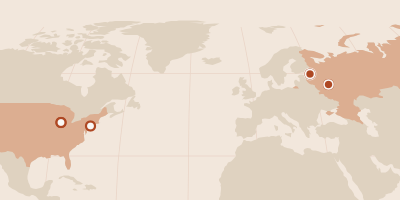
Three provincial girls, a dormitory and a city that does not believe in tears: the Oscar-winning Soviet melodrama follows Katerina from a borrowed high-rise flat in 1958 to the director's chair twenty years later.
The route visits the places the film was shot or set, from the Kudrinskaya tower and Gogol Boulevard to the Klin factory and the round house of the final credits. Most pins mark the shooting location, not a scene's exact spot.
Tommy Shelby's gang rules 1919 Birmingham, but the streets, trains and mansions you see on screen are mostly somewhere else.
The route follows the story from Small Heath, through the Liverpool street that played Watery Lane, a Yorkshire railway, Aunt Polly's village and the Black Country, to Bradford's warehouses, Tommy's country house and the beach where series 4 ends. Most pins mark stand-ins, labelled as such.
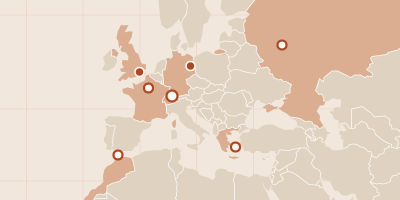
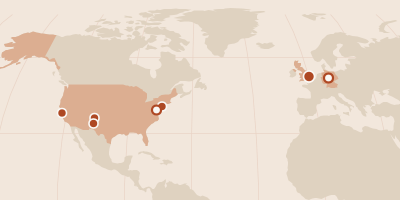
A man with no memory, a safe deposit box and a CIA programme that wants him gone: Jason Bourne runs across Europe and beyond, and the films keep him on real streets, stations and squares.
The route follows the three films in order, from Zurich and Paris through Mykonos, Berlin and Moscow to London and Tangier. Several cities were stand-ins for others, so the pins mark the story's places or honest approximations.
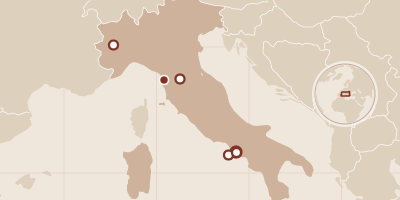
Two girls grow up in a poor Naples neighbourhood in the 1950s, one pushed on by school, the other by sheer brilliance. Elena Ferrante's four Neapolitan Novels follow their friendship from a doll thrown down a cellar chute to a package in the mail in 2010.
The route runs from the district of the first book through Ischia, Pisa, San Giovanni a Teduccio and Florence to Turin. The books never name the streets, so most pins mark areas, not buildings.
A rabbi shapes a figure from river clay and a slip of paper gives it life. The Golem of Prague is among the best-known legends of the city, yet historians find it first told in the 19th century, long after the real Rabbi Loew died in 1609.
The route follows the legend from the Vltava to the Old New Synagogue and a modern television tower, and sets it beside what the sources show: an emperor's audience, a tomb and a 1915 novel.
Game Science scanned real Chinese temples, pagodas and statues to build Black Myth: Wukong, and most of the sites on its list of filming locations are in Shanxi: 27 of 36.
This route visits seven of them, from the cliff-hung temple near Datong to a tower in Yongji. Each is tied to the game by Wikipedia or a published location guide, but the game does not say which scene copies which site.
Sailor Moon is a fantasy about moon princesses and magical warriors, but its home ground is a real Tokyo neighbourhood. Author Naoko Takeuchi had lived in Azabu-Jūban, and apart from the fantasy elements most places in the story are modelled on real ones nearby.
This route visits five of them: the shopping street, a park under a highway, two shrines that stand in for the Hikawa Shrine of the story, and Tokyo Tower. The manga and the older anime sometimes used different real models, and the two shrine pins mark real stand-ins for the story's invented Hikawa Shrine.
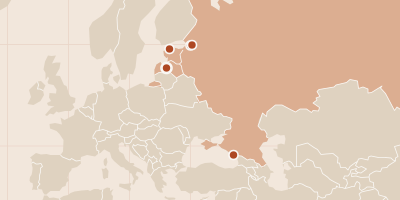
Vasily Livanov and Vitaly Solomin's Soviet Holmes and Watson were made when filming abroad was impossible, so a Riga lane became Baker Street, a Petersburg station became Victoria and a waterfall in Abkhazia became the Reichenbach Falls.
The route follows the Lenfilm television films of 1979 to 1986 from the Riga street with the screen 221b to Peterhof, Saint Petersburg, the Gega Waterfall and Tallinn.
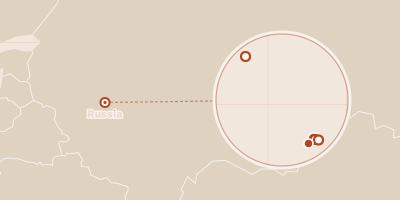
Danila Bagrov comes home from the First Chechen War, goes to look for his older brother in Saint Petersburg and ends up a hitman by accident. In the sequel he is in Moscow and then Chicago, chasing the men who threaten a dead friend's twin brother.
The route follows Danila through Vitebsky Station, the Adamini House, a market and a cemetery in Petersburg, then Moscow and the American stops. Several stops are filming locations standing in for the story's places.
It rains on Tokyo all summer, and runaway Hodaka Morishima meets Hina Amano, a girl who can pray the sky clear. Makoto Shinkai's film follows them through real corners of the city: a McDonald's in Kabukichō, a rooftop shrine on an abandoned building, a hillside flat, a fireworks festival and a jewellery shop at Shinjuku Station.
Seven stops run from Hodaka's home island to Lumine Shinjuku. Several pins mark a district rather than a spot, and Yoyogi Kaikan was demolished in 2019–20, so that stop is a memory.
On 16 July 1969 a Saturn V lifted the Apollo 11 crew off a Florida launch pad; eight days later their capsule dropped into the Pacific. In between, the first people walked on another world while an estimated 600 million watched on Earth.
The route follows the mission through six stops: the launch pad in Florida, Mission Control in Houston, Tranquility Base on the Moon, the Australian dish that carried the moonwalk pictures, the splashdown and the capsule's museum home. The Moon stop has no pin because the map shows Earth only; its lunar coordinates are given in the text.
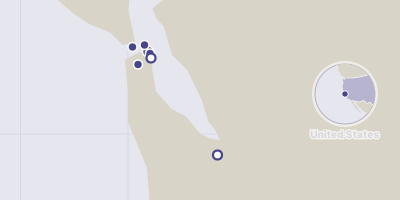
In Watch Dogs 2, the hacker Marcus Holloway and his crew DedSec set out to bring down the surveillance network run by the Blume corporation, across a fictional Bay Area that recreates San Francisco, Oakland, Marin County and Silicon Valley. Their campaign of break-ins and leaks plays out at real landmarks and at parodies of the region's tech giants.
This route follows the places where the story's operations happen, from Coit Tower and Embarcadero Center to Sutro Tower, the Googleplex, Ubisoft's own studio, the Golden Gate Bridge and Alcatraz.
J. Robert Oppenheimer studies in Cambridge and Göttingen, builds a physics school at Berkeley, and is handed the one job nobody else wants: build the atomic bomb before the Nazis do. Christopher Nolan's Oppenheimer (2023) follows him from the Cavendish Laboratory to a secret mesa in New Mexico, through the Trinity test and the political fallout that ends his career.
This route follows the film's real places — Cambridge, Göttingen, LeConte Hall, Los Alamos, Trinity, the White House, the Institute for Advanced Study and the room where his security clearance was revoked. The film's own stand-ins, from Ghost Ranch to Kerckhoff Hall, Belen and Alhambra, are noted at each stop.
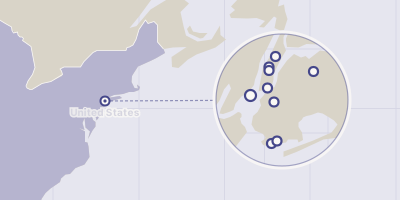
Liberty City is New York with the labels peeled off. Grand Theft Auto IV rebuilds four of the boroughs, borrows New Jersey for the state across the river, and copies in the Statue of Liberty, the Coney Island Cyclone, the Manhattan Bridge, Times Square and the Empire State Building — then renames nearly all of them, so the game's Liberty statue holds a takeaway coffee instead of a torch. The story is set in 2008, the year the game arrived.
This route pins nine real places behind those names: the triumphal arch at Brooklyn's Grand Army Plaza, the wooden Cyclone at Coney Island, the Manhattan Bridge as the Algonquin Bridge, Brighton Beach as Hove Beach, the surviving 1964 World's Fair site in Queens, and three Manhattan landmarks — Middle Park, Star Junction and the Rotterdam Tower. Each stop names the in-game location it stands in for. One caveat: Rockstar deliberately avoided a precise recreation of New York, so expect the landmarks, not the street plan.
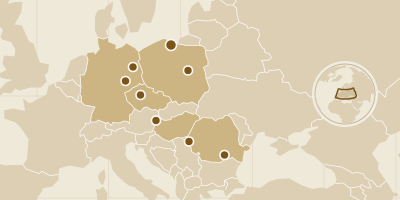
In 1989 communist rule in Central and Eastern Europe came apart in a few months — through round-table talks in Poland, a picnic on the Hungarian border, candlelit marches in Leipzig, a muddled press conference in Berlin, students in Prague and a bloody uprising in Romania. Each country had its own causes, but every crack made the next one easier.
The route visits the exact places where it happened, most of them marked today by a memorial, a museum or a plaque: the shipyard gate where Solidarity was born, the palace of the Round Table, the old border road near Sopron, the church in Leipzig, the bridge at Bornholmer Straße, a street corner in Prague, a pastor's flat in Timișoara and the balcony in Bucharest.
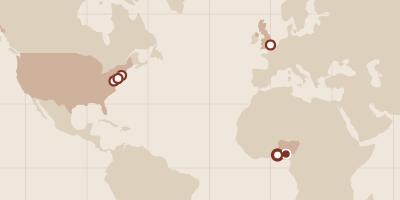
Ifemelu and Obinze fall in love at secondary school in Lagos, in a Nigeria under military rule where everyone seems to be planning to leave. She gets a scholarship to Philadelphia; he, refused an American visa after 9/11, ends up working illegally in London. Over thirteen years in the United States Ifemelu discovers that she has become "black" — and writes a hit blog about it — before deciding to go home.
Chimamanda Ngozi Adichie's 2013 novel moves between real cities on three continents, and the route follows it in story order rather than in the book's flashback structure. Homes, salons and the university in Philadelphia are not identified, so most pins mark the city or campus.