Harriet Tubman escaped slavery in 1849 and then went back to Maryland about 13 times, bringing out some 70 people. Her work depended on a chain of Quakers, free Black ministers and abolitionists who hid and moved people north.
The route follows that chain from the Eastern Shore through Wilmington and Philadelphia to Niagara and Salem Chapel in St. Catharines, then to her farm at Auburn. Real routes were kept secret, so most pins are approximate.
Cut off from the rest of the country, Leningrad lived through the winter of 1941–42 on 125 grams of bread a day, half of it sawdust. This route follows the siege through the places that carried the city through: a fortress island, an ice road, a seed bank, a diary, a symphony.
It runs from the first day of the encirclement to the memorials that came after, and keeps to documented facts. Several stops are memorials: please visit with respect.
Grigory Melekhov loves another man's wife, goes to war, and changes sides in the Civil War four times. Sholokhov's novel of the Don Cossacks grew out of the Upper Don, and its landscape is still there.
The route moves from the invented hamlet of Tatarsky to Vyoshenskaya, the stanitsa of the 1919 uprising, then to the villages where Sholokhov lived and wrote. Tatarsky and the monument are marked approximately.
In the summer of 1935 the young Laurie Lee left London for Spain with a violin and a single Spanish phrase. For a year he walked and played his way from Galicia to the Andalusian coast, sleeping under the open sky or in cheap posadas, welcomed even by the poorest villagers.
The route follows his memoir from Vigo through Zamora, Toledo, Tarifa and Málaga to Almuñécar, where he was rescued by a British destroyer as the Spanish Civil War began. Pins mark towns, not the roads he actually walked.
In Jujutsu Kaisen, 31 October 2018 turns Shibuya Station into a sealed trap, and the fighting that follows is the best-known arc of the series. The places in the story are real ones, from the station's lowest platform to Aoyama Cemetery.
This route follows the Shibuya Incident through the real district: the cemetery, Hikarie, the station, Meiji-jingumae, Mark City and the Scramble Crossing. Several scenes are only tied to a building or an area, so those stops are approximate.
Federico García Lorca was born in a farming village in the Granada vega and wrote his rural plays in the family's summer house on the city's edge. In August 1936, weeks into the Civil War, he was arrested in Granada and killed near Víznar.
The route follows his life from the birthplace to the orchard house, then the last days in 1936 and the memorials in the hills. The exact place of his death and grave is still disputed, and the final stops are marked as approximate or speculative.
Macondo is not on any map, but its author grew up on Colombia's Caribbean coast. Gabriel García Márquez was raised in Aracataca by grandparents who treated the extraordinary as perfectly natural, and that deadpan voice became the novel.
The route runs from Riohacha, where the Buendías begin, through the marsh and sierra country around Macondo to the railway, the banana company and the massacre, and ends in Mexico City, where the book was written. Macondo itself is fictional, so its stops are real stand-ins.
Nioh plays out its dark-fantasy 1600 on real ground: the Tower of London, Kyoto, Sekigahara and Osaka Castle. William Adams, a blond outsider, escapes England and becomes Ieyasu's ally against demons and the alchemist Edward Kelley in Japan's civil wars.
The route follows the main campaign and its last two expansions: the Tower of London, Kyoto, Sekigahara, then the Sanada-maru, Tennōji and Osaka Castle. The game is fantasy, so the map shows where its history happened, not where it was filmed or modelled.
On the night of 14 April 1865 John Wilkes Booth shot President Abraham Lincoln at Ford's Theatre in Washington and escaped on horseback. Lincoln died the next morning in a house across the street; Booth was hunted down twelve days later in a Virginia barn, in what was then the largest manhunt in US history.
The route follows both threads in turn: the theater and the room where Lincoln died, then Booth's road south through the Navy Yard Bridge, a Maryland tavern, a doctor's farmhouse and a swamp, to the farm where it ended.
War and Peace travels from the Rostovs' house on Moscow's Povarskaya and Bald Hills, modelled on Yasnaya Polyana, through Schöngrabern and Austerlitz to Borodino, Fili and Poklonnaya Hill in 1812. Prince Andrew falls under the lofty sky at Austerlitz; Pierre, a civilian in a white hat, climbs the Raevsky redoubt.
The route follows the book from a Moscow house and a country estate through Schöngrabern and Austerlitz to 1812: Borodino, the council at Fili and Napoleon waiting on Poklonnaya Hill. Some stops are real places Tolstoy wrote about, others are real stand-ins for places that exist only in the novel; each says which. Dates follow the modern calendar, with Tolstoy's Old Style date noted where it differs.
Private First Class Ronald "Red" Daniels lands on Omaha Beach on D-Day with the 1st Infantry Division and fights his way into Germany with one squad, until a friend is captured and the search for him ends at a concentration camp. Call of Duty: WWII is a 2017 game by Sledgehammer Games, and its campaign is set among real battles.
The route follows the missions in order: Omaha Beach, Marigny, Aachen, the Hürtgen Forest, the Ardennes, the bridge at Remagen and Berga, with the real battle each one echoes. Pins mark battle areas, not a mission's exact street.
Kingdom Come: Deliverance II is set in Bohemia, 1403, from Trosky Castle to Kuttenberg, today Kutná Hora. Henry of Skalitz and Sir Hans Capon ride to Trosky, and the civil war drags them through the Bohemian Paradise to the silver city; the 2025 sequel by Warhorse Studios rebuilds both maps from real castles, villages and streets.
The route follows the story from Trosky to the siege of Suchdol. The game's version of each place is a 1403 reconstruction, so look for the castle ruins and rebuilt keeps rather than the exact buildings Henry sees. The first game's story ends just before it, so this route picks up at Trosky.
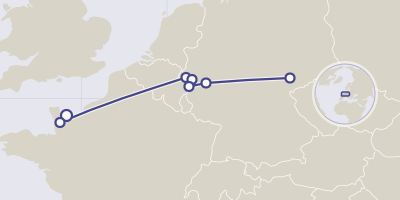
On 26 February 1815 Napoleon slipped away from Elba with some 1,000 men. Within a month he was back in the Tuileries, and by mid-July he had surrendered to the Royal Navy.
The route follows him stop by stop: his villa on Elba, the landing at Golfe-Juan, the meeting at Laffrey and the entry into Grenoble on the Route Napoléon, the Tuileries, the farms of Hougoumont and La Haye Sainte at Waterloo, then Malmaison and Île d'Aix, where his journey ended. The pins at Golfe-Juan and Grenoble mark the towns, not exact spots.
In Indiana Jones and the Great Circle (MachineGames, 2024), set in 1937, the trail of a stolen mummified cat runs from the Vatican and Giza to Shanghai and Sukhothai. Indy races the Nazi archaeologist Emmerich Voss around this "Great Circle" of sacred sites — a story Todd Howard conceived for the game.
The circle and its secret are pure adventure fiction, but its stops are real: the Vatican, Giza, wartime Shanghai, the ruined Thai capital of Sukhothai and the ziggurat of Ur. The designers rebuilt them from books and photographs as they would have looked in the 1930s. This route follows the main story.
The Motorcycle Diaries follows Ernesto Guevara and Alberto Granado's 1952 journey from Buenos Aires across South America — Valparaíso, the Chuquicamata copper mine, Machu Picchu, the San Pablo leper colony on the Amazon — to Caracas. Their overloaded Norton died in Chile; the poverty they saw on the way changed Guevara.
Guevara's diary of the trip, published decades later as The Motorcycle Diaries, records how poverty, exploited miners and the lepers they worked with changed him; within a few years he was "Che", a leader of the Cuban Revolution. The route follows the journey from both men's accounts as summarised by historians.
On a Sunday evening in May 1857 Indian soldiers of the East India Company's army mutinied at Meerut and rode for Delhi. Within weeks much of northern India was in revolt — soldiers, princes dispossessed by the Company, and villagers with their own grievances. It took the British more than a year to crush it, and afterwards the Company itself was abolished and India placed under the Crown.
The rebellion goes by many names, from the Sepoy Mutiny to the First War of Independence. It was not one army on one road but a chain of uprisings, and the route visits its main centres in order: Meerut, Delhi, Kanpur, Lucknow, Jhansi, Kalpi and Gwalior. Both sides committed atrocities against civilians, and the texts name them plainly.
In October 1934 the Chinese Communists' main army, beaten by Chiang Kai-shek's Nationalists, broke out of its base in Jiangxi and fled west. A year and some 9,000 kilometres later, after river crossings under fire, snow passes and a high-altitude swamp, a few thousand survivors reached northern Shaanxi. On the way, Mao Zedong rose to lead the party, and the retreat became its founding legend.
The route follows the Central Red Army, the best-known of several Long March columns, in date order. Official histories have polished some episodes, and historians still argue about how much fighting there was at Luding Bridge; the texts note where accounts disagree. Most stops now have memorials and museums.
The Boshin War ran from Kyoto to Hakodate in eighteen months: the battlefield at Toba, Edo Castle, the hill of Ueno, Aizu's castle and Goryōkaku. In January 1868 the young emperor was declared ruler in fact as well as name, ending more than 250 years of Tokugawa rule, and the last shogun's supporters fought on until a breakaway republic made its last stand.
The route follows that war in six places, all of them visitable: the battlefield at Toba, Edo Castle, the hill of Ueno, Aizu's castle and the hill where its teenage soldiers died, and Goryōkaku. Dates are given in the Western calendar, converted from the Japanese lunar dates used at the time.
Barcelona, 1945. A bookseller leads his ten-year-old son Daniel through a dark alley off the Ramblas to the Cemetery of Forgotten Books, a secret library where every child may adopt one book. Daniel chooses a novel by Julián Carax — and discovers that someone has spent years hunting down and burning every other copy.
Carlos Ruiz Zafón's 2001 bestseller is a love letter to the old city, and its mystery runs through real streets: the Ramblas, the Gothic Quarter, the Ribera, Tibidabo and Montjuïc. The library, the bookshop, the hospice and the Aldaya mansion are invented, so those pins mark the streets where Zafón put them; the café, squares and castle are real and open to visitors.