Willy Wonka & the Chocolate Factory (1971) was shot in Germany: Wonka's factory gates are a Munich gasworks, the Chocolate Room was built at Bavaria Studios, and the final flight over town is footage of Nördlingen.
The route follows the film in story order, from Bill's Candy Shop and Charlie Bucket's street to the factory gates, the Chocolate River set and the glass Wonkavator. Some pins mark only a street, and the Chocolate Room was a studio set.
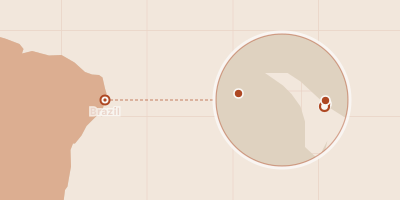
The Secret Agent (O Agente Secreto) is set in Recife during the 1977 carnival and was filmed on location in the city: Rua da Aurora, the Cinema São Luiz, the Capibaribe River and Parque 13 de Maio, plus the Federal University of Pernambuco campus. Director Kleber Mendonça Filho follows Armando, a former professor on the run in the Brazilian military dictatorship.
The route walks the film's carnival week, from the parade street to the shark, the cinema and the park where the Hairy Leg legend, based on real newspaper reports, takes hold.
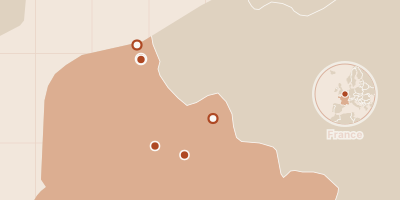
Welcome to the Sticks (Bienvenue chez les Ch'tis) is set in Bergues, near Dunkirk, and filmed there, with scenes in Lille, Lens, Malo-les-Bains and Bruay-la-Buissière.
A post-office manager from the south is sent north for two years and finds the warmest welcome of his life. The route follows the film from the café where Philippe crashes his bike to the belfry where the love story ends.
Gran Turismo, Forza and Assetto Corsa race on real circuits: the Nürburgring Nordschleife, Spa-Francorchamps, Monza, Le Mans, Suzuka and Laguna Seca.
This route lists six tracks you can drive in racing games, with what each game does with them and the real circuit behind the screen. Game appearances differ by title and year.
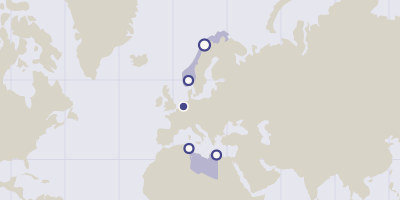
Battlefield V sends you to Narvik in Norway, Tobruk in Libya, Kasserine Pass in Tunisia, Rjukan in Norway and the Nijmegen railway bridge in the Netherlands, all real places of the war.
The game's prologue jumps between fronts, and the "Nordlys" war story follows a Norwegian resistance fight over heavy water. This route lines up those settings with the real history of each place. Only the places named in the game's own plot summary are included.
Shakushain's War (1669) was the Ainu uprising against the Matsumae clan of Japan, fought between Shinhidaka, Matsumae Castle and Kunnui in Hokkaido.
The route follows the revolt from the feud on the Shibechari River to the mediation at Matsumae, the fighting at Kunnui and the leader's death at Piypok. It ends with the Shakushain statue in Shinhidaka. Several sites are approximate and are marked as such.
Leif Erikson's voyage runs from Eiríksstaðir in Iceland through Brattahlíð in Greenland to L'Anse aux Meadows in Newfoundland, the only confirmed Norse site in North America outside Greenland.
The route follows the sagas: a boyhood on Erik the Red's farms, a crew of thirty-five, and the lands Leif named Helluland and Markland. The saga lands are only traditionally identified, so their pins are approximate regions rather than exact spots.
York has been defended by walls since Roman times, and this walk strings together six places around them: the Multangular Tower, York Minster, Clifford's Tower, Micklegate Bar, the Shambles and Walmgate Bar.
Each stop is a moment in the city's story, from a Roman fort built around 71 AD to a siege in 1644.
Europe's Thirty Years' War runs from a window in Prague Castle to the town halls of Münster and Osnabrück. This route follows it through the battlefields of White Mountain, Magdeburg, Breitenfeld, Lützen and Nördlingen — from the defenestration of 1618 to the peace of 1648.
The stops are in the order the war happened: the castle window in Prague, the hill where Frederick V's army broke, the square where 27 rebel leaders were executed, then the sacked city of Magdeburg, Gustavus Adolphus's victories at Breitenfeld and Lützen, the Swedish collapse at Nördlingen, and the two Westphalian town halls where the treaties were finally signed. Nine places, thirty years, one continuous story.
The Karate Kid was filmed across Los Angeles's San Fernando Valley: Daniel's South Seas apartments in Reseda, the street in Canoga Park where Miyagi's house stood, the beach at Leo Carrillo and the final tournament at the Matadome in Northridge.
The route follows Daniel's arrival in California, from the Reseda apartment where he and his mother arrive, past West Valley High and the Cobra Kai dojo, to Ali's house in Encino, the go-karts at Golf N' Stuff and the lake in the Chatsworth preserve where Miyagi teaches balance. Most of the places still stand, though Miyagi's house was demolished.
Office Romance (1977) is set in Moscow, and its statistical office is assembled from three places: the Petrovka 3/6 facade, Mosfilm studio sets and a rooftop in Bolshoy Gnezdnikovsky Lane.
Eldar Ryazanov's comedy follows a shy statistician and his stern boss, with a city chosen carefully to show who lives where.
This route visits the film's real locations, the studio where the office was built, and the homes and station that give each character a place in Moscow.
Jaws was filmed on Martha's Vineyard, which stood in for Amity Island: Edgartown, State Beach and the Jaws Bridge.
Steven Spielberg began shooting there on 2 May 1974, using the island's whaling town, its barrier beaches and the little Chappaquiddick ferry as the summer resort the shark terrorises. This route follows the film from the opening bonfire at South Beach to the last shot off Cape Poge Light. In between are Brody's beach-closing signs at Water and Main, the Kintner attack at Joseph Sylvia State Beach, the shark's run under the American Legion Memorial Bridge into Sengekontacket Pond, Quint's vanished workshop at Menemsha and the open water between Oak Bluffs and East Chop where the Orca hunts.
Gereon Rath arrives from Cologne in 1929 to a Berlin of police headquarters, cabarets and armed conspiracies. The series follows him and Charlotte Ritter from the May Day riots through the fall of the Weimar Republic to Hitler's first weeks in power, mixing real streets with sets and stand-ins.
This route visits the places the story names and the buildings that played them: the Rotes Rathaus as the police headquarters, the real Moka Efti, the Anhalter goods yard, the Hermannplatz U-Bahn, a Duisburg steelworks, the Theater am Schiffbauerdamm, Schloss Drachenburg and the Volksbühne. Some stops are exact; others are stand-ins far from Berlin.
Ragnar Lothbrok goes from farmer to king in History's Vikings, a series that sprints through more than a century of Viking Age history and the sagas. This route follows the places of its events in story order, setting what the show does against what history and the sagas say. The series itself was filmed in Ireland.
From a raid on Lindisfarne to Paris under siege, a snake pit near York, a Mediterranean raid, a colony in Iceland and a court in Kiev and a voyage west, with the fictional village of Kattegat left unpinned.
Port Royal and Tortuga were built on a quiet St Vincent bay, Cannibal Island is Dominican rainforest, and a private Bahamian cay sits behind a famous duel.
This route follows the shoots from St Vincent in 2002 through Dominica in 2005 to Grand Bahama, where the ships were filmed in a hurricane season. Most pins mark areas, not exact sets; the sets themselves were built and taken down.
In 1893 Fridtjof Nansen froze a purpose-built ship into the Arctic ice on purpose. His bet was that the pack would carry it across the top of the world, and the sceptics called it self-destruction.
This route follows the voyage from Vardø to the pack ice, the drift, the sledge dash to 86°14′N, a hard winter in a stone hut and a lucky meeting at Cape Flora, ending at the museum where the ship rests. Ocean and ice stops have no map pin.
A Russian student expelled from university in 1864 ends up living among people in north-eastern New Guinea who had never seen a European. Nikolai Miklouho-Maclay was a zoologist and anthropologist, an early follower of Darwin who refuted the view that human races were different species.
The route follows him from Haeckel's Jena and the Canary Islands to Astrolabe Bay, the Sydney research station he founded, and his grave in St Petersburg. Most pins are approximate: the sources name regions, not camps.
Stieg Larsson's Millennium trilogy is a Stockholm novel before it is a thriller: journalist Mikael Blomkvist and hacker Lisbeth Salander live, drink and work on Södermalm, the island district where much of the action takes place.
This route walks the real addresses behind the books, from Blomkvist's home on Bellmansgatan to Lisbeth's penthouse on Fiskargatan, and ends at the City Museum that runs the official tour. Some addresses are private homes, so most are seen from the street.
On 26 August 1768 the Endeavour left Plymouth with 94 people aboard, bound for Tahiti to watch Venus cross the Sun. Almost three years later she anchored off the Kent coast again, having reached New Zealand and the east coast of Australia, and with many of her people lost to disease on the way home.
The route follows James Cook's own journal and modern accounts through ten stops, from the anchorage at Plymouth to the Great Barrier Reef and Batavia. Dates follow modern accounts, which sometimes differ by a day from the journal.
Forza Horizon 5 drops the Horizon Festival into a fictionalised Mexico, on a map 50% larger than Forza Horizon 4's. Creative director Mike Brown calls Mexico almost the whole world in one country: snowy peaks, tropical jungles, epic canyons, beautiful beaches, ancient architecture and modern cities.
This route visits seven real places the game recreates, from a sea arch at the tip of Baja to a canyon with a train, and says what the game does at each. The map is a condensed Mexico, so the pins mark the real sites, not their positions in the game.
The Hound of the Baskervilles takes Sherlock Holmes across Dartmoor: Cabell's tomb at Buckfastleigh, the ten-thirty train from Paddington, Princetown's prison and Hound Tor. A spectral hound stalks the moor.
The route runs from the grave that may have inspired the legend and the ten-thirty train from Paddington to the convict prison at Princetown, the mire, the tors and the Stapletons' house. Baskerville Hall and Merripit House exist only in the book, so their pins mark a stand-in or nothing at all.
A shy waitress at a Montmartre café staffed and frequented by eccentrics finds a metal box of childhood memorabilia hidden behind a bathroom tile and gets drawn into the lives around her: practical jokes on the nasty greengrocer Collignon, street scenes described aloud to a blind man, and a dropped photo album belonging to Nino, a collector of discarded photo-booth pictures.
The route follows her Paris from the café on Rue Lepic to the photo booths of the Gare de l'Est and the blue arrows on the steps of the Sacré-Cœur, taking in skipping stones on the Canal Saint-Martin and a surge of love on the Pont des Arts along the way. Nearly every stop is a real place you can visit.
Forza Horizon 4, released on 2 October 2018, turns Great Britain into one giant racetrack: an open world with condensed representations of Edinburgh, the Scottish Highlands, the Lake District and the Cotswolds, where seasons change every week and Derwentwater freezes hard enough to drive across. Microsoft counted 24 million players by November 2020, and Polygon found the game world a theme-park version of England where everything has "the faint whiff of an idealised 1950s about it, a place of ordered pub gardens and rosebushes".
This route drives the real Britain behind the game, north to south: Edinburgh's Old Town, Bamburgh Castle on its coastal crag, three Lake District stops at Derwentwater, Ambleside and Tarn Hows, and the honey-coloured village of Broadway in the Cotswolds. Every stop can be visited today.
Before the Minotaur, there was the road. Theseus grew up in Troezen, never knowing his father; when he was old enough to lift a great stone and take the sword and sandals hidden beneath it, he set out to find him in Athens. The safe way was by sea. He chose the coast road round the Saronic Gulf instead, which was infested with bandits, and dealt with each one in the way they had treated travellers.
The route follows the six labours of that journey as Plutarch tells them in his Life of Theseus, written around AD 100 from much older tales. The places are real; the giants and robbers belong to myth, and several sites are traditional guesses.