Books
In Search of the Castaways: Captain Grant's 37th Parallel
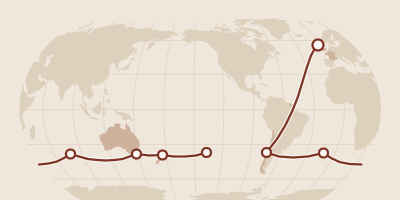
Jules Verne's In Search of the Castaways (Captain Grant's Children) follows the 37th parallel south from Dumbarton in Scotland to Talcahuano in Chile, Tristan da Cunha, Amsterdam Island, the Snowy River in Australia and Lake Taupo in New Zealand.
This route follows Lord Glenarvan's yacht Duncan and the search for Captain Grant, ending on Tabor Island. Most pins are approximate, since the book gives a latitude and a landscape rather than street addresses.
Contains major story spoilers.
Timeline & locations
What do the location labels mean?
- Approximate
- The right area — a town, park or district — but not a precise spot.
- Fictional
- The place exists only in the story; any pin marks a real-world stand-in or inspiration.
The expedition is born in Scotland. Lord Glenarvan, of Malcolm Castle at Luss in Dumbartonshire, decides to search for Captain Grant himself after a bottle message turns up. When the crew of his yacht Duncan hear where they are bound, "the rocks of Dumbarton rang again with their joyous outbursts of cheers." Dumbarton Rock is a 240-foot basalt plug above the Clyde, topped by Dumbarton Castle.
Location precision: The novel names Dumbarton, not a quay; the pin marks Dumbarton Rock, the landmark on the Clyde.
Visitor guidance: Dumbarton Castle stands on the rock above the town.
Sources
- Dumbarton Rock
- Locator:
- Lead
- In Search of the Castaways
- Locator:
- Full text
- Dumbarton Rock
Landfall in South America. The Duncan steams into the bay of Talcahuano, which Verne calls "a magnificent estuary, twelve miles long and nine broad." A chapter of the novel is set in this bay, which makes Talcahuano the Chilean stop of any Captain Grant's Children route.
Location precision: The pin marks the town of Talcahuano on its bay, not a specific spot in the chapter.
Visitor guidance: Talcahuano is a town on the bay.
Sources
- In Search of the Castaways
- Locator:
- Full text
- In Search of the Castaways
- Locator:
- Synopsis
- Talcahuano
- Locator:
- Culture
- In Search of the Castaways
The 37th parallel crosses the Atlantic, and Paganel argues that the Duncan should stop "a day or two at the Tristan d'Acunha Isles and the Amsterdam", since both lie on the route. The group explores Tristan da Cunha in search of the wrecked Britannia. In reality it is the most remote inhabited place in the world, and the only way to travel to or from Tristan is by ship.
Open area inGoogle MapsApple MapsOrganic MapsOpenStreetMap-37.11500, -12.28500Not currently visitableLocation precision: The pin marks the main island, not a landing place described in the book.
Sources
- Tristan da Cunha
- Locator:
- Lead
- In Search of the Castaways
- Locator:
- Full text
- In Search of the Castaways
- Locator:
- Synopsis
- Tristan da Cunha
Next comes Amsterdam Island, which Verne places at 37 degrees 47 minutes of latitude and 77 degrees 24 minutes of longitude. Its high cone is visible fifty miles off in clear weather. The real island, part of the French Southern and Antarctic Lands, reaches 867 metres at Mont de la Dives. It is another stop on the 37th parallel where the searchers hope to find a trace of Captain Grant.
Open area inGoogle MapsApple MapsOrganic MapsOpenStreetMap-37.83333, 77.55000Not currently visitableLocation precision: The pin marks the island's centre; the book gives no landing spot.
Sources
- Amsterdam Island
- Locator:
- Geography
- In Search of the Castaways
- Locator:
- Full text
- In Search of the Castaways
- Locator:
- Synopsis
- Amsterdam Island
Crossing Australia, the party hopes to camp on the banks of the Snowy River, "an important river which throws itself into the Pacific, south of Victoria." The real Snowy River rises on the slopes of Mount Kosciuszko, Australia's highest mainland peak, and runs through the Alpine National Park and the Snowy River National Park in Victoria before reaching Bass Strait.
Location precision: The novel gives the river's course, not one campsite; the pin marks the river in Victoria.
Visitor guidance: The Snowy River National Park in Victoria protects much of the river's course.
Sources
- In Search of the Castaways
- Locator:
- Full text
- Snowy River
- Locator:
- Lead
- In Search of the Castaways
The search ends up on New Zealand's North Island, where the travellers end up as captives. At sunset the captives are led back to their prison, "just as the sun was sinking beyond Lake Taupo." In reality Lake Taupo is New Zealand's largest lake by surface area, a crater lake in the caldera of a volcano.
Location precision: The scene is placed near the lake; the pin marks the lake itself.
Visitor guidance: The town of Taupo lies on the lake's northeastern shore.
Sources
- In Search of the Castaways
- Locator:
- Full text
- In Search of the Castaways
- Locator:
- Synopsis
- Lake Taupo
- Locator:
- Lead
- In Search of the Castaways
The Duncan sights "a low, elongated island, scarcely raised above the waves, and looking like an enormous whale." It is Maria Theresa on English charts and Tabor on French ones, and it shelters Captain Grant. Ayrton, the renegade, is left in Grant's place. The real Maria Theresa Reef appears to be a phantom reef: no island has been found there.
Real-world stand-in inGoogle MapsApple MapsOrganic MapsOpenStreetMap-36.83333, -136.65000Not currently visitableLocation precision: The island in the book is invented; the pin marks the reef position Wikipedia lists, which probably does not exist.
Sources
- In Search of the Castaways
- Locator:
- Full text
- Maria Theresa Reef
- Locator:
- Lead
- In Search of the Castaways
- Locator:
- Synopsis
- In Search of the Castaways