Books
Commissaire Dupin: Bannalec's Brittany Crime Novels
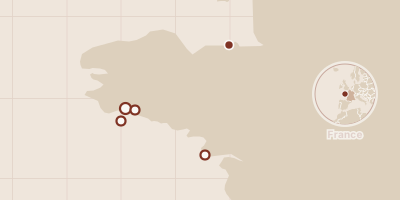
Commissaire Dupin is set in Brittany: Jean-Luc Bannalec's detective, a Paris policeman transferred to Concarneau, solves murders in Pont-Aven, on the Glénan islands and in the Guérande salt marshes.
This route follows the first three novels, Bretonische Verhältnisse, Bretonische Brandung and Bretonisches Gold, then looks at how the TV series borrows other places such as Saint-Malo. Settings in the story are partly invented.
Timeline & locations
What do the location labels mean?
- Exact
- The pin marks the actual place where it happened or was filmed.
- Approximate
- The right area — a town, park or district — but not a precise spot.
Commissaire Georges Dupin is the Paris detective transferred to Concarneau, the port in Brittany where Jean-Luc Bannalec's crime novels are based. In the TV adaptation the police station of episodes 1 and 2 is really a theatre, the Centre des Arts de Concarneau, and its interior shots look out over the sea. The novels never reduce Concarneau to one building, so this stop marks the harbour front and the town as Dupin's home ground.
Location precision: Dupin's Concarneau is a whole town and the TV police station is a theatre, so the pin marks the harbour front rather than one building.
Sources
- Jean-Luc Bannalec
- Locator:
- Krimiautor
- Kommissar Dupin
- Locator:
- Drehorte
- Jean-Luc Bannalec
Dupin's first case, Bretonische Verhältnisse, opens in Pont-Aven, where hotel manager Pierre-Louis Pennec is found bloodied in the bar of the Hôtel Central. In the film the hotel once housed Gauguin and other artists, and the stolen painting is an invented second version of his Vision after the Sermon. Pont-Aven's artists' colony is real, which is why the plot feels so local.
Location precision: The novel's Hôtel Central is fictional; the pin marks Place Paul Gauguin in Pont-Aven.
Sources
- Bretonische Verhältnisse – Ein Fall für Kommissar Dupin
- Locator:
- Das Buch, Handlung
- Kommissar Dupin: Bretonische Verhältnisse
- Locator:
- Handlung
- Bretonische Verhältnisse – Ein Fall für Kommissar Dupin
In the second case, Bretonische Brandung, a kayaker finds three bodies on the beach of an uninhabited island ten nautical miles off Concarneau. Next door, St. Nicolas is the only inhabited island of the archipelago, with a sailing school and the restaurant Les Quatre Vents. The TV version began shooting on 6 May 2014, partly on the Glénan islands, so the archipelago is the nearest real stand-in for the story's setting.
Location precision: The story's island is not named in the sources; the pin marks the Glénan archipelago where the TV version was shot.
Sources
- Bretonische Brandung
- Locator:
- Handlung, Dreharbeiten
- Bretonische Brandung
Dupin's third case, Bretonisches Gold, takes him outside his own district. A journalist, Lilou, suspects that something illegal is being done with salt on the Guérande peninsula. Dupin drives to the salt works to meet her and is shot at in the dark instead. In the TV episode the police station is filmed in the port of La Turballe, on the same stretch of coast.
Location precision: The salt works of the story are not tied to one farm; the pin marks the Guérande salt marshes.
Sources
- Kommissar Dupin
- Locator:
- Drehorte
- Bretonisches Gold
- Locator:
- Handlung
- Kommissar Dupin
The series spreads Dupin's Brittany well beyond Concarneau by borrowing other buildings in Brittany as his police headquarters. In episode 9 the Palais du Grand Large in Saint-Malo plays the station, while episode 6 uses the Centre Philippe Joppé in Trébeurden. The stories keep Dupin based in Concarneau; the camera simply travels along the coast.
Sources
- Kommissar Dupin
- Locator:
- Drehorte
- Kommissar Dupin