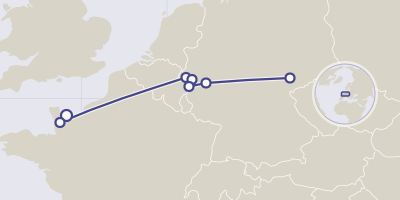
In the summer of 1588 a Spanish fleet appeared off Cornwall with a plan to join Parma's army. Beacons carried the news to London, the English fleet came out of Plymouth, and within weeks fireships, a day of heavy gunnery and autumn storms had ended the plan.
The route follows the campaign through seven places, from the first sighting to a beach in County Sligo where three ships broke up. Most of the fighting was at sea, so the pins mark the nearest coast landmark, and the story of Drake and his game of bowls at Plymouth is labelled as legend.
On 26 August 1768 the Endeavour left Plymouth with 94 people aboard, bound for Tahiti to watch Venus cross the Sun. Almost three years later she anchored off the Kent coast again, having reached New Zealand and the east coast of Australia, and with many of her people lost to disease on the way home.
The route follows James Cook's own journal and modern accounts through ten stops, from the anchorage at Plymouth to the Great Barrier Reef and Batavia. Dates follow modern accounts, which sometimes differ by a day from the journal.
Hemingway wrote A Moveable Feast about his poor, happy early years in 1920s Paris, working from notebooks he had left in trunks at the Ritz in 1928. It was published in 1964, after his death.
This route walks the memoir's Paris: the flat on the rue du Cardinal-Lemoine, Gertrude Stein's salon, Sylvia Beach's bookshop, the cafés of Montparnasse and Saint-Germain, and the Ritz where the notebooks resurfaced. Hemingway himself said the book may be read as imagination, so treat its scenes as a memory, not a record.
Thelma & Louise runs from Arkansas to the Grand Canyon, but it was filmed in California and Utah, around Long Beach, Los Angeles, Arches and Dead Horse Point. One violent night at a roadhouse bar turns a weekend trip into a run for Mexico.
This route follows the story in film order through six real places: a Long Beach bar, a Los Angeles motel, a Colorado general store, the desert at Arches, the ghost town of Cisco and the cliff edge at Dead Horse Point. Almost all of them stand in for somewhere else, and each stop says where.
Private First Class Ronald "Red" Daniels lands on Omaha Beach on D-Day with the 1st Infantry Division and fights his way into Germany with one squad, until a friend is captured and the search for him ends at a concentration camp. Call of Duty: WWII is a 2017 game by Sledgehammer Games, and its campaign is set among real battles.
The route follows the missions in order: Omaha Beach, Marigny, Aachen, the Hürtgen Forest, the Ardennes, the bridge at Remagen and Berga, with the real battle each one echoes. Pins mark battle areas, not a mission's exact street.
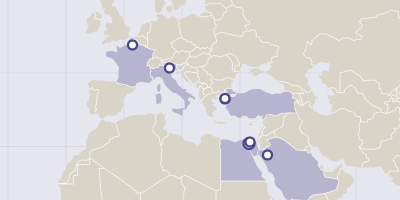
Battlefield 1 sends its soldiers across the Western Front, the Italian Front, Gallipoli and Arabia. This route follows the War Stories and multiplayer maps that go with them, from the Suez Canal in 1915 to Monte Grappa in October 1918.
Stops run in the order of the real battles, not the game's menu. The maps are the game's own reconstructions, so each pin marks the real ground behind a level, and one stop is a village the game invented.
Forza Horizon 5 drops the Horizon Festival into a fictionalised Mexico, on a map 50% larger than Forza Horizon 4's. Creative director Mike Brown calls Mexico almost the whole world in one country: snowy peaks, tropical jungles, epic canyons, beautiful beaches, ancient architecture and modern cities.
This route visits seven real places the game recreates, from a sea arch at the tip of Baja to a canyon with a train, and says what the game does at each. The map is a condensed Mexico, so the pins mark the real sites, not their positions in the game.
HBO's Game of Thrones prequel was filmed primarily in the United Kingdom, and its Velaryon world is Cornish: the island seat of Driftmark is a tidal island, and the Stepstones war camp is a cove on the Lizard peninsula. For the capital and the free city of Pentos, the crew went to western and southern Spain.
The route follows the story from the Stepstones war (season 1, episode 3) through the Driftmark episodes to King's Landing in season 2. Sources do not name the exact streets used in Cáceres, so that pin marks the old town.
On 20 September 1519 five ships and about 270 men sailed from Spain to find a western sea road to the Spice Islands. Magellan died in the Philippines, but Juan Sebastián Elcano brought the Victoria home three years later with eighteen survivors and 26 tons of spices, having sailed all the way around the world.
The route follows the voyage from the mouth of the Guadalquivir past Port St. Julian, through the strait and across the Pacific to the Moluccas, then home past the Cape of Good Hope. Anchorages are often unrecorded, so most pins mark the nearest known place; the dates come from Pigafetta's journal and modern accounts.
In AD 79 a mountain above the Bay of Naples blew apart. Pliny the Younger watched from Misenum across the water, lost his uncle, the admiral Pliny the Elder, to the eruption, and years later described it for the historian Tacitus in two letters: the only eyewitness account that survives.
The route follows the eruption in the order of its events, from the mountain's first column to Pompeii, Herculaneum, the beach at Stabiae and back to Misenum. Pliny's letters never mention Pompeii or Herculaneum, so those stops come from archaeology. The traditional date is 24 August, but newer evidence points to the autumn.
Fitzgerald set The Great Gatsby on two invented peninsulas, West Egg and East Egg, but he built them from the Long Island he knew in Great Neck, where he lived from October 1922. Behind the glamour sit a dump, a station and a hotel suite that were all real.
This route follows Nick from the Eggs through the valley of ashes, Penn Station, the Queensboro Bridge and the Plaza Hotel. The Eggs, the valley and Gatsby's house are invented, so their pins mark the real places the novel is read against.
L.A. Noire rebuilds Los Angeles in 1947 with fanatical care: the studio mapped the real streets, modelled building interiors on the originals, and filled the map with the city's landmarks. Detective Cole Phelps drives that recreation through traffic, homicide, vice and arson cases, and much of the city he moves through is still standing.
This tour follows the real places behind the game's map, from Union Station and Bunker Hill to Wilshire's art deco and the Hollywood movie palaces, then down to the river where the story ends. Every pin marks a real site the game put on its streets.
Bond's final outing opens beside a lake in Norway and closes on an island in the Faroe Islands, with a long detour through southern Italy and a retirement in Jamaica in between. The story's geography is real: Matera's cave lanes, a bridge over the Gravina gorge, a railway station at Sapri, a waterfront house at Port Antonio, the Atlantic Ocean Road and the cliffs of Kalsoy.
The route follows the film's order — the frozen-lake flashback, the grave and the bridge, the Matera car chase, the farewell at Sapri, five quiet years in Jamaica and the 'Cuban' harbour that is really Port Antonio, then the Norway drive and the villain's island in the Faroe Islands. The beach house in Jamaica and the lake house in Norway were sets, both since dismantled.
A feather drifts down onto a bench in Savannah, and a man starts to talk. His life unrolls across half a century of American history, from an Alabama childhood to the jungles of Vietnam, the Lincoln Memorial, the Watergate and a bayou shrimp boat.
This route follows the film in order, from the bench on Chippewa Square to the lighthouse in Maine and the desert where the running finally stops. It marks the real locations and the real stand-ins, since the fictional town of Greenbow and the Vietnam jungle were both played by South Carolina.
Vice City is Miami with the labels peeled off. The 2002 game, set in 1986, follows gangster Tommy Vercetti's rise to power after prison, from an ambushed drug deal to the takeover of a drug lord's mansion. The developers built the world from extensive field research in Miami, and the plot draws on the city's real Cubans, Haitians and biker gangs.
This route pins six real places behind the fiction: the port of the opening ambush, the Ocean Drive strip behind Ocean Beach, Little Havana and Little Haiti with their warring gangs, Downtown's biker ground, and the private island behind the Starfish Island mansion. Every pin marks the real stand-in, and each stop names the game location it doubles for. One caveat: Vice City itself is fictional, so expect the flavour of 1980s Miami rather than a street-by-street copy.
Mamma Mia! sets fictional Kalokairi on Skopelos and Skiathos: the town below Villa Donna, the Old Port, Glysteri's rock jump and the wedding chapel of Agios Ioannis Prodromos. Sophie has secretly invited three possible fathers to her wedding.
Five stops on the real islands behind Kalokairi, where principal photography took place from August to September 2007: the town below the villa's hill, the Skiathos harbour where two of the men arrive in identical cabs, the cove of the diary reading and the rock jump, the main beach set with its vanished bar and jetty, and the rock-top chapel of the wedding. One caveat: there is no Villa Donna to visit — the hotel was a Pinewood set.
Liberty City is New York with the labels peeled off. Grand Theft Auto IV rebuilds four of the boroughs, borrows New Jersey for the state across the river, and copies in the Statue of Liberty, the Coney Island Cyclone, the Manhattan Bridge, Times Square and the Empire State Building — then renames nearly all of them, so the game's Liberty statue holds a takeaway coffee instead of a torch. The story is set in 2008, the year the game arrived.
This route pins nine real places behind those names: the triumphal arch at Brooklyn's Grand Army Plaza, the wooden Cyclone at Coney Island, the Manhattan Bridge as the Algonquin Bridge, Brighton Beach as Hove Beach, the surviving 1964 World's Fair site in Queens, and three Manhattan landmarks — Middle Park, Star Junction and the Rotterdam Tower. Each stop names the in-game location it stands in for. One caveat: Rockstar deliberately avoided a precise recreation of New York, so expect the landmarks, not the street plan.
Indiana Jones and the Last Crusade (1989) sends Indy from a Boy Scout outing in the Utah desert to the rock-cut façade of Petra, chasing the Holy Grail and his missing father. Three trials guard the cup at the end. The film borrows its scenery from half of Europe, the Middle East and the American West.
Nine stops, most of them still standing: the Arches canyons of the opening, the church façade in Venice's Campo San Barnaba that plays the library, an Eifel castle dressed as Brunwald, a San Francisco building that played Berlin's Tempelhof airport, the Almería beach where Henry brings down a fighter with an umbrella, a Granada station playing Alexandretta, the Tabernas tank chase, the Treasury that fronts the Grail's temple, and the Texas sunset the film ends on. Dates are story time; filming ran from May 1988 to early 1989.
James Joyce's Ulysses is one ordinary day, 16 June 1904, in Dublin, told in eighteen episodes through Leopold Bloom, a Jewish advertisement canvasser, and Stephen Dedalus, who starts the day in a tower by the sea. This route walks the day in the order the novel runs it: from the Martello tower at Sandycove where it opens to Howth Head, where Molly Bloom's memory ends it with a yes.
Almost every stop is a place you can still stand in: the tower where Joyce stayed in 1904, the strand Stephen walks, the street of the chemist's where Bloom buys soap, the cemetery of the funeral, the pub where he eats his sandwich, the library where he passes between Stephen and Mulligan, the quay of the Ormond Hotel and the maternity hospital. The last stop is a recollection rather than a setting: the novel never says where on Howth Head the two of them lay.
Just after midnight on 6 June 1944, gliders landed beside a canal bridge at Bénouville, and by mid-morning Allied troops were ashore on five code-named beaches — Utah, Omaha, Gold, Juno and Sword — along the Normandy coast. This route visits the places where that day was won and lost, and what stands there today.
It starts with the glider coup de main at Pegasus Bridge, then runs along the coast from west to east: the museum built on the sand at Utah, the Rangers' climb at Pointe du Hoc, the American cemetery above Omaha, the concrete of the Mulberry harbour at Arromanches, the Canadian centre behind Juno and the Grand Bunker above Sword.
A jazz pianist and an aspiring actress argue through the windows of their cars in a Los Angeles traffic jam, and the city itself becomes the romance: a night on a funicular, a broken projector, a kiss in a planetarium. Damien Chazelle shot La La Land in 40 days across Los Angeles in the summer of 2015, and most of the places the couple reaches for are still there.
This route follows Mia and Sebastian from the freeway ramps where they shout at each other to the jazz bar Seb finally gets to open — the 105/110 connector ramps, the Burbank café on the Warner lot, the Lighthouse Café and the pier beside it, the Rialto in South Pasadena, Griffith Observatory and Angels Flight. The film rarely names its own locations, so a few pins mark the real building that stood in for the one on screen.
Los Santos feels like Los Angeles because it is Los Angeles, compressed. Grand Theft Auto V squeezes the city's most famous miles into one playable map, from a hillside sign to a Venice boardwalk.
This tour visits seven real stand-ins behind the fiction: the hillside sign, a movie palace, a luxury shopping street, an observatory, a pier, a beach and a towered folk-art park. Every pin marks the real place, and each stop names the game location it doubles for. Expect crowds at the beach and on Hollywood Boulevard, and quiet at the towers.
Bond is shot off a train in Turkey and left for dead, while a former agent with a grudge against M attacks MI6 from within. Sam Mendes's 2012 film — the 23rd Bond and the highest-grossing of them all — was shot between November 2011 and May 2012 in London, Turkey and Scotland, with much of "Shanghai" and "Macau" faked in England.
The route follows the story from the rooftops of the Grand Bazaar to the railway viaduct where Bond falls, a beach bar in Fethiye, MI6's real headquarters, a Turner in the National Gallery, an abandoned Japanese island, a disused Tube platform and the glen where Bond takes M home. Skyfall Lodge itself was a set in Surrey.
King Pelias sends his nephew Jason to fetch the Golden Fleece from Colchis, at the far end of the Black Sea, hoping he will never come back. Jason builds the Argo, gathers the greatest heroes of his day, Heracles among them, and sails east. Apollonius of Rhodes told the voyage in his Argonautica in the 3rd century BC, and he filled it with real coasts, harbours and local legends.
This route follows the outward voyage to Colchis. The way home is left out: ancient writers sent the Argo back by wildly different routes, up rivers into the Adriatic and even across Libya. The heroes and the fleece are myth; the shores, islands and ancient cities are real. Quotations are from R. C. Seaton's 1912 translation.