On the night of 18 April 1775 Paul Revere was rowed across the Charles River, got a horse in Charlestown and rode west to warn John Hancock and Samuel Adams that British troops were on the move. He left three accounts of that night, and this route follows them rather than the poem.
It runs through nine places, from his house in North Square and the lanterns at Old North Church to the pasture in Lincoln where a British patrol stopped him, and on to Concord, which Samuel Prescott reached without him. Where a spot is only traditional, the stop says so.
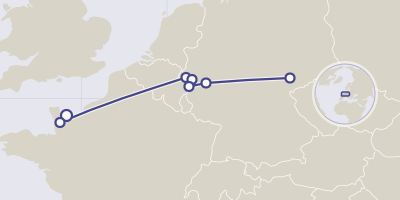
In December 1933, eighteen-year-old Patrick Leigh Fermor set off from the Hook of Holland to walk to Constantinople, carrying a few clothes, some letters of introduction, an anthology of English verse and a volume of Horace. He slept in barns and shepherds' huts, but gentry and aristocracy kept inviting him into their country houses. He wrote the journey up decades later in A Time of Gifts, Between the Woods and the Water and The Broken Road.
The route follows him through ten places the sources let us pin, from the Hook and a Stuttgart apartment to Melk, Vienna, Prague, the bridge into Hungary, an island on the Danube that now lies under water, Plovdiv and Istanbul. Many pins are approximate: the sources name a town, not the exact spot where he stood.
At 11:30 a.m. on 29 May 1953 Edmund Hillary and Tenzing Norgay stood on the summit of Mount Everest, the first people confirmed to have done so. They were part of a British expedition led by Colonel John Hunt, which in the end amounted to over four hundred men, including twenty Sherpa guides and 362 porters.
The route follows that expedition from winter training in Wales through Kathmandu, Thyangboche, Base Camp, the Khumbu Icefall, the Western Cwm and the South Col to the summit, then to the telegraph runner's stop at Namche Bazaar. Pins above Base Camp mark the terrain, not the exact camps of 1953.
A stranger who looks foreign joins two writers at Patriarch's Ponds, predicts a death, and Moscow's strangest spring begins. In Bulgakov's novel the devil, as Woland, visits Soviet Moscow with a retinue that includes the cat Behemoth and the henchman Azazello, while Margarita bargains with him for the Master.
The route follows the Moscow chapters in order: the ponds where it all starts, a writers' club, a haunted flat, a stage show, a flight of revenge, a ball, a terrace beside the Kremlin and a farewell on the Sparrow Hills. Several places are invented or only inspired by real ones, and each stop says which.
The Travels of Marco Polo runs from Venice and Acre to Kublai Khan's Xanadu, then south to Hangzhou and home again. In 1271 a seventeen-year-old Venetian set out with his father and uncle and did not come home for 24 years.
The route follows the book from Venice and Acre to the Persian Gulf, across the Pamir highlands and the desert to Kublai's summer and winter capitals, south to Hangzhou and the port of Zayton, and home again. Some of the roads are reconstructed by scholars, and Polo sometimes exaggerates, so each stop notes where the evidence is thin.
Hemingway wrote A Moveable Feast about his poor, happy early years in 1920s Paris, working from notebooks he had left in trunks at the Ritz in 1928. It was published in 1964, after his death.
This route walks the memoir's Paris: the flat on the rue du Cardinal-Lemoine, Gertrude Stein's salon, Sylvia Beach's bookshop, the cafés of Montparnasse and Saint-Germain, and the Ritz where the notebooks resurfaced. Hemingway himself said the book may be read as imagination, so treat its scenes as a memory, not a record.
Huck Finn fakes his own murder and, with Jim, who has run away from slavery, takes a raft down the Mississippi. Their goal is Cairo, where Jim would be a free man the minute he saw it. They miss it in the fog and drift on into slave country, past a feud, two con men and a farm with the book's last twist.
Twain built St. Petersburg from his boyhood town of Hannibal. Most places in the novel are invented, so each pin marks a real landmark or stand-in, and the Grangerfords' country and Bricksville stay off the map.
A retired detective with a fear of heights is hired to follow a friend's wife around San Francisco, because her husband fears she is possessed by Carlotta Valdes, a woman who died in 1857. Hitchcock's 1958 thriller was shot on location in San Francisco, at Mission San Juan Bautista, in Big Basin Redwoods State Park, at Cypress Point on 17-Mile Drive and at Paramount Studios in Hollywood.
This route follows the story in film order through nine places: a vanished restaurant, a Nob Hill apartment block, a mission cemetery and an art museum, a fort under the Golden Gate Bridge, a coastal kiss, a mission bell tower and a hotel with a green neon sign.
A young bear stows away from Peru, turns up at Paddington station and is taken in by the Brown family. Paul King's 2014 film follows him through a cosy London of antique shops and a gentlemen's club, while a taxidermist closes in.
Most of it was shot on real London streets. This route runs from the station to Primrose Hill, Portobello Road, Pall Mall and the Natural History Museum, with one caveat: the film's station front door is borrowed from Marylebone.
Private First Class Ronald "Red" Daniels lands on Omaha Beach on D-Day with the 1st Infantry Division and fights his way into Germany with one squad, until a friend is captured and the search for him ends at a concentration camp. Call of Duty: WWII is a 2017 game by Sledgehammer Games, and its campaign is set among real battles.
The route follows the missions in order: Omaha Beach, Marigny, Aachen, the Hürtgen Forest, the Ardennes, the bridge at Remagen and Berga, with the real battle each one echoes. Pins mark battle areas, not a mission's exact street.
Forza Horizon 5 drops the Horizon Festival into a fictionalised Mexico, on a map 50% larger than Forza Horizon 4's. Creative director Mike Brown calls Mexico almost the whole world in one country: snowy peaks, tropical jungles, epic canyons, beautiful beaches, ancient architecture and modern cities.
This route visits seven real places the game recreates, from a sea arch at the tip of Baja to a canyon with a train, and says what the game does at each. The map is a condensed Mexico, so the pins mark the real sites, not their positions in the game.
Where The White Lotus season 3 was filmed: its Thai resort is stitched from the Four Seasons on Ko Samui, the Anantara Mai Khao and the Rosewood in Phuket, and Frank's scenes in Bangkok at the Mandarin Oriental. It opens with gunshots and a body in a lake, then rewinds a week.
This route visits six real places in story order, from the Four Seasons on Ko Samui to a Bangkok hotel and a Muay Thai stadium. The on-screen resort was stitched together from several hotels, so no single place is the White Lotus.
Tony Soprano's mob is a New Jersey one, and the series made a point of it: the majority of its exterior scenes were filmed on location in the state, with most interiors built at Silvercup Studios in New York.
The route follows the opening titles from the Pulaski Skyway to the Soprano house, then the pork store, the Great Falls, the Bada Bing, the Pine Barrens and the diner of the finale. The Pine Barrens episode was filmed in New York, and the house is a private home, so its pin marks only the borough.
HBO's Game of Thrones prequel was filmed primarily in the United Kingdom, and its Velaryon world is Cornish: the island seat of Driftmark is a tidal island, and the Stepstones war camp is a cove on the Lizard peninsula. For the capital and the free city of Pentos, the crew went to western and southern Spain.
The route follows the story from the Stepstones war (season 1, episode 3) through the Driftmark episodes to King's Landing in season 2. Sources do not name the exact streets used in Cáceres, so that pin marks the old town.
King Arthur's legend has no single home: he is conceived at Tintagel and holds court at Caerleon, Cadbury Castle is claimed as Camelot and Glastonbury is linked to Avalon. The route follows Geoffrey of Monmouth, Malory and others from Merlin's dragons to the sword returned to the water.
Every pin marks a real place that tradition has attached to an episode, not a site proven by history, and each stop says where the link is doubted.
The Hound of the Baskervilles takes Sherlock Holmes across Dartmoor: Cabell's tomb at Buckfastleigh, the ten-thirty train from Paddington, Princetown's prison and Hound Tor. A spectral hound stalks the moor.
The route runs from the grave that may have inspired the legend and the ten-thirty train from Paddington to the convict prison at Princetown, the mire, the tors and the Stapletons' house. Baskerville Hall and Merripit House exist only in the book, so their pins mark a stand-in or nothing at all.
The Count of Monte Cristo on a map: from Notre-Dame de la Garde in Marseille to the Château d'If, the island of Monte Cristo and its treasure, Rome's catacombs and the Paris of the count's revenge. A young sailor is arrested at his own engagement party, escapes in a dead man's burial sack and comes back as a count to settle accounts.
Most of the stops can be visited; the island of Monte Cristo is a nature reserve with a years-long waiting list, and several scenes happen in places Dumas invented, so those pins mark the real landmark nearby.
In April 1625 an eighteen-year-old Gascon rides into the market town of Meung on a yellow pony, bound for Paris and the King's Musketeers. Dumas's novel follows D'Artagnan from that first quarrel through duels, a secret night in the Louvre, a bet made during a siege and a midnight ending on a river bank.
The route runs from the Loire to Paris, on to La Rochelle and Portsmouth, and back to the banks of the Lys. The streets, squares and palaces are real; most inns, houses and bastions are Dumas's, so several pins mark a town or a street rather than a building.
A CIA officer called the Protagonist joins Tenet, a secret organisation fighting a war across time. Inverted bullets and a Russian oligarch named Sator pull him from a Kyiv opera house to Mumbai, Oslo, the Amalfi Coast and Tallinn, chasing a device sent back from the future.
This route follows the film's real locations: Tallinn's Linnahall standing in for the Kyiv opera house, Colaba in Mumbai, the Oslo freeport sequence, the gardens of Villa Cimbrone above Amalfi, the Tallinn streets of the car chase and the California ghost town used for Stalsk-12. The Oslo Freeport and Stalsk-12 are fictional, so their pins mark the real places the film points to.
Bond's final outing opens beside a lake in Norway and closes on an island in the Faroe Islands, with a long detour through southern Italy and a retirement in Jamaica in between. The story's geography is real: Matera's cave lanes, a bridge over the Gravina gorge, a railway station at Sapri, a waterfront house at Port Antonio, the Atlantic Ocean Road and the cliffs of Kalsoy.
The route follows the film's order — the frozen-lake flashback, the grave and the bridge, the Matera car chase, the farewell at Sapri, five quiet years in Jamaica and the 'Cuban' harbour that is really Port Antonio, then the Norway drive and the villain's island in the Faroe Islands. The beach house in Jamaica and the lake house in Norway were sets, both since dismantled.
J. Robert Oppenheimer studies in Cambridge and Göttingen, builds a physics school at Berkeley, and is handed the one job nobody else wants: build the atomic bomb before the Nazis do. Christopher Nolan's Oppenheimer (2023) follows him from the Cavendish Laboratory to a secret mesa in New Mexico, through the Trinity test and the political fallout that ends his career.
This route follows the film's real places — Cambridge, Göttingen, LeConte Hall, Los Alamos, Trinity, the White House, the Institute for Advanced Study and the room where his security clearance was revoked. The film's own stand-ins, from Ghost Ranch to Kerckhoff Hall, Belen and Alhambra, are noted at each stop.
In 1984 Ghostbusters turned real New York addresses into a haunted city: the New York Public Library's marble reading room, the Hook & Ladder 8 firehouse in Tribeca and 55 Central Park West, the apartment block that becomes Spook Central. The Sedgewick Hotel was filmed at the Millennium Biltmore in downtown Los Angeles.
Most of the exterior landmarks survive and can be visited, though the Sedgewick Hotel's interiors were filmed on the other side of the country, at a grand downtown Los Angeles hotel. This route follows the film's story from the first library ghost to the rooftop battle with Gozer.
A feather drifts down onto a bench in Savannah, and a man starts to talk. His life unrolls across half a century of American history, from an Alabama childhood to the jungles of Vietnam, the Lincoln Memorial, the Watergate and a bayou shrimp boat.
This route follows the film in order, from the bench on Chippewa Square to the lighthouse in Maine and the desert where the running finally stops. It marks the real locations and the real stand-ins, since the fictional town of Greenbow and the Vietnam jungle were both played by South Carolina.
Assassin's Creed IV Black Flag sets its pirate Caribbean in Havana, Nassau, Kingston and Port Royal. Edward Kenway steals a dead Assassin's name, takes the Jackdaw, builds a brotherhood in Nassau, loses his friends and chases the Observatory, a device that can watch anyone on earth.
Black Flag sets all of it in real ports — Havana, Nassau, Kingston, Port Royal — and then leaves the Caribbean for the Maya ruins of Tulum, an island in the Gulf of Guinea and a final scene in London. The route follows Edward from the harbour where Torres's plot starts, through the pirate republic and the governor who ends it, to the Kingston house where Mary Read drops the disguise, the jail at Port Royal, Príncipe, where the Sage is waiting, and Covent Garden. Most stops mark a real landmark in the town the game rebuilds.