In August 2010 a Bohemia Interactive team went to Lemnos to gather references, and came back with the material for Altis, the island where Arma 3 is set. Two years later two of the studio's developers were arrested on the same island and held for 129 days on suspicion of spying. After the arrest the game's main island, until then called Limnos, was renamed Altis; Stratis kept its name.
The route follows the real island from Myrina and its castle, past a church with no roof and a miniature desert, to the airport and the old Allied base at Moudros, then across the water to Agios Efstratios. Arma 3's war is set in 2034–2035; the harbours, theatre and dunes are not.
Two years after a pandemic turns millions of people into feral Freakers, outlaw biker Deacon St. John rides central Oregon as a drifter and bounty hunter. He believes his wife Sarah died when a NERO helicopter lifted her out of the outbreak — until he learns she was moved to a military outpost at Crater Lake.
Days Gone's Oregon is a compressed, renamed version of the real high desert: Bend becomes Farewell, Black Butte Ranch becomes Iron Butte Ranch, and the militia holds Crater Lake. The route follows Deacon's ride from the opening evacuation to the volcanic lake where the story ends, through the hot springs, small towns and logging country that Bend Studio used as its model.
In September 1978, an 18-year-old photographer named Reza Shirazi comes home to Tehran and is pulled into the last days before Black Friday. The developers built the game from interviews with forty Iranians who lived through the revolution and from photographs by Michel Setboun; the streets, the cinema hideout and the prison are real places, filled with a fictional cast.
This route follows the game's 1978 story in order, from a Hasanabad rooftop to the shooting at Jaleh Square, then ends in the Evin Prison interrogation that frames the whole game. It is a route through the city the game recreates, not a walking itinerary.
Test Drive Unlimited sent players around Oʻahu's 1,000 miles of roads in 2006; The Crew Motorfest returned to a scaled-down island in 2023, with a car-culture festival at its centre. Both treat the island as a stage, one for a free-roam lifestyle racer and the other for a themed racing playground.
This route follows a road-trip loop from Honolulu Airport through Waikiki, Diamond Head, Hanauma Bay and the North Shore to Haleʻiwa, then back south to Pearl Harbor. Pins mark the real places; the games shrink the island and invent some of the roads in between.
Cole MacGrath loses his first fight with the Beast, flees the ruins of Empire City and sails south to New Marais, a Louisiana city under the thumb of a demagogue named Joseph Bertrand. To beat the Beast he needs a scientist, a device and a handful of power cores — and then he has to decide what he is willing to sacrifice.
New Marais is Sucker Punch's New Orleans: a fictional city assembled from the French Quarter, above-ground cemeteries, plantation houses, a Civil War fort, the bayous and the flooded districts left by a hurricane. This route follows Cole's story through seven of those stand-ins, from the swamp where he lands to the cathedral tower where the game ends.
In January 1981 a CIA team led by Russell Adler hunts Perseus, a Soviet spy Adler believed dead. The trail runs from an Amsterdam bar and a Vietnam flashback to East Berlin, the KGB's Lubyanka and a Cuban firefight, before reaching the Solovetsky Islands. The route follows the campaign's real places in mission order and keeps the game's story apart from the real history of each place. A final stop marks the alternate ending at Duga.
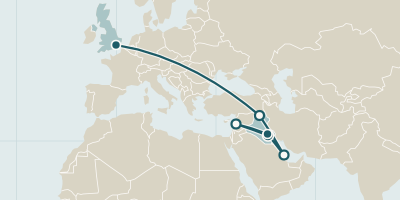
Deus Ex: Mankind Divided opens in a half-built Dubai hotel, moves to a near-future Prague, and ends at a London summit. The game's city is a fiction: Prague is compressed into three invented districts, while Dubai's hotel and London's Apex Centre do not exist. But each stop stands on a real place, and this route follows the story from Dubai to the Vltava and the Thames, using the real cities, the real model for Golem City and the real Alpine range as anchors.
The six stops follow the main mission order, from the Dubai prologue through Prague, Golem City and the Swiss Alps to the London finale.
Every Far Cry game drops you into a country that does not exist, and almost every one was built from a real place. The developers camped on the savanna, sent a team to Nepal, spent two weeks in Montana and a month in Cuba.
This route follows the series in release order, one stop per game. Pins mark whole countries or regions, not scenes: they show where each fictional setting came from, and one entry has no sourced real model.
Gilgamesh, king of Uruk, goes looking for the secret of immortality. This route follows the epic from its city to the Cedar Forest and the flood hero's home, then to the Nineveh library where the tablets were found.
The poem's places are legend and the tablets' places are archaeology; each stop says which, and which pins are only candidates. The Iraqi sites are not visitor destinations.
Hemingway wrote his last great novella in Cuba, about a fisherman and one enormous marlin. The places around it are real: the hotel room where he first lived, the bar he loved, the house where he wrote, and the fishing village next door.
This route follows the writer's Cuba from Old Havana to the harbour of Cojímar, where the Pilar was moored. The novella itself is under copyright, so the story is kept to its outline.
A few hundred Cossacks, a Stroganov fortress on the Kama and a khan's capital on the Irtysh: in four years Yermak turned a raid into the Russian entry into Siberia.
The route follows the campaign from Orel-gorodok over the Urals to the battle at Chuvash Cape, the fall of Qashliq, Yermak's death at the Vagay and the founding of Tobolsk. Dates differ between chronicles and modern sources, and the sources mark the death site and the legends as uncertain; the notes at each stop say which.
Before The Little Prince, Antoine de Saint-Exupéry flew the mail. He flew the Aéropostale line from Toulouse, ran the Cape Juby airfield, directed an airline in Buenos Aires and survived a crash in the Sahara that later fed his most famous book.
The route follows his life in the air, from the take-off strip at Montaudran to the sea off Marseille where his plane was found. The Sahara crash site is only an educated guess.
Two Naughty Dog adventures, two treasure hunts: the Drake brothers chase a pirate hoard from a hidden cathedral in the Scottish Highlands to the fabled pirate utopia of Libertalia, and Chloe Frazer and Nadine Ross follow a trail of Hindu temples through India's Western Ghats to the Tusk of Ganesh.
The route follows both games in order. Madagascar and Karnataka have real pirate coves and real Hoysala temples behind the fiction, but the games' exact settings are invented, so every pin marks the nearest real place.
In 1937 Amelia Earhart tried to become the first woman to fly around the world, on a roughly equatorial route. Two attempts, a crash in Hawaii and a lost radio signal over the Pacific turned her flight into one of history's great mysteries.
The route follows both attempts, from Oakland and Pearl Harbor to Miami, Lae and Howland Island, and ends at Nikumaroro, where one theory says she and her navigator came down. That final stop is only a hypothesis.
In 1857 two British officers set out from Zanzibar to find the Great Lakes rumoured to lie in the centre of the continent and, they hoped, the source of the Nile. They found two lakes, and then fell out over what they had found.
The route runs from a failed Somali expedition through Zanzibar, Kazeh and Ujiji to Lake Victoria, then on to Speke's Ripon Falls and the Bath debate that never happened. All pins are approximate, as the sources name regions and towns rather than exact spots.
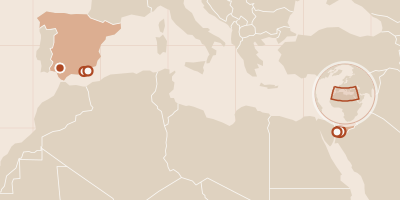
David Lean's 1962 epic follows T. E. Lawrence through the Arab Revolt, but most of its Arabia was built in Spain. Seville played Cairo, Jerusalem and Damascus, while Almería and a beach near Carboneras supplied the desert and a whole replica of Aqaba.
The route follows the story's order and keeps history apart from the film's shooting locations. Stops say plainly whether they show what happened in 1917 or where the cameras stood.
In July 1497 four ships left Lisbon to find a sea route to India. Vasco da Gama's fleet crossed the open South Atlantic, rounded the Cape, worked its way up the African coast, and reached Calicut on 20 May 1498. The voyage ended with two ships and over half the men lost.
The route follows the voyage from the Restelo shore in Lisbon to Calicut, then home via Anjediva and the Azores. Landing sites are mostly debated or only broadly known, so most pins are approximate. Dates are as the sources give them, in the Julian calendar then in use.
On 16 September 1810 a parish priest in a small Mexican town called his parishioners to arms, and within weeks a vast, ill-armed army was marching on the capital. Miguel Hidalgo's revolt began Mexico's war of independence.
The route follows it from the plot in Querétaro and the Cry of Dolores through the storming of the Alhóndiga in Guanajuato, the near-miss at Mexico City and the defeat at Calderón Bridge, to the ambush in Coahuila and the execution in Chihuahua. Violence is part of the story and is named plainly.
Two snake spirits take human form, one borrows an umbrella from a young pharmacist, and an abbot spends the rest of the story trying to separate them. One of China's best-loved folk tales still has its stage set in real places.
The route follows the popular opera version from the legend's mountain origin, through Hangzhou's West Lake and the flooded temple at Jinshan, to Broken Bridge and the pagoda where the White Snake ends up imprisoned. The tale exists in many versions; this route follows the standard opera telling.
China's first emperor unified the warring states in 221 BC and spent his last decade building: a capital, canals, walls, palaces and a vast tomb. Some of what is told about him is documented history; some is legend.
This route visits seven places tied to him, from Xianyang to the Terracotta Army. Stops marked as legend or speculative (the elixir quest on Zhifu Island, the lost course of the Qin wall) are kept apart from sites that archaeology has confirmed.
Jin Yong, the grand master of martial arts fiction, was born in Haining, Zhejiang. This route follows him out of the family house, to the tide he loved, and then across China to the places his heroes fight: a lake in Jiaxing, an island off Zhoushan, the mountains and monastery of Hua, Shaolin and Wudang, and a cell under Hangzhou's West Lake.
The real landmarks are documented; the sects, manors and duels set at them are fiction. Each stop says which is which, and where a pin marks the real place, it is not a scene.
On 6 August 1945 an atomic bomb was dropped on Hiroshima; three days later, another on Nagasaki. This route follows the two days on the ground, from the bridge that served as the aiming point to the places that survived or were rebuilt.
It starts in Hiroshima at Aioi Bridge, the hypocenter and the Dome, then moves to Nagasaki's hypocenter, cathedral and shrine, and ends with the two museums and parks built in 1955. Death tolls are estimates and are given as the ranges researchers publish.
In July 1853 four black warships anchored off Uraga and ended more than two centuries of Japanese seclusion. Within a year, Commodore Matthew Perry had delivered a president's letter, signed a treaty and opened two ports.
The route follows his two voyages: from the Ryukyu court at Shuri to Uraga, Kurihama, the treaty at Yokohama and the temples of Shimoda. Perry also visited Hakodate in 1854, but that stop is not included.
In April 1701 a lord drew a blade inside Edo Castle, and two years later forty-seven of his leaderless samurai stormed the mansion of the man he had attacked. The documented story runs from a corridor in Edo, through a surrendered castle and a quiet retreat near Kyoto, to a night raid and a temple cemetery in Tokyo.
The route sticks to dated events and places. The legend of Chūshingura, the later play, is kept to the final stop, where it is set apart from what happened.