The 1999 Kargil War was fought on the ridges above the Srinagar–Leh highway, around Kargil, Dras, Tololing and Tiger Hill in Ladakh, after Pakistani forces occupied heights on the Indian side of the Line of Control. India calls its campaign Operation Vijay.
The route goes from the highway at Kargil to the battles for Tololing, Tiger Hill and Point 4875, and ends at the Dras war memorial. Both Indian and Pakistani accounts are noted, and many of the heights remain military ground.
The 1972 film The Dawns Here Are Quiet is set at a railway siding in wartime Karelia but was shot around Syamozero, in the village of Syargilakhta and at the Ruskeala waterfalls. Based on Boris Vasiliev's 1969 novel, it follows five young women gunners and a sergeant major against sixteen saboteurs.
The route runs from the story's invented Siding 171 and Vop Lake to the real shores, village and waterfalls where Stanislav Rostotsky filmed in 1971. Note that the siding and the lake exist only in the story.
On 28 July 2010 Okabe Rintaro and Mayuri Shiina walk into the Radio Kaikan for a conference, and Okabe finds Kurisu Makise lying in a pool of blood. A text message sent moments later reaches his friend Daru a week early, and the PhoneWave in their Akihabara lab turns out to send mail into the past.
The route follows the real streets behind the visual novel and anime: the station exit, the Radio Kaikan hall where the story starts, the lab above a television repair shop, Mayuri's maid café, Ruka's shrine and the gyudon shop where the lab members eat. The old Radio Kaikan was demolished in 2011, so the present building is a 2014 replacement.
A dumped teenager from Ohio crosses Europe to find his German pen pal: London, Paris, Amsterdam, Bratislava, Berlin and finally the Vatican. The joke is that nearly all of it was shot in one city, Prague, apart from a single beach scene in Rostock.
Each stop pairs the story city with the real place that played it, so you can see where the fiction and the film set part ways. Story cities are approximate; the Prague filming spots are exact.
In 1893 Fridtjof Nansen froze a purpose-built ship into the Arctic ice on purpose. His bet was that the pack would carry it across the top of the world, and the sceptics called it self-destruction.
This route follows the voyage from Vardø to the pack ice, the drift, the sledge dash to 86°14′N, a hard winter in a stone hut and a lucky meeting at Cape Flora, ending at the museum where the ship rests. Ocean and ice stops have no map pin.
In April 1519 Cortés landed on the coast of Veracruz; in August 1521 the Aztec capital fell. In between came alliances, a massacre, a night of disaster on a causeway and an eight-month siege.
The route follows the campaign from Villa Rica to Tlatelolco and sets the Spanish accounts of Cortés and Díaz beside Tlaxcalan and Aztec ones where they are known. Where the accounts conflict, the stop says so.
In Alfonso Cuarón's Roma, a live-in maid named Cleo moves through a year of heartbreak in Mexico City's Colonia Roma, from her employers' house on Tepeji Street to the street violence of 10 June 1971 and a rescue on the beach at Tuxpan. Cuarón built the story from his own childhood memories.
The route follows the film in order across five places: the house, the Teatro Metropólitan, a rebuilt cinema corner, the Corpus Christi massacre site and the beach. Several were rebuilt or filmed elsewhere, so the pins are marked approximate.
Heracles' first six labours are set across the Peloponnese: Tiryns, Nemea and its lion, Lerna and its Hydra, Ceryneia, Erymanthos and Elis. He must kill a lion no arrow pierces and a many-headed Hydra, and clean a stable of thirty years' dung.
This route follows the first six labours in their traditional order, from the fortress of Tiryns through Nemea, Lerna, Ceryneia, Erymanthos and Elis to Lake Stymphalia. The myth rarely names an exact spot, so most pins mark the place the tale is tied to, not a cave or a lair.
For eighteen months in 1860 and 1861, relays of light riders on fast horses carried letters 1,900 miles from the Missouri River to California. It took about ten days, was never profitable, and was made obsolete by the telegraph within a year and a half — yet it became one of the great legends of the Old West.
The route follows the mail west through eight places: the stables where the first rider set out, a surviving station in Kansas, Fort Kearny, Julesburg, the plains where Mark Twain saw a rider flash past his stagecoach, Utah, the Nevada desert and the terminus in Sacramento. Where legend (Buffalo Bill, Twain's eight days) outruns the record, the text says so.
Santiago, a shepherd boy from Andalusia, keeps dreaming of treasure at the Egyptian pyramids. A fortune-teller and a mysterious old king send him across the strait to Africa, where he is robbed in Tangier, falls in love at an oasis and crosses a desert of warring tribes. Paulo Coelho's 1988 fable has sold more than 150 million copies.
The route follows the boy from a ruined church to the Giza plateau and back again. The book keeps its geography loose, so most pins mark the best-known place for a scene rather than a spot the author names.
Bob is a fading American movie star in Tokyo to advertise whiskey; Charlotte is a disillusioned recent graduate, married for two years. Both are far from home, and they find each other at the Park Hyatt Tokyo.
The route follows their story in the film's order: the neon streets of Shinjuku, the hotel, Shibuya Crossing and a karaoke room, then Charlotte's day trip to Kyoto Station, Nanzen-ji and Heian Shrine. Coppola shot for just 27 days, many of its locations in real places of business and public areas. The karaoke branch is pinned approximately.
In AD 79 a mountain above the Bay of Naples blew apart. Pliny the Younger watched from Misenum across the water, lost his uncle, the admiral Pliny the Elder, to the eruption, and years later described it for the historian Tacitus in two letters: the only eyewitness account that survives.
The route follows the eruption in the order of its events, from the mountain's first column to Pompeii, Herculaneum, the beach at Stabiae and back to Misenum. Pliny's letters never mention Pompeii or Herculaneum, so those stops come from archaeology. The traditional date is 24 August, but newer evidence points to the autumn.
King Arthur's legend has no single home: he is conceived at Tintagel and holds court at Caerleon, Cadbury Castle is claimed as Camelot and Glastonbury is linked to Avalon. The route follows Geoffrey of Monmouth, Malory and others from Merlin's dragons to the sword returned to the water.
Every pin marks a real place that tradition has attached to an episode, not a site proven by history, and each stop says where the link is doubted.
A shy waitress at a Montmartre café staffed and frequented by eccentrics finds a metal box of childhood memorabilia hidden behind a bathroom tile and gets drawn into the lives around her: practical jokes on the nasty greengrocer Collignon, street scenes described aloud to a blind man, and a dropped photo album belonging to Nino, a collector of discarded photo-booth pictures.
The route follows her Paris from the café on Rue Lepic to the photo booths of the Gare de l'Est and the blue arrows on the steps of the Sacré-Cœur, taking in skipping stones on the Canal Saint-Martin and a surge of love on the Pont des Arts along the way. Nearly every stop is a real place you can visit.
Kalos is Metropolitan France turned into a star-shaped Pokémon region. Lumiose City is inspired by Paris, its Prism Tower by the Eiffel Tower and its art museum by the Louvre; the Battle Château recalls Chenonceau on the Loire, the palais Chaydeuvre is the château de Versailles, and the stones outside Geosenge Town are the Carnac stones. The games never confirm their models — these are fan and encyclopaedia identifications — so every pin on this route is speculative.
The route follows the story across the real France behind Kalos: the town where the adventure begins, Lumiose's iron tower, two châteaux and a royal palace, a coastal aquarium, the island tower where Mega Evolution is learned, the cathedral clock behind Anistar's sundial, the Breton megalith field where Team Flare hides its ultimate weapon, and an abandoned mine where the legendary Zygarde sleeps.
Outlander's Scotland: the standing stones of Craigh na Dun near Kinloch Rannoch, Doune as Castle Leoch, Culross as Cranesmuir and Culloden moor. Claire, a twentieth-century nurse, touches a stone and wakes in 1743; a highlander knocks out the officer chasing her, and she marries Jamie Fraser to stay out of his reach.
They start near Kinloch Rannoch, where the production found its Craigh na Dun, then move to the real castles and villages playing Castle Leoch, Fort William, Cranesmuir and Lallybroch, and to a Fife castle standing in for a French abbey. The last stop is Culloden, the moor where Claire and Jamie say goodbye in the second-season finale.
One caveat: the standing stones on screen are a built set. The Bronze Age Clava Cairns near Inverness that fans often visit are said to have inspired them, but they are not where the circle was filmed.
Crown Princess Ann, on a goodwill tour of Rome, slips out of her embassy for one night of ordinary life. Reporter Joe Bradley finds her asleep in the street, recognises her from a newspaper photograph, and secretly guides her through the city to land an exclusive — a day of ice cream, a Vespa and the Mouth of Truth that turns into something neither of them planned.
William Wyler's 1953 comedy was shot almost entirely in Rome. The route follows Ann and Joe through the real locations: the palace that played the embassy, Joe's flat on Via Margutta, the Trevi and the barber by the Spanish Steps, the Colosseum, the Bocca della Verità, the riverside dance beside Castel Sant'Angelo and the closing press conference at Palazzo Colonna.
One night at Cruachan, Queen Medb of Connacht and her husband Ailill compare their riches and find them equal in all but one thing: Ailill owns a magnificent white-horned bull. Medb sets out to take an even finer one, the Brown Bull of Cooley, from Ulster, whose warriors are all laid low by an ancient curse. Only the seventeen-year-old Cú Chulainn stands in her way, holding off her army ford by ford, one champion a day.
The Táin Bó Cúailnge, "the Cattle Raid of Cooley", is the centrepiece of Ireland's Ulster Cycle, preserved in manuscripts from the 12th century on. Its storytellers loved explaining place-names, and many of its places are real and visitable. This route follows the raid from Connacht to Cooley and the bull's last journey home. Quotations are from Joseph Dunn's 1914 translation.
On the eve of his coronation, Prince Rama of Ayodhya is sent into the forest for fourteen years, so that his stepmother's son can rule. His wife Sita and brother Lakshmana go with him. In the forest Sita is carried off by Ravana, the demon king of Lanka, and Rama, helped by Hanuman and an army of vanaras, monkey-like forest people, crosses the sea to win her back. The Sanskrit epic attributed to Valmiki runs to some 24,000 verses and is still retold, staged and worshipped across South and Southeast Asia.
For centuries pilgrims have tied its episodes to real places, from Ayodhya to the hills of Sri Lanka. This route follows those traditional identifications, which are matters of faith and local memory rather than archaeology. Most of the stops are living temples.
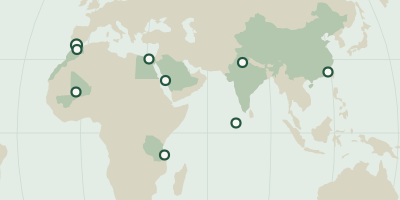
In June 1325 a 21-year-old law student left Tangier to make the pilgrimage to Mecca. He did not come home for 24 years. Ibn Battuta crossed the Islamic world and beyond — Arabia, East Africa, Anatolia, Central Asia, India, the Maldives, Sumatra and China — earning his keep as a judge and a guest of sultans, marrying and divorcing along the way. By some estimates he covered about 117,000 kilometres, more than any traveller before the age of steam.
Back in Morocco he dictated his memories, the Rihla, to a scholar who polished them and borrowed passages from older books, so not every scene was his own. The route picks out nine stops in the order he reached them; it is not one continuous road. There are no travel tips for Mecca or Mali.