Books
The Red and the Black: Verrières to Besançon
The Red and the Black is set in Franche-Comté: Julien Sorel grows up in the fictional town of Verrières, studies at the seminary in Besançon, and meets his end after a church shooting based on a real 1827 crime near Grenoble.
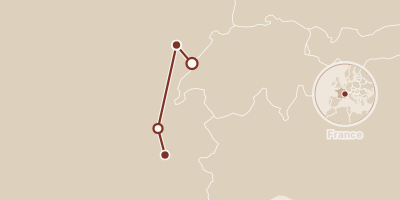
The route follows Julien from Verrières-de-Joux, the village that may have lent its name, through Besançon's citadel, seminary and cathedral, to Brangues and Place Grenette, where the real Antoine Berthet who inspired the novel was tried and executed.
Contains major story spoilers.
Timeline & locations
What do the location labels mean?
- Exact
- The pin marks the actual place where it happened or was filmed.
- Approximate
- The right area — a town, park or district — but not a precise spot.
- Speculative
- A reasoned guess: sources disagree or the exact place is unknown.
Julien Sorel is the carpenter's son of Verrières, a fictional town in Franche-Comté, who would rather daydream about Napoleon than work in his father's timber business. The Abbé Chélan finds him a post tutoring the children of Monsieur de Rênal, the mayor. Stendhal's Verrières is a larger industrial town on the Doubs, so the real border village of Verrières-de-Joux, which may have lent its name, is only a pin for the area.
Open area inGoogle MapsApple MapsOrganic MapsOpenStreetMap46.89750, 6.44972Visitability not confirmedLocation precision: The novel's town is fictional; the pin marks Verrières-de-Joux, whose name may have inspired Stendhal's, though his town is much larger.
Sources
- Verrières-de-Joux
- Locator:
- Histoire
- The Red and the Black
- Locator:
- Plot summary
- Verrières-de-Joux
On the road to the seminary Julien sees "the white walls beyond the distant mountain": the citadel of Besançon. He sighs that he might have entered this fine city as a sub-lieutenant, not a peasant boy. The fortress is a Vauban masterpiece on Mount Saint-Etienne, listed by UNESCO in 2008 together with Fort Griffon. Today it is an important tourist site, which is why its walls make the best first view of Julien's Besançon.
Visitor guidance: Now a tourist site with several museums, above the loop of the Doubs.
Sources
- Citadel of Besançon
- Locator:
- Lead
- The Red and the Black
- Locator:
- Plot summary
- Besançon
- Locator:
- In fiction
- Citadel of Besançon
Abbé Chélan sends Julien to the seminary in Besançon, which he finds intellectually stifling and full of social cliques. The director, Abbé Pirard, takes a liking to him and becomes his protector. The Grand séminaire, built between 1670 and 1695, is the building identified as the novel's setting. Its chapel, with a Corinthian facade on rue Mégevand, has been a listed historic monument since 17 March 1926.
Sources
- The Red and the Black
- Locator:
- Plot summary
- Grand séminaire de Besançon
- Locator:
- Histoire
- The Red and the Black
Chapter 28, "A Procession", takes place in Besançon Cathedral and describes its decorations for the Feast of Corpus Christi. The church was rebuilt between 1127 and 1161 on the foundation of a 9th-century basilica, and its clock tower holds a notable astronomical clock with thousands of moving parts. Stand inside and you see the setting Stendhal used for Julien's day among the seminarians and the city's clergy.
Visitor guidance: The astronomical clock is in the cathedral clock tower.
Sources
- Besançon Cathedral
- Locator:
- In fiction; History
- The Red and the Black
- Locator:
- Plot summary
- Besançon Cathedral
In the novel Julien shoots Madame de Rênal during Mass in the village church. Stendhal took the scene from the Berthet affair: on 22 July 1827 a former seminarian entered the church of Brangues during Mass and fired at his former mistress. After the scandal the old church was demolished and replaced; the present one dates from 1847.
Location precision: The pin marks Brangues village; the church Berthet entered was demolished, and the present church is a later building.
Visitor guidance: The church of Brangues, in Isère, is the village parish church.
Sources
- The Red and the Black
- Locator:
- Plot summary
- Brangues
- Locator:
- Lieux et monuments
- Le Rouge et le Noir
- Locator:
- L'affaire Berthet
- The Red and the Black
Julien is imprisoned and sentenced to death, and is guillotined. The real model for his fate, Antoine Berthet, was executed on Place Grenette in Grenoble on 23 February 1828; the case became one of the sources of the novel. Grenoble was Stendhal's own hometown. The square, one of the city's oldest, takes its name from the medieval grain markets held here.
Visitor guidance: A public square in Grenoble.
Sources
- Place Grenette
- Locator:
- Historique
- Le Rouge et le Noir
- Locator:
- L'affaire Berthet
- The Red and the Black
- Locator:
- Plot summary
- Place Grenette