A failed Spanish expedition to Florida left four survivors, and one of them, Álvar Núñez Cabeza de Vaca, walked and traded his way across the continent over roughly eight years before meeting Spaniards again in Mexico. He wrote his account from memory.
The route runs from Spain through Cuba, Florida and the Texas coast to Culiacán and Mexico City. Most stops are approximate, and the middle of the journey is not traced because historians cannot fix his route.
A seventeen-year-old heir is sold to a brig bound for the colonies, wrecked off Mull, and thrown into the heather beside a fugitive named Alan. Stevenson's chase carries them from the Firth of Forth through Appin and the Highlands to the bridge at Stirling.
The route follows David's journey in chapter order, from the Queensferry inn where he is handed over to the old bridge where the pair cross the Forth. Several scenes rest on real events, such as the Appin murder and Cluny MacPherson's hiding place.
Qin Shi Huang's China: his capital Xianyang, Mount Tai, where he proclaimed the empire's unity, the Lingqu Canal near Guilin, and his tomb at Mount Li with the Terracotta Army. He unified the warring states in 221 BC; some of what is told about him is legend.
This route visits seven places tied to him, from Xianyang to the Terracotta Army. Stops marked as legend or speculative (the elixir quest on Zhifu Island, the lost course of the Qin wall) are kept apart from sites that archaeology has confirmed.
Jin Yong, the grand master of martial arts fiction, was born in Haining, Zhejiang. This route follows him out of the family house, to the tide he loved, and then across China to the places his heroes fight: a lake in Jiaxing, an island off Zhoushan, the mountains and monastery of Hua, Shaolin and Wudang, and a cell under Hangzhou's West Lake.
The real landmarks are documented; the sects, manors and duels set at them are fiction. Each stop says which is which, and where a pin marks the real place, it is not a scene.
Genshin Impact's Liyue is a fantasy nation, but its cliffs, pools and harbour were built from real Chinese places.
The route follows the landscapes its developers named as models, from Yangshuo and Huanglong to Zhangjiajie, Fenghuang and Huangshan. Three of them, Zhangjiajie, Huanglong and Guilin, also hosted official in-park collaborations in 2020. The pins mark the real models, not game locations.
Love Live! Sunshine!! is set in a real corner of Shizuoka: the port city of Numazu and the coastal town of Uchiura, where the heroines come from.
The route follows the story from the cape-top school and the family inn to Awashima island, the station, the aquarium park and the city school of the film. Some places are real and appear as themselves; the school, the inn and the film's school are invented, and their pins mark the real buildings they are modelled on.
In Alfonso Cuarón's Roma, a live-in maid named Cleo moves through a year of heartbreak in Mexico City's Colonia Roma, from her employers' house on Tepeji Street to the street violence of 10 June 1971 and a rescue on the beach at Tuxpan. Cuarón built the story from his own childhood memories.
The route follows the film in order across five places: the house, the Teatro Metropólitan, a rebuilt cinema corner, the Corpus Christi massacre site and the beach. Several were rebuilt or filmed elsewhere, so the pins are marked approximate.
In 1961 Yuri Gagarin trained at Moscow's Khodynka Airfield, launched from Baikonur and came down near Engels. Less than two hours in space made the pilot a worldwide celebrity; his capsule is kept in a museum in Korolev City.
This route follows Yuri Gagarin from the training ground at Moscow's Khodynka Airfield to the launch pad at Baikonur, the field in the Saratov region where he came down, the Kremlin ceremony and the museum that keeps his capsule. The museum pin marks the Energia company site rather than the museum itself.
The Old English poem Beowulf is set in Denmark and Sweden, and a surprising number of its kings, battles and halls turn up in Scandinavian sources and in the ground. Follow the hero from his Geatish homeland to Hrothgar's hall, then to the raid in Frisia, the royal mounds at Uppsala, and the English ship burial and library shelf where the poem survived.
Most identifications here are traditional rather than proven, and the pins say so.
For eighteen months in 1860 and 1861, relays of light riders on fast horses carried letters 1,900 miles from the Missouri River to California. It took about ten days, was never profitable, and was made obsolete by the telegraph within a year and a half — yet it became one of the great legends of the Old West.
The route follows the mail west through eight places: the stables where the first rider set out, a surviving station in Kansas, Fort Kearny, Julesburg, the plains where Mark Twain saw a rider flash past his stagecoach, Utah, the Nevada desert and the terminus in Sacramento. Where legend (Buffalo Bill, Twain's eight days) outruns the record, the text says so.
In December 1933, eighteen-year-old Patrick Leigh Fermor set off from the Hook of Holland to walk to Constantinople, carrying a few clothes, some letters of introduction, an anthology of English verse and a volume of Horace. He slept in barns and shepherds' huts, but gentry and aristocracy kept inviting him into their country houses. He wrote the journey up decades later in A Time of Gifts, Between the Woods and the Water and The Broken Road.
The route follows him through ten places the sources let us pin, from the Hook and a Stuttgart apartment to Melk, Vienna, Prague, the bridge into Hungary, an island on the Danube that now lies under water, Plovdiv and Istanbul. Many pins are approximate: the sources name a town, not the exact spot where he stood.
The Travels of Marco Polo runs from Venice and Acre to Kublai Khan's Xanadu, then south to Hangzhou and home again. In 1271 a seventeen-year-old Venetian set out with his father and uncle and did not come home for 24 years.
The route follows the book from Venice and Acre to the Persian Gulf, across the Pamir highlands and the desert to Kublai's summer and winter capitals, south to Hangzhou and the port of Zayton, and home again. Some of the roads are reconstructed by scholars, and Polo sometimes exaggerates, so each stop notes where the evidence is thin.
Jesse and Céline are now a couple with twin daughters, on a summer holiday in southern Greece. Before Midnight, the third and final film of Richard Linklater's Before trilogy, was shot in 15 days on the Peloponnese coast and turns one last night into a long, honest argument about love.
The route follows the film from an airport farewell to a writer's house, a castle, a harbour town and a resort hotel. The filmmakers have named few exact addresses, so the Pylos and hotel stops are approximate.
Nine years after a night in Vienna, Jesse is on a book tour in Europe when Céline walks into his reading in a Paris bookshop. He has an hour before his flight, and they spend it wandering the city. Richard Linklater's 2004 film plays in real time: the story lasts about as long as the film, roughly eighty minutes.
It was shot in 15 days across Paris, and its locations jump about more than the dialogue admits. This route follows the film's order from the Left Bank bookshop through the Marais and the east of the city to the Seine and a gated courtyard in the Faubourg Saint-Antoine.
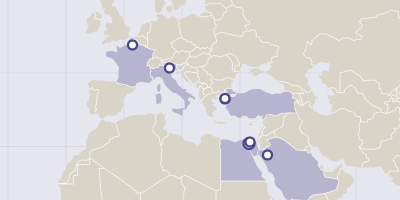
Battlefield 1 sends its soldiers across the Western Front, the Italian Front, Gallipoli and Arabia. This route follows the War Stories and multiplayer maps that go with them, from the Suez Canal in 1915 to Monte Grappa in October 1918.
Stops run in the order of the real battles, not the game's menu. The maps are the game's own reconstructions, so each pin marks the real ground behind a level, and one stop is a village the game invented.
The Kanto of Pokémon Red and Blue is based on the real Kantō region of Japan: fans match Pallet Town to Machida, Vermilion City to Yokohama, Celadon City to Shinjuku and Lavender Town to Narita. You start in a quiet town, beat eight gym leaders and take on Team Rocket.
This route follows the game's journey from Pallet Town to the final gym and sets each stop beside the real place it is said to resemble. The game's Kanto is inspired by the real one, not a copy of it, so every pin is an outside reading of the map, not an official location.
Twin Peaks is set five miles from the Canadian border, but its exteriors come from the Snoqualmie Valley, all around 25–30 miles from Seattle. David Lynch and Mark Frost found the places they had written into the pilot in Snoqualmie, North Bend and Fall City.
This route follows the series through five of them: the falls from the opening titles, the road with the welcome sign, the hotel, the sheriff's station and the diner. Most interiors were built on sets in a San Fernando Valley warehouse, so these stops are exteriors, and the Reinig Road pin marks the road, not one spot.
Fitzgerald set The Great Gatsby on two invented peninsulas, West Egg and East Egg, but he built them from the Long Island he knew in Great Neck, where he lived from October 1922. Behind the glamour sit a dump, a station and a hotel suite that were all real.
This route follows Nick from the Eggs through the valley of ashes, Penn Station, the Queensboro Bridge and the Plaza Hotel. The Eggs, the valley and Gatsby's house are invented, so their pins mark the real places the novel is read against.
J. Robert Oppenheimer studies in Cambridge and Göttingen, builds a physics school at Berkeley, and is handed the one job nobody else wants: build the atomic bomb before the Nazis do. Christopher Nolan's Oppenheimer (2023) follows him from the Cavendish Laboratory to a secret mesa in New Mexico, through the Trinity test and the political fallout that ends his career.
This route follows the film's real places — Cambridge, Göttingen, LeConte Hall, Los Alamos, Trinity, the White House, the Institute for Advanced Study and the room where his security clearance was revoked. The film's own stand-ins, from Ghost Ranch to Kerckhoff Hall, Belen and Alhambra, are noted at each stop.
Gotham is Chicago. The film shot most of Batman's city on real streets and buildings in the Loop, dressing them up as Gotham, then flew the crew to Hong Kong for its one overseas detour. This route follows The Dark Knight in order, from the bank heist that opens it to the rooftop where Batman and the Joker have their last fight.
Along the way: the disused post office that doubled as a bank, the glass office where Wayne holds a fundraiser, the financial street of the convoy chase, the hospital the Joker destroys, an old Chicago bar, the pier where two ferries wait, and Hong Kong's International Finance Centre.
In 1984 Ghostbusters turned real New York addresses into a haunted city: the New York Public Library's marble reading room, the Hook & Ladder 8 firehouse in Tribeca and 55 Central Park West, the apartment block that becomes Spook Central. The Sedgewick Hotel was filmed at the Millennium Biltmore in downtown Los Angeles.
Most of the exterior landmarks survive and can be visited, though the Sedgewick Hotel's interiors were filmed on the other side of the country, at a grand downtown Los Angeles hotel. This route follows the film's story from the first library ghost to the rooftop battle with Gozer.
Kalos is Metropolitan France turned into a star-shaped Pokémon region. Lumiose City is inspired by Paris, its Prism Tower by the Eiffel Tower and its art museum by the Louvre; the Battle Château recalls Chenonceau on the Loire, the palais Chaydeuvre is the château de Versailles, and the stones outside Geosenge Town are the Carnac stones. The games never confirm their models — these are fan and encyclopaedia identifications — so every pin on this route is speculative.
The route follows the story across the real France behind Kalos: the town where the adventure begins, Lumiose's iron tower, two châteaux and a royal palace, a coastal aquarium, the island tower where Mega Evolution is learned, the cathedral clock behind Anistar's sundial, the Breton megalith field where Team Flare hides its ultimate weapon, and an abandoned mine where the legendary Zygarde sleeps.
Vice City is Miami with the labels peeled off. The 2002 game, set in 1986, follows gangster Tommy Vercetti's rise to power after prison, from an ambushed drug deal to the takeover of a drug lord's mansion. The developers built the world from extensive field research in Miami, and the plot draws on the city's real Cubans, Haitians and biker gangs.
This route pins six real places behind the fiction: the port of the opening ambush, the Ocean Drive strip behind Ocean Beach, Little Havana and Little Haiti with their warring gangs, Downtown's biker ground, and the private island behind the Starfish Island mansion. Every pin marks the real stand-in, and each stop names the game location it doubles for. One caveat: Vice City itself is fictional, so expect the flavour of 1980s Miami rather than a street-by-street copy.
Indiana Jones and the Last Crusade (1989) sends Indy from a Boy Scout outing in the Utah desert to the rock-cut façade of Petra, chasing the Holy Grail and his missing father. Three trials guard the cup at the end. The film borrows its scenery from half of Europe, the Middle East and the American West.
Nine stops, most of them still standing: the Arches canyons of the opening, the church façade in Venice's Campo San Barnaba that plays the library, an Eifel castle dressed as Brunwald, a San Francisco building that played Berlin's Tempelhof airport, the Almería beach where Henry brings down a fighter with an umbrella, a Granada station playing Alexandretta, the Tabernas tank chase, the Treasury that fronts the Grail's temple, and the Texas sunset the film ends on. Dates are story time; filming ran from May 1988 to early 1989.