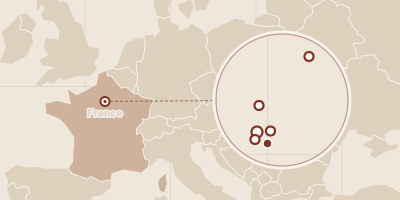
Two years after a pandemic turns millions of people into feral Freakers, outlaw biker Deacon St. John rides central Oregon as a drifter and bounty hunter. He believes his wife Sarah died when a NERO helicopter lifted her out of the outbreak — until he learns she was moved to a military outpost at Crater Lake.
Days Gone's Oregon is a compressed, renamed version of the real high desert: Bend becomes Farewell, Black Butte Ranch becomes Iron Butte Ranch, and the militia holds Crater Lake. The route follows Deacon's ride from the opening evacuation to the volcanic lake where the story ends, through the hot springs, small towns and logging country that Bend Studio used as its model.
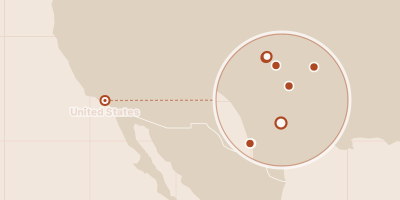
In the 1920s the Osage Nation drew oil wealth from beneath its Oklahoma land, and newspapers called the Osage the richest nation or social group on earth, man for man. Then they began to die — shot, poisoned, killed by a bomb in Fairfax — while local courts and guardians controlled the money.
This route follows the documented places of the Osage murders, from Mollie Kyle's Gray Horse and Pawhuska's Million Dollar Elm to the Fairfax bombing, a lawyer's body beside the railroad, and the trials at Guthrie and Oklahoma City. It ends at the Osage Nation Museum, which keeps the record in the tribe's own voice. Scorsese's 2023 film was shot in many of the same towns.
At 21, Jack London sailed north in July 1897 to join the Klondike gold rush. He came home without gold but with scurvy and the stories that made his name: The Call of the Wild, "To Build a Fire" and more.
This route follows him from the beach at Dyea over the Chilkoot Pass, down the lakes and rapids of the Yukon, through a winter at the Stewart River to Dawson City, where his cabin still stands.
Hemingway wrote his last great novella in Cuba, about a fisherman and one enormous marlin. The places around it are real: the hotel room where he first lived, the bar he loved, the house where he wrote, and the fishing village next door.
This route follows the writer's Cuba from Old Havana to the harbour of Cojímar, where the Pilar was moored. The novella itself is under copyright, so the story is kept to its outline.
A five-year-old orphan is led up a Swiss mountain path to live with a grandfather the whole village avoids. Johanna Spyri's 1881 novel follows Heidi from the alm to a grand house in Frankfurt, where homesickness sends her sleepwalking, and back to the mountain, where her friend Klara finally comes to visit.
The route runs from Ragaz, where Spyri wrote the book, through Maienfeld and the alm above it to Frankfurt and the tourist Heididorf. Spyri never names the exact hamlet or house, so most pins mark an area or a tradition.
On 6 January 1482, a poet, a gypsy dancer, a deaf bellringer and a tormented priest cross paths in the Paris of Victor Hugo's imagination. It is a city of crowds, bonfires, gibbets and a cathedral that is almost a character in its own right.
This route follows the story from the Palais de Justice to the square where punishments were held, the beggars' court, the Seine bridge, Notre-Dame itself and the hilltop gibbet. Much of medieval Paris is gone, so most pins mark an area rather than a surviving building.
Bruce Lee was born in San Francisco, but Hong Kong was the city that shaped him: a Nathan Road childhood, Wing Chun lessons with Ip Man, and the film studios that made him a star. This route follows his documented life and the places where his films and legacy meet.
It runs from a Kowloon flat and school days, through a surviving Enter the Dragon location and the hospital where he died, to the statue and museum that remember him. Where accounts differ, the stop says so.
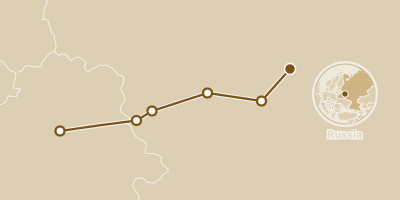
Andrei Tarkovsky's Zone, a fenced-off wilderness where a guide takes a writer and a professor toward a Room said to grant wishes, was largely shot around Tallinn, Estonia, among abandoned hydropower plants, a power station and an old chemical works.
This route follows the film's story through those places: the factory and power plant seen before the Zone, the gate, the river plants where the journey was shot, a highway bridge and the power station that smokes behind the final homecoming. Exact spots are often unrecorded, so most pins are approximate.
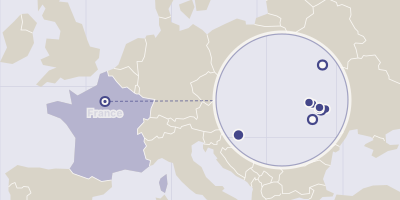
On 19 October 1812 the Grande Armée walked out of Moscow after five weeks of occupation. Six weeks later, what was left of it scrambled across the Berezina on two hastily built bridges. In between lay a blocked road, a burning town, a depleted depot, a blizzard and a river full of ice.
The route follows six places on that march, from the mined Kremlin through Maloyaroslavets, Vyazma, Smolensk and Krasny to the crossing at Studienka. Most pins mark a town or village, not a battlefield.
Toru Watanabe, a drama student in late-1960s Tokyo, looks back on the years he spent between two women: Naoko, the fragile girlfriend of his dead best friend, and Midori, a classmate who is everything Naoko is not. Haruki Murakami's 1987 novel made him a superstar in Japan.
The route follows Watanabe across the city: his dormitory, a long Sunday walk by the moat, Naoko's apartment in Kokubunji, the campus, the streetcar to Midori's neighbourhood, a house at the edge of Kichijōji and the platform at Ueno. Murakami drew on his own student years, but the novel's dormitory and university are invented, so those two pins mark real stand-ins.
In 1910 two expeditions set out for the bottom of the world. Roald Amundsen's Norwegians, masters of skis and sled dogs, reached the South Pole on 14 December 1911. Robert Falcon Scott's party arrived on 17 January 1912, 34 days later, to find a Norwegian tent already standing. Amundsen sent his news from Hobart; Scott's party of five died on the return journey.
The route follows both men from Cardiff and Madeira to their bases, up their two glaciers, to the Pole and to the endings: Amundsen's cables from Hobart and Scott's last camp. Antarctic pins mark glaciers and bays, not camps, and the ice has moved since.
King Arthur belongs to no single place. His story was built up by Geoffrey of Monmouth, Thomas Malory and many others, and this route follows it in the legend's own order: Merlin's dragons, Arthur's conception and coronation, his battles and court, the last fight, the sword in the water and Avalon.
Every pin marks a real place that tradition has attached to an episode, not a site proven by history, and each stop says where the link is doubted.
Tommy sets out for Seattle to hunt Abby, and Ellie and Dina follow him into a ruined city where the WLF militia and a cult, the Seraphites, fight for control. The Last of Us Part II plays the same three days twice: first as Ellie, then as Abby. The city is the real one: Naughty Dog chose Seattle for its hills and varied weather, and its artists travelled there to study the architecture, vegetation and topography.
This route follows both runs. Ellie's: the synagogue they call the Dome, the Pinnacle Theatre, the convention centre and its stalkers, the hospital and the aquarium. Abby's: the stadium she lives in, the Great Wheel of her memories, the Chinatown Gate and the Space Needle seen from the island. Many of the game's buildings carry new names; each stop names the real one behind it.
A jazz pianist and an aspiring actress argue through the windows of their cars in a Los Angeles traffic jam, and the city itself becomes the romance: a night on a funicular, a broken projector, a kiss in a planetarium. Damien Chazelle shot La La Land in 40 days across Los Angeles in the summer of 2015, and most of the places the couple reaches for are still there.
This route follows Mia and Sebastian from the freeway ramps where they shout at each other to the jazz bar Seb finally gets to open — the 105/110 connector ramps, the Burbank café on the Warner lot, the Lighthouse Café and the pier beside it, the Rialto in South Pasadena, Griffith Observatory and Angels Flight. The film rarely names its own locations, so a few pins mark the real building that stood in for the one on screen.
Arno Dorian is a nobleman who walks into a trap: framed for the murder of the man who adopted him, he spends the opening hours of Unity's Paris of 1789 in a prison cell, and walks out of it an Assassin. From there he is off across the capital hunting the true powers behind the Revolution, while Napoleon, Robespierre and an Apple of Eden keep arriving before he can finish the job.
Unity rebuilds late 18th-century Paris at roughly 1:1 scale across seven districts, plus Versailles, so almost every stop here is a building you can walk to: the Bastille site, the Assassins' hideout under the Île Saint-Louis, Notre-Dame's towers, the storming of the Tuileries, the execution square that is now the Place de la Concorde, Robespierre at the Hôtel de Ville, and — with the Dead Kings expansion — a Precursor temple under the basilica at Saint-Denis. Two stops are places the game invented rather than built: that hideout and that temple.
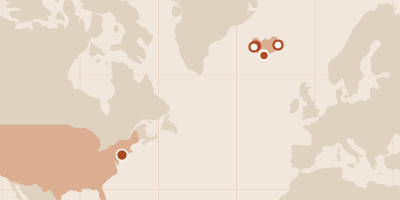
Walter Mitty manages photo negatives at Life magazine in New York and escapes his dull days in elaborate daydreams. When the negative chosen for the last print cover goes missing, he has to track down its photographer, Sean O'Connell — to Greenland, Iceland and the Himalayas. Ben Stiller's 2013 film was shot on analog film, and almost all of its adventure was shot in Iceland.
This route starts at Life's real Manhattan home and then follows Walter through the Icelandic towns, harbour, mountain road, volcano and waterfall that stand in for Greenland and Afghanistan. The places are real; which country they play is not.
In about 1986 a boy of five or six fell asleep on an empty train in central India and woke up nearly 1,500 kilometres away in Calcutta, unable to name his home town. Adopted by a couple in Tasmania, Saroo Brierley found his way back 25 years later by tracing railway lines on Google Earth. His memoir A Long Way Home became the 2016 film Lion, with Dev Patel as the grown-up Saroo and Nicole Kidman as his adoptive mother.
The route follows the real journey, which the film tells closely, from Khandwa station to Burhanpur, Howrah and Hobart, and back to Khandwa. Family homes are private and not pinned.
In spring 1689 the poet Matsuo Bashō gave up his hut in Edo and set off on foot with his friend and disciple Kawai Sora into Oku, the remote north of Japan. For about 156 days and some 2,400 kilometres they walked to the places the old poets had made famous — a barrier gate, a bay of pine islands, a battlefield, a mountain temple — and Bashō answered them with haiku.
The travel diary he made of it, Oku no Hosomichi, published in 1702, is one of the classics of Japanese literature, and its stops are still pilgrimage sites. Bashō polished the facts for art; Sora's own diary shows where. Dates follow the old lunar calendar, so they are given here by season.
In 1791 Saint-Domingue was France's richest colony, a sugar and coffee economy worked by hundreds of thousands of enslaved Africans under brutal conditions. Thirteen years later it was Haiti, the first nation born from a successful slave revolt and the first independent Black-led state in the Americas. The cost was enormous: some 200,000 Black Haitians died, and tens of thousands of French and British soldiers, most of them from yellow fever.
The route follows the turning points, from the ceremony that tradition places at Bois Caïman to the declaration at Gonaïves, with a detour to the French mountain fortress where Toussaint Louverture died. Fighting was savage on all sides, and the texts say so plainly. The route offers no travel advice for Haiti.
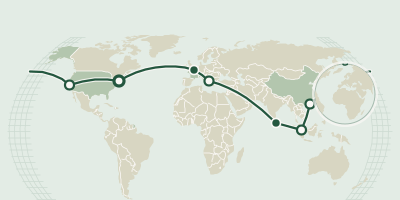
On the evening of 2 October 1872, the punctual and unflappable Phileas Fogg bets his fellow members of the Reform Club £20,000 — half his fortune — that he can go around the world in eighty days, and leaves that same night with his new French valet, Passepartout. On his heels comes Detective Fix, convinced that Fogg is a bank robber on the run. Jules Verne's novel appeared in 1872, when the opening of the Suez Canal and new railways across India and America had made such a race against the timetable just about possible.
The route follows the journey eastward in the novel's own dates, from Pall Mall back to Pall Mall.
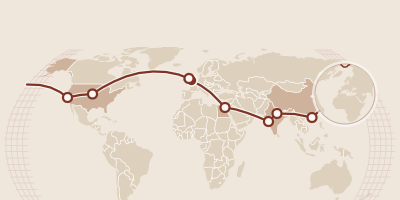
In 1888 Nellie Bly, the star reporter of Joseph Pulitzer's New York World, proposed turning Jules Verne's Around the World in Eighty Days into fact. On 14 November 1889, with two days' notice and as little luggage as she could manage, she sailed from Hoboken to beat Phileas Fogg's fictional record. She came home 72 days, 6 hours and 11 minutes later, a world record — briefly — and a celebrity, while the World's readers guessed her arrival time to the second.
The route follows her book of 1890, stop by stop, with the dates from her own record. She went east by steamer and train, through the Suez Canal and the British ports of Asia.