Mythology
William Tell: Lake Lucerne and Uri
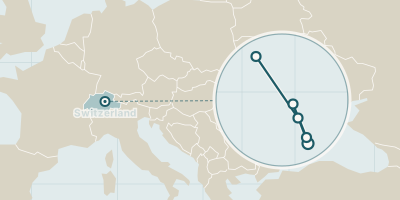
William Tell's legend is set around Lake Lucerne in central Switzerland: his home village Bürglen, the Rütli meadow, the marketplace of Altdorf where he shot the apple, the Tellsplatte where he leaped from the boat, and the Hohle Gasse near Küssnacht where Gessler was killed.
The route follows the story as the chronicler Tschudi and Schiller's play tell it. The legend is not documented history, and every stop is a traditional identification, but each place is real and can be visited.
Contains major story spoilers.
Timeline & locations
What do the location labels mean?
- Approximate
- The right area — a town, park or district — but not a precise spot.
- Speculative
- A reasoned guess: sources disagree or the exact place is unknown.
The legend puts William Tell's home in Bürglen, a village at the mouth of the Schächental in Uri. The first accounts name no first name and no home; the chronicler Aegidius Tschudi, writing around 1570, added "Wilhelm" and made him a native of Bürglen. The village took the story to heart: its church had a bell dedicated to Tell from 1581, and a nearby chapel has a fresco dated 1582 showing his death in the Schächenbach.
Location precision: Tschudi's later chronicle, not the earliest accounts, ties Tell to Bürglen, so the pin marks the village rather than a known house.
Visitor guidance: The village centre, its church and the nearby chapel are the places the legend is tied to.
Sources
- Bürglen, Uri
- Locator:
- Notable residents
- William Tell
- Locator:
- Legend; Tschudi's account
- Bürglen, Uri
The oldest written mention of Tell, in the White Book of Sarnen of 1474, names him as one of the conspirators of the Rütli, the lakeside meadow where the Swiss Confederacy's founders swore their oath. During the 16th century the two stories merged. Rütli became a national symbol in the early 18th century, and Schiller's play Wilhelm Tell of 1804 dramatized the oath. On 25 July 1940 General Guisan briefed Swiss officers here on the country's defence.
Location precision: Tell's presence at the oath comes from a late-medieval tradition, not from a documented event.
Visitor guidance: The meadow is a protected national site on Lake Lucerne.
Sources
- Rütli
- Locator:
- History
- William Tell
- Locator:
- Legend; Tschudi's account
- Rütli
In the legend this is the marketplace where the Austrian bailiff Gessler hung his hat on a pole under the linden tree and demanded that everyone bow to it. On 18 November 1307 Tell walked past with his young son and refused. His punishment: shoot an apple from the boy's head. Tell split it with a single bolt, then admitted that a second bolt was meant for Gessler. Richard Kissling's bronze statue of the scene was unveiled here in 1895.
Location precision: The legend names Altdorf's marketplace; the pin marks the Tell monument, not a documented spot.
Visitor guidance: The monument stands in the centre of Altdorf; the Tell theatre, opened in 1899, is close by.
Sources
- Altdorf, Uri
- Locator:
- Sights: Tell Monument
- William Tell
- Locator:
- Legend; Tschudi's account
- Altdorf, Uri
Arrested, Tell was carried in Gessler's boat toward the dungeon at Küssnacht when a storm broke on Lake Lucerne. The guards begged Gessler to unchain him so he could take the helm; Tell steered to a rocky shelf and leaped out. That ledge is the Tellsplatte, three kilometres south of Sisikon. A chapel was recorded here in 1388, the present one was built in 1879/1880, and Uri still makes a ship pilgrimage to it every year.
Location precision: The legend does not fix the ledge; the Tellsplatte is the traditional identification, marked by the chapel.
Visitor guidance: The chapel stands on the lake shore near Sisikon.
Sources
- Tellskapelle
- Locator:
- Introduction
- William Tell
- Locator:
- Legend; Tschudi's account
- Tellskapelle
Free, Tell ran cross-country to Küssnacht and waited for Gessler on the road cut through the rock between Immensee and Küssnacht. Schiller gave him the line: "Through this hollow way he must come. There is no other road to Küssnacht." There Tell shot the bailiff with his second bolt, and the killing sparked the rebellion that led to the Old Swiss Confederacy. Swiss schoolchildren's donations saved the lane in 1934; today it is a footpath with a picnic spot and an information pavilion.
Location precision: The legend names the sunken road between Immensee and Küssnacht; the pin marks the preserved Hohle Gasse, a traditional identification.
Visitor guidance: A footpath with a picnic area and an information pavilion at the lower end.
Sources
- Hohle Gasse
- Locator:
- Introduction
- William Tell
- Locator:
- Legend; Tschudi's account
- Hohle Gasse