Mapped Chronicles

Author

Mapped Chronicles editors

882 routes

On the map

Published routes and how readers responded.

Published
882
Likes
0
Categories
6
Countries
140

Achievements · 6/7

  • First route

    Publish your first route.

    Earned

  • Cartographer

    Publish 5 routes.

    Earned

  • Atlas maker

    Publish 10 routes.

    Earned

  • Polyglot

    Publish a route with a translation.

    Earned

  • Reader favourite

    Collect 10 likes across your routes.

    0/10

  • Genre hopper

    Publish routes in 3 categories.

    Earned

  • Globetrotter

    Publish routes across 5 countries.

    Earned

Routes

Real JourneysApproximate

Karl Bushby's Goliath Expedition: Punta Arenas to Hull

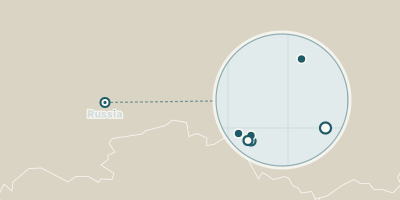
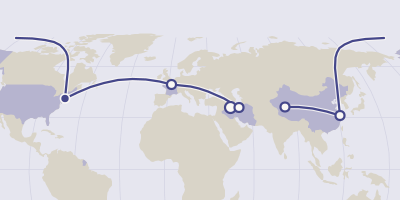
Karl Bushby's Goliath Expedition is a walk from Punta Arenas, Chile, to his home town of Hull, England, via the Darién Gap, the Bering Strait, Siberia, Mongolia, the Caspian Sea and the English Channel. He started on 1 November 1998 and arrived in Hull on 2 November 2026. The route follows twelve landmarks of the nearly 28-year journey, from the jungle of Panama to a frozen sea crossing in 2006 and two long swims. Positions are approximate except the start and the Dover beach, since the actual paths are not published stop by stop.

12 locations0/12 visitable
HistorySpeculative

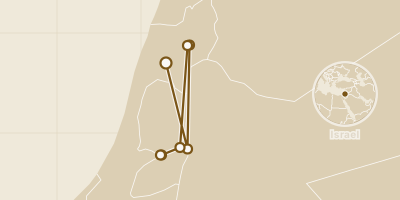
In the Footsteps of Jesus: Nazareth to Jerusalem

Follow in the footsteps of Jesus through the Holy Land: from the Basilica of the Annunciation in Nazareth to the Jordan baptism site, Capernaum, the Sea of Galilee shore, Jericho, Gethsemane and the Church of the Holy Sepulchre in Jerusalem. The Gospels name many places but rarely fix a spot, so most stops here rest on tradition. Each is labelled as exact, approximate or speculative, with what archaeology can and cannot show.

7 locations6/7 visitable
MythologyApproximate

The Mistress of the Copper Mountain: Bazhov's Ural Tales

The Mistress of the Copper Mountain lives in the Gumeshevsky mine in Polevskoy, in the Urals, and Pavel Bazhov wrote her tales in Yekaterinburg after hearing them as a boy on Dumnaya Gora. Her story, from The Malachite Box (1939), is told here with Azov-gora and the Stone Flower town. The route runs from Bazhov's birthplace in Sysert through the Polevskoy hills where the legends were told to the Yekaterinburg house where he wrote them down.

6 locations1/6 visitable
MythologySpeculative

William Tell: Lake Lucerne and Uri

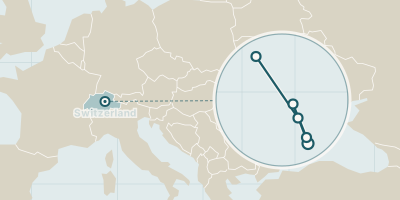
William Tell's legend is set around Lake Lucerne in central Switzerland: his home village Bürglen, the Rütli meadow, the marketplace of Altdorf where he shot the apple, the Tellsplatte where he leaped from the boat, and the Hohle Gasse near Küssnacht where Gessler was killed. The route follows the story as the chronicler Tschudi and Schiller's play tell it. The legend is not documented history, and every stop is a traditional identification, but each place is real and can be visited.

5 locations5/5 visitable
BooksApproximate

Commissaire Dupin: Bannalec's Brittany Crime Novels

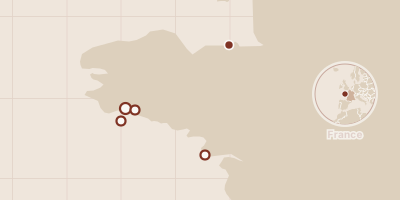
Commissaire Dupin is set in Brittany: Jean-Luc Bannalec's detective, a Paris policeman transferred to Concarneau, solves murders in Pont-Aven, on the Glénan islands and in the Guérande salt marshes. This route follows the first three novels, Bretonische Verhältnisse, Bretonische Brandung and Bretonisches Gold, then looks at how the TV series borrows other places such as Saint-Malo. Settings in the story are partly invented.

5 locations5/5 visitable
BooksApproximate

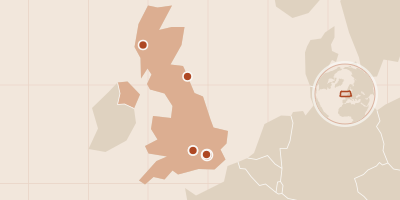
The Unlikely Pilgrimage of Harold Fry: Kingsbridge to Berwick

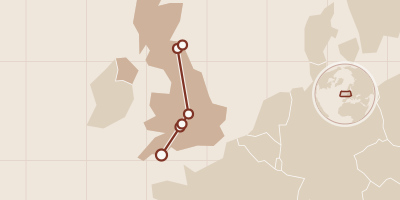
In Rachel Joyce's The Unlikely Pilgrimage of Harold Fry, a retired man walks from Kingsbridge in Devon to Berwick-upon-Tweed, passing Stroud, Cheltenham, Coventry and the Scottish border town of Kelso to reach a dying friend. The route follows the walk stage by stage, from a post box in Devon to the hospice at the far end of England, and the reasons Harold gives, and withholds, for going. The novel names towns rather than streets, so every pin marks a town.

6 locations0/6 visitable
BooksSpeculative

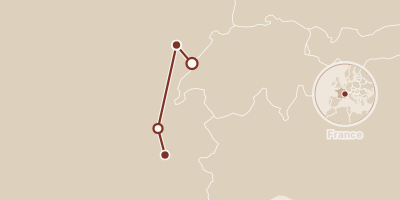
The Red and the Black: Verrières to Besançon

The Red and the Black is set in Franche-Comté: Julien Sorel grows up in the fictional town of Verrières, studies at the seminary in Besançon, and meets his end after a church shooting based on a real 1827 crime near Grenoble. The route follows Julien from Verrières-de-Joux, the village that may have lent its name, through Besançon's citadel, seminary and cathedral, to Brangues and Place Grenette, where the real Antoine Berthet who inspired the novel was tried and executed.

6 locations4/6 visitable
BooksApproximate

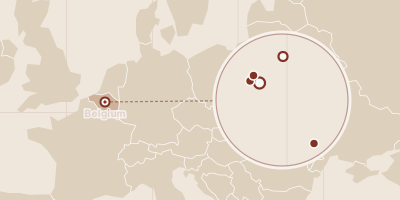
The Adventures of Tintin: Hergé's Brussels

Tintin's Brussels is the Marolles flea market where he buys the Unicorn, the Etterbeek street where Hergé was born, and the museums that keep his work: the Belgian Comic Strip Center, the Hergé Museum in Louvain-la-Neuve and the Moon rocket at Brussels Airport. Hergé was born in Brussels, and the city shows up in his books and in the places that celebrate them. This route follows five real places from his birth in 1907 to the Tintin sights you can visit today. The Unicorn flea-market scene is set in the Marolles; other stops are Tintin landmarks rather than story scenes.

5 locations4/5 visitable
BooksFictional

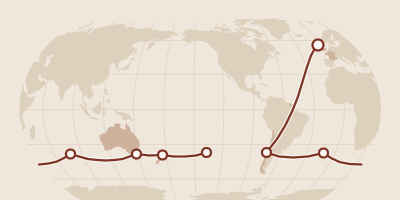
In Search of the Castaways: Captain Grant's 37th Parallel

Jules Verne's In Search of the Castaways (Captain Grant's Children) follows the 37th parallel south from Dumbarton in Scotland to Talcahuano in Chile, Tristan da Cunha, Amsterdam Island, the Snowy River in Australia and Lake Taupo in New Zealand. This route follows Lord Glenarvan's yacht Duncan and the search for Captain Grant, ending on Tabor Island. Most pins are approximate, since the book gives a latitude and a landscape rather than street addresses.

7 locations4/7 visitable
MoviesApproximate

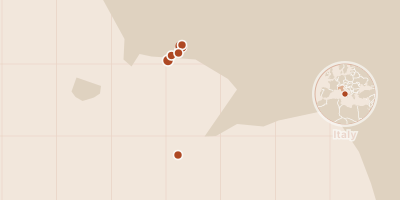
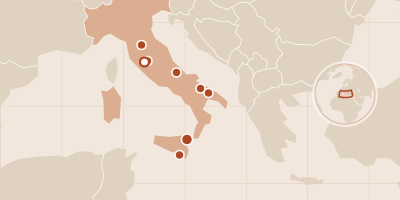
Parthenope: Sorrentino's Naples and Capri

Parthenope (2024), Sorrentino's film, was shot in Naples and on Capri: Villa Lauro in Posillipo, the Galleria Umberto I, Federico II University, the Gardens of Augustus, Spaccanapoli, Naples Cathedral and Via Partenope. It follows a woman named after her city from her birth in 1950 to 2023. The route runs in story order, from the sea at Posillipo to the seafront where the film ends.

8 locations7/8 visitable
MoviesApproximate

Tale of Tales: Garrone's Italian Castles

Matteo Garrone's Tale of Tales (Il racconto dei racconti, 2015) was shot entirely in Italy: Castel del Monte in Apulia, Donnafugata Castle in Sicily, Sammezzano Castle in Tuscany, Roccascalegna in Abruzzo and the Alcantara Gorge all play fairy-tale kingdoms. The route follows the film's three tales through eight real locations, from the gorge where the sea dragon lives to the tuff lanes where an ogre chases a runaway princess. Several castles are used only for exteriors or interiors, and the notes say which.

8 locations6/8 visitable
MoviesApproximate

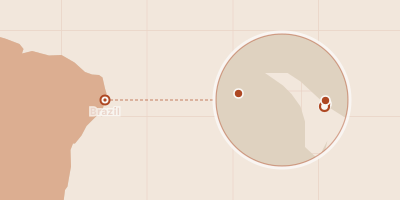
The Secret Agent: Recife, 1977

The Secret Agent (O Agente Secreto) is set in Recife during the 1977 carnival and was filmed on location in the city: Rua da Aurora, the Cinema São Luiz, the Capibaribe River and Parque 13 de Maio, plus the Federal University of Pernambuco campus. Director Kleber Mendonça Filho follows Armando, a former professor on the run in the Brazilian military dictatorship. The route walks the film's carnival week, from the parade street to the shark, the cinema and the park where the Hairy Leg legend, based on real newspaper reports, takes hold.

5 locations4/5 visitable
MoviesApproximate

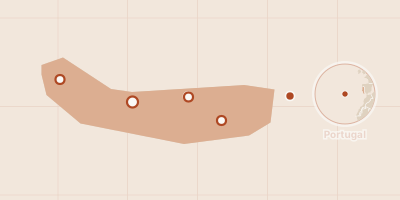
Rabo de Peixe (Turn of the Tide): Filming Locations in the Azores

Rabo de Peixe, the Netflix series known as Turn of the Tide, is set in a fishing village on São Miguel in the Azores, but it was shot in several places across the island: Porto Formoso, the Arnel lighthouse, Furnas and the ruined Monte Palace Hotel above Sete Cidades. The story is loosely based on a real 2001 cocaine landing. The route follows the series from the village to its final scenes, with a note on what you can visit today.

6 locations5/6 visitable
MoviesApproximate

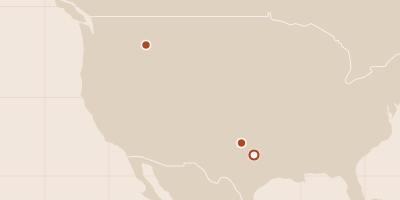
1883: Fort Worth to the Dutton Ranch in Montana

1883 is set on the Dutton family's wagon journey from Fort Worth, Texas, to Montana, and its town scenes were filmed on Exchange Avenue in the Fort Worth Stockyards, with the Dutton ranch at Chief Joseph Ranch in Darby. The route follows the story from the Pinkerton office and Hotel Calhoun in Fort Worth through Doan's Crossing on the Red River to the Montana valley where the Duttons settle. Filming locations are marked where the sources name them; Doan's Crossing is the story's place, not a set.

6 locations2/6 visitable
MoviesFictional

Miraculous Ladybug: Real Paris Landmarks

Miraculous: Tales of Ladybug & Cat Noir is set in Paris, and the real places behind it are the Eiffel Tower, the Place des Vosges, a bakery on Rue Caulaincourt, the Lycée Carnot, the Plaza Athénée and the Parc des Princes. The series mixes real monuments with places it renames or reshapes. This route follows six places, from the tower on the skyline to the real bakery behind Marinette's family shop. Several places are inspirations rather than filming sites, so each one says what the show changed.

6 locations4/6 visitable
MoviesApproximate

Christiane F.: Bahnhof Zoo and West Berlin Locations

Christiane F. – Wir Kinder vom Bahnhof Zoo is set in West Berlin and filmed around Bahnhof Zoo, Kurfürstenstraße and the Deutschlandhalle, with the heroine's home in Gropiusstadt. It is based on the 1978 book Zoo Station. Uli Edel's 1981 film follows 13-year-old Christiane Felscherinow from a high-rise in Gropiusstadt through a Bowie concert to the station's underpasses. The route visits the five places the film and the book make famous, in story order, and says plainly where the pins are only the area.

5 locations1/5 visitable
MoviesApproximate

Meister Eder und sein Pumuckl: Filming Locations in Munich

Meister Eder und sein Pumuckl, the Munich kobold series, was filmed at Widenmayerstraße 2 in the Lehel, outside Zum Huterer in Haidhausen and at Tierpark Hellabrunn. This route follows six places where scenes were shot, from the demolished workshop courtyard to the Kabelsteg footbridge and the zoo. The pub's pin marks its street, not its door.

6 locations5/6 visitable
MoviesApproximate

Rosenheim Cops: Filming Locations in Rosenheim and Chiemgau

Die Rosenheim-Cops is set in Rosenheim and the Chiemgau, but the town hall, Max-Josefs-Platz, the Chiemsee, Weyarn and Dietramszell are only part of where it was shot. This route follows seven places where the crime series was set or filmed, from the police headquarters in Rosenheim's town hall to villas near Lake Starnberg. Several stops are marked by area, because the sources name the place but not the exact spot.

7 locations4/7 visitable
MoviesApproximate

The Black Forest Clinic: Filming Locations from Glottertal

The Black Forest Clinic (Die Schwarzwaldklinik) was filmed at the Carlsbau in Glottertal, with the Brinkmann house in Grafenhausen and the town scenes in Schiltach. The route follows the series' exteriors from the clinic building through Schluchsee, Triberg, Freiburg and Konstanz. Interiors were shot at Studio Hamburg, and the series stitches distant places into one fictional town.

7 locations4/7 visitable
MoviesApproximate

Der Bergdoktor: Ellmau and the Wilder Kaiser

Der Bergdoktor is filmed in Tyrol, in the villages of Ellmau, Going, Scheffau and Söll below the Wilder Kaiser mountains, plus the hospital in Schwaz. The doctor series follows Dr. Martin Gruber through a mountain village. The route walks the real places behind it: the practice farm, the family farm, the village inn, the lake, the studio clinic and the hospital that stands in for Klinik Hall. Visiting seasons vary.

6 locations4/6 visitable
MoviesApproximate

Un passo dal cielo: Filming Locations in the Dolomites

Un passo dal cielo, the Rai 1 series, is set in San Candido in South Tyrol and later in San Vito di Cadore in the Belluno Dolomites, but it was mostly filmed around Lago di Braies, Prato Piazza, Dobbiaco, Lago di Mosigo and Misurina. This route follows the series from its South Tyrol seasons to its Cadore seasons, with eight places where scenes were set or shot. Where the sources only name a place, the pin marks the area.

8 locations8/8 visitable
MoviesApproximate

Winnetou: Croatia's Wild West

The Winnetou films of the 1960s are set in the Wild West but were shot in Croatia: the Silver Lake is Plitvice, the Apache pueblo stood above the Zrmanja canyon and Santa Fe is the town of Trogir. This route follows three of the films (Der Schatz im Silbersee, Winnetou 1 and Winnetou 3, 1962 to 1965) from Plitvice and Paklenica to the Krka falls, Trogir and Mali Alan, where Winnetou dies. Most sets were torn down after filming, but the landscapes remain.

7 locations5/7 visitable
MoviesApproximate

A Good Year: From London to Provence

A Good Year is set in Provence and London, and was filmed at Château La Canorgue in Bonnieux, in Gordes and at the village pond of Cucuron, with Broadgate and the Criterion Restaurant standing in for London. Max, a London trader, inherits his uncle's Luberon vineyard and falls for a local café owner. The route follows him from the City to the estate, the café and the candlelit dinner by the water.

5 locations4/5 visitable
MoviesApproximate

The Great Beauty: Filming Locations in Rome

The Great Beauty (La grande bellezza) was filmed in Rome, from the Fontana dell'Acqua Paola on the Janiculum and Palazzo Sacchetti on Via Giulia to Santa Maria del Priorato on the Aventine, Villa Medici and the Verano Cemetery, with a last scene on Giglio Island. Shooting began on 9 August 2012 and lasted about eight weeks. This route follows Jep Gambardella's story through seven of those places, and says where you can still go.

7 locations7/7 visitable
MoviesApproximate

Jean de Florette: Filming Locations in Provence

Jean de Florette was filmed around Riboux, Mirabeau and Vaugines, with market scenes in Sommières, for Claude Berri's 1986 adaptation of the Provence story. The film follows Ugolin and his uncle Papet, who plug a spring to take over a neighbour's land, and the newcomer Jean de Florette, who farms without knowing it. The route runs from the farm of Les Romarins to the village church and bench; some stops are stand-ins for the story's places.

5 locations2/5 visitable
MoviesExact

Il Postino: Procida and Salina

Il Postino (1994) was filmed on two islands: Procida in the Gulf of Naples, where Mario delivers Pablo Neruda's mail around Marina Corricella, Via San Rocco and Piazza dei Martiri, and Salina in the Aeolian Islands, whose Pollara bay hosts Neruda's house and a beach. The film moves the story to Italy around 1950 and never names the island. This route follows the real places: the waterfront bar where Mario meets Beatrice, the village street, the post office square and the two beaches.

5 locations5/5 visitable
MoviesApproximate

Three Wishes for Cinderella: Moritzburg to Norway

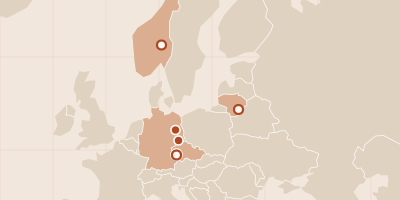
Three Wishes for Cinderella (Drei Haselnüsse für Aschenbrödel, 1973) was shot at Moritzburg Castle near Dresden and Švihov Castle in Bohemia, and the 2021 Norwegian remake at Trakai in Lithuania and Maihaugen in Lillehammer. The route follows the winter film from the Bohemian forests and the Babelsberg ballroom set to the Moritzburg stairs, then to the remake's locations.

6 locations2/6 visitable
MoviesApproximate

Welcome to the Sticks: Bergues and Lille

Welcome to the Sticks (Bienvenue chez les Ch'tis) is set in Bergues, near Dunkirk, and filmed there, with scenes in Lille, Lens, Malo-les-Bains and Bruay-la-Buissière. A post-office manager from the south is sent north for two years and finds the warmest welcome of his life. The route follows the film from the café where Philippe crashes his bike to the belfry where the love story ends.

6 locations6/6 visitable
MoviesApproximate

La Grande Vadrouille: Paris to Burgundy

La Grande Vadrouille (1966) is set in occupied France and filmed at the Paris Opéra, the Grande Mosquée de Paris, the Hospices de Beaune, Meursault and villages of Burgundy. It follows British airmen and two civilians from Paris to the demarcation line. This route follows the film's chase from the capital's baths and opera into Burgundy, using the real locations where Gérard Oury shot the scenes. Several stops can be visited; scenes set in one village were sometimes shot in another.

6 locations5/6 visitable
MoviesExact

Les Visiteurs: Carcassonne to Thoiry

Les Visiteurs (1993) was filmed in Carcassonne, Thoiry, Ermenonville, Argenteuil and Vigny: the Château Comtal in the Cité de Carcassonne is the medieval castle, and the Château d'Ermenonville is Montmirail in the present day. The route follows a 12th-century knight and his squire from 1123 to 1992, across five film locations, and notes where the film and the places differ.

5 locations3/5 visitable
Real JourneysApproximate

Marie Curie: Warsaw to Paris

Marie Curie's life runs from her birthplace on Freta Street in Warsaw to the Latin Quarter, the Radium Institute and the Panthéon in Paris. This route follows the places where Maria Skłodowska became Marie Curie. It starts with the Flying University and a first laboratory in Warsaw, then the Sorbonne years, her 1895 wedding in Sceaux, the street where Pierre Curie died, the Musée Curie and her tomb in the Panthéon.

7 locations6/7 visitable
HistorySpeculative

Crazy Horse: Little Bighorn to Fort Robinson

Crazy Horse's story runs through six places: Fort Phil Kearny in Wyoming, the Rosebud and Little Bighorn battlefields in Montana, Fort Robinson in Nebraska, and the Crazy Horse Memorial in South Dakota. The Oglala Lakota war leader helped defeat the army from 1866 to 1876, then surrendered and was killed at Fort Robinson in 1877. The route follows his campaigns in order, then turns to what remains: the burial legend near Wounded Knee Creek and the unfinished mountain carving that many Lakota oppose.

6 locations5/6 visitable
HistoryExact

Munich History Walk: Marienplatz to Nymphenburg

A Munich sightseeing route from Marienplatz and the Frauenkirche to the Residenz and Nymphenburg Palace, tracing six centuries of the city's Wittelsbach rulers, markets and churches. The walk starts on the old market square, passes the cathedral, the Viktualienmarkt, the royal Residenz and the Theatine Church, then ends at the summer palace where King Ludwig II was born. Many buildings were rebuilt after World War II bombing.

6 locations6/6 visitable
HistoryApproximate

Lourdes: Bernadette's Pilgrimage Town

Lourdes in the Pyrenees of France became a major pilgrimage town after Bernadette Soubirous reported 18 visions at the Grotto of Massabielle in 1858, and this route links the Boly mill, the Cachot, the grotto and the basilicas. It follows Bernadette from her birthplace through the apparitions to the three basilicas and the church that grew around the grotto. The visions are described as Bernadette reported them; the Church confirmed them in 1862.

7 locations5/7 visitable
HistoryExact

Vauban's Fortresses: Lille to Briançon

Vauban's fortifications, a UNESCO World Heritage group, include the citadels of Lille and Besançon, the Mont-Louis citadel, the ramparts of Saint-Martin-de-Ré, Mont-Dauphin, Neuf-Brisach and the Asfeld Bridge at Briançon. Louis XIV's military engineer drew a belt of strongholds around France. Each stop here is a place you can still walk through, and each shows a different way of making a border hard to cross. Stops follow the date each fortress was begun. Some of them are still working towns, not just monuments.

7 locations1/7 visitable
MythologySpeculative

Ramayana: In the Footsteps of Rama

The Ramayana trail runs from Ayodhya, Rama's traditional birthplace, through Chitrakoot, Panchavati and Hampi to Rameswaram, Dhanushkodi and Sri Lanka's Sita Eliya. Every place here is a traditional identification, not a proven site. The route follows the epic's order: the exile decreed in Ayodhya, the forests, Sita's abduction, the search in Kishkindha, Hanuman's find in Lanka, and the bridge to Lanka. Most stops are living pilgrimage places you can visit.

7 locations6/7 visitable
Real JourneysSpeculative

Seven Churches of Revelation: Ephesus to Laodicea

The Seven Churches of Revelation lie in western Turkey: Ephesus near Selçuk, Smyrna, Pergamon at Bergama, Thyatira at Akhisar, Sardis, Philadelphia at Alaşehir and Laodicea near Denizli. They are the seven cities addressed in the letters of Revelation 2–3. This pilgrimage route follows the letters in order, from Ephesus to Laodicea, and sets each message beside what stands on the ground. The sources identify some sites exactly and others only by their modern town.

7 locations5/7 visitable
Real JourneysSpeculative

In the Footsteps of Saint Paul: Missionary Journeys

Saint Paul's missionary journeys run from Paphos in Cyprus through Antioch of Pisidia, Philippi, Athens, Corinth and Ephesus to Malta and Rome, as told in the Acts of the Apostles. The route follows Paul from his first journey with Barnabas to the shipwreck on Malta and his final years in Rome, with the ruins, hills and basilicas you can still visit. Several spots, like the Areopagus and Paul's tomb, are traditional identifications, and each stop says how firm the evidence is.

8 locations8/8 visitable
HistoryApproximate

Pablo Picasso: From Málaga to Paris

Pablo Picasso was born in Málaga in 1881 and found his path in A Coruña, Barcelona, Madrid and Paris; the route visits his birthplace on Plaza de la Merced, Els Quatre Gats café, the Royal Academy of San Fernando and the Bateau-Lavoir in Montmartre. It follows the young painter from his birth to the studio where he completed Les Demoiselles d'Avignon in 1907. Four of the five stops can still be seen today.

5 locations3/5 visitable
HistorySpeculative

Vermeer's Delft: From Baptism to Grave

Vermeer's Delft is a short walk through the Dutch city where Johannes Vermeer was baptized, painted and was buried. The route runs from the Nieuwe Kerk and the Vermeer Centre to the Paardenmarkt, the Vlamingstraat of The Little Street, a view of the skyline from the south, and the Oude Kerk. The stops follow his life, from baptism in 1632 and the guild in 1653 to the 1654 explosion and his burial in 1675. The exact site of The Little Street is still debated.

6 locations6/6 visitable
HistoryApproximate

Rembrandt's Amsterdam: House, Night Watch and Grave

Rembrandt lived in Amsterdam from 1631 to his death in 1669, and his story runs from the Rembrandt House Museum and the Rijksmuseum's Night Watch to the Oude Kerk, Rozengracht, Westerkerk and Rembrandtplein. The route follows the painter from the Jodenbreestraat house he bought in 1639, through his wife Saskia's burial, bankruptcy and the move to the Jordaan, to his rented grave in 1669. Several stops can still be visited today.

6 locations6/6 visitable
HistoryApproximate

Elvis Presley: From Tupelo to Graceland

Elvis Presley's story runs from his birthplace in Tupelo, Mississippi, to Humes High School, Beale Street, Sun Studio, the Overton Park Shell and Graceland in Memphis, Tennessee. The route follows him from a shotgun house in 1935 to the 1954 recording session and first paid concert that launched him, and the mansion he bought in 1957. Most stops can still be visited.

6 locations5/6 visitable
HistoryExact

The Beatles: Liverpool to Abbey Road

Beatles places in Liverpool and London: the church hall in Woolton where Lennon met McCartney, Penny Lane, Strawberry Field, the Cavern Club, the Savile Row rooftop and the Abbey Road zebra crossing. The route follows the band from 1957 to 1969 in seven stops, from McCartney's family home in Allerton to the last public concert on a London roof and the cover photo of Abbey Road. Most stops can still be visited.

7 locations6/7 visitable
HistoryApproximate

Tchaikovsky: From Votkinsk to Saint Petersburg

Tchaikovsky's life runs from his birthplace in Votkinsk through the School of Jurisprudence, the Saint Petersburg and Moscow conservatories, the Mariinsky Theatre and his house in Klin to his grave in Tikhvin Cemetery. Most of these places can still be visited. The route follows the composer from his birth on 7 May 1840 to his death on 6 November 1893: childhood in Udmurtia, a civil-service training he gave up, music school, two opera premieres and the last symphony. The cause of his death is still debated, and the final stop says so.

7 locations7/7 visitable
HistoryApproximate

Chopin: From Warsaw to Paris

Frédéric Chopin was born in Żelazowa Wola near Warsaw, lived in Warsaw until 1830, wintered on Mallorca, composed in Nohant and died in Paris; his body lies in Père Lachaise, his heart in Warsaw's Holy Cross Church. This route follows the composer's life from his birthplace and the Warsaw home he left in 1830 to Valldemossa, Nohant, his last Paris apartment on Place Vendôme and the two resting places that split him between France and Poland.

7 locations6/7 visitable
HistoryApproximate

Beethoven: From Bonn to Vienna

Beethoven's life runs from Bonn, where he was born in 1770, to Vienna, where he lived from 1792, wrote the Eroica and the Fifth Symphony, and is buried in the Zentralfriedhof. He was born in a small house on Bonngasse and moved to Vienna at 21. There he faced growing deafness, which he wrote about in the Heiligenstadt Testament in 1802, and composed in the Pasqualati House and the Theater an der Wien. This route follows the composer from his Bonn birthplace through the Vienna addresses where his symphonies and Fidelio were written and first heard, to his grave and the 1845 Bonn monument.

6 locations6/6 visitable
HistoryApproximate

Wyatt Earp: From Dodge City to Tombstone

Wyatt Earp's lawman years run from the cattle towns of Wichita and Dodge City, Kansas, to Tombstone, Arizona, where the gunfight at the O.K. Corral took place in 1881. Earp wore a badge in Kansas, then followed his brothers to a silver boomtown. This route follows him from his first police job to the shootout, his brother Morgan's murder and the vendetta ride through Tucson, ending at his grave in Colma, California. The real gunfight was not at the corral at all, and the stops say where it actually happened.

7 locations2/7 visitable
HistoryExact

Battle of Britain 1940: RAF Airfields from Dover to Uxbridge

The Battle of Britain was fought over south-east England in 1940, and its places are still there: Dover, RAF Biggin Hill, RAF Kenley, RAF Hornchurch, RAF Tangmere and the underground Uxbridge bunker. The route follows the summer of 1940 from the Dunkirk headquarters at Dover Castle through the Kent and Sussex fighter fields, which were bombed in August, to the operations room where Churchill watched 15 September. Many sites are now museums, parks or airports.

8 locations8/8 visitable
HistoryApproximate

Pearl Harbor and Midway: From 7 December 1941 to June 1942

Pearl Harbor and Midway tell the Pacific war's first six months: the Japanese attack on Battleship Row and the USS Arizona Memorial in Hawaii on 7 December 1941, then the naval battle at Midway Atoll in June 1942 that sank four Japanese carriers. The route runs from Ford Island and Hickam Field to the codebreakers of Station HYPO, the fighting at Midway and the wreck of USS Yorktown on the seabed. Pearl Harbor stops can be visited; Midway Atoll is remote and the Yorktown wreck lies on the deep seabed.

6 locations1/6 visitable
HistoryApproximate

The Underground Railroad: From Maryland to Canada

The Underground Railroad's northern routes ran from Maryland's Eastern Shore through Wilmington and the Ohio River towns to Niagara Falls and Dresden, Ontario. This route follows seven real places linked to it, from Harriet Tubman's escape to the Dawn settlement. It joins Harriet Tubman's park in Maryland, Thomas Garrett's Wilmington, the Rankin and Levi Coffin houses, the Freedom Center in Cincinnati, the Niagara bridge and the Dawn settlement. The stops follow the geography, not one person's single journey.

7 locations4/7 visitable
HistoryExact

Boston's Freedom Trail: Revolutionary Sites Walk

Boston's Freedom Trail is a 2.5-mile walking route past 16 sites of the American Revolution, from the State House and Old South Meeting House to Paul Revere's House, Old North Church and Bunker Hill. This route covers nine stops in order: the Massachusetts State House, the Granary Burying Ground, the Tea Party meeting house, the Old State House, Faneuil Hall, Revere's home, the lanterns of Old North Church, USS Constitution and the Bunker Hill Monument.

9 locations9/9 visitable
HistorySpeculative

The Mayflower: From Scrooby to Plymouth Rock

The Mayflower's 1620 voyage runs from Scrooby in Nottinghamshire and Leiden in the Netherlands through Southampton, Dartmouth and Plymouth, England, to Provincetown and Plymouth Rock in Massachusetts. The Pilgrims were English Separatists who left home for the Netherlands, then sailed for America in two ships. One, the Speedwell, kept leaking, so they crowded onto the Mayflower alone and finally sailed from Plymouth in September 1620, bound for Virginia. This route follows them stop by stop, from the manor where their church met to the rock tradition names as their landing place. Plymouth Rock is a tradition, not a documented spot, and the stop says so.

7 locations6/7 visitable
HistoryExact

Hegra and the Nabataeans: Mada'in Salih to Petra

Hegra (Mada'in Salih) in Saudi Arabia was the Nabataean kingdom's second capital after Petra in Jordan, and the rock-cut tombs of both cities come from the same 1st-century world. This route follows the Nabataean caravan network from the Hegra tombs through Humeima and Little Petra to the Treasury and Monastery in Petra, and ends at Avdat on the Petra-Gaza road in the Negev.

6 locations6/6 visitable
HistoryApproximate

Jamestown to Yorktown: Virginia's Colonial and Revolutionary Road

Jamestown to Yorktown is the best-known stretch of Virginia's early American history: from the 1607 James Fort at Historic Jamestowne, via the Capitol in Williamsburg and St. John's Church in Richmond, to the Moore House and surrender field at Yorktown. The route follows 174 years from England's first lasting colony to Cornwallis's surrender in 1781, with Patrick Henry's speeches along the way. Most stops can be visited; the Williamsburg Capitol is a reconstruction.

6 locations6/6 visitable
HistoryApproximate

José Rizal: Calamba to Bagumbayan

José Rizal, the Philippine national hero, was born in Calamba, exiled to Dapitan, imprisoned in Fort Santiago and shot at Bagumbayan, now Rizal Park in Manila, on 30 December 1896. This route follows his life and death through six places: the reconstructed family house in Calamba, the shrine on his Dapitan estate, Fort Santiago in Intramuros, the execution ground at Luneta, his secret first grave at Paco Park and the monument that now holds his remains.

6 locations6/6 visitable
HistorySpeculative

The First Crusade: Clermont to Jerusalem

The First Crusade (1096-1099) ran from Clermont in France through Constantinople, Nicaea and Antioch to Jerusalem, and this route follows it stop by stop. It began with Pope Urban II's sermon at Clermont on 27 November 1095. The six stops cover the sermon, the oaths sworn to the Byzantine emperor in Constantinople, the sieges of Nicaea and Antioch, the battle at Dorylaeum and the fall of Jerusalem in July 1099. Violence is named plainly; the medieval accounts are partly written after the fact.

6 locations0/6 visitable
HistoryApproximate

Spartacus: The Slave Revolt of 73–71 BC

The Spartacus revolt began at a gladiator school in Capua, climbed Mount Vesuvius, ran south to the Strait of Messina and ended on the Sele River in 71 BC. It was the Third Servile War, the largest slave uprising Rome ever faced. The route follows the rebellion in order: the breakout of 73 BC, the siege on Vesuvius, the failed attempt to cross to Sicily, the last battle against Crassus and the crucifixions along the Appian Way. Ancient sources were written a century or more later and disagree in places, so the exact spots of the school and the battlefield are approximate.

5 locations4/5 visitable
BooksApproximate

Alice in Wonderland: Oxford and Christ Church

Alice's Adventures in Wonderland grew out of Oxford: Lewis Carroll wrote it as a Christ Church mathematician for Alice Liddell, the daughter of the college's Dean, and the story began on a boat trip from Folly Bridge to Godstow. The route runs from Christ Church Cathedral, where Carroll met the Liddells in 1856, through Christ Church, the river, the Botanic Garden and the Natural History Museum's dodo to the St Aldate's shop that became the Old Sheep Shop. Most places can still be visited. Links between scenes and places are readings, not Carroll's own statements.

7 locations7/7 visitable
BooksFictional

Heart of Darkness: Brussels to the Congo River

Heart of Darkness is set in the Congo Free State, a Belgian company's territory, and this route follows Marlow from Brussels to Boma, Matadi, the Livingstone Falls rapids and Kinshasa, then on to Kurtz's station upriver. Conrad's novella names almost none of its places, so most stops are marked as likely identifications, drawn from Conrad's own job on the Congo River.

6 locations0/6 visitable
HistoryExact

Pompeii, AD 79: A Walking Tour of the Lost City

Pompeii is the Roman city near Naples buried by the eruption of Mount Vesuvius in AD 79, and this walking tour goes from its Amphitheatre and the Forum's Temple of Apollo to the House of the Faun, the Lupanar and the Garden of the Fugitives. The route covers the town in its last years: a brawl in the arena in AD 59, the earthquake of 62, a rebuilt town, and the two days of the eruption itself. All six places can be visited today inside the Pompeii archaeological park.

6 locations6/6 visitable
BooksApproximate

The Diary of Anne Frank: Amsterdam and the Secret Annex

Anne Frank wrote her diary in the Secret Annex at Prinsengracht 263 in Amsterdam, within sight of the Westerkerk tower. The route starts at the family's flat on the Merwedeplein, where she got the diary on her thirteenth birthday in 1942. It follows the family from the Annex through the arrest of 4 August 1944 to Westerbork, Auschwitz-Birkenau and Bergen-Belsen, where Anne died in early 1945.

7 locations6/7 visitable
BooksFictional

East of Eden: The Salinas Valley

East of Eden is set in California's Salinas Valley, mostly between the start of the twentieth century and the end of World War I, and its places are Salinas, King City and the farmland between them. The 1955 James Dean film moved the story to Monterey on screen but was shot largely in Mendocino, with scenes in Spreckels and the valley. This route follows John Steinbeck's novel through the valley, Kate's town of Salinas and the film's locations, so you can see where the story and the screen version happen.

6 locations4/6 visitable
BooksFictional

The Catcher in the Rye: Holden's New York

Holden Caulfield's weekend in The Catcher in the Rye runs from a Pennsylvania boarding school to Grand Central Terminal, the Metropolitan Museum of Art, the Central Park Zoo and the Central Park Carousel in New York City. The route follows Holden's escape from Pencey Prep and ends with his sister Phoebe on the carousel. The museum, zoo and carousel can all be visited; Pencey is invented, and the pin marks the real school Salinger may have used as its model.

5 locations4/5 visitable
MoviesApproximate

Seventeen Moments of Spring: Filming Locations from Moscow to Riga and Meissen

Seventeen Moments of Spring is set in Berlin and Bern in 1945, but it was filmed mostly elsewhere: Arkhangelskoye-Tyurikovo park and Butyrka prison in Moscow, Jauniela in Old Riga, and the Saxon towns of Hohnstein and Meissen, plus the Berlin inn Zur letzten Instanz. The route follows these real sites in the order of the Soviet spy series, from the Bavarian forest to Bern's Flower Street, and shows how Moscow and Riga stood in for wartime Germany and Switzerland.

7 locations5/7 visitable
MoviesApproximate

Sirāt (2025): Filming Locations in Morocco and Spain

Sirāt, Óliver Laxe's 2025 road film, is set in southern Morocco but opens at a Spanish rave: the Rambla de Barrachina near Teruel stands in for the desert, while the mountain road, the white sand and the train were shot near Errachidia and Erfoud. The route follows the father Luis and his son Esteban as they chase a missing daughter and join a convoy of ravers. Each stop is a place in the film's region, not a precise pin: the director names the area, rarely the exact spot.

5 locations0/5 visitable
MoviesApproximate

La bola negra: Granada, Castil de Carrias and Comillas

La bola negra (The Black Ball), the 2026 film by Javier Calvo and Javier Ambrossi, was shot in Granada, Sierra Nevada, Castil de Carrias, Sigüenza, Madrid, Athens and Comillas. It follows three timelines inspired by Federico García Lorca's unfinished play. The route runs through the 1932, 1937 and 2017 storylines. The film does not name most of its settings, so most pins mark the listed filming locations.

7 locations3/7 visitable
MoviesApproximate

Dexter: Miami and the Long Beach Filming Locations

Dexter is set in Miami, but only part of it was filmed there: Ocean Drive in South Beach and the waters off Virginia Key are real Miami, while Long Beach, California, plays much of the rest. The route follows the Showtime series from the pilot's Miami street scenes to Long Beach's Villa Riviera and university campus, and ends at Ontario International Airport for the finale.

6 locations5/6 visitable
MoviesApproximate

The Wire: Filming Locations in Baltimore

The Wire was set and filmed in Baltimore: the Ritz Cabaret in Fells Point, East Baltimore's Middle East, Locust Point, Greenmount West and Camden Yards all appear on screen. The HBO series by David Simon ran for five seasons from 2002 to 2008. This route follows five places from the first-season pilot to the school storyline of season 4. Most pins are neighborhoods, not single doors.

5 locations5/5 visitable
MoviesApproximate

Heated Rivalry: Filming Locations in Ontario and Montreal

Heated Rivalry was filmed in Ontario: Hamilton (McMaster University, Dundurn Castle, FirstOntario Concert Hall), the Sleeman Centre in Guelph, and Muskoka, with Montreal landmarks in establishing shots. The route follows the Crave series across seven places, from Shane and Ilya's first meeting on a Hamilton campus to the cottage finale. Most are visitable; the Muskoka pin is only an area.

7 locations6/7 visitable
MoviesFictional

KPop Demon Hunters: Real Seoul Locations

KPop Demon Hunters is set in Seoul, and several real places appear on screen: Seoul Olympic Stadium in the opening scene, Jayang Station on Line 7, Namsan Seoul Tower, Naksan Park and Bukchon Hanok Village. It is an animated film, so these are places it shows rather than filming sites. The route follows five of them, with what each is like to visit today.

5 locations5/5 visitable
MoviesFictional

Bluey: Brisbane and Its Queenslander Houses

Bluey is set in Brisbane, Queensland: the show draws on Queen Street Mall, South Bank and the city's Queenslander houses, with a trip to the Big Pelican on the Noosa River. The route follows the series from Ludo Studio in Fortitude Valley to the real places it draws, ending at Bluey's World in Hamilton. The Heeler house is fictional, so it is not pinned.

6 locations3/6 visitable
MoviesExact

Blade Runner: Los Angeles 2019 Filming Locations

Blade Runner's 2019 Los Angeles was filmed at the Bradbury Building, the Ennis House, Union Station, the 2nd Street Tunnel and a Warner Bros. backlot in Burbank. Ridley Scott's 1982 film follows Rick Deckard as he hunts four replicants through a rainswept, neon-lit city. This route follows the story from the police station to the final chase across a rooftop, and shows which real downtown and Los Feliz landmarks stood in for the future. Most sets were dressed heavily for the camera, so expect the buildings, not the neon.

5 locations2/5 visitable
MoviesApproximate

Fast & Furious: Filming Locations from Los Angeles to Abu Dhabi

Fast & Furious was filmed in Los Angeles, Tokyo, Puerto Rico, Atlanta and Abu Dhabi, with Rio and the Dominican Republic as story settings. The first film used Echo Park and San Bernardino; later sequels travelled to Shibuya, Naranjito and the Etihad Towers. The route follows the saga from Dom's Los Angeles streets through Tokyo, the Dominican Republic, Rio and Puerto Rico to Atlanta and Abu Dhabi. Several stops can be visited; some cities were stand-ins for other places.

9 locations6/9 visitable
MoviesApproximate

The Good, the Bad and the Ugly: Almería and Burgos Locations

The Good, the Bad and the Ugly was filmed in Spain: the Tabernas Desert in Almería, then Burgos for the Sad Hill Cemetery, the Arlanza monastery and the bridge battle. Spanish soldiers helped build its sets. The route follows the shoot from the Mini Hollywood set in Almería to the restored Sad Hill graveyard, tying each location to its scene. Some sites are visitable, while the Cortijo del Fraile is a ruin, and the bridge spot is not pinned.

6 locations2/6 visitable
MoviesApproximate

Jeepers Creepers: Filming Locations in Florida

Jeepers Creepers was filmed around Ocala in northern Florida in 2000, with its road scenes shot on SW 180th Avenue Road near Dunnellon. The church, diner, police station and factory were spread across Ocala, Lake Panasoffkee and Reddick. The route follows Trish and Darry from the country road to the church, the diner, the station and the finale. Several of the sites are gone or changed, so the pins are approximate.

5 locations1/5 visitable
MoviesApproximate

A Few Good Men: Filming Locations and Guantanamo Stand-ins

A Few Good Men (1992) is set at Guantanamo Bay but was filmed in Southern California, at Fort MacArthur, Crystal Cove State Park and Point Mugu, with Culver Studios as the courtroom and Memorial Bridge in Washington. The route follows the court-martial story from the real base to the stand-ins that played it, then to Washington and the courtroom where Colonel Jessep says "You can't handle the truth!". Nothing was filmed at Guantanamo, so the first pin shows the setting only.

6 locations0/6 visitable
MoviesApproximate

Boyz n the Hood: South Central Los Angeles Filming Locations

Boyz n the Hood was filmed in the South Central Los Angeles neighbourhoods where director John Singleton grew up: Inglewood's Woodworth Avenue, Cimarron Street in Park Mesa Heights, and Crenshaw Boulevard. This route follows Tre Styles from his 1984 childhood to the fatal night in 1991. Singleton wrote the film from his own life and shot it in sequence from October 1990. The route covers six stops, from the school and the Styles house to Crenshaw High School and the boulevard's restaurant. Several stops are private homes, so check the pin precision.

6 locations3/6 visitable
MoviesApproximate

30 Rock: Rockefeller Center and Manhattan Filming Locations

30 Rock is set at 30 Rockefeller Plaza in Midtown Manhattan but mostly filmed at Silvercup Studios in Long Island City, with Battery Park City and Douglaston standing in for Cleveland and Needmore. The route follows the sitcom from its NBC address and studio, through the Queens soundstages where the sets were built, to the New York neighbourhoods that played other towns, and ends at the cast reunion at Radio City Music Hall.

5 locations3/5 visitable
MoviesApproximate

Four Weddings and a Funeral: Filming Locations in England

Four Weddings and a Funeral was shot mainly in London and the Home Counties: the first wedding in the Hertfordshire village of Sarratt, the second reception at Luton Hoo, the funeral at St Clement's in West Thurrock, Essex, and the fourth wedding at St Bartholomew-the-Great in the City of London. Five stops follow Charles and his friends through the 1994 film in story order, from a Somerset wedding that was actually filmed in Hertfordshire to the Islington street where the story ends. Carrie's wedding is not on the route because the sources do not name where it was shot.

5 locations0/5 visitable
MoviesApproximate

Steel Magnolias: Filming Locations in Natchitoches, Louisiana

Steel Magnolias (1989) was filmed in Natchitoches, Louisiana: the Steel Magnolia House on Jefferson Street, St. Augustine Church at Isle Brevelle, Front Street and Cane River Lake, American Cemetery and Beau Jardin. Follow Shelby's wedding day, the Christmas festival, a funeral and an Easter egg hunt through the real streets of the town that played Chinquapin Parish. Pins mark the sites on the town's own film trail, and the private homes on that trail are left out.

5 locations4/5 visitable
MoviesFictional

Zombieland: Georgia on the Run

Zombieland (2009) is set across America, from Texas to Los Angeles, but it was shot almost entirely in Georgia: downtown Atlanta, Powder Springs, Decatur, Newnan and the Wild Adventures theme park in Valdosta, with a few days in Hollywood. The route follows Columbus and Tallahassee in story order, from the first streets of chaos to the Pacific Playland finale. Several stops are only approximate because the sources name a street or town, not an exact spot.

7 locations2/7 visitable
MoviesFictional

Gilmore Girls: Real Stars Hollow Filming Locations

Stars Hollow is fictional. Gilmore Girls was filmed on the Warner Bros. backlot in Burbank, with the pilot shot in Unionville, Ontario, and the inspiration taken from Washington, Connecticut. The route follows the town from its Connecticut inspiration to the Ontario pilot, the Burbank set, the Vermont opening-credits view and the California campuses that played Chilton and Yale. Several stops can be visited.

6 locations5/6 visitable
HistoryApproximate

Elizabeth I: From Greenwich to Richmond

Queen Elizabeth I's life runs through Greenwich, the Tower of London, Hatfield, Westminster Abbey, Tilbury Fort and Richmond: where she was born, imprisoned, crowned, made her Armada speech and died. The route follows her from her birth in 1533 to her death in 1603. Some palaces are gone, so three pins mark the nearest surviving site.

6 locations5/6 visitable
MoviesApproximate

War of the Worlds (2005): New Jersey to Boston

Steven Spielberg's War of the Worlds is set in Brooklyn, New Jersey and Boston, but it was filmed in Newark, Bayonne, Athens on the Hudson, Lexington, Virginia, and Naugatuck, Connecticut. Ray Ferrier tries to get his children to their mother as alien tripods rise around them. The route follows the film's flight in story order and shows where each scene was actually shot, from the first tripod to the final reunion. Several stops are film stand-ins, so pins mark towns rather than exact addresses.

6 locations0/6 visitable
HistoryApproximate

Trafalgar and Nelson: From Portsmouth to St Paul's

The Battle of Trafalgar was fought off Cape Trafalgar in Spain, but Nelson's story runs from Portsmouth and HMS Victory to Gibraltar, Greenwich and St Paul's Cathedral in London. This route follows Nelson's last journey in order: his farewell at Portsmouth in September 1805, the battle on 21 October, the tow to Gibraltar, his lying in state at Greenwich, the funeral at St Paul's, and Nelson's Column in Trafalgar Square. The Portsmouth and Gibraltar pins are approximate.

7 locations4/7 visitable
MoviesApproximate

Napoleon Dynamite: Filming Locations in Preston, Idaho

Napoleon Dynamite is set and was filmed in Preston, Idaho, from Preston High School and the Deseret Industries thrift shop to a chicken farm in Franklin and Lamont Reservoir. Director Jared Hess shot his 2004 comedy in July 2003 in the town where he grew up. This route follows Napoleon, Kip and Uncle Rico through six places, from the school gym to the wedding. Some scenes were shot elsewhere in Idaho, and the guide gives only street-level addresses for a few spots.

6 locations2/6 visitable
HistorySpeculative

Attila the Hun: From the Danube to the Catalaunian Plains

Attila the Hun's campaigns run from Margus and Viminacium on the Danube to Orléans, the Catalaunian Plains in France and Aquileia in Italy. This route follows the Hun king from the 435 treaty to his 452 meeting with Pope Leo I. Six stops trace his rise as ruler of the Huns, the sack of Danube cities, the check in Gaul and the invasion of Italy. Several battle sites are approximate or disputed, and the pins say so.

6 locations2/6 visitable
MoviesApproximate

Kindergarten Cop: Filming Locations in Astoria, Oregon

Kindergarten Cop (1990) is set in a small Oregon town and was filmed in Astoria, with the school picnic at Ecola State Park and the opening scene at a Santa Ana mall. Arnold Schwarzenegger plays LAPD detective John Kimble, who goes undercover as a kindergarten teacher to find a drug lord's ex-wife and son. This route follows five places: the opening mall, downtown Commercial Street, the school, the picnic park and the house street. Some places are private or only approximate.

5 locations4/5 visitable
HistoryApproximate

Richard the Lionheart: Crusade to Château Gaillard

Richard the Lionheart's Third Crusade and captivity run from Limassol and Acre to Arsuf, Dürnstein Castle, Trifels Castle and Château Gaillard in Normandy. The king of England took Cyprus in 1191 and reached Acre, then won at Arsuf. On the way home he was captured and held for ransom, and later built Château Gaillard above the Seine. The Cyprus wedding is only a tradition.

6 locations1/6 visitable
BooksApproximate

The Chronicles of Narnia: From Belfast and Oxford to the Film Sets

The Chronicles of Narnia began in C. S. Lewis's Belfast and Oxford, and the films were shot in New Zealand, Slovenia and Queensland. This route runs from the Digory statue at the Holywood Arches to The Kilns, the Eagle and Child pub, Elephant Rocks, Bovec and Cleveland Point. Three stops follow the author: his birthplace, the Oxford house where he wrote every Narnia book, and the pub where he handed round the proofs of The Lion, the Witch and the Wardrobe. Three follow the cameras, one for each film. Film sites are marked as the places where scenes were shot, not as Narnia itself.

6 locations1/6 visitable
HistoryApproximate

Suleiman the Magnificent: From Belgrade to Szigetvár

Suleiman the Magnificent's campaigns run from Belgrade Fortress to Mohács, Vienna and Szigetvár, with the Süleymaniye Mosque in Istanbul as his monument. The route follows the sultan through the sieges and battles of 1521–1566, from the fall of Belgrade and the battle of Mohács to the failed siege of Vienna in 1529 and his death during the siege of Szigetvár. The Mohács pin marks the town, not the battlefield itself.

5 locations3/5 visitable
HistoryApproximate

Tamerlane: From Shahrisabz to Samarkand

Tamerlane (Timur) was born near Shahrisabz and buried in Samarkand, and in between he built palaces, mosques and tombs from Uzbekistan to Kazakhstan, and fought the Ottomans at Ankara. The route follows his reign from his family's tombs at Shah-i-Zinda in 1372 to his own at Gur-e-Amir, with stops at the Ak-Saray Palace, the Yasawi Mausoleum, the Battle of Ankara and the Bibi-Khanym Mosque.

6 locations5/6 visitable
BooksApproximate

Thomas Hardy's Wessex: Dorset to Stonehenge

Thomas Hardy's Wessex is the real Dorset and Wiltshire under invented names: Puddletown becomes Weatherbury, Bere Regis becomes Kingsbere, and Stonehenge keeps its own name in Tess of the d'Urbervilles. The route starts at Hardy's birthplace cottage and his house Max Gate, then follows his novels to the real villages and ancient sites behind them: Puddletown, Maiden Castle, Bere Regis and finally Stonehenge. Hardy himself called Wessex a "partly real, partly dream-country", so some pins mark the area rather than one building.

6 locations6/6 visitable
MoviesApproximate

Batman Begins: Filming Locations from Chicago to Iceland

Batman Begins was filmed on Iceland's Vatnajökull glacier, at Mentmore Towers and Cardington in England, and on the streets of Chicago, including Lower Wacker Drive and the Franklin Street Bridge. Gotham City is a patchwork of real places. This route follows the story from the League of Shadows in "Bhutan" to Wayne Manor, the Tumbler chase and the Narrows, with the real site behind each scene.

5 locations1/5 visitable
HistoryApproximate

Lizzie Borden: Fall River Murders and Trial

The Lizzie Borden murders happened in 1892 at 92 Second Street in Fall River, Massachusetts, now the Lizzie Borden House; her trial followed in New Bedford and she is buried in Fall River's Oak Grove Cemetery. The route follows the case from the house where Andrew and Abby Borden were killed, to the June 1893 trial that ended in acquittal, to Maplecroft, the Providence shoplifting accusation of 1897 and the family plot where Lizzie was buried in 1927. The Providence and New Bedford pins are city-level; the exact trial building and store are not pinned.

5 locations2/5 visitable
HistoryApproximate

Rasputin: From Pokrovskoye to the Moika Palace

Grigori Rasputin's story runs from the village of Pokrovskoye to Saint Petersburg's Alexander Nevsky Lavra, Peterhof and the Yusupov Palace on the Moika, where he was killed in December 1916. The route follows the peasant who became the tsar's controversial confidant: his birthplace, his first steps in the capital, his meeting with Nicholas II, the murder, the bridge where his body was found and his burial at Tsarskoye Selo. Much about his death is disputed, and the stops say so.

6 locations4/6 visitable
MoviesApproximate

Top Gun: San Diego, Miramar and Filming Locations

Top Gun (1986) is set at Naval Air Station Miramar in San Diego and was filmed there, in Oceanside, at Kansas City Barbeque and at NAS Fallon in Nevada. This route follows Maverick and Goose from the Miramar flight line to Charlie's house in Oceanside, the piano bar where they sing "Great Balls of Fire", the Nevada skies of the dogfights and North Island, where the sequel Top Gun: Maverick puts its school. Miramar, Fallon and North Island are active military bases.

5 locations2/5 visitable
HistoryExact

Marie Antoinette: From Vienna to the Conciergerie

Marie Antoinette was born in Vienna's Hofburg, married at the Palace of Versailles, played at country life in the Petit Trianon and was held in the Conciergerie before her execution on the Place de la Concorde in Paris. This route follows the youngest daughter of Empress Maria Theresa from the Habsburg palaces of Vienna to the royal court of France and the guillotine, in six stops you can still visit.

6 locations6/6 visitable
MoviesApproximate

The Shawshank Redemption: Filming Locations in Ohio

The Shawshank Redemption was filmed mostly in Ohio: Shawshank State Prison is the Ohio State Reformatory in Mansfield, the opening trial is the Wyandot County Courthouse in Upper Sandusky, and the final beach is on Saint Croix. The route follows Andy Dufresne from his trial to the Mansfield prison, the woodshop where Red hears Figaro, Brooks's halfway house and the Caribbean beach that stands in for Zihuatanejo.

6 locations2/6 visitable
HistoryApproximate

Mary, Queen of Scots: Linlithgow to Fotheringhay

Mary, Queen of Scots, was born at Linlithgow Palace, married at Holyrood Palace, was imprisoned at Lochleven Castle and was beheaded at Fotheringhay Castle in 1587. The route follows her life from the cradle to the scaffold: the murder of David Rizzio, the stand-off at Carberry Hill and her escape across Loch Leven. Several of the sites can still be visited, though Fotheringhay is now earthworks and a few remains.

6 locations4/6 visitable
MoviesApproximate

Groundhog Day: Woodstock and Punxsutawney

Groundhog Day is set in Punxsutawney, Pennsylvania, but it was filmed almost entirely in Woodstock, Illinois, around the town square and the Opera House. A weatherman arrives for the real February 2 festival and wakes up to the same day again and again. The route follows the film from its Pennsylvania setting to the Woodstock square, the diner, the hotel tower, a railway museum and the quarry where the cliff scene was shot.

6 locations5/6 visitable
HistoryApproximate

Henry VIII and His Six Wives: Greenwich to Syon

Henry VIII's six marriages played out in a handful of English palaces: Greenwich, Hampton Court, Whitehall, the Tower of London and Hever Castle, plus Peterborough Cathedral and Syon Abbey. Follow where he was born, where his wives lived, and where two of them ended. This route takes seven stops from Henry's birth in 1491 to Catherine Howard's last months in 1542, and says what you can still visit today. Several Tudor buildings have gone, so those pins mark the site.

7 locations6/7 visitable
MoviesApproximate

Quigley Down Under: Filming Locations from Alice Springs to Warrnambool

Quigley Down Under is set in Fremantle, Western Australia, but it was filmed in the Northern Territory and Victoria: Alice Springs, Apollo Bay and Warrnambool. This route follows the sharpshooter from the dock to the Outback ranch, the desert and the coastal town to the final wharf. Warrnambool played Fremantle, so the Western Australia stop marks only the real port the story names.

5 locations4/5 visitable
GamesFictional

Max Payne 3: São Paulo, Panama and Bahia

Max Payne 3 is set in São Paulo, Brazil, with scenes in Hoboken, New Jersey, a yacht attack on the Panama Canal and an ending in the state of Bahia. Max, a retired NYPD cop, leaves New York for a security job with the wealthy Branco family in São Paulo, and a kidnapping pulls him into the city's favelas. The route follows the story from Hoboken to São Paulo, the Panama Canal and Bahia. It contains spoilers. The game names cities and regions rather than streets, and its favela is invented, so the pins are approximate.

5 locations1/5 visitable
GamesFictional

Final Fantasy XV: Tokyo, Venice and Havana

Final Fantasy XV's Insomnia is based on Shinjuku in Tokyo, Altissia on Venice, while Lestallum is loosely reminiscent of Cuba. This route follows the story from the royal capital through the road trip to the water city. It visits Shinjuku and the Tokyo Metropolitan Government Building, Old Havana, the Riva degli Schiavoni and St Mark's Basilica. The Havana link is only a loose comparison by the developers.

5 locations5/5 visitable
GamesExact

Racing Games: Real Racetracks from Nürburgring to Laguna Seca

Gran Turismo, Forza and Assetto Corsa race on real circuits: the Nürburgring Nordschleife, Spa-Francorchamps, Monza, Le Mans, Suzuka and Laguna Seca. This route lists six tracks you can drive in racing games, with what each game does with them and the real circuit behind the screen. Game appearances differ by title and year.

6 locations0/6 visitable
GamesApproximate

Rainbow Six Siege: Real Places Behind the Maps

Rainbow Six Siege borrows from the real world: the Consulate map echoes the 1980 Iranian Embassy siege in London, Favela is based on Rocinha in Rio de Janeiro, and Mok Myeok Tower is loosely based on Lotte World Tower in Seoul. The route follows five places in the order Ubisoft brought them to the game, from a London townhouse to a Moroccan Kasbah and the Detroit of the story campaign. Most maps are inspirations, not copies, and the pins mark the real place that inspired each one, or only its city or country.

5 locations1/5 visitable
GamesApproximate

Battlefield V: From Narvik to Nijmegen

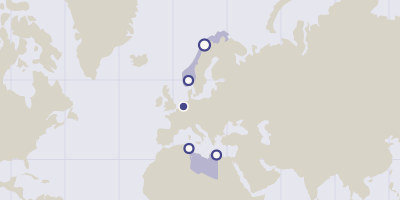
Battlefield V sends you to Narvik in Norway, Tobruk in Libya, Kasserine Pass in Tunisia, Rjukan in Norway and the Nijmegen railway bridge in the Netherlands, all real places of the war. The game's prologue jumps between fronts, and the "Nordlys" war story follows a Norwegian resistance fight over heavy water. This route lines up those settings with the real history of each place. Only the places named in the game's own plot summary are included.

5 locations1/5 visitable
GamesApproximate

Battlefield 3 and 4: From Tehran to Shanghai

Battlefield 3 is set in Tehran, Paris and New York, and Battlefield 4 in Shanghai and the Kunlun Mountains. The campaigns follow Marines from Sulaymaniyah in Iraqi Kurdistan to a nuclear plot that ends in Times Square. The route follows the two campaigns in story order across six real places, from Mehrabad Airport in Tehran to central Shanghai. Most stops are city-level pins, because the games name cities rather than streets.

6 locations1/6 visitable
GamesApproximate

Call of Duty: Modern Warfare — London to Chicago

Call of Duty: Modern Warfare (2019) and Modern Warfare II (2022) are set in real cities such as London, Saint Petersburg, Amsterdam and Chicago, plus Moldova and Georgia, alongside invented countries. The route follows the campaigns in story order: the attack on Piccadilly Circus and the Camden Town raid, the trail through Saint Petersburg, Baurci and Borjomi, then the courier chase in Amsterdam and the finale in Chicago. Invented countries are left off the map, and the pins mark each real city or town, not a mission's exact setting.

7 locations5/7 visitable
GamesApproximate

Call of Duty: Modern Warfare - Real Places Behind the Missions

Call of Duty 4: Modern Warfare and its sequels Modern Warfare 2 and 3 are set in real cities, from Pripyat and Rio de Janeiro to Washington, D.C., New York, Hamburg, Paris, Prague and Dubai. This route follows the story of Price, Soap and Makarov across eight settings. The games' levels are invented layouts, so most pins mark the city rather than a mission spot.

8 locations5/8 visitable
GamesApproximate

Call of Duty: Black Ops: From Cuba to Rebirth Island

Call of Duty: Black Ops sends CIA operative Alex Mason from the Bay of Pigs in Cuba to the Vorkuta gulag, Baikonur Cosmodrome, Huế in Vietnam and Kowloon Walled City in Hong Kong. Mason's story is told in flashbacks from an interrogation room, in order, from April 1961 to 1968. This route follows seven real places behind the campaign, and what happened at each one in real history. The game's levels are fiction, so most pins are approximate. Spoiler notice: the last stop reveals the campaign's twist.

7 locations1/7 visitable
MoviesApproximate

Chitty Chitty Bang Bang: Filming Locations from Turville to Neuschwanstein

Chitty Chitty Bang Bang (1968) was filmed at Cobstone Windmill near Turville in Buckinghamshire, at Cap Taillat in the South of France, in Rothenburg ob der Tauber and at Neuschwanstein Castle in Bavaria. The route follows the film from the Potts family's windmill home to the beach picnic, then on Caractacus's story to Vulgaria, with the castle of Baron Bomburst as the finale. Several pins are approximate because the guides name an area, not a spot.

6 locations5/6 visitable
MoviesApproximate

The Exorcist: Georgetown to Hatra

The Exorcist is set in Georgetown, Washington DC, and opens in the ruins of Hatra in northern Iraq. The real Exorcist Steps, Healy Hall and Lauinger Library are on the Georgetown campus, and a hospital on Roosevelt Island stood in for a Washington scene. The route follows the film from Merrin's dig at Hatra to the MacNeil house and the stairs where Father Karras falls.

5 locations3/5 visitable
MoviesApproximate

The Birds: Filming Locations from San Francisco to Bodega Bay

Hitchcock's The Birds is set in Bodega Bay, California, and filmed there too: the harbor, the Tides Wharf restaurant and the schoolhouse in nearby Bodega are all real places you can find on the map. The route starts in San Francisco's Union Square, follows Melanie Daniels across the bay to the Brenner farm, and ends with the crows at the schoolhouse and the diner siege. Some Bodega Bay scenes were shot on a studio set, so the pins mark the real places the film borrowed.

5 locations1/5 visitable
MoviesApproximate

Twister (1996): Oklahoma and Iowa Filming Locations

Twister is set in Oklahoma, and was filmed there at Fairfax, Kaw Lake, Wakita and Guthrie before the finale moved to Eldora, Iowa. Storm chasers Jo and Bill race tornadoes across the plains. This route follows the story from the opening farm to the F5 climax. Several stops are towns rather than single sites, and the Eldora finale house is private.

5 locations1/5 visitable
MoviesFictional

Big Little Lies: Monterey and Big Sur Filming Locations

Big Little Lies is set in Monterey, California, and filmed around Monterey, Pacific Grove and Big Sur. Real places include Old Fisherman's Wharf, Monterey Bay Aquarium, Lovers Point and Bixby Bridge. The series follows five women drawn into a homicide investigation. This route moves from the wharf and beaches of Monterey to the cliffs and bridge of the Big Sur coast; some cafes you see on screen were sets, so those stops are marked as approximate.

6 locations6/6 visitable
MoviesApproximate

The English Patient: Tunisia and Tuscany

The English Patient was filmed in Tunisia and Italy: desert scenes near Tozeur, Nefta and Chott el Djerid, and the wartime monastery at Sant'Anna in Camprena near Pienza in Tuscany. Contains story spoilers. The route follows the film's Italian settings, then its desert story: Hana's frescoes at Arezzo, a Venice hotel standing in for Cairo, the Cave of Swimmers and Almásy's camp. Some desert sites need a guided trip.

7 locations2/7 visitable
MoviesApproximate

Ben-Hur: Filming Locations in Rome and Matera

Ben-Hur's Jerusalem, Nazareth and chariot arena were filmed in Italy: Cinecittà Studios in Rome for the 1959 classic, and Matera and Cinecittà World for the 2016 remake. The route follows the story from Jerusalem and Nazareth to the sea battle, the great chariot race and the Valley of the Lepers, and shows where each scene was shot. Most stops are stand-ins for the story's places, and each says so.

5 locations3/5 visitable
MoviesApproximate

The Lizzie McGuire Movie: Filming Locations in Rome

The Lizzie McGuire Movie was filmed in Rome in autumn 2002, with scenes at the Trevi Fountain, the Pantheon, the Spanish Steps, Villa d'Este in Tivoli and the Colosseum. Contains story spoilers. On a class trip to Rome, Lizzie agrees to pose as an Italian pop star and ends up at a music video awards show. The route follows the film's Rome scenes; the awards performance itself was shot in a studio.

5 locations5/5 visitable
MoviesApproximate

The Silence of the Lambs: Filming Locations from Quantico to Pittsburgh

The Silence of the Lambs is set in Virginia, Baltimore and Memphis but was filmed largely in and around Pittsburgh, Pennsylvania, with the FBI Academy at Quantico, the Carnegie Museum of Natural History and the Soldiers and Sailors Memorial Hall as real stops. This route follows Clarice Starling from her FBI training to Lecter's cell and the hunt for Buffalo Bill. Two sites are private or gone, so the map marks them with a caveat.

5 locations2/5 visitable
MoviesApproximate

Good Will Hunting: Boston and Cambridge

Good Will Hunting is set in Boston and was shot in South Boston, at MIT and Harvard in Cambridge, and at Bunker Hill Community College. Will, a janitor and self-taught genius, moves between a dive bar and the lecture halls of two famous campuses. The route follows five places from the film, from the blackboard at MIT and the L Street Tavern to Harvard Square and the college where Sean Maguire teaches.

5 locations3/5 visitable
MoviesApproximate

Field of Dreams: Dyersville to Fenway Park

Field of Dreams is set on a corn farm in Dyersville, Iowa, and the baseball field built for the film is still there. Ray Kinsella follows a voice from the cornfield to Fenway Park in Boston and on to Chisholm, Minnesota, played on screen by Galena, Illinois. The route follows the film from the farm to the ballgame in Boston, the search for Moonlight Graham, and the closing line of headlights back at Dyersville. Some details differ from the real Graham, and the Chisholm scenes were not shot in Minnesota.

5 locations5/5 visitable
HistoryApproximate

Catherine the Great: From Stettin to St Petersburg

Catherine the Great was born in Stettin (now Szczecin, Poland), crowned in the Moscow Kremlin and lived at Oranienbaum, the Winter Palace and Tsarskoye Selo near Saint Petersburg. The route follows the German princess from her birth in 1729 through the 1762 coup and her coronation to her English garden and the Bronze Horseman statue she commissioned. Birthplace sources differ, so the first pin is approximate.

6 locations6/6 visitable
MoviesApproximate

Footloose (1984): Filming Locations in Utah County

Footloose (1984) is set in the fictional town of Bomont, Utah, but it was filmed in real Utah County towns: Payson, American Fork, Provo, Vineyard and Lehi, where the Lehi Roller Mills hosts the famous prom. The route follows the film's story from church and high school to the honky-tonk, the steel-mill dance and the prom night. Some sites have changed: the Provo drive-in and bar no longer stand, so those pins are approximate.

6 locations1/6 visitable
MythologyApproximate

Roswell UFO Incident: From Corona Ranch to Hangar 18

The Roswell UFO incident of July 1947 began on a ranch near Corona, New Mexico, and ran through Roswell Army Air Field, Fort Worth and Wright Field in Ohio. The official explanation was a Project Mogul balloon. This route follows the debris from the Alamogordo balloon launch to the Hangar 18 legend and the International UFO Museum in Roswell. Several stops are approximate, because the sources do not name exact spots.

6 locations1/6 visitable
HistoryApproximate

Battle of Gettysburg: Three Days in 1863

The Battle of Gettysburg was fought around Gettysburg, Pennsylvania, from 1 to 3 July 1863, at places like McPherson Ridge, Culp's Hill, Little Round Top and Cemetery Ridge. This route follows the three days in order, from the opening shots to Pickett's Charge, then ends at Gettysburg National Cemetery, where Lincoln came on 19 November. The Angle and Culp's Hill pins are approximate.

5 locations5/5 visitable
MoviesApproximate

Dawn of the Dead (1978): Monroeville Mall and Pittsburgh

Dawn of the Dead (1978) was filmed at Monroeville Mall, east of Pittsburgh, Pennsylvania, with other scenes shot at a downtown Pittsburgh dock, a Monroeville airfield and a truck yard in Irwin. George A. Romero's zombie film is set in Philadelphia and a mall, but it was made in the Pittsburgh area. This route follows the survivors from the police dock to the mall, with the real places that stood in for each scene. Several of those places have changed or disappeared.

5 locations2/5 visitable
GamesApproximate

Medal of Honor: Allied Assault: From Arzew to Omaha Beach

Medal of Honor: Allied Assault follows Lieutenant Mike Powell from Arzew in Algeria and Trondheim in Norway to the D-Day landing on Omaha Beach, then on to Carentan and Brest in France. This route pins the real places named in the single-player plot. The game's own levels are not mapped to exact sites, so most stops are approximate.

5 locations1/5 visitable
MythologySpeculative

Loch Ness Monster: Famous Sightings and Urquhart Castle

The Loch Ness Monster, or Nessie, is reported around Loch Ness in the Scottish Highlands, from the River Ness and Foyers to Urquhart Castle. The route follows the legend from Saint Columba's water beast in AD 565 through the sightings of 1888 and 1933, the 1934 "surgeon's photograph" later shown to be a hoax, and the 1977 photo taken beside Urquhart Castle. The stories are claims and legends, not proven facts.

5 locations1/5 visitable
HistoryApproximate

Sinking of the Lusitania, 1915: Liverpool to Cobh

The RMS Lusitania was torpedoed on 7 May 1915 11.5 nautical miles off the Old Head of Kinsale, Ireland, on a voyage from New York to Liverpool. This route follows her final journey through Liverpool, New York, Kinsale and Cobh. It starts at Cunard's home port, moves to Pier 54 in New York, then to the Old Head of Kinsale and Cobh, where the survivors and the dead were brought and where a memorial now stands. Several stops are approximate because the ship went down at sea.

5 locations4/5 visitable
Real JourneysApproximate

Via Francigena: From Canterbury to Rome

The Via Francigena is the medieval pilgrim road from Canterbury Cathedral through France and Switzerland to St Peter's in Rome, recorded by Archbishop Sigeric around 990. This route follows it from Canterbury over the Great St Bernard Pass to Lucca, Siena and Viterbo. Sigeric's return trip ran to 80 stages of about 20 km each, some 1,700 km in all. Pilgrims still walk it today. Stops are landmarks on the route, not proven overnight stays.

7 locations7/7 visitable
MoviesApproximate

Harry Potter and the Deathly Hallows Part 1: Filming Locations

Harry Potter and the Deathly Hallows – Part 1 was filmed at the Dartford Crossing, Lavenham, Hardwick Hall and Freshwater West, with the Forest of Dean as its story setting. This route follows the film's road-movie plot from the Death Eaters chase to Godric's Hollow, the frozen pond, Malfoy Manor and Shell Cottage. Two stops are approximate; each says why.

5 locations4/5 visitable
MoviesApproximate

Harry Potter and the Half-Blood Prince: Filming Locations

Harry Potter and the Half-Blood Prince was filmed at London's Millennium Bridge, Lacock Abbey in Wiltshire, Fort William in Scotland, Norway's Rauma Line and the Cliffs of Moher in Ireland. The route follows the 2009 film's scenes in order, from the bridge collapse that opens it to the sea cave where Harry and Dumbledore hunt a Horcrux. Hogwarts Express shots even left the UK for snow in Norway. Most spots are real places you can visit; the cave interior itself was computer-generated.

5 locations2/5 visitable
MoviesApproximate

Harry Potter and the Order of the Phoenix: Filming Locations

Harry Potter and the Order of the Phoenix was filmed on the River Thames, in Westminster Underground station, at the Glenfinnan Viaduct and in Glen Etive in the Scottish Highlands. The route follows the film in order: the Order's night flight over London, Harry's walk to his hearing at the Ministry of Magic, the Hogwarts Express in the Highlands, the empty glens of the aerial shots and the Thestral flight to the Ministry over the Thames. Interiors were built at Leavesden Studios in Watford, so only the exteriors can be visited.

5 locations5/5 visitable
MoviesApproximate

Harry Potter and the Goblet of Fire: Filming Locations

Harry Potter and the Goblet of Fire was filmed at Seven Sisters in East Sussex, Ivinghoe Beacon in the Chiltern Hills, Black Park in Buckinghamshire, New College and the Divinity School in Oxford, and Steall Falls in Glen Nevis. From the Portkey landing before the Quidditch World Cup to the dragon task and the Yule Ball lessons, this route follows the 2005 film in story order. Scenes at Hogwarts itself and at the studio are not covered here.

6 locations4/6 visitable
MoviesApproximate

Harry Potter and the Prisoner of Azkaban: Filming Locations

Harry Potter and the Prisoner of Azkaban was filmed on Lambeth Bridge and Stoney Street in London, the Glenfinnan Viaduct and Glen Coe in Scotland, Virginia Water in Surrey and the Divinity School in Oxford. The third film was the first to use real locations extensively, so this route follows the story in film order, from the Knight Bus in London to the Dementors on the Highland train and the hospital wing in Oxford. Several lakes stood in for the Black Lake, so some pins are approximate.

7 locations7/7 visitable
MoviesApproximate

Harry Potter and the Chamber of Secrets: Filming Locations

Where was Harry Potter and the Chamber of Secrets filmed? Hogwarts is Alnwick Castle, Lacock Abbey, Gloucester and Durham cathedrals and Oxford's Bodleian Library, while King's Cross plays Platform 9¾. The route follows the 2002 film from the blocked barrier to the hunt for the heir of Slytherin, six real places across England. Most scenes were built at Leavesden Studios, so some pins mark where a location was used, not one exact scene.

6 locations1/6 visitable
MoviesApproximate

Harry Potter and the Philosopher's Stone: Filming Locations from London to Durham

Harry Potter and the Philosopher's Stone (2001) was filmed at London Zoo, Australia House in London, Goathland station in North Yorkshire, and Gloucester and Durham cathedrals. This route follows the film's scenes in order, from the snake at the zoo to Harry's first months at Hogwarts, and goes beyond the best-known sites in the overview route.

5 locations5/5 visitable
GamesApproximate

Need for Speed: The Run — San Francisco to New York

Need for Speed: The Run races across the United States, from the Golden Gate Bridge in San Francisco through Death Valley, Las Vegas, Denver and Chicago to Times Square in New York. The racing game is an illegal street race from San Francisco to New York City with the Mob and the police in pursuit. Wikipedia records two plots: the Black Box version, starring street racer Jack Rourke, and a Firebrand version, starring a former pro racer called Matt. Most scenes here come from the Firebrand version; each stop says which. The roads are real, but scenes are not tied to exact spots, so most pins mark the city or region. Spoiler notice: the last stop reveals the ending.

6 locations0/6 visitable
BooksApproximate

Walden: Thoreau's Concord and Walden Pond

Walden is set at Walden Pond in Concord, Massachusetts, where Henry David Thoreau lived from July 1845 to September 1847. This route follows the book from his cabin site to the railroad, Concord's jail, Flint's Pond, Baker Farm and Brister's Hill. Thoreau compressed his two years into a single calendar year in the book. The stops follow the order of its chapters, and most of the paths and ponds can still be walked around Walden Pond State Reservation. Several spots in the woods are only approximately placed on the map.

7 locations1/7 visitable
MoviesApproximate

Gone Girl: Filming Locations in Cape Girardeau

Gone Girl is set in the made-up town of North Carthage, Missouri, but David Fincher shot it almost entirely in Cape Girardeau: The Bar on Themis Street, the Common Pleas Courthouse, the old federal building and the Bill Emerson Memorial Bridge over the Mississippi. The route follows Nick Dunne's first days as the husband of a missing woman, from the bar to the press conference, the vigil, the police station and the bridge. One stop, the Drury Lodge, is marked approximately: it has closed and the pin sits on its street.

5 locations4/5 visitable
MythologyExact

Easter Island: The Moai and Their Legends

The moai of Easter Island (Rapa Nui) were carved at Rano Raraku quarry and raised on platforms such as Ahu Tongariki and Ahu Akivi, and the island's legends explain them: a founder who landed at Anakena, seven scouts turned to stone, statues that walked, and a birdman race at Orongo. The route follows those stories from the landing beach to the quarry, the restored platforms and the cliff village above the sea. Oral traditions are told as traditions, not as proven history.

5 locations5/5 visitable
HistoryApproximate

Jack the Ripper: Whitechapel in 1888

Jack the Ripper's Whitechapel murders of 1888 happened along a few Whitechapel and Spitalfields streets: Durward Street (then Buck's Row), Hanbury Street, Berner Street, Mitre Square and Miller's Court in Spitalfields. Five killings are generally attributed to the unidentified murderer. This route follows the canonical victims in date order, with the Goulston Street graffito and the Ten Bells pub. Some sites are gone or renamed, and Miller's Court has no pin.

7 locations6/7 visitable
BooksApproximate

The Adventures of Tom Sawyer: Hannibal, Missouri

The Adventures of Tom Sawyer is set in St. Petersburg, a town based on Hannibal, Missouri, where Mark Twain grew up: the Boyhood Home, Cardiff Hill and Mark Twain Cave. Five stops follow the novel from the whitewashed fence to the cave where Tom and Becky Thatcher get lost, on the Mississippi's west bank. Jackson's Island, the pirates' hideaway, has no identified real model, so that stop marks the town and the river.

5 locations4/5 visitable
MoviesApproximate

Zodiac: Bay Area Killings and Fincher's Film

Zodiac (2007) is set around the San Francisco Bay Area, from Vallejo and Lake Berryessa to Presidio Heights and the San Francisco Chronicle. The film follows the real Zodiac Killer case. This route walks five places from the film in story order, from the July 1969 attack at Blue Rock Springs Park to the police hunt. Several scenes were shot in Los Angeles, which is noted where it matters.

5 locations0/5 visitable
GamesFictional

A Plague Tale: From Aquitaine to Marseille

A Plague Tale: Innocence is set in Aquitaine in 1348, with landscapes inspired by Saint-Émilion, a town gate modelled on Carcassonne and a final cathedral based on Reims. Its sequel, Requiem, moves to Provence and Marseille in 1349. The route follows Amicia and Hugo de Rune from their family estate through plague-ridden France to the Order's city of Marseille. Most pins are real stand-ins or regions, and each stop says how close the game comes to the real place.

5 locations4/5 visitable
BooksApproximate

Little Women: Concord, Orchard House and Beyond

Little Women is set in a Massachusetts town loosely based on Concord, and Louisa May Alcott wrote it at Orchard House, the Alcott family home that is now a museum. Follow the March sisters from Concord to Washington, Nice and Lake Geneva. The route visits Orchard House and The Wayside, where the Alcott family lived and acted out scenes later used in the book, then follows the story abroad: a Washington hospital, the Promenade des Anglais in Nice and Chillon on Lake Geneva. The Concord stops are the real houses behind the March family's home.

5 locations4/5 visitable
MoviesApproximate

Beverly Hills Cop: Detroit to Beverly Hills

Beverly Hills Cop (1984) is set in Detroit and Beverly Hills, but most of it was shot around Los Angeles: the Biltmore Hotel downtown, Beverly Hills City Hall and the Athenaeum in Pasadena. Detroit detective Axel Foley travels to California to find the killer of his friend Mikey. The route follows him from the opening chase and his apartment to the hotel, the police station, Maitland's club and the final shootout. Only the Biltmore, City Hall and the Athenaeum are places you can visit.

6 locations2/6 visitable
GamesApproximate

Company of Heroes: Normandy 1944

Company of Heroes is set in Normandy in 1944, from Omaha Beach and Carentan to Cherbourg, Saint-Lô, Mortain and Chambois. Its Able Company missions follow real battles of the Normandy campaign. The route follows the game's single-player story in order, pairing each mission with what the real fight there looked like. The game simplifies events.

6 locations6/6 visitable
MythologySpeculative

Atlantis: Where Is the Lost City?

Atlantis comes from two dialogues by Plato, Timaeus and Critias, and searchers have placed it at Santorini, the Strait of Gibraltar, Spartel Bank, Doñana in Spain and the Richat Structure in Mauritania. This route starts with Plato's own frame in Sais, Egypt, then visits five of the proposed locations. Every pin after the first is a theory, not a find.

6 locations1/6 visitable
HistoryApproximate

Trail of Tears: The Cherokee Removal, 1835–1838

The Trail of Tears, the forced removal of the Cherokee from Georgia to Indian Territory (Oklahoma), runs from New Echota, Red Clay and Fort Cass to Blythe Ferry in Tennessee and Fort Gibson. Each stop ties to a documented moment: a treaty signed by a minority, a council that rejected it, the camps of summer 1838, a river crossing and the arrival in Indian Territory. Some sites are memorials today and others are only markers; the Fort Cass and Fort Gibson pins are approximate.

5 locations4/5 visitable
BooksSpeculative

The Legend of Sleepy Hollow: Tarrytown to the Church Bridge

Washington Irving's The Legend of Sleepy Hollow is set around 1790 near Tarrytown, New York, and you can visit its places today: Philipsburg Manor, Patriot's Park, the Old Dutch Church and Sleepy Hollow Cemetery. Ichabod rides to a party at the Van Tassel farm, then home through a haunted glen and over a bridge by the church. The route follows his night, with Raven Rock first. Some places are only visitor tradition, and each stop says so.

5 locations5/5 visitable
MoviesApproximate

Pretty Woman: Beverly Hills and Hollywood Locations

Pretty Woman is set in Los Angeles, mostly around Hollywood Boulevard, the Beverly Wilshire Hotel and Rodeo Drive in Beverly Hills, with one night at the San Francisco Opera. This route follows Vivian and Edward's week in story order, from the Hollywood street where they meet to the opera house. Some scenes were filmed elsewhere, such as the Ambassador Hotel lobby and the Cicada dinner, and the stops say so.

6 locations5/6 visitable
GamesApproximate

Overwatch maps in Africa and Asia: real-life locations

Overwatch (called Overwatch 2 until February 2026) sets maps in real places across Africa and Asia: the Temple of Anubis is on the Giza Plateau near Cairo, Petra is in Jordan, Busan is in South Korea, and Neon Junction is inspired by Tokyo. This route follows ten maps west to east, from Morocco to Tokyo, with the mode, the date each arrived and the real place behind it. Other routes cover Overwatch maps in Europe and in the Americas. Aatlis has no pin because Blizzard names no city in Morocco; Oasis and Suravasa pin only their country.

10 locations3/10 visitable
GamesApproximate

Overwatch maps in the Americas: real-life locations

Overwatch (called Overwatch 2 until February 2026) sets its American maps in real places: Midtown ends at Grand Central in New York, New Queen Street is Toronto, Havana is in Cuba, Paraíso is Rio de Janeiro and Hollywood is a Los Angeles movie lot. This route follows seven maps west to east from Hollywood to Rio, including Dorado, a Mexican town whose look came from a photo of Italy. Other routes cover Overwatch maps in Europe and in Africa and Asia. Pins mark a real model place, not a copied district; Dorado and Runasapi have no pin because they are invented towns with no named real place.

7 locations1/7 visitable
GamesApproximate

Overwatch maps in Europe: real-life locations

Overwatch (called Overwatch 2 until February 2026) sets its European maps in real places: King's Row is a London neighborhood, Circuit Royal is Monte Carlo, Colosseo is Rome, Rialto is Venice and Esperança is inspired by Porto. This route follows eleven maps west to east, from Grímsvötn in Iceland to Volskaya Industries near St. Petersburg, with the mode, the date each arrived and the real place behind it. Other routes cover Overwatch maps in the Americas and in Africa and Asia. Pins mark a real model place or landmark, not a copied district.

11 locations4/11 visitable
GamesApproximate

War Thunder: Real Places Behind the Ground Maps

War Thunder's tank maps are based on real places: Stalingrad Tractor Plant, Bastogne, Hürtgen Forest, Cologne Cathedral, Berlin's Reichstag, Novorossiysk, Volokolamsk, Breslau (Wrocław), Darwin Hill in the Falklands and the Fulda Gap. The developers say how close each map is to its original, from rebuilt photographs of the Stalingrad factory to a layout only inspired by the real ground. This route follows ten of them in the order of their history, with a short note on what happened at each real place. Maps are classed here as exact only where the developers copy a real district; the rest are marked approximate.

10 locations0/10 visitable
MoviesExact

Look Back: Nikaho, Akita

Look Back is set around the hometown of manga artist Tatsuki Fujimoto, Nikaho in Akita Prefecture, and the live-action film of 2026 was shot mainly there, from the cherry-tree lane at Kunpuen to Nikaho Station. The story follows Fujino and Kyomoto, two girls who draw manga together. It became an anime film in June 2024. The route follows the story from Fujino's childhood walks in Nikaho and the bookshop in Hirasawa, to the rebuilt bedroom sets at the station and the Smile centre, and on to the art university in Yamagata where the story turns.

5 locations4/5 visitable
MoviesApproximate

Seven Samurai: Kurosawa's Filming Locations

Seven Samurai was filmed at Toho Studios in Tokyo and in Shizuoka and Hakone, because no single location could cover the whole area. Kurosawa's 1954 film has one mountain village, but it was stitched together from different places: studio rice fields in Setagaya, a valley above the Tanna Tunnel, a mill site in Izu, a waterfall in Shizuoka and a mountain pass in Hakone. The stops are approximate because the screen village never existed as one place.

5 locations2/5 visitable
HistoryApproximate

Kūkai: From Shikoku to China and Mount Kōya

Kūkai (Kōbō Daishi) was born in Shikoku, studied in Xi'an and founded Shingon Buddhism at Jingo-ji, Tō-ji and Mount Kōya, where he is entombed at Okunoin. The route follows the monk from his birthplace at Zentsū-ji to Qinglong Temple in Tang China, then back to the temples near Kyoto and the mountain retreat he asked for in 816. It ends at his mausoleum, where monks still bring him meals.

6 locations6/6 visitable
HistorySpeculative

Himiko and Yamatai: Yoshinogari vs Makimuku

Where was Yamatai, the kingdom of Queen Himiko? The two leading answers are Yoshinogari in Saga, northern Kyushu, and Makimuku beside the Hashihaka Kofun in Sakurai, Nara. The route follows the Wei Zhi account of Himiko from Iki Island and the Shikanoshima gold seal to the two rival sites, and ends at the burial mound often linked with her grave. The location of Yamatai is still unsettled.

5 locations1/5 visitable
HistoryApproximate

Emperor Shōmu and the Great Buddha of Nara

The Great Buddha of Nara at Tōdai-ji was the work of Emperor Shōmu, who also ordered a temple in every province and moved his capital from Heijō Palace to Kuni-kyō and Shigaraki. After smallpox, rebellion and poor harvests, Shōmu turned to Buddhism for protection. This route follows him from Nara through two short-lived capitals and a provincial temple in today's Tokyo, back to the Eye-opening Ceremony of 752. Some sites are only ruins or remain approximate.

5 locations4/5 visitable
HistorySpeculative

Prince Shōtoku: Asuka, Ikaruga and Hōryū-ji

Prince Shōtoku's temples in Japan run from Tachibana-dera and Asuka-dera in Asuka to Hōryū-ji and Chūgū-ji in Ikaruga, plus Shitennō-ji in Osaka. The route follows the regent who promoted Buddhism, from the place said to be his birthplace to his palace site at Ikaruga and the embroidery made after his death in 622. Several dates rest on temple tradition rather than firm records, and the birthplace is marked as traditional.

6 locations2/6 visitable
MoviesApproximate

Massan: From Glasgow to Yoichi Distillery

Massan, the NHK drama of 2014–2015, is set in Glasgow, Takehara, Osaka and Yoichi, and is based on the life of Nikka Whisky founder Masataka Taketsuru and his Scottish wife Rita. The route follows Masaharu and Ellie from Scotland and Japan's early whisky years at Yamazaki to the Yoichi Distillery in Hokkaido, with notes on what the real couple did. Scenes set in Scotland were not filmed there.

5 locations2/5 visitable
HistoryApproximate

Hiroo Onoda: Holdout on Lubang Island

Hiroo Onoda, the Japanese soldier who kept fighting on Lubang Island in the Philippines until 1974, is traced here from the Nakano School in Tokyo to Lubang's mountains and Manila's Malacañang Palace. Sent to Lubang on 26 December 1944 with orders never to surrender, Onoda stayed in hiding for 28 years, 6 months and 8 days after Japan's surrender. The route follows his training, his years in the hills, his surrender in March 1974 and a disputed return visit in 1996. Several locations are approximate, and accounts of the violence on the island are contested.

5 locations0/5 visitable
MoviesApproximate

Amachan: Kuji and the Sanriku Coast

Amachan, the 2013 NHK morning drama, is set in Kitasanriku, a fictional town modelled on Kuji, Iwate; this route visits Kuji Station, Kosode Coast and railway stations along the Sanriku Coast. Aki, a shy Tokyo girl, becomes a sea-urchin diver and a local idol in a small seaside town. This route follows the hometown chapter through five real places: Kuji Station, Kosode Coast, Horinai Station, Tanohata Station and Taneichi High School. Several stand in for places the drama names differently.

5 locations4/5 visitable
HistoryApproximate

Hashima (Gunkanjima): Nagasaki's Coal and Shipyard Story

Hashima, nicknamed Gunkanjima or Battleship Island, lies about 15 km off Nagasaki, and its coal mine grew from the same story as Glover Garden, the Kosuge Slip Dock and the Takashima mine. The route follows Nagasaki's industrial rise from 1859: the Scottish merchant Thomas Blake Glover, Japan's first western-style dock, a pioneering coal shaft, the Mitsubishi shipyard and finally Hashima, packed with 5,259 people in 1959 and empty after 1974. It also records the wartime forced labour of Korean civilians and Chinese prisoners of war on Hashima.

5 locations3/5 visitable
MoviesFictional

The Last Samurai: Filming Locations from Taranaki to Kyoto

The Last Samurai (2003) is set in Japan in 1876 but was filmed mostly in Taranaki, New Zealand, where Mount Taranaki stands in for Mount Fuji, plus Engyō-ji near Himeji, Chion-in in Kyoto and Castle Green in Pasadena. This route follows Nathan Algren's story from the opening restaurant scene to the parade ground, the fog battle, Katsumoto's village, his temple and the emperor's palace, and shows where each one really is. Several stops are sets or stand-ins.

6 locations3/6 visitable
HistoryApproximate

Emperor Go-Daigo: From Oki Exile to Yoshino

Emperor Go-Daigo overthrew the Kamakura shogunate in 1333 after holding out at Kasagi Temple, being exiled to the Oki Islands and escaping to Mount Funanoue, and he ended his life at Yoshino. This route follows him from Kasagi to Kyoto and the Southern Court. The six stops trace 1331 to 1339: the failed stand at Kasagi, exile on Oki, the escape to Mount Funanoue, the short Kenmu Restoration in Kyoto, the temporary palace at Yoshimizu Shrine and the emperor's tomb at Nyoirin-ji. Several pins are approximate because the sources describe regions or traditions, not exact spots.

6 locations2/6 visitable
MoviesFictional

Love Letter: Filming Locations in Otaru

Shunji Iwai's Love Letter (1995) is set in snowy Otaru and Kobe, but Otaru stands in for both. This route follows the filming locations: the Former Nippon Yusen Otaru Branch as the library, Otaru City Hall as the hospital, Irinai crossing and Temiya Park. It starts at the Former Suhara Residence, which doubles as the Fujii house in Kobe, and follows Hiroko's letters to Itsuki. Some sites are open to visitors; others are a city office or a public street.

5 locations5/5 visitable
HistoryApproximate

Kusunoki Masashige: Chihaya Castle to Minatogawa

Kusunoki Masashige, Japan's famous loyal samurai, fought from Akasaka and Chihaya Castle in Osaka Prefecture and died at Minatogawa in Kobe in 1336. Five stops follow his life from a temple school to his statue in Tokyo. The route runs from Kanshin-ji in Kawachinagano, where he studied, through the two mountain fortresses that made his name, to the shrine at Minatogawa and the bronze monument beside the Imperial Palace. Where the exact spot is not known, the pin marks the area.

5 locations5/5 visitable
MoviesApproximate

Departures (Okuribito): Filming Locations in Yamagata

Departures (Okuribito), the 2008 film, was shot around Sakata, Kaminoyama and Tsuruoka in Yamagata, Japan. The story follows a cellist who becomes an encoffinment mortician in his hometown. The route visits the Concerto café in Kaminoyama, the NK Agent office and Minato-za cinema in Sakata, the Tsuru-no-yu bathhouse in Tsuruoka and Amarume Station. Several buildings have moved or closed since filming.

5 locations2/5 visitable
HistoryApproximate

Shakushain's War: The Ainu Revolt in Hokkaido

Shakushain's War (1669) was the Ainu uprising against the Matsumae clan of Japan, fought between Shinhidaka, Matsumae Castle and Kunnui in Hokkaido. The route follows the revolt from the feud on the Shibechari River to the mediation at Matsumae, the fighting at Kunnui and the leader's death at Piypok. It ends with the Shakushain statue in Shinhidaka. Several sites are approximate and are marked as such.

5 locations1/5 visitable
MoviesApproximate

Tokyo Story: Onomichi, Atami and Tokyo

Tokyo Story (1953) follows an elderly couple from Onomichi to Tokyo and the hot spring town of Atami, with filming at Jōdo-ji temple, Ueno Park, Tokyo Station and Osaka Castle. The route follows the film in order: the Onomichi temple of its famous dawn scene, the Adachi suburbs, the Atami seawall, Ueno Park, Tokyo Station and Osaka Castle. Several original film spots, such as the Atami seawall, are gone.

6 locations5/6 visitable
HistoryExact

Ryukyu Kingdom: Shuri Castle and the Gusuku of Okinawa

The Ryukyu Kingdom ruled Okinawa from Shuri Castle in Naha, and its story can still be walked at Nakijin, Zakimi and Katsuren castles and the Tamaudun royal tombs. The route follows the kingdom from the three-principality era and Shō Hashi's unification in 1429, through a rival lord's fall in 1458, to the royal tombs of 1501. Most of these castle sites are ruins or reconstructions.

5 locations5/5 visitable
MoviesFictional

Hachiko and Hachi: From Ōdate to Shibuya

The true story behind Hachi: A Dog's Tale and Hachikō Monogatari runs from Ōdate, Akita, where the dog was born, to the Hachikō statue at Shibuya Station in Tokyo, Aoyama Cemetery, and a Rhode Island depot that played "Bedridge" in the 2009 film. The route follows Hachikō, the Akita who kept waiting for his owner Hidesaburō Ueno, a Tokyo Imperial University professor, long after Ueno failed to return on 21 May 1925. It covers the birthplace, the station, the final morning, the grave and the 2009 film's location. Film details differ from the real history in places.

5 locations4/5 visitable
HistoryApproximate

Russo-Japanese War: Port Arthur, Mukden and Tsushima

The Russo-Japanese War of 1904–05 was fought at Port Arthur, on the Yalu River, at Mukden and in the Tsushima Strait, and ended at Portsmouth, Maine. This route follows the war from the first night attack on Port Arthur in February 1904 to the peace treaty signed in September 1905. Battlefields are pinned approximately; only the Mikasa and the Portsmouth shipyard are exact.

7 locations1/7 visitable
MoviesFictional

The Wolverine: Tokyo to Tomonoura

The Wolverine (2013) is set in Tokyo and Nagasaki, but it was filmed at Zojo-ji Temple, Nakagin Capsule Tower, Fukuyama Station and the port of Tomonoura, plus a reserve near Sydney standing in for 1945. The route follows Logan from a prisoner-of-war camp in August 1945 to Yashida's funeral in Tokyo, a bullet-train fight and a hideout in a love hotel, ending in the fishing port of Tomonoura. Several scenes were shot in Australia, and the Nakagin tower no longer stands.

5 locations3/5 visitable
HistoryApproximate

Battle of Iwo Jima: From the Beaches to Arlington

The Battle of Iwo Jima was fought in February and March 1945 on a small volcanic island in Japan's Ogasawara group, from the black-sand landing beaches to the summit of Mount Suribachi. Its famous flag-raising photograph became the Marine Corps War Memorial in Arlington, Virginia. This route follows the battle from the landing on 19 February, through the Suribachi flag-raising and the fight for the northern gorge, to the memorial in Arlington and the 1985 Reunion of Honor, where veterans of both sides met on the same beach. Iwo Jima itself is not open to ordinary visitors.

5 locations1/5 visitable
MoviesFictional

Tokyo Drift: Shibuya, Tokyo and Where It Was Really Filmed

The Fast and the Furious: Tokyo Drift is set in Tokyo, but most of it was shot in Los Angeles; Shibuya Crossing is the best-known real Tokyo spot. This route follows Sean Boswell from his Arizona school to the car meets, garages and mountain pass of the film, and shows the Los Angeles locations that stood in for Tokyo, from Hawthorne Plaza to San Gabriel Dam. Several scenes are pinned to the stand-in, not the story setting.

7 locations1/7 visitable
HistoryApproximate

Battle of Okinawa 1945: From Kerama to Mabuni

The Battle of Okinawa, fought from March to June 1945, ran from the Kerama Islands and the Kadena landing beaches to Shuri Castle and Mabuni Hill in the south of the island. This route follows the land campaign through six places you can find on a map today, from the first landing to the Cornerstone of Peace, where the names of those who died on all sides are inscribed. Several sites are memorials, and the pins for the Kerama Islands and Kakazu Ridge are approximate.

6 locations4/6 visitable
HistoryApproximate

Atsuhime: From Kagoshima to Edo Castle

NHK's 2008 drama Atsuhime follows Tenshō-in from Kagoshima and Sakurajima in Satsuma to Edo Castle in Tokyo, where she became wife of the 13th shōgun. Born Okatsu in the Imaizumi branch of the Shimazu clan, she is adopted by Shimazu Nariakira, moves into Tsurumaru Castle and leaves for the shōgun's court in 1853, the year of Perry's Black Ships. The route follows five places from the drama's first half in Satsuma to the Ōoku. The Imaizumi pin and the Kurihama stop are approximate.

5 locations5/5 visitable
MythologyApproximate

Hagoromo: The Feather Robe at Miho no Matsubara

The Hagoromo legend, retold in the Noh play Hagoromo, is set at Miho no Matsubara, a pine-lined beach in Shimizu Ward, Shizuoka, with Miho Shrine nearby and Mount Fuji in the distance. A fisherman finds a celestial maiden's feather robe hanging on a pine and will not give it back until she dances. The route follows the tale from the beach and the legendary pine to the maiden's ascent toward Mount Fuji, the shrine that keeps her plumage, and the monument to a French dancer who loved the story.

5 locations4/5 visitable
HistorySpeculative

Sanada Yukimura: Ueda to the Siege of Osaka

Sanada Yukimura's story runs from Ueda Castle to exile in Kudoyama and a last stand at Osaka Castle, Sanada Maru and Tennōji. He held Ueda against a far larger Tokugawa army in 1600, then died in 1615. The route follows him from the Sekigahara campaign through exile below Mount Kōya to the Winter and Summer sieges of Osaka. Some sites are marked approximately, because the sources do not give exact spots.

5 locations4/5 visitable
BooksApproximate

Nansō Satomi Hakkenden: Tateyama to Koga

Nansō Satomi Hakkenden (Hakkenden) opens in Awa, today southern Chiba, with Takida Castle, Tateyama Castle and Mount Tomi in Chiba, then Koga Castle and Gyōtoku. A lord's careless joke to his dog brings down a curse, and eight dog warriors are born from a princess's scattered prayer beads. The route follows the opening tale from the old castles of Awa to Princess Fuse's mountain, then the first dog warriors' duel at Koga and rescue at Gyōtoku. The novel's Tateyama and Hōryūkaku are not the same as the real sites, so most pins are approximate.

5 locations3/5 visitable
MythologySpeculative

Japanese Ghost Stories: Oiwa and Okiku

Yotsuya Kaidan, the story of the ghost Oiwa, is set in Yotsuya in old Edo and first played at the Nakamura-za theatre in 1825; Banchō Sarayashiki, the tale of Okiku and the missing plate, is set in Banchō, Edo, and claimed by Himeji Castle. This route follows both kabuki ghost stories through Tokyo and Himeji: the premiere theatre's replica, the Oiwa Inari Tamiya Shrine in Yotsuya, Oiwa's reputed grave at Myōgyō-ji in Sugamo, the Banchō district and Okiku's Well. Several identifications are traditional or disputed, and each stop says so.

5 locations3/5 visitable
HistoryApproximate

Ashikaga Shoguns: Kinkaku-ji, Ginkaku-ji and Muromachi Kyoto

The Ashikaga shoguns ruled Japan from Kyoto from 1336 to 1573, and their temples survive as Tenryū-ji, Shōkoku-ji, Kinkaku-ji (the Golden Pavilion), Ryōan-ji and Ginkaku-ji (the Silver Pavilion). The route follows the dynasty from Ashikaga Takauji's memorial temple for Emperor Go-Daigo, through Yoshimitsu's Flower Palace and golden villa, to the Ōnin War and Yoshimasa's unfinished silver pavilion. The Flower Palace itself is gone; only a stone marker commemorates it.

6 locations6/6 visitable
BooksApproximate

Lafcadio Hearn: Matsue, Kumamoto and Yaizu

Lafcadio Hearn's Japan runs from Matsue Castle and Izumo Taisha to Kumamoto, Yaizu and Akama Shrine in Shimonoseki, home of the Kwaidan ghost tale of Hōïchi the Earless. The route follows his years as a teacher and writer: the samurai house in Matsue, a railway station scene from Kokoro, a fishing town he wrote about, and the shrine that keeps Hōïchi's statue. Hearn does not name the Kumamoto station, so that pin is approximate.

6 locations4/6 visitable
MythologyApproximate

Sugawara no Michizane: From Kyoto to Dazaifu and Tenjin

Sugawara no Michizane, the scholar-poet worshipped today as Tenjin, rose at the Heian Palace in Kyoto, was exiled to Dazaifu in Kyushu and is buried at Dazaifu Tenmangū. Kitano Tenmangū in Kyoto was built for him. The route follows his career from court professor to governor of Sanuki, then to exile in 901, death in 903 and the shrines that turned a feared spirit into the god of scholarship. Both shrines can be visited; the palace and the exile site are approximate.

5 locations3/5 visitable
HistoryApproximate

Mongol Invasions of Japan: Tsushima to Hakata Bay

The Mongol invasions of Japan in 1274 and 1281 were fought at Tsushima, Iki Island and Hakata Bay in Fukuoka, and ended off Takashima, where a typhoon struck the fleet. This route follows the two attempts in order: the 1274 landings on Tsushima and Iki, the Battle of Bun'ei at Hakata Bay and Hakozaki Shrine, then the stone wall built afterwards, the fleet anchored off Shikanoshima and the storm of 15 August 1281. Several spots are approximate, and the exact site of the Takashima episode is only the island's general area.

7 locations3/7 visitable
BooksSpeculative

A Wild Sheep Chase: Tokyo to Hokkaido

Haruki Murakami's A Wild Sheep Chase is set in Tokyo and Hokkaido in 1978, from an advertising agency in the capital to Sapporo, Asahikawa and a lonely farm house in the north. The route follows the narrator's hunt for a star-marked sheep in five stops. Only Tokyo and Sapporo are named in the book, so the later stops follow readers' inferences about the real setting, and the Dolphin Hotel and the Rat's villa are fictional.

5 locations1/5 visitable
Real JourneysApproximate

Shirase Antarctic Expedition: New Zealand to Antarctica

Nobu Shirase led Japan's first Antarctic expedition in 1910–12, sailing the small ship Kainan Maru from Wellington and Sydney to the ice shelf, Bay of Whales and King Edward VII Land. The route follows the doubtful welcome in Wellington, a winter camp at Parsley Bay in Sydney, a dash across the ice near Amundsen's Fram, and the museum in Shirase's hometown of Nikaho. Antarctic pins are approximate.

6 locations2/6 visitable
MythologySpeculative

Taira no Masakado: Head Mound and Curse in Tokyo

Taira no Masakado, the rebel who declared himself New Emperor, is remembered at Masakado's Mound in Ōtemachi and at Kanda Shrine in Tokyo, with battle sites in Ibaraki and a head legend in Gifu. The route follows his feud and rebellion, his death in 940, the story of his flying head and the Tokyo mound that is said to punish neglect. Some places are traditional identifications, marked as such.

5 locations2/5 visitable
HistorySpeculative

Minamoto no Yoritomo: Founding the Kamakura Shogunate

Minamoto no Yoritomo founded Japan's first shogunate in Kamakura. This route follows him from his exile in Izu and Mishima Taisha to Ōkura, Hiraizumi and Tsurugaoka Hachimangū. The stops trace his rise from exile in 1160, his first residence in Kamakura, the fall of Hiraizumi in 1189, the shogunate of 1192, his grave and the Hōjō regents who followed. Some sites, including the exile and the grave, are traditional identifications.

8 locations7/8 visitable
MythologySpeculative

Kintarō: The Golden Boy of Mount Ashigara

Kintarō, Japan's "Golden Boy", is said to have grown up on Mount Ashigara near Hakone, wrestling bears before Minamoto no Yorimitsu met him at Ashigara Pass and took him as a retainer. The route follows the folk legend from several claimed birthplaces, Oyama and Yuhi Falls, through Mount Kintoki and Ashigara Pass to Mount Ōe, home of the demon Shuten-dōji. Versions differ, so most pins mark traditional sites rather than proven ones.

5 locations2/5 visitable
HistoryApproximate

The Shinsengumi: From Hino to Kyoto and Hakodate

The Shinsengumi, the squad of Kondō Isami and Hijikata Toshizō, began in Hino in the Tama region and ended in Hakodate. Their story runs through Mibu-dera and the Ikedaya Inn in Kyoto, the battle of Fushimi, and Kondō's execution in Itabashi. The route follows Kondō Isami and Hijikata Toshizō from a dojo in Hino to the Boshin War. Several stops can still be visited, though some pins mark an area rather than the exact spot.

7 locations5/7 visitable
MoviesFictional

Lycoris Recoil: Sumida Anime Locations

Lycoris Recoil is set in Tokyo, and its café LycoReco sits in Sumida, near Kinshichō Station, with Kinshi Park, the Sumida River water bus, Sumida Aquarium and Tokyo Skytree nearby. This route follows the series from the café and the real streets around it to the river, Ryōgoku and the aquarium, ending at the tower of the finale. LycoReco is fictional, and the link between the story's tower and Tokyo Skytree is a guess.

6 locations3/6 visitable
Real JourneysApproximate

Hiroshige's One Hundred Famous Views of Edo: Tokyo Today

Hiroshige's One Hundred Famous Views of Edo, a series of 119 ukiyo-e prints, shows Edo, as Tokyo was then called: Nihonbashi, Kanda Shrine, Shinobazu Pond, Kameido Tenjin, Zōjō-ji and Sensō-ji in Asakusa. This route follows seven of its views in print order, from Nihonbashi in snow to the gates of Sensō-ji, each tied to a place you can still visit. The Sumida River bridge of the famous sudden shower, and the Nihonbashi stop, have approximate pins.

7 locations6/7 visitable
MythologySpeculative

Shuten-dōji: Demon of Mount Ōe, Kyoto Legend Sites

The legend of Shuten-dōji, the ogre-king of Mount Ōe, is tied to shrines and temples in and around Kyoto: Iwashimizu Hachimangū, Sumiyoshi Taisha, the Ōeyama range, Byōdō-in and Nariai-ji. In the story, abductions plague the capital and the warrior Raikō leads a band against the ogre-king. The route follows the hunt from prayers at the shrines to the lair, the beheading and the places that claim the head or the sake. Versions differ, and the exact mountain is disputed.

6 locations5/6 visitable
HistoryApproximate

Sakamoto Ryōma: Kōchi, Nagasaki and Kyoto

Sakamoto Ryōma, the Tosa samurai of the last shogunate years, is remembered across Kōchi, Nagasaki and Kyoto: from his birthplace memorial to Kameyama Shachū, the Teradaya inn and the Ōmiya Inn. The route follows him from his birth in 1836 through the founding of Kameyama Shachū in 1865, the Teradaya raid of 1866 and his death at the Ōmiya Inn in 1867, then ends at the Katsurahama museum that keeps his letters.

5 locations2/5 visitable
GamesApproximate

Onimusha: From Inabayama Castle to Kyoto and Paris

Onimusha: Warlords is set around Inabayama Castle, today's Gifu Castle in Gifu, after the Battle of Okehazama; Onimusha 3 takes the samurai Samanosuke Akechi to Honnō-ji in Kyoto, then to Paris and Mont-Saint-Michel. Capcom's demon-slaying samurai series borrows real battlefields and castles for its war against Nobunaga Oda and the demonic Genma. This route follows the plots of the first and third games, from Okehazama and Gifu to Kyoto, the Arc de Triomphe and Mont-Saint-Michel. The game versions of Kyoto, Paris and Mont-Saint-Michel are story settings only.

5 locations2/5 visitable
BooksApproximate

The Sound of Waves: Kamishima Island and Okinawa

Mishima's novel The Sound of Waves (Shiosai) is set on Utajima, a fishing island based on Kamishima in Mie Prefecture, with a lighthouse, a shrine and a ruined observation post that fans still visit. The route follows young fisherman Shinji and the pearl diver Hatsue from the island to a typhoon in Okinawa's Unten Port and back to the lighthouse. Kamishima is the model for the island; the novel renames it, so the island stops share one approximate pin.

5 locations4/5 visitable
Real JourneysApproximate

The Iwakura Mission: From Yokohama to Windsor Castle

The Iwakura Mission was a Japanese embassy that sailed from Yokohama in 1871 and travelled through San Francisco, Liverpool, Sheffield and Windsor Castle on a two-year tour of the West. From 1871 to 1873, about 50 government officials of the newly established Meiji government studied the political, military, economic and educational institutions of the United States and Europe. This route follows the British leg in detail: a textile mill near Bradford, a country house in Sheffield, Chatsworth, and an audience with Queen Victoria. The Yokohama, San Francisco and Liverpool pins mark the port or station area, not an exact landing spot.

7 locations3/7 visitable
MythologySpeculative

Tamamo-no-Mae: The Nine-Tailed Fox to Nasu

Tamamo-no-Mae, the nine-tailed fox of Japanese legend, ends at the Sesshō-seki, the Killing Stone at Nasu, after a path through Yin Xu in China and Emperor Konoe's court in Kyoto. The route follows the fox from Daji at the Shang court to the hunt on the Nasu plain, the poison stone and its scattered fragments. The legend names few exact places, so most pins are approximate.

5 locations1/5 visitable
HistoryApproximate

Date Masamune: From Yonezawa to Sendai

Date Masamune, the One-Eyed Dragon, was born at Yonezawa Castle and ended his life as lord of Sendai. This route follows him through Yonezawa, Aizu, Iwadeyama, Sendai Castle, Zuigan-ji at Matsushima and his mausoleum at Zuihoden. It covers the castles he took, rebuilt or founded between 1584 and 1636, and the temple and tomb that survive him. Most of the original buildings are gone, so several stops are sites or rebuilds.

6 locations3/6 visitable
MoviesApproximate

In This Corner of the World: Kure and Hiroshima

In This Corner of the World is set in Hiroshima and Kure, Japan, during the Second World War. Suzu Urano grows up in Eba, sketches at the Atomic Bomb Dome building, and marries into a family in the naval port of Kure. The route follows Fumiyo Kōno's story from Suzu's hometown of Eba to the Kure Naval Arsenal and Niko Park, where the Hōjō family goes to see the cherry blossoms in spring 1945. Kure's Hōjō home is only approximately placed.

5 locations2/5 visitable
MythologySpeculative

Benkei: From Gojō Bridge to Koromogawa

The legend of Benkei, Japan's warrior monk, runs from Gojō Bridge and Kiyomizu-dera in Kyoto to the Ataka Barrier in Ishikawa and the Koromogawa battle site at Hiraizumi. Benkei is said to have lost a duel to the young Minamoto no Yoshitsune on a Kyoto bridge, then served him to the end. The route follows that story through five places, from the duel to the famous "Standing Death of Benkei". Most tales come from later writings, and no records from Benkei's own time survive.

5 locations4/5 visitable
HistoryApproximate

Saigō Takamori and the Satsuma Rebellion: Kagoshima to Shiroyama

The Satsuma Rebellion of 1877 began in Kagoshima, besieged Kumamoto Castle, was fought out at Tabaruzaka and ended on Shiroyama, where Saigō Takamori died. This route follows the samurai army from its first march to its last stand. Six stops run from Kagoshima Castle through Kumamoto, Hitoyoshi and Mount Enodake and back to Kagoshima. Three are exact landmarks you can visit; the battlefield and retreat stops are approximate.

6 locations4/6 visitable
BooksApproximate

Kokoro: Natsume Sōseki's Tokyo and Kamakura

Sōseki's novel Kokoro is set between Kamakura, Zōshigaya Cemetery, Ueno Park, Nogi Shrine and Koishikawa in Tokyo. This route follows the student narrator and his mysterious teacher, "Sensei", through places the book names. Starting at a summer beach in Kamakura, the route visits the cemetery where Sensei brings flowers each month, the cherry trees of Ueno, the Akasaka house of General Nogi, whose death in 1912 changes everything, and Koishikawa, where Sensei's story of K unfolds. Some stops are approximate, since the novel names districts, not addresses.

5 locations5/5 visitable
MythologySpeculative

Sansho the Bailiff: Naoetsu, Tango and Sado

Sansho the Bailiff (Sanshō Dayū) follows Anju and Zushiō, two noble children sold into slavery, from Naoetsu in Niigata to Tango in northern Kyoto and back to Sado Island. Mizoguchi's 1954 film and Mori Ōgai's 1915 story both retell an older oral tale. The route runs from the Naoetsu bridge where the family is torn apart, through Yura and the Tango Kokubunji to Kyoto and Sado, and ends on Mount Iwaki, where Anju's memory lives on. The legend is fictional, so most pins are approximate.

6 locations0/6 visitable
HistoryExact

Siege of Odawara 1590: The Fall of the Later Hōjō

The Siege of Odawara of 1590 was fought at Odawara Castle in Kanagawa, with Toyotomi Hideyoshi's one-night castle at Ishigakiyama and Hōjō outposts at Hachigata, Hachiōji and Oshi. Hideyoshi's army surrounded the Hōjō capital while other forces took its castles across the region one by one. This route follows the campaign through five castle sites, from the siege to the last holdouts, and most can still be visited as parks or ruins.

5 locations5/5 visitable
HistoryApproximate

Francis Xavier in Japan: Kagoshima to Kyoto

Francis Xavier, the missionary, came ashore at Kagoshima in 1549 and spent more than two years in Japan, preaching in Hirado and Yamaguchi before a failed trip to Kyoto. The route follows his path through Kagoshima, Hirado, Yamaguchi and Kyoto, with dates from his life. Pins mark towns and areas, since the exact spots are not recorded.

5 locations2/5 visitable
MythologySpeculative

Tomoe Gozen: From Kiso to Awazu

Tomoe Gozen, the woman warrior of The Tale of the Heike, rode with Kiso Yoshinaka from the Kiso Valley through Kurikara Pass and the Uji River to the battle of Awazu, near Gichū-ji temple in Ōtsu. The route follows her legend from Shinano to Yoshinaka's last stand in 1184, then to the places that claim her afterlife as a nun. Her later life is uncertain, so the last stops rest on temple and local tradition.

6 locations4/6 visitable
HistoryApproximate

Shimabara Rebellion: Amakusa, Hara Castle and Nagasaki

The Shimabara Rebellion of 1637–38 was fought at Tomioka and Shimabara Castle and ended at Hara Castle, with roots in the martyrdoms of Nagasaki and a legacy of hidden Christians. The route starts on Nishizaka Hill in Nagasaki, follows the revolt through Amakusa, Shimabara and Hara Castle, and ends at Dejima, where seclusion pushed Christianity underground.

5 locations4/5 visitable
MoviesApproximate

Battle Royale: Filming Locations in Japan

The film Battle Royale (2000) was filmed on Hachijō-kojima, at a school location in Oni-ishi, Gunma, at Tsurugisaki Lighthouse in Miura and at Toei Tokyo Studio, and it ends in Shibuya, Tokyo. The story is set on a fictional island, so these five stops follow the film from the class waking on the island to the last run toward Shibuya Station. Each pin marks where a scene was shot.

5 locations0/5 visitable
BooksApproximate

Matsumoto Seichō: Points and Lines and Castle of Sand

Points and Lines is set between Tokyo Station and the beach at Kashii in Fukuoka, while Castle of Sand follows a detective from the Kamata rail yard in Tokyo to Akita and Shimane. Seichō Matsumoto's two best-known crime novels turn Japan's railways into the clues. This route follows both stories: the four-minute gap on Tokyo Station's platforms, the Kashii shore, and the stations named Kameda that lead the detective to Kamedake. Pins at Kashii and Kamata are approximate.

5 locations5/5 visitable
HistoryApproximate

Nakasendō: Magome, Tsumago and the Kiso Valley

The Nakasendō is the old "Central Mountain Route" between Edo and Kyoto, and its best-known stretch runs through the Kiso Valley, from Narai-juku to Tsumago and Magome in Nagano and Gifu. This route follows six stops west along the Kisoji, the valley road that became part of the Nakasendō: the highest post town, a checkpoint, a town rebuilt after a flood, and two villages restored so well that you can still walk the road between them. Station numbers are counted from Edo.

6 locations6/6 visitable
MythologySpeculative

The Legends of Tōno: Kappa, Zashiki-warashi and Yanagita's Iwate

Tōno Monogatari, Kunio Yanagita's 1910 book of folk legends, is set in Tōno, Iwate: Kappabuchi, Denshoen, Mount Hayachine and Yamaguchi village carry its kappa, zashiki-warashi and Oshira-sama stories. The route follows five places in the order of the tales, from the mountain goddess of Hayachine to the Oshira-sama gods and the kappa pool. Two stops are only approximate, and one is a traditional identification.

5 locations3/5 visitable
HistoryApproximate

Minamoto no Yoshitsune: From Kurama to Hiraizumi

Minamoto no Yoshitsune's life runs from Kurama temple in Kyoto through the Genpei War battles of Ichi-no-Tani in Kobe, Yashima in Takamatsu and Dan-no-ura near Shimonoseki, to his last stand at Takadachi in Hiraizumi. The route follows the famous general from a boy among the monks to a hero turned out by his own brother at Koshigoe. Battle sites are approximate; the temple, the Koshigoe temple and the Hiraizumi chapel can be visited.

6 locations2/6 visitable
GamesApproximate

Tokyo Xtreme Racer: From the Shuto Expressway to Irohazaka

Tokyo Xtreme Racer (Shutokō Battle in Japan) is set on the Shuto Expressway: the C1 loop and the Bayshore Route in Tokyo, then Nagoya, Osaka and the Irohazaka mountain road at Nikko. The route follows the series from its Tokyo expressway roots through the Tokyo Xtreme Racer 3 city expansion to the Kaido Battle mountain spin-offs. The games recreate long roads, so pins mark one point on each.

5 locations0/5 visitable
HistoryApproximate

Hokusai's Thirty-six Views of Mount Fuji: Tokyo to Lake Suwa

Hokusai's Thirty-six Views of Mount Fuji is set along real places from Mannen Bridge and Nihonbashi in Tokyo to Hodogaya, Edo Bay off Kanagawa, Lake Suwa and the Fuji River at Kajikazawa. The series was produced c. 1830 to 1832, and each plate names its place. The route follows seven of them, from the capital out toward the mountain. Several spots are only approximate, and the pins mark the nearest modern place.

7 locations4/7 visitable
BooksApproximate

The Temple of the Golden Pavilion: Maizuru to Kinkaku-ji

Mishima's The Temple of the Golden Pavilion is set in Kyoto at Kinkaku-ji, with earlier scenes near Maizuru and Cape Nariu, at Nanzen-ji and on the Sea of Japan coast at Yura. The novel is loosely based on the burning of the Golden Pavilion by a young Buddhist acolyte in 1950. This route follows the narrator Mizoguchi from his childhood on the north coast to the night he sets the temple alight. Three stops are approximate and two are unpinned.

6 locations2/6 visitable
Real JourneysApproximate

John Manjirō: From Tosa to Massachusetts and Back

John Manjirō, the Japanese fisherman rescued in 1841, travelled from Tosashimizu in Japan to Honolulu, Fairhaven and New Bedford in Massachusetts, then home via Okinawa and Nagasaki. This route follows the castaway from his fishing village to the wreck on Torishima, his school years in Fairhaven, whaling in the South Seas, the California gold fields, and his return to a closed Japan. Several stops are approximate: the sources name the places but not exact spots.

8 locations3/8 visitable
MythologySpeculative

Yamata no Orochi: Susanoo's Serpent in Izumo

The Yamata no Orochi myth is set along the Hii River in Izumo, Shimane, with Mount Sentsu named as the battlefield and Yaegaki Shrine and Susa Shrine honouring Susanoo afterwards. The serpent's sword ends up at Atsuta Shrine in Nagoya. The route follows the Kojiki story: the god Susanoo sees a chopstick floating down the river, meets a family upstream, and defeats an eight-headed serpent with sake. Every location is a traditional identification of a mythical event, not a proven site.

5 locations4/5 visitable
HistorySpeculative

Takeda Shingen vs Uesugi Kenshin: The Battles of Kawanakajima

The Battles of Kawanakajima pitted Takeda Shingen of Kai against Uesugi Kenshin of Echigo on a plain near Nagano, with Zenkō-ji, Kaizu (Matsushiro) Castle and Kasugayama Castle as key sites. The two warlords fought repeatedly over the plain. This route follows the fourth battle of 1561: Kenshin's march from Kasugayama, the signal fires from Kaizu Castle to Shingen's seat at Kōfu, and the legendary duel at Hachimanbara. The exact battlefield is traditional, and the duel itself is a tale from the chronicles.

5 locations5/5 visitable
BooksApproximate

The Dancing Girl of Izu: Shuzenji to Shimoda

Kawabata's The Dancing Girl of Izu (The Izu Dancer) is set on the Izu Peninsula, from Shuzenji and Yugashima over the Amagi Tunnel to Yugano and the harbour at Shimoda. A student on the last days of his summer holidays follows a troupe of travelling musicians south, drawn to its youngest dancer. The route walks the same road, from the hot-spring towns of the north to the quay where he boards the boat home. Most pins mark a town or area rather than a single building.

5 locations5/5 visitable
Real JourneysApproximate

Philipp Franz von Siebold: Dejima, Nagasaki and the Road to Edo

Philipp Franz von Siebold's Japan story starts on Dejima, the Dutch trading island at Nagasaki, where the physician arrived in 1823. From there it runs to his Narutaki school, his 1826 court journey to Edo and his museum home in Leiden. The route follows Siebold from Nagasaki to Edo, then to the SieboldHuis in Leiden and his grave in Munich. Nagasaki's Siebold Memorial Museum and Leiden's SieboldHuis can still be visited. The Edo stop is a general marker, not a single building.

5 locations3/5 visitable
MythologySpeculative

The Tale of the Bamboo Cutter: Kaguya-hime's Towns to Mount Fuji

The Tale of the Bamboo Cutter (Kaguya-hime) never names its setting, but Japanese towns from Kōryō and Takatori in Nara to Fuji City and Lake Yogo claim a link, and the tale ends on Mount Fuji. The route follows the story from the shining bamboo stalk, through the Moon princess's farewell, to the Emperor burning her letter on the summit. Four of the five stops are rival local claims, not proven sites.

5 locations0/5 visitable
HistoryApproximate

Tokugawa Ieyasu: From Okazaki to Nikkō

Tokugawa Ieyasu, founder of the Tokugawa shogunate, was born at Okazaki Castle and buried at Nikkō Tōshō-gū. His route also crosses the Sekigahara battlefield, Edo Castle in Tokyo and Sunpu Castle in Shizuoka. Follow five places from his birth in 1543 through the 1600 battle, his rise to shogun in 1603, his retirement and his death in 1616. Sekigahara is pinned approximately to the town.

5 locations4/5 visitable
MoviesApproximate

Golden Kamuy: Otaru, Abashiri and Hokkaido

Golden Kamuy is set in Hokkaido after the Russo-Japanese War, and its gold hunt runs through Otaru, Yūbari, Kushiro Marsh, Abashiri Prison and Sapporo. Veteran Saichi Sugimoto and the Ainu girl Asirpa chase convicts tattooed with a map to hidden gold. This route follows the manga's trail across real Hokkaido places, from the port of Otaru to the prison at Abashiri. The manga names towns and landmarks, not exact spots, so most pins are approximate.

5 locations3/5 visitable
BooksFictional

Snow Country: Kawabata's Echigo-Yuzawa

Kawabata's Snow Country is set in the hot spring town of Yuzawa in Niigata, reached through the Shimizu Tunnel on the Joetsu Line. The author never names the town in the novel, but later wrote that the snow country is the Echigo-Yuzawa hot spring. This route follows Shimamura's train ride from the long border tunnel, past the signal stop and Echigo-Yuzawa Station, to the inn where Kawabata stayed, Komako's attic room and the warehouse fire that ends the book.

6 locations2/6 visitable
Real JourneysApproximate

Engelbert Kaempfer: Journey from Nagasaki to Edo, 1691

Engelbert Kaempfer travelled from Dejima in Nagasaki to the shogun's court in Edo in 1691, via Shimonoseki, Osaka and the Tokaido road near Lake Ashi. He was a German physician with the Dutch trading post. The route follows his 1691 trip in five stops, from the island of Dejima to his audience with the shogun Tokugawa Tsunayoshi. The exact spots in Shimonoseki, Osaka and Hakone are not known, so those pins are approximate.

5 locations4/5 visitable
MythologySpeculative

Urashima Tarō: From Tango to the Dragon Palace

Urashima Tarō, Japan's fisherman who visits the Dragon Palace, is tied to the Tango Peninsula in Kyoto Prefecture, where Urashima Shrine in Ine keeps his story, and to rival claims in Okinawa, Yokohama and the Kiso Valley. The route follows the tale from its 8th-century Tango roots through the undersea palace to the opened box, then visits the places that say he lived or ended up there. Most links are local legend, and each stop says how firm it is.

5 locations3/5 visitable
HistoryApproximate

Toyotomi Hideyoshi: From Nakamura to Osaka Castle

Toyotomi Hideyoshi, the foot soldier's son from Nakamura in Nagoya who rose to power, left his mark on Sunomata, Nagahama, Mount Tennozan, Osaka Castle, Jurakudai in Kyoto and Fushimi Castle. This route follows his rise in order: the birthplace, the legendary one-night fort, his first lordship on Lake Biwa, the 1582 battle that avenged Nobunaga, and the great castles and palaces of his later years. Several of the original buildings are gone, so some stops are approximate.

7 locations3/7 visitable
MythologySpeculative

Krishna: From Mathura to Dwarka

Krishna's legend is set across northern and western India: born in Mathura, raised around Gokul, Vrindavan and Govardhan Hill, then his city of Dwarka in Gujarat, the battlefield of Jyotisar and his last place at Bhalka. The seven stops follow the story from birth in a prison cell to his death by a hunter's arrow. Most sites are traditional identifications, so the labels say how firm each pin is.

7 locations7/7 visitable
MythologySpeculative

Saint Nicholas: From Patara to Bari

Saint Nicholas, the early Christian bishop of Myra, was born at Patara, served at Myra (modern Demre) and now rests in Bari, with more relics in Venice. This route follows his legend from Lycia to Nicaea, Gemiler Island and Apulia. Historians know little of the real man, so the route follows the traditional story and the journey of his bones. It ends in 1087, when sailors carried them across the sea, and in the Venice church that holds more.

6 locations6/6 visitable
MythologySpeculative

Yamato Takeru: From Ise to Atsuta

Japan's legendary prince Yamato Takeru rides east from Ise Grand Shrine, escapes a burning plain at Yaizu, crosses Ashigara Pass and meets his end on Mount Ibuki. His sword ends up at Atsuta Shrine in Nagoya. The route follows the legend, told in the Kojiki and Nihon Shoki chronicles, through five places. Several are traditional identifications, so the pins mark shrines and mountains tied to the tale, not proven battlefields.

5 locations3/5 visitable
MythologySpeculative

Momotarō: Okayama and Kibitsu

Momotarō, Japan's peach-born ogre-slayer, is tied to Okayama through the legend of the ogre Ura, Mount Kijo's fortress, Kibitsu Shrine and Megijima, the island of caves linked to Onigashima. The route follows the Ura legend from the hilltop fortress to the shrines of Prince Kibitsuhiko, then the island of ogres and the statue at Okayama Station. The Okayama link to the tale is modern, and some stops are traditional identifications.

5 locations5/5 visitable
MythologySpeculative

Romulus and Remus: The Founding of Rome

The legend of Romulus and Remus begins at Alba Longa in the Alban Hills and ends on Rome's Palatine and Aventine hills, with a she-wolf's cave and a fig tree along the Tiber in between. The bronze Capitoline Wolf still carries the story to visitors on the Capitoline Hill. The route follows the myth from the twins' birth to the quarrel that leaves Romulus as founder. Most sites are traditional rather than proven, and the stops say so.

6 locations4/6 visitable
MythologySpeculative

Olympian Gods: Birthplaces from Crete to Olympus

The Olympian gods' birthplaces are scattered across Greece: Zeus in a cave on Crete or on Mount Lykaion, Apollo and Artemis on Delos, Apollo's oracle at Delphi, and the gods' home on Mount Olympus. The route follows the myths from Zeus's cradle to the mountain where the gods live. Ancient authors disagreed about where Zeus was born, so those first two stops are traditional claims, not proven sites.

5 locations1/5 visitable
MythologyApproximate

The Children of Lir: Derravaragh to Inishglora

The Irish legend of the Children of Lir runs from Lough Derravaragh in Westmeath to the Sea of Moyle off County Antrim, the mouth of the Bann, and Erris and Inishglora on the Mayo coast. Four children of the sea-lord Lir are turned into swans by their jealous stepmother and spend 900 years on Ireland's waters. The route follows the three 300-year sentences to the bell that ends them. Several pins mark traditional areas, not exact spots.

5 locations0/5 visitable
MythologySpeculative

The Mabinogion: Myths Across Wales

The Mabinogion, Wales's medieval collection of myths, is set across Narberth in Pembrokeshire, Harlech, Tomen y Mur, Segontium and Dinas Emrys in Gwynedd. Its tales of Rhiannon, Branwen, Lleu and two fighting dragons have all been tied to real hills, forts and castles. This route follows three of the Four Branches and two native tales, from Pembrokeshire to Gwynedd. Several identifications are traditional rather than proven, and each stop says so.

5 locations5/5 visitable
MythologySpeculative

Egil's Saga: From Borg to Norway and England

Egil's saga is set in Iceland, Norway and England, and begins at Borg, the farm where Skallagrim settled near today's Borgarnes. Its hero Egill is a poet and warrior whose road runs through the ale feast on Atløy, the battle of Vínheiðr, the Gulating assembly and York. The route follows the saga from Skallagrim's settlement to Egill's old age, ending with the legend of his hidden silver near Mosfellsbær. Several places are only approximate, because the saga's sites are not firmly identified.

6 locations2/6 visitable
Real JourneysApproximate

Johnson and Boswell: Journey to the Western Islands

Samuel Johnson and James Boswell toured Scotland and the Hebrides in 1773, visiting Monboddo House, Raasay, Inch Kenneth, Iona and Auchinleck. Johnson was sixty-three, Boswell thirty-two, and the journey took eighty-three days. The route follows five places where their two books touch real ground: a philosopher in farmer's clothes, a dance on Raasay, island hospitality, the ruins of Iona and Boswell's family seat in Ayrshire. The sources do not give exact dates for each stop.

5 locations1/5 visitable
Real JourneysApproximate

Travels with a Donkey: Through the Cévennes

Robert Louis Stevenson's Travels with a Donkey in the Cévennes follows a real 1878 walk from Le Monastier through Pradelles and the hills of Gévaudan to Pont-de-Montvert and Saint-Jean-du-Gard, with a night at a Trappist monastery on the way. The route follows his stubborn donkey Modestine from the first purchase to her sale, at the end of the trail that now bears his name (GR 70). One stop, near Fouzilhac, is approximate because the book gives no precise position.

6 locations3/6 visitable
Real JourneysApproximate

Isabella Bird: A Lady's Ride Through the Rockies

Isabella Bird's 1873 ride through Colorado, told in A Lady's Life in the Rocky Mountains, runs from Greeley and Fort Collins to Estes Park, Longs Peak and Manitou Springs. She lived out of doors and on horseback, and climbed a 14,700-foot peak with the guide Rocky Mountain Jim. Six stops follow her letters from the Plains into the mountains and on to Colorado Springs. Most pins mark towns, because her letters rarely name exact buildings.

6 locations2/6 visitable
Real JourneysApproximate

Captain Cook's Third Voyage: Plymouth to Hawaii

Captain James Cook's third voyage ran from Plymouth Sound by way of Table Bay, Queen Charlotte Sound and Christmas Island to the Hawaiian Islands, where he first landed at Waimea on Kauai and later died at Kealakekua Bay. The route follows the ships across seven stops: the Cape, a New Zealand anchorage, a coral atoll, and the two Hawaiian landfalls that ended the voyage for its commander. Positions for the bays and the atoll are approximate.

7 locations2/7 visitable
Real JourneysSpeculative

Coronado's Expedition: Seven Cities to Quivira

Francisco Vázquez de Coronado's 1540–42 expedition went from Montezuma Pass to Hawikuh, the Grand Canyon, Bernalillo and Kansas in search of a golden city. It found no gold. The route follows six places tied to the journey, from the border memorial to Coronado Heights. Several routes and sites are only approximate, and the captions say so.

6 locations4/6 visitable
Real JourneysApproximate

Pole to Pole: Michael Palin's 30th Meridian

Pole to Pole with Michael Palin is a 1992 BBC series that follows the 30-degree east line of longitude from the North Pole to the South Pole, through Spitsbergen, Chernobyl, Istanbul, Wadi Halfa, the Ngorongoro Crater, Lake Tanganyika and Victoria Falls. The route picks eight stops from the eight episodes, in order, ending at the Amundsen-Scott South Pole Station. Several are named only as towns or regions in the series summary, so those pins are approximate.

8 locations1/8 visitable
Real JourneysApproximate

Long Way Down: John o' Groats to Cape Town

Long Way Down follows Ewan McGregor and Charley Boorman's 2007 motorbike ride from John o' Groats in Scotland through Silverstone, Tunisia and the pyramids of Giza to Cape Agulhas and Cape Town. The route picks five stops along the 12 May to 4 August 2007 journey, from the Scottish start to the southernmost tip of Africa. Pins at Tunisia and Giza are approximate.

5 locations4/5 visitable
Real JourneysApproximate

Trans-Siberian Railway: Moscow to Vladivostok

The Trans-Siberian Railway runs 9,289 kilometres from Moscow's Yaroslavsky Station across Krasnoyarsk, Lake Baikal and Khabarovsk to Vladivostok, crossing a record eight time zones. The line was begun in 1891 and finished only when the Amur bridge opened in 1916. This route follows it west to east through five landmarks: the two matching terminal stations, the great Yenisei bridge, the loop line around Baikal and the long Amur crossing.

5 locations3/5 visitable
Real JourneysSpeculative

Semyon Dezhnev: Round the Tip of Asia, 1648

In 1648 Semyon Dezhnyov sailed from the Kolyma River past Cape Dezhnev and through the Bering Strait, eighty years before Vitus Bering entered the strait in 1728, and ended up wrecked near the mouth of the Anadyr. The route follows the voyage from Srednekolymsk to the cape, the Diomede Islands, the Anadyr mouth and the winter quarters at Anadyrsk. Some details, including the exact route, are debated, so most pins are approximate.

5 locations0/5 visitable
Real JourneysApproximate

Burke and Wills: Melbourne to the Gulf

The Burke and Wills expedition of 1860–61 set out from Royal Park in Melbourne to cross Australia from south to north, by way of Menindee, the Dig Tree on Cooper Creek and the swamps near the Gulf of Carpentaria. Only one man of the four who made the dash north came back alive. The route follows the journey in order, from the crowd-watched departure to the tree where a carved message and a buried cache were missed by hours, and ends at the Melbourne General Cemetery, where a state funeral was held in 1863. The Gulf pin is approximate: the party's last camp, not a proven shore.

5 locations1/5 visitable
HistorySpeculative

Francis Drake: Around the World, 1577–80

Francis Drake's circumnavigation ran from Plymouth through San Julian, Valparaíso and Callao to California and the Spice Islands of Ternate. The voyage lasted from 1577 to 26 September 1580. This route follows seven stops, from the storm-hit departure at Plymouth to treasure at Callao and a royal welcome on Ternate. Several places are approximate, and the California landing is only traditionally identified.

7 locations2/7 visitable
Real JourneysApproximate

John Muir: A Thousand-Mile Walk to the Gulf

John Muir's 1867 walk from Kentucky to the Gulf of Mexico passed Mammoth Cave, the Cumberland Mountains, Savannah's Bonaventure Cemetery and Cedar Key. He told it in A Thousand-Mile Walk to the Gulf. The route follows the book from Louisville to Florida, then on to Yosemite Valley in 1868. Some stops are general areas rather than exact spots, as marked on each point.

5 locations3/5 visitable
Real JourneysApproximate

Heyerdahl's Ra II: Safi to Barbados

In 1970 Thor Heyerdahl sailed the papyrus boat Ra II from Safi in Morocco to Barbados, with reed from Lake Tana, builders from Lake Titicaca and a finish in Barbados. Today the boat sits in the Kon-Tiki Museum in Oslo. The route follows the boat from its materials and builders to the departure, the landfall and the museum. Most stops are approximate: sources name the lakes, the port and the island, not exact docks.

5 locations1/5 visitable
Real JourneysApproximate

Mutiny on the Bounty: Tahiti to Pitcairn

The 1789 mutiny on HMS Bounty began about 30 nautical miles south of Tofua, after five months at Point Venus in Tahiti, and ended on Pitcairn Island, where the ship was burned. Bligh's launch took in Restoration Island and Kupang on Timor. The route follows both halves of the story: Captain Bligh's 41-day open-boat voyage to Timor, and Christian's search for a hiding place. Most stops are remote; the caveat is that the mutiny spot at sea can only be marked by the nearest island.

5 locations1/5 visitable
Real JourneysApproximate

Franklin's Lost Expedition: Orkney to the Wrecks

Sir John Franklin's 1845 search for the Northwest Passage began at Stromness in Orkney, passed Disko Bay in Greenland and Beechey Island, and ended off King William Island, where HMS Erebus and HMS Terror were trapped in ice in 1846. No one from the expedition came home. The route follows the ships from Orkney to the Victory Point note, the last message the crew left, then to the two wrecks found in 2014 and 2016. Most Arctic stops are remote or protected, so treat them as map stories rather than places to visit.

6 locations1/6 visitable
Real JourneysApproximate

Amundsen's Gjøa: Through the Northwest Passage

Roald Amundsen's Gjøa expedition of 1903–06 was the first to sail through the Northwest Passage, from Beechey Island and Gjoa Haven in Arctic Canada to Nome in Alaska. Today the little herring boat sits in the Fram Museum in Oslo. The route follows the voyage stop by stop: the Franklin memorial at Beechey Island, two winters at King William Island, a long ski trip to the telegraph at Eagle, the arrival in Nome, Gjøa's decades in San Francisco's Golden Gate Park, and her return to Norway.

6 locations1/6 visitable
Real JourneysSpeculative

Leif Erikson: From Iceland to Vinland

Leif Erikson's voyage runs from Eiríksstaðir in Iceland through Brattahlíð in Greenland to L'Anse aux Meadows in Newfoundland, the only confirmed Norse site in North America outside Greenland. The route follows the sagas: a boyhood on Erik the Red's farms, a crew of thirty-five, and the lands Leif named Helluland and Markland. The saga lands are only traditionally identified, so their pins are approximate regions rather than exact spots.

5 locations3/5 visitable
HistoryExact

York: A Walk Inside the Walls

York has been defended by walls since Roman times, and this walk strings together six places around them: the Multangular Tower, York Minster, Clifford's Tower, Micklegate Bar, the Shambles and Walmgate Bar. Each stop is a moment in the city's story, from a Roman fort built around 71 AD to a siege in 1644.

6 locations5/6 visitable
HistoryExact

Venice: From the Rialto to San Marco

A short walk from the Rialto Bridge to Piazza San Marco packs in Shylock's Rialto, a clock tower from a Bond film, the basilica that holds Saint Mark, Galileo's telescope demonstration and Casanova's roof-top escape from the Doge's Palace. Six stops lead from the Rialto to the Doge's Palace, each tied to a story: Shakespeare, Moonraker, the legend of Saint Mark, Galileo, Casanova and A Little Romance. The film links are screen fiction, not history.

6 locations6/6 visitable
HistoryExact

Florence: A Walk Through the Renaissance Centre

Florence's Renaissance is packed into a few streets: the Duomo and Brunelleschi's dome, the Medici palace, Piazza della Signoria, the Uffizi and the Ponte Vecchio. Each stop here ties one building to a dated event, from a dome competition in 1418 to Michelangelo's David arriving at the Accademia in 1873. The walk follows the buildings in date order, from the cathedral to the Accademia, and every stop can be visited. Dates mark the event at each place, not a single journey.

7 locations7/7 visitable
HistoryExact

St Petersburg: A Walk Along Nevsky and the Neva

St Petersburg's history can be walked in an afternoon: from the Peter and Paul Fortress, where the city was founded in 1703, past Kazan Cathedral on Nevsky Prospect to Senate Square, Palace Square and the cruiser Aurora on the Neva. Seven stops follow the city from its foundation through the Decembrist revolt of 1825, the assassination of Alexander II, Bloody Sunday in 1905 and the events of October 1917. The stops zigzag across the centre, so the pins are markers rather than a single line.

7 locations7/7 visitable
HistoryApproximate

The Cuban Revolution: From Granma to Havana

The Cuban Revolution runs from the Moncada Barracks in Santiago to a Mexican port, a mangrove beach near Niquero, the Sierra Maestra, an armored train in Santa Clara and the old Presidential Palace in Havana. In December 1956 eighty-two men crowded onto the yacht Granma; only about twelve survived the ambush at Alegría de Pío. Two years later the rebels were in Havana. The route follows that arc in seven stops. Three of the pins are approximate, and two places have no pin.

7 locations5/7 visitable
HistoryApproximate

Oda Nobunaga: Kiyosu to Honnō-ji

Oda Nobunaga's rise runs from Kiyosu Castle and the Okehazama battlefield through Gifu, Mount Hiei, Nagashino and Azuchi to Honnō-ji in Kyoto. The seven stops follow his campaigns in order, from a family struggle in Owari to the 1582 day Akechi Mitsuhide turned on him. Several are castle ruins or rebuilt replicas, and the Honnō-ji pin marks the rebuilt temple.

7 locations7/7 visitable
HistoryApproximate

The Easter Rising: Dublin, 1916

The Easter Rising of April 1916 was fought across central Dublin, from the General Post Office on O'Connell Street to the Royal College of Surgeons on St Stephen's Green and the canal at Mount Street Bridge. This route follows the week from the muster at Liberty Hall and the seizure of City Hall to the surrender from Moore Street and the executions at Kilmainham Gaol. Several stops can be visited today.

7 locations5/7 visitable
HistoryApproximate

The Berlin Wall: From Barbed Wire to Gallery

The Berlin Wall ran past the Brandenburg Gate, Checkpoint Charlie and Bernauer Straße, and much of that story can be walked today. It went up overnight on 13 August 1961 and stood until the border opened in November 1989. This route follows the Wall from its first day to its afterlife: the gate it closed, the checkpoint where tanks faced each other, the station border hall, an escape tunnel, the memorial and the painted East Side Gallery.

6 locations6/6 visitable
HistoryApproximate

Nelson Mandela: Mvezo to the Union Buildings

Nelson Mandela's life runs from a Mbashe River village to the lawns of the Union Buildings in Pretoria, with stops at Fort Hare, Liliesleaf Farm in Rivonia, Robben Island and Victor Verster Prison along the way. The route follows him from his birth in Mvezo on 18 July 1918 through student days, underground work, years in prison and his inauguration as South Africa's first democratically elected president on 10 May 1994. Most stops can be visited; the pins at Mvezo and Qunu mark the villages, not a single building.

7 locations6/7 visitable
HistoryApproximate

The First Transcontinental Railroad: Sacramento to Promontory

The first transcontinental railroad began at the Sacramento waterfront in 1863, climbed through Dutch Flat and Donner Pass, and ended at Promontory Summit, Utah, where the Golden Spike was driven on 10 May 1869. The route follows the Central Pacific's eastward build from California: the groundbreaking, Judah's Sierra survey, the granite labour of Chinese workers and the final ceremony. Some stops are approximate.

5 locations2/5 visitable
HistoryApproximate

Salem Witch Trials: From Danvers to Salem

The Salem witch trials of 1692 began in Salem Village (now Danvers), reached the Witch House and Proctor's Ledge in Salem, and are remembered today at the Rebecca Nurse Homestead and the Salem memorial. More than 200 people were accused, thirty were found guilty and nineteen were hanged. This route follows the story from the Parris household and the Nurse farm to the magistrate's house, the execution site and the 1992 memorial park. The Parsonage stop is approximate and has no map pin.

5 locations4/5 visitable
HistoryApproximate

Bonnie and Clyde: Texas to Gibsland

Bonnie and Clyde's two-year run took them from Eastham prison farm in Texas through a Joplin shootout, the Red Crown Tourist Court in Missouri and Dexfield Park in Iowa, to a roadside ambush near Gibsland, Louisiana. This route follows the real trail in order, from Clyde Barrow's prison years to the morning of 23 May 1934 and his burial in Dallas. Some spots are only approximately known, and each says so.

7 locations1/7 visitable
HistoryApproximate

Billy the Kid: Lincoln County to Fort Sumner

Billy the Kid's story runs through southeastern New Mexico: the street of Lincoln, where he fought in the Lincoln County War and escaped the gallows, the stone hut at Stinking Springs, the plaza at Mesilla, and Fort Sumner, where he was shot in 1881. The route follows Billy from the ambush of Sheriff Brady in April 1878 to his death and burial in July 1881. Lincoln and Fort Sumner can still be visited; some exact spots, such as the saloon and the trial room, are not pinned.

7 locations5/7 visitable
HistoryApproximate

Wyatt Earp: Dodge City to Tombstone

Wyatt Earp's story runs from the Long Branch Saloon in Dodge City, Kansas, to the Oriental Saloon, the lot beside Fly's and Boothill Graveyard in Tombstone, Arizona, and on to the railroad tracks of Tucson. It follows the lawman from his 1878 job as a Dodge City assistant marshal through the Gunfight at the O.K. Corral on 26 October 1881 to the killings that followed in 1882. Exact buildings are uncertain for several stops, and those pins are marked approximate.

6 locations2/6 visitable
HistoryApproximate

California Gold Rush: Coloma to San Francisco

The California Gold Rush began at Sutter's Mill in Coloma in January 1848 and spread to Sacramento, San Francisco, Placerville and the boomtown of Columbia. The route follows the news from a sawmill tailrace to a crowd in a San Francisco square, then to two mining towns where the rush turned into streets, aqueducts and brick buildings. Most stops can still be visited, though the Placerville pin is only the main street.

5 locations5/5 visitable
HistoryApproximate

The Maya Cities: Palenque to Chichén Itzá

Palenque, Tikal, Copán and Chichén Itzá are four great Maya cities, from the jungle of Chiapas to the plains of Yucatán. Their kings built tombs, pyramids and monuments that archaeologists have read and dug out of the forest. This route follows them in time, from Pakal's tomb in 683 to the capture of Copán's king in 738 and on to the pyramid and Sacred Cenote of Chichén Itzá. Pins at Tikal and Copán mark the whole site.

5 locations5/5 visitable
HistoryApproximate

Admiral Yi Sun-sin: The Imjin War at Sea

Admiral Yi Sun-sin fought Japan's invasion fleets in 1592–1598 along Korea's south coast, from his base at Yeosu to Okpo, Hansan Island, the Myeongnyang Strait and the Noryang Strait, where he died in the last major battle. The route follows five places in order: the headquarters, the first victory, the crane-wing trap, the strait where 13 ships faced a far larger fleet, and the final night. Several pins mark waters or harbours rather than exact battle spots.

5 locations2/5 visitable
HistoryExact

The Buddha's Life: Lumbini to Kushinagar

The Buddha's story, as Buddhist tradition tells it, runs from Lumbini in Nepal, where he was born, through Bodh Gaya, Sarnath and Jetavana to Kushinagar, where he died. Each of these places can be visited today. The route follows five stops in life order: birth, enlightenment under the Bodhi Tree, the first teaching at Sarnath, the monastery at Savatthi and the parinirvana. The dates are traditional; the accounts come from Buddhist scriptures and legends.

5 locations5/5 visitable
HistorySpeculative

The Mughals: Babur's Road to the Taj Mahal

Babur, born in Andijan in 1483, fought his way from Samarkand and Kabul to Panipat and Agra and founded the Mughal line that later gave the world the Taj Mahal. The route crosses Uzbekistan, Afghanistan and India. It follows his conquests and his gardens, and ends at the Taj Mahal, whose charbagh garden follows the pattern Babur introduced. Chauburji's identification as his first tomb is disputed.

7 locations4/7 visitable
HistoryApproximate

Tutankhamun: From Highclere to the Valley of the Kings

The discovery of Tutankhamun's tomb in 1922 began at Highclere Castle in Hampshire, the home of Lord Carnarvon, who paid for Howard Carter's search in the Valley of the Kings. This route follows the money and the dig, from Hampshire to Luxor and Cairo. It runs from the 1907 digs at Deir el-Bahari to the first step of KV62, Carnarvon's death in Cairo, his burial on Beacon Hill and the museum where the treasures ended up. One caveat: the exact site of the Cairo hotel is not pinned.

7 locations4/7 visitable
HistoryApproximate

Empress Sisi: Possenhofen to Geneva

Empress Elisabeth of Austria, known as Sisi, grew up at Possenhofen Castle in Bavaria, married in Vienna's Augustinerkirche and died in Geneva in 1898. Her life runs from a lakeside summer home to a hotel on Lake Geneva. The route follows her through Bad Ischl, Gödöllő, the Achilleion on Corfu and the Imperial Crypt in Vienna. The Gödöllő stop has no verified pin.

7 locations5/7 visitable
HistoryApproximate

Gaudí's Barcelona: From Casa Vicens to the Crypt

Antoni Gaudí's Barcelona runs from Casa Vicens in Gràcia and Palau Güell in El Raval to Park Güell, Casa Batlló, La Pedrera and the Sagrada Família. Follow the architect from his first major house in 1883 to the tram accident of June 1926. Most stops are open to visitors; the exact spot of the accident is approximate.

7 locations6/7 visitable
HistoryApproximate

Van Gogh: Zundert to Auvers-sur-Oise

Vincent van Gogh was born in Zundert in the Dutch province of North Brabant and died in Auvers-sur-Oise. In between came Nuenen, Antwerp, the Yellow House in Arles and the asylum at Saint-Rémy. This route follows six places in his life, from the birthplace on the Markt to the attic room at the Auberge Ravoux. Some are gone or only approximate, and each stop says so.

6 locations3/6 visitable
HistoryApproximate

Mozart: Salzburg, Vienna, Prague

Mozart's life runs from a Salzburg birthplace on Getreidegasse and the cathedral font where he was baptized, through the Figaro House and Stephansdom in Vienna, to the Estates Theatre in Prague where Don Giovanni premiered in 1787. Six stops follow him from his birth in 1756 to his funeral and burial in Vienna in 1791, and most of them can still be visited.

6 locations6/6 visitable
HistoryExact

The Medici's Florence: Palaces and Power

The Medici ruled Florence from Palazzo Vecchio, Palazzo Medici Riccardi, the Uffizi and the Pitti Palace, and plotters struck at them in the Duomo in 1478. This route follows the family from Cosimo's cell in 1435 to Vasari's private corridor of 1564. Seven stops, all in the old centre and almost all open to visitors, show how a banking family turned into a ducal court, and how they left offices, tombs and a museum behind.

7 locations7/7 visitable
HistorySpeculative

Galileo: From Pisa to Arcetri

Galileo's life runs through Pisa, Padua, Rome and Florence: the cathedral lamp and Leaning Tower of Pisa, the University of Padua, the Minerva convent in Rome, Villa Il Gioiello in Arcetri and Santa Croce. The route follows him from birth in Pisa in 1564, through his teaching years, the trial of 1633 and house arrest, to his burial in Florence. Two Pisa stories, the lamp and the cannonballs, are legend rather than record.

6 locations1/6 visitable
HistorySpeculative

Leonardo da Vinci: From Vinci to Amboise

Leonardo da Vinci's life runs from Vinci, where he was born in 1452, through Milan, Florence and Rome to Amboise in France, where he died in 1519 and was buried at the château. The route follows six places tied to his life: the Museo Leonardiano in Vinci, Santa Maria delle Grazie in Milan, Florence's Palazzo Vecchio, the Belvedere Courtyard in Rome, Clos Lucé and the Château d'Amboise. Where his remains lie today is only presumed.

6 locations3/6 visitable
HistoryApproximate

Garibaldi's Thousand: From Genoa to Teano

In 1860 Giuseppe Garibaldi sailed from Quarto near Genoa with 1,089 volunteers, landed at Marsala, won at Calatafimi, took Palermo and Milazzo, and handed southern Italy to King Victor Emanuel II at Teano. This route follows the Expedition of the Thousand through seven places, from the rock where the Redshirts embarked to the handshake that helped make Italy. Several stops are towns rather than precise battle sites, and are marked as approximate.

7 locations2/7 visitable
HistoryExact

The Cathars: Béziers to Quéribus

The Cathar story runs through Béziers, Carcassonne and Montségur: six places in southern France where the Albigensian Crusade of 1209 to 1255 left its mark. The route starts with the fall of Béziers and Carcassonne in 1209, continues through the castles of Lastours and the well of Minerve, and ends at Montségur and Quéribus, the last strongholds. Several stops are ruins or later rebuilds, so what you see is not always the medieval Cathar castle.

6 locations6/6 visitable
HistoryApproximate

Flight to Varennes: The King's Escape, 1791

In June 1791 Louis XVI and his family fled the Tuileries Palace in Paris for the fortress of Montmédy, only to be stopped at Varennes-en-Argonne after being recognised at Sainte-Menehould. This route marks the royal coach's stops from the palace to Varennes, the citadel it never reached, and the way back through Châlons to a silent Paris. Several stops are approximate, because the sources do not name exact buildings.

6 locations1/6 visitable
HistoryApproximate

Richard III: Middleham to Leicester

Richard III's story runs from Middleham Castle in Yorkshire to Bosworth Field, where he died in 1485, and on to Leicester, where his grave was found under a car park in 2012. The route follows his childhood at Middleham, the battle of Tewkesbury, the princes at the Tower of London, his last charge at Bosworth, and the Greyfriars dig and cathedral tomb in Leicester. The exact Bosworth battlefield is still debated.

6 locations5/6 visitable
HistoryApproximate

Bonnie Prince Charlie: Eriskay to Culloden and Skye

Prince Charles Edward Stuart's 1745 rising began on the beach of Eriskay, raised its standard at Glenfinnan, won at Prestonpans and ended on Culloden Moor, after which the prince fled through Skye and Raasay. The route follows the campaign from landing to flight in six stops across Scotland's west coast, the East Lothian coast, the area near Inverness and the islands of Skye and Raasay. Positions for the Skye crossing and for the battlefields are approximate, so check local signage before you go.

6 locations3/6 visitable
HistoryApproximate

Mary, Queen of Scots: Linlithgow to Fotheringhay

Mary, Queen of Scots was born at Linlithgow Palace in 1542 and beheaded at Fotheringhay Castle in 1587, with Holyroodhouse, Loch Leven and Carlisle along the way. Her life runs from a royal cradle to a prison and a scaffold. The route follows seven places: her birthplace, the Edinburgh palace where Rizzio was murdered, the island prison she escaped, the battlefield at Langside, two English prisons and the site of her execution. Fotheringhay Castle was demolished, so only earthworks remain.

7 locations6/7 visitable
HistoryExact

Russian Revolution 1917: Petrograd Landmarks

The Russian Revolution of 1917 played out across a few kilometres of Petrograd, now Saint Petersburg: the Tauride Palace, Finland Station, the Smolny Institute, the cruiser Aurora and the Winter Palace. All five can still be seen today. The route follows the year from the February Revolution to the October seizure of power, and separates what the sources record from the legend of the "storming" of the Winter Palace. Dates are Old Style, as used at the time.

5 locations5/5 visitable
HistoryApproximate

Alexander Pushkin: A Life in Six Places

Russia's national poet, Alexander Pushkin, went from the Lyceum at Tsarskoye Selo to exile at Mikhailovskoye, a Moscow wedding, the duel at the Black River in Saint Petersburg and a grave at Svyatogorsky Monastery. The route follows his life, not his fiction. It runs from the schoolboy of 1811 to the funeral of 1837, and ends at the monastery near Pskov where he was buried beside his mother. Where the exact spot of a stop is only approximate, the stop says so.

6 locations3/6 visitable
HistoryApproximate

The Decembrists: Senate Square to Siberian Exile

The Decembrist revolt began on Senate Square in Saint Petersburg on 26 December 1825, when officers led about 3,000 men against the new tsar, and ended for its leaders in Siberian exile at Irkutsk, Chita and Petrovsky Zavod. The route follows the day of the uprising in the capital, then the long road east, where the exiles' wives followed them and won small concessions from Nicholas I. Dates are given in the modern calendar; the Siberian stops are towns, not exact prison sites.

5 locations3/5 visitable
HistoryApproximate

Minin and Pozharsky: Nizhny Novgorod to Moscow, 1612

In 1612 a Nizhny Novgorod merchant, Kuzma Minin, and Dmitry Pozharsky raised the volunteer army that cleared Polish forces from the Moscow Kremlin. The route follows it from the Nizhny Novgorod Kremlin through Yaroslavl and the Trinity Lavra to Red Square. The five stops trace the militia's march and the monuments to its leaders. The Yaroslavl pin marks the city, as the sources name no building.

5 locations4/5 visitable
HistoryApproximate

Kulikovo 1380: Dmitry Donskoy's March to the Don

The Battle of Kulikovo, fought on 8 September 1380 at Kulikovo Field near the Don, made Grand Prince Dmitry of Moscow famous as Donskoy, "of the Don". The route follows him from Trinity Lavra and Kolomna to the battlefield, Old Simonov and the Moscow Kremlin. It covers the muster against Mamai's army, the crossing in fog, the ambush regiment, the burial of the fallen and Moscow's burning in 1382. Battlefield pins are approximate because sources give no exact spot.

6 locations4/6 visitable
HistorySpeculative

Alexander Nevsky: From the Neva to Vladimir

Alexander Nevsky's career runs from Pereslavl-Zalessky and Novgorod to the Neva at Ust-Izhora, Pskov, frozen Lake Peipus and, at the end, Gorodets and Vladimir, where he was buried in 1263. The route follows the prince from his birth in 1221 to his death on the way home from the Golden Horde. Several battle sites are only believed locations, and the accounts of the Neva and the Ice come mostly from Russian chronicles.

7 locations4/7 visitable
HistorySpeculative

Varangians to the Greeks: Ladoga to Constantinople

The route from the Varangians to the Greeks ran from Staraya Ladoga by the Volkhov and Lake Ilmen, down the Dnieper past Kyiv and Khortytsia, to Berezan and the Golden Horn of Constantinople. It is the river road that linked the Baltic to the Byzantine capital. The six stops follow Rurik, Oleg and Sviatoslav along it, through the Primary Chronicle's tales of 862, 882, 907 and 972. Several accounts are legend-tinged, and the stops are not in strict date order because they follow the river.

6 locations1/6 visitable
HistorySpeculative

Charlemagne: From Pavia to Aachen

Charlemagne's reign is traced here through Pavia, Paderborn, Roncesvalles, Rome and Aachen, the places where he won a kingdom, met a pope, lost his rearguard, became emperor and was buried. The route follows five moments from 774 to 814: the surrender of the Lombard capital, the court in Saxony, the ambush at a mountain pass, the Christmas Day coronation of 800 and the chapel of his imperial capital. The exact site of the ambush is disputed.

5 locations2/5 visitable
HistoryApproximate

The Via Appia: Rome to Brindisi

The Via Appia, the Appian Way, ran from Rome through the Pontine Marshes, Terracina, Capua and Beneventum to the port of Brindisi, and parts of it can still be walked. It was begun in 312 BC. The seven stops follow the road in order, from the Porta Appia gate and the Tomb of Caecilia Metella to the Spartacus story at Capua, the defeat of Pyrrhus at Beneventum and the column by the harbour at Brindisi. Several locations are approximate, as the road crossed whole regions.

7 locations4/7 visitable
HistoryApproximate

Hadrian's Wall: Wallsend to Bowness-on-Solway

Hadrian's Wall ran 73 miles across northern England, from Segedunum at Wallsend on the Tyne to Bowness-on-Solway, begun in AD 122 under Emperor Hadrian. Six stops, from Chesters and Housesteads to Vindolanda and Birdoswald, show how it was built, changed and garrisoned. The route follows the wall west, from Roman forts to the Solway shore. The exact western end of the wall near Bowness is not known.

6 locations5/6 visitable
HistoryApproximate

Cleopatra: From Alexandria to Actium

Cleopatra's story runs from the palace of Alexandria to Caesar's Forum in Rome, the gate of Tarsus in Turkey and the sea battle off Actium in Greece, before ending back in Alexandria in 30 BC. The route follows her meetings with Caesar and Antony and her fall to Octavian. Some places are exact and some only approximate; the palace and tomb in Alexandria have no certain location.

5 locations0/5 visitable
HistorySpeculative

Julius Caesar: From the Rubicon to the Ides of March

Julius Caesar's last decade runs from the siege of Alesia in Gaul through the Rubicon, Pharsalus in Greece and besieged Alexandria to the Curia of Pompey in Rome, where he died on the Ides of March, 44 BC. Six stops follow the Gallic Wars, the civil war and the assassination. Where the exact site is debated, the pins say so.

6 locations2/6 visitable
HistoryApproximate

Musashi: From Sekigahara to Reigandō

Miyamoto Musashi, Japan's most famous swordsman, moves through this route from the Sekigahara campaign of 1600 to the duel on Ganryū Island, Osaka Castle, Kumamoto Castle and the cave of Reigandō, where he wrote The Book of Five Rings. The route follows the biography stop by stop, from a village birthplace that sources place in two provinces to the cave where he spent his last years. Several details, including his role at Sekigahara and Osaka, are debated or rest on later accounts.

6 locations2/6 visitable
GamesApproximate

Root Letter: Searching for Aya in Matsue

Root Letter is set in Matsue, Shimane, and its backdrops copy real places: the Shimane Art Museum, the Kyomise shopping street, Lake Shinji, Yaegaki Shrine and Matsue Castle. A man travels to Matsue to find Fumino Aya, a pen pal who vanished 15 years earlier, and questions her old classmates one by one. The route follows five real places that the game turns into scenes, from the lakeside city to a shrine tied to the Yamata-no-Orochi legend. The game's order of visits is not documented, so the stops are a sequence, not a timetable.

5 locations4/5 visitable
GamesApproximate

Tony Hawk's Pro Skater: The Real Skate Spots

Tony Hawk's Pro Skater turned real places into levels: the Brooklyn Banks in New York, Venice Beach, Philadelphia's Love Park, a Tijuana arena, Kona Skatepark in Jacksonville and Alcatraz Island. The route follows Pro Skater 2 and Pro Skater 4 from city plaza to island prison, and says what each spot is like in real life. Two pins are approximate where the game names a city but not the exact spot.

6 locations3/6 visitable
GamesApproximate

Watch Dogs: Legion: Hacking Near-Future London

Watch Dogs: Legion is set in a fictionalised near-future London, and its story runs through the Palace of Westminster, New Scotland Yard, The Shard (renamed the Nexus Tower), Nine Elms and the Tower of London. The hacker group DedSec fights a surveillance state built by the private military company Albion. This route follows the story from the bomb plot at Parliament to the showdown at the Tower. The game remakes London, so pins mark real landmarks and districts, not in-game buildings.

5 locations2/5 visitable
GamesFictional

Detroit: Become Human: The Real Detroit

Detroit: Become Human is set in a near-future Detroit, 2038, where androids work and revolt among real landmarks like the Spirit of Detroit, the Monument to Joe Louis and Belle Isle. The route follows six places where the game meets the real city, from downtown sculptures and Eastern Market murals to the suburb of Ferndale, the Packard plant and Belle Isle. The game is an approximation, not a recreation, so several stops are marked approximate or fictional.

6 locations4/6 visitable
GamesApproximate

The Division 2: Washington, D.C. in Collapse

Tom Clancy's The Division 2 is set in a ruined Washington, D.C., from the White House and the Capitol to Roosevelt Island, Union Station and the Tidal Basin. Seven months after the Green Poison outbreak, five factions carve up the capital and the Agent works to restore order. This route follows the game's key places, with a note on what each real landmark is today. The developers described the map as a one-to-one recreation of the city.

6 locations6/6 visitable
GamesApproximate

The Division: Manhattan in the Outbreak

Tom Clancy's The Division is set in a quarantined New York City after a Black Friday virus outbreak, and it plays out among real Manhattan landmarks: the James A. Farley Building, Madison Square Garden and the United Nations Headquarters. This route follows the Agent from the Brooklyn tutorial and Hudson Pier into Midtown, to the base and a rooftop firefight, and on to the final assault on the UN. The game's map is its own, so the pins mark the real places behind it.

5 locations3/5 visitable
BooksFictional

Gone with the Wind: Atlanta and Jonesboro

Gone with the Wind is set in Georgia: Tara lies about five miles outside Jonesboro, and Scarlett O'Hara's Atlanta runs along Peachtree Street. The depot, Five Points and Oakland Cemetery are real Atlanta places the story names. The route follows the novel from the eve of the Civil War through the depot and Five Points in the fall of Atlanta in 1864, and ends at the Margaret Mitchell House, where the book was written.

6 locations4/6 visitable
BooksApproximate

Agatha Christie's Devon: Greenway to Burgh Island

Agatha Christie's Devon runs from Burgh Island, the model for Soldier Island in And Then There Were None, to Churston, Dittisham and her own Greenway estate on the River Dart. The route follows five stops through The A.B.C. Murders, And Then There Were None, Five Little Pigs, Towards Zero and Dead Man's Folly. Two stops share the Greenway pin, and Nasse House is fictional.

5 locations4/5 visitable
BooksApproximate

The Two Captains: From Pskov to the Arctic

Veniamin Kaverin's The Two Captains is set in Pskov (the book's "Ensk"), Moscow, Leningrad and the Arctic, following Sanya, a mute boy who grows into an Arctic pilot and sets out to prove what happened to a lost polar expedition. The route follows the book from a flooded yard in Pskov to the orphanages of Moscow, the Leningrad blockade, the archipelago of Severnaya Zemlya and Polyarny's Square of Two Captains. Moscow, Leningrad and Severnaya Zemlya are city- or region-level pins, since the book names no exact addresses there.

5 locations2/5 visitable
Real JourneysApproximate

Jane Austen: Steventon to Winchester

Jane Austen's life ran through four places in southern England: the Hampshire village of Steventon, the spa city of Bath, the cottage at Chawton and, at the end, Winchester Cathedral. Bath's Pump Room and Assembly Rooms also appear in her novels Northanger Abbey and Persuasion. The route follows her from the rectory where she grew up in 1775 to her grave in 1817. The Steventon rectory is gone, so that pin is approximate; the other four places can all be visited today.

5 locations5/5 visitable
BooksApproximate

Beatrix Potter: Hill Top and the Lake District

Beatrix Potter's tales are set in the real Lake District: Mr McGregor's garden at Lingholm near Derwentwater, Owl Island on St Herbert's Island, Mrs Tiggy-Winkle's home on Catbells, and the village and farm of Near Sawrey, including Hill Top. The route follows five places from Peter Rabbit in 1901 to the Hill Top tales of 1907 and 1908, moving from the shores of Derwentwater to the house Potter bought in 1905. Some pins mark an area, not a single spot.

5 locations1/5 visitable
BooksSpeculative

Tolkien's England: From Sarehole to Oxford

The Shire is partly Birmingham: Tolkien said Sarehole Mill and its pond inspired the Mill at Hobbiton, and the wooded Moseley Bog beside it fed the ancient forests of his books. Both lie in the suburbs of Birmingham, England. The route follows Tolkien from his childhood at Sarehole and Moseley Bog, past Perrott's Folly in Edgbaston, to North Oxford, where he wrote The Hobbit, and the Eagle and Child pub, where the Inklings met. Some links are Tolkien's own words; the Folly is only a suggestion.

5 locations1/5 visitable
BooksFictional

His Dark Materials: Lyra's Oxford

Philip Pullman's Jordan College is a fictional Oxford college that borrows from Exeter College, with the Gyptians moored in Jericho and the trilogy's last promise made on a bench in the Oxford Botanic Garden. Film and TV shot Jordan at Christ Church and New College. The route follows Lyra from her home college to the canal and the garden, with the film and series stand-ins. Jordan itself is invented, so some pins mark real stand-ins.

5 locations4/5 visitable
BooksFictional

Brideshead Revisited: Oxford to Venice

Evelyn Waugh's Brideshead Revisited is set in Oxford, at a fictional country house played on screen by Castle Howard, in Venice and at London's Savoy Chapel. It follows Charles Ryder, who is drawn into the family of his friend Sebastian. This route visits Hertford and Christ Church in Oxford, the Yorkshire house that played Brideshead, the Venice palace used by the 1981 serial, and the Savoy Chapel. Brideshead itself is fictional, so some pins mark filming stand-ins.

5 locations3/5 visitable
BooksApproximate

Botchan: Matsuyama and Dōgo Onsen

Natsume Sōseki's Botchan is set in Matsuyama on Shikoku: its hero lands at the harbour, rides a tiny train into town and bathes daily at Dōgo Onsen. The route follows the young Tokyo teacher from the harbour and the toy train to the school, the bathhouse and the castle during his short, eventful stay in Matsuyama.

5 locations3/5 visitable
BooksSpeculative

Hans Christian Andersen: Odense to Copenhagen

Hans Christian Andersen's Denmark runs from a cobbler's house in Odense to the Royal Danish Theatre, the colourful quay of Nyhavn and the bronze Little Mermaid on Copenhagen's Langelinie. The route follows the shoemaker's son who left Odense at 14 to become an actor; a theatre colleague told him he was a poet instead. Two Odense houses, three Copenhagen landmarks and a ride at Tivoli show where his life and his stories touch the map. The birthplace house is traditionally identified, not proven.

6 locations6/6 visitable
BooksFictional

Astrid Lindgren's Småland: Vimmerby to Katthult

Astrid Lindgren's Pippi, Emil and the children of Bullerbyn trace back to Näs and Sevedstorp near Vimmerby, to the Gibberyd farm that played Katthult, and to Mariannelund, where Emil heads for the doctor. The route runs from the author's birthplace through the village that served as the model for Bullerbyn to the film farm and the theme park. Katthult and Bullerbyn are story places; the pins mark their real stand-ins.

5 locations3/5 visitable
BooksApproximate

The Wonderful Adventures of Nils: Across Sweden

Selma Lagerlöf's Nils Holgersson flies over Sweden on a goose's back, from the castles of Skåne at Vittskövle and Glimmingehus to the cliffs of Kullaberg, Karlskrona, Öland and Stockholm's Skansen. The novel takes a tiny boy across all the historical provinces of Sweden. This route follows six real places from its southern chapters to the capital, with the scene the book sets at each. Ottenby is approximate.

6 locations2/6 visitable
BooksSpeculative

Faust: From Auerbachs Keller to the Brocken

Goethe's Faust sends its hero from the student tavern of Auerbachs Keller in Leipzig to the witches' mountain of the Brocken in the Harz, then on to ancient Greece around Farsala, Sparta and Arcadia. The route follows Mephistopheles' bargain across Faust I and II, from the drunken revelers of Leipzig to the Walpurgis Night on the Brocken and the classical world of Helen of Troy. Leipzig and the Brocken are real places in the play; the Greek stops are stage settings with approximate pins.

5 locations2/5 visitable
BooksApproximate

Captain Alatriste: Madrid, Breda and Seville

Captain Alatriste is set in Madrid, from the Plaza Mayor and the House of the Seven Chimneys to the Prado, where Velázquez's The Surrender of Breda hangs, and from the siege of Breda to Seville. Arturo Pérez-Reverte's novels follow a Spanish sword for hire and his young squire Íñigo Balboa. The route walks the Madrid of the first two books, follows the army to Breda in the third, and ends in Seville with The King's Gold. Breda and Seville are approximate pins; the Madrid stops can be visited.

7 locations4/7 visitable
BooksFictional

The Leopard: Palermo and Sicily

Lampedusa's The Leopard is set in Palermo and the fictional Donnafugata, which is really Santa Margherita di Belice; Visconti's 1963 film borrowed Ciminna and Palazzo Gangi for the same scenes. The route follows the Prince of Salina through the Sicily of 1860: his observatory villa near Palermo, the ruined town palace of the author's family, the country estate at Donnafugata and the great ball. The novel's places are partly invented, so each stop says how closely the pin matches the page.

5 locations2/5 visitable
BooksFictional

Captain Corelli's Mandolin: Filming Kefalonia

Captain Corelli's Mandolin is set on the Greek island of Cephalonia (Kefalonia) in the Second World War, and the 2001 film shot it around Sami, Antisamos Beach and Myrtos Beach. The route follows the film's scenes from the opening feast at a ruined monastery to the seafront built as Argostoli, the Italian camp, the mine on the beach, a partisan hideout and the mountain ambush. Much of the film was made on sets that were dismantled afterwards, so some stops are approximate.

6 locations2/6 visitable
BooksApproximate

The Good Soldier Švejk: Prague to the East

Hašek's The Good Soldier Švejk is set in Prague, in the pub U Kalicha on Na Bojišti, and in Tábor, Putim, České Budějovice and Bruck an der Leitha, on Švejk's way to the front. The route follows Švejk from his Prague local, by train and on foot through South Bohemia, to the town on the Austria–Hungary border where the regiment is stationed.

5 locations2/5 visitable
BooksApproximate

Homage to Catalonia: Barcelona to Aragon

George Orwell's Homage to Catalonia is set in Barcelona and on the Aragon front in 1937, from Alcubierre and the lines around Huesca to the May Days on La Rambla and Plaça de Catalunya. It is Orwell's account of fighting with the POUM militia, written from his own experience. The route follows the book in order: the village where rifles are handed out, the siege lines at Huesca, the telephone exchange where the street fighting began, the rooftop on La Rambla and a quiet day in Barbastro.

5 locations4/5 visitable
BooksApproximate

The Grapes of Wrath: Oklahoma to California

John Steinbeck's The Grapes of Wrath follows the Joad family from a repossessed farm near Sallisaw, Oklahoma, along Route 66 through Needles to Weedpatch Camp in California. Tom Joad starts the story at McAlester prison. This route follows that migration in five stops, from the prison gates to a New Deal camp south of Bakersfield. The Santa Rosa stop is tied to the 1940 film rather than the book.

5 locations2/5 visitable
BooksApproximate

A Farewell to Arms: From the Isonzo to Montreux

Hemingway's A Farewell to Arms follows American ambulance lieutenant Frederic Henry from Gorizia and the retreat from Caporetto to the Grand Hotel at Stresa and a mountain house above Montreux. The war, the retreat and the flight over Lake Maggiore are the backbone of the book. The route follows Frederic's path from the Italian front to Switzerland. Most pins are approximate, since the novel names towns and rivers rather than buildings; the hotel in Stresa is the one exact stop.

5 locations4/5 visitable
BooksApproximate

Madame Bovary: Ry and Rouen

Flaubert's Madame Bovary is set in the Normandy countryside around Rouen: Yonville-l'Abbaye is traditionally held to be based on the village of Ry, and the novel's city scenes play out in Rouen, around its cathedral, its opera and its old churches. The route follows Emma Bovary from the couple's first home at Tostes, through the market town of Yonville, to an evening at the opera and the famous cab ride through Rouen. Several places are approximate, since the novel names few of them as they are today.

5 locations3/5 visitable
BooksFictional

In Search of Lost Time: Combray to Venice

Proust's Combray is the village of Illiers, his Balbec is the seaside resort of Cabourg, and his narrator's walks lead through the Champs-Élysées in Paris and on to Venice. The route follows five places from the novel across its volumes, from the madeleine memory in Combray to a trip to Venice with the narrator's mother. Most pins are approximate, since Proust blends real places into invented ones.

5 locations4/5 visitable
BooksApproximate

Five Weeks in a Balloon: Zanzibar to Senegal

Jules Verne's novel sends Dr. Samuel Ferguson across Africa in a balloon filled with hydrogen, from Zanzibar past Lake Victoria, Lake Chad and Timbuktu to the Senegal River and Saint-Louis. The route follows seven places from the book in order, from the departure port to the Nile source, the desert crossing and the falls of Gouina where the Victoria is lost. Verne's Africa is a nineteenth-century view, and the novel's pins are broad: most marks are areas, not exact spots.

7 locations2/7 visitable
BooksApproximate

Origin: Bilbao, Barcelona and Madrid

Dan Brown's Origin is set across Spain: Edmond Kirsch's reveal at the Guggenheim Museum in Bilbao, a chase through Gaudí's Casa Milà and Sagrada Família in Barcelona, a finale at the Barcelona Supercomputing Center, and a royal palace in Madrid. Robert Langdon and curator Ambra Vidal race to broadcast a dead billionaire's discovery. The route starts at Montserrat Abbey and follows the story through six real places, most of which you can visit.

6 locations5/6 visitable
BooksExact

Inferno: Florence to Istanbul

Dan Brown's Inferno sends Langdon from the Palazzo Vecchio and Baptistery in Florence to St Mark's Basilica in Venice and the Hagia Sophia and Basilica Cistern in Istanbul, in a race to find a plague. The route visits six real places in story order, from the Vasari Corridor to the cistern of 336 columns.

6 locations5/6 visitable
BooksSpeculative

Macbeth: From Glamis to Dunsinane

Shakespeare's Macbeth is set in Scotland, from a heath near Forres and Glamis Castle to Dunsinane Hill. Its thane titles, coronation and a marching wood all belong to real names on the map. The real Macbeth ruled from 1040 to 1057, and the play takes liberties with him. The route follows the story from the witches' prophecy to the final duel, through Glamis, Cawdor, Scone, the Birnam Oak and Dunsinane. Several places carry the play's names without staging its scenes, and each stop says so.

6 locations5/6 visitable
BooksSpeculative

Shakespeare's Italy: Verona, Padua and Venice

Romeo and Juliet is set in Verona, The Taming of the Shrew in Padua and The Merchant of Venice in Venice: three cities of northern Italy, from Juliet's courtyard to the Rialto and the Ghetto. The route visits five stops, two tied to the star-crossed lovers, one student comedy and two Venetian money-lending scenes. Several sites are traditional identifications rather than proven settings, and each stop says how firmly the place is tied to the play.

5 locations5/5 visitable
BooksFictional

Morimi's Kyoto: Tatami Galaxy to Pontochō

Tomihiko Morimi's The Tatami Galaxy and The Night Is Short, Walk On Girl are set among Kyoto University students, on Kiyamachi Street, the Kamo Delta, Pontochō and the grounds of Shimogamo Shrine. The Tatami Galaxy replays one student's college years in parallel timelines that always end on a bridge over the river. The Night Is Short follows a black-haired heroine through a night of drinking in Pontochō and a used book fair. The stops are real Kyoto places; the boarding house exists only in the story.

6 locations5/6 visitable
MoviesSpeculative

Inspector Morse: An Oxford Trail

Inspector Morse is set and filmed in Oxford, from the Randolph Hotel and the Ashmolean Museum to the Bodleian Library and Exeter College, where the detective's final episode was shot. Colin Dexter's Morse novels became a 1987 to 2000 ITV series, and the prequel Endeavour returned to the same city. This route follows six places tied to the detective, from his student past to his last case.

6 locations4/6 visitable
MoviesFictional

Hanasaku Iroha: Yuwaku Onsen

Hanasaku Iroha is set in the fictional spa town of Yunosagi, modelled on Yuwaku Onsen in Kanazawa, with a station borrowed from Nishigishi. Follow Ohana from her grandmother's inn to the lantern festival. The five stops cover the spa town, the demolished hotel that inspired Kissuisō, the rival inn, the station and the real Bonbori Festival. Several models have since closed or changed, so this is as much a fan trail as a set of sites.

5 locations3/5 visitable
MoviesFictional

Zombie Land Saga: Saga Prefecture

Zombie Land Saga is set across Saga Prefecture, from a mansion modelled on a real Karatsu building and Saga Castle to the hot springs of Ureshino and the Alpino hall in Karatsu. In the anime, seven legendary girls from different eras are revived as zombies to form an idol group and revive Saga. This route follows their gigs and haunts, with the real venues behind them. Some places are fictional or only approximate, as noted.

6 locations2/6 visitable
MoviesFictional

K-On!: Toyosato, Kyoto and London

K-On! never names its setting, but its anime borrows from real places: Toyosato's Vories school buildings in Shiga, the Eizan railway stations of Kyoto, and a cafe in London's Earl's Court. The route follows the light music club from its high school through Kyoto's commuter stations and training-camp trains to the graduation trip in London. Some links are fan identifications, and Kyoto Animation denies the school one.

6 locations4/6 visitable
MoviesApproximate

Lucky Star: Washinomiya and Kasukabe

Lucky Star is set in Saitama, north of Tokyo, and its anime borrows real places: Washinomiya Shrine in Kuki, Kasukabe Station, the Gongendo embankment in Satte and Akihabara. The route follows the four high-school girls from their neighbourhoods to the shrine where fans began their pilgrimages in 2007, then on to Akihabara and Tokyo Big Sight. The anime changes some names, so several pins mark a model, not an exact scene.

5 locations4/5 visitable
MoviesApproximate

Andrei Rublev: From Moscow to Suzdal

Tarkovsky's Andrei Rublev follows a medieval icon painter through the Russia of 1400–1424, and its key scenes were shot around Vladimir and Suzdal, from the Church of the Intercession on the Nerl to the Dormition Cathedral. The route also visits the Izborsk Fortress, where the Vladimir raid was filmed, plus the Andronikov Monastery in Moscow, where the story starts and ends, and the Trinity Lavra, home of Rublev's most famous icon, which the film shows in its colour epilogue. Some stops are filming spots rather than named story places.

6 locations5/6 visitable
MoviesApproximate

Mimino: From Telavi to Moscow

Mimino, Georgiy Daneliya's 1977 comedy about a Georgian helicopter pilot, was filmed in the Tusheti village of Omalo, at the Hotel Rossiya, the Bolshoi Theatre and Butyrka prison in Moscow, and at Tegel airport in West Berlin. The route follows Valentin Mizandari from his mountain home to Moscow's hotels, courts and airports, and on to the Berlin phone call that connects him to Tel Aviv. Several sites are only stand-ins for the story's places, and the Hotel Rossiya is gone.

7 locations0/7 visitable
MoviesApproximate

The Pokrovsky Gate: Moscow Filming Locations

The Pokrovsky Gate (1982) is set in 1950s Moscow near the Boulevard Ring, and its real locations include a house on Nashchokinsky Lane, Patriarch Ponds, the Hermitage Garden and a Stalinist high-rise on Kotelnicheskaya Embankment. Mikhail Kozakov's film, made for television by Mosfilm, follows a student, Kostik, and his neighbours in a communal flat. The six stops run from the house to the rink, the bandshell and the hospital. The flat's interior was built in a Mosfilm pavilion, so only the exteriors are real.

6 locations0/6 visitable
MoviesFictional

Kin-dza-dza!: From Moscow to the Karakum

Kin-dza-dza! (1986) begins on New Arbat in Moscow and throws two Soviet men into a sandy desert that is really the Karakum near Balkanabat, Turkmenistan. Georgiy Daneliya's cult comedy then plays out on the planet Pluke, which was built from desert, a metro station and studio sets. The route follows the plot through five real places: the Moscow avenue where the teleporter appears, the Karakum sands, Polyanka metro station, the Army Theatre and Mosfilm. The Pluke locations are approximate or studio stand-ins.

5 locations3/5 visitable
MoviesApproximate

Drive My Car: Hiroshima and Hokkaido

Drive My Car is set in Hiroshima, where a theatre director is driven in his red Saab, and was filmed at Peace Memorial Park, the Naka incineration plant, the port of Mitarai and Akabira in Hokkaido. The route follows the film's Hiroshima stay, from the festival venue and the park rehearsal to Misaki's favourite spot and the island town where Yusuke lives, then north to Hokkaido for the climax. Mitarai and Akabira are pinned at town level.

5 locations3/5 visitable
MoviesExact

XO, Kitty: Filming Locations Around Seoul

XO, Kitty, the spin-off of the To All the Boys films, is set at a fictional Seoul school but filmed at real places: Incheon International Airport, Kaywon University of Art and Design, the Dongdaemun Design Plaza and Hwaseong Fortress's Seojangdae. The route follows Kitty's first season from landing at the airport to the end-of-term talent show, taking in a hotel exterior at State Tower Namsan, Nodeul Island on the Han River and the Independence Hall of Korea in Cheonan. The school itself is fictional, and its interiors were shot at other sites around Seoul.

7 locations7/7 visitable
MoviesApproximate

Hometown Cha-Cha-Cha: The Pohang Coast

The fictional seaside village of Gongjin in Hometown Cha-Cha-Cha is Pohang, South Korea: Cheongha Market, the village of Cheongjin-ri, Sabang Memorial Park and the Seokbyeong-ri lighthouse. Seoul dentist Yoon Hye-jin opens a clinic in Gongjin and falls for Chief Hong. The route follows the market, clinic, boat and lighthouse, then makes one side trip to a museum in Yangju. Two pins mark villages, not exact buildings.

5 locations5/5 visitable
MoviesApproximate

Itaewon Class: Park Sae-ro-yi's Seoul

Itaewon Class is set in Seoul's Itaewon, where ex-convict Park Sae-ro-yi opens the DanBam bar, and its real filming spots include SEOUL BAM, the Noksapyeong Overpass and Namsan Park. The route follows six places where scenes of the 2020 series were shot, from the guesthouse where the leads first meet to the graffiti wall where they take pictures at the end. Some pins mark only a street, as noted at each stop.

6 locations6/6 visitable
MoviesApproximate

Winter Sonata: Nami Island and Chuncheon

Winter Sonata, the 2002 Korean drama that started the second wave of the Korean Wave, was filmed primarily on Nami Island in Chuncheon, with more scenes at Yongpyong Resort and on the Oedo garden island. Its tale of a first love lost to amnesia sends you to a lakeside city and a snowy ski slope. The route follows Joon-sang and Yoo-jin from their school days in Chuncheon through Nami Island, Jungdo and Chuam Beach, then ten years on to Yongpyong and the finale at Oedo. Two stops are unpinned: the sources name them without an exact spot.

6 locations4/6 visitable
MoviesApproximate

Hero: From Hengdian to Jiuzhaigou

Zhang Yimou's Hero (2002) was shot at Hengdian World Studios in Zhejiang, near old Dunhuang in the desert, at Arrow Bamboo Lake and Nuorilang Falls in Jiuzhaigou, and in an autumn oak grove in Inner Mongolia. The route follows the film from the Qin king's palace to the calligraphy school, the golden-leaf duel, the lake fight and the waterfall. Two stops are unpinned: the sources name the desert location and the oak grove only by area.

5 locations3/5 visitable
MoviesApproximate

Dilwale Dulhania Le Jayenge: Switzerland to Punjab

Dilwale Dulhania Le Jayenge is set between London, the Swiss Alps and Punjab, and was filmed in Gstaad, Saanen, Zweisimmen and near Gurgaon. Raj and Simran meet on a backpacking trip across Europe and fall in love before her arranged marriage. The route follows the story from Trafalgar Square and King's Cross to the Swiss stations and the Gstaad promenade, then to the mustard fields outside Gurgaon and the final platform at Apta. The Punjab scenes were filmed elsewhere in India, which the stops say plainly.

7 locations6/7 visitable
MoviesApproximate

Zindagi Na Milegi Dobara: A Road Trip Across Spain

Zindagi Na Milegi Dobara follows three friends on a Spanish road trip, from the Costa Brava and La Tomatina in Buñol to Seville, Alájar and the running of the bulls in Pamplona. Each friend picks one adventure sport that all three must complete. The route follows the story's chapters, with notes on what was filmed where. Some pins mark a region or town rather than an exact set.

5 locations0/5 visitable
MoviesApproximate

Good Bye, Lenin!: East Berlin

Good Bye, Lenin! is set in East Berlin and shot largely on Karl-Marx-Allee and around Alexanderplatz, where Alex hides the fall of East Germany from his coma-waking mother. Its famous flying Lenin statue was filmed on the avenue. The route follows the plot through five places: the Kerners' flat on Berolinastraße, Alexanderplatz, the former Coca-Cola headquarters in Lichterfelde, Karl-Marx-Allee and the dacha in Finsterwalde. The flat's interiors were studio sets, so that pin is approximate.

5 locations2/5 visitable
MoviesApproximate

Run Lola Run: Berlin in 20 Minutes

Run Lola Run is set and filmed in Berlin: a U-Bahn station, the bank at Bebelplatz, the Oberbaum Bridge and a casino in Schöneberg's town hall. Lola has 20 minutes to find 100,000 marks and save Manni, and the film replays them three times. This route follows the story through the real places where those scenes were shot, from the platform where the money is lost to the casino table where number 20 comes up twice. The film's own geography is loose, so the stops are filming sites rather than a running route.

5 locations3/5 visitable
MoviesExact

Vicky Cristina Barcelona: Gaudí to Asturias

Woody Allen's Vicky Cristina Barcelona is set in Barcelona and Oviedo and shot there and in Avilés, from the rooftop of Casa Milà to the Hotel de la Reconquista and the Avilés lighthouse. The route follows the summer of Vicky and Cristina in story order: Gaudí's chimneys, a spur-of-the-moment weekend in Asturias, Park Güell and the arched gate of Sant Pau. Each stop is a place where a scene from the film was set or shot.

6 locations5/6 visitable
MoviesApproximate

Lupin: Paris and Étretat

Netflix's Lupin is set across Paris, from the Louvre and the Pont des Arts to Place Vendôme, with a Normandy detour to the cliffs of Étretat. Assane Diop, a modern gentleman thief inspired by Arsène Lupin, uses real landmarks as his stage. The route follows six filming locations: the Louvre, the Musée Nissim de Camondo, the Pont des Arts, the Luxembourg Gardens, Étretat and Place Vendôme. Exact spots in Étretat are not named by the sources.

6 locations6/6 visitable
MoviesFictional

Life Is Beautiful: From Arezzo to the Camp

Life Is Beautiful (La vita è bella), Benigni's film, is set in Arezzo and shot in Arezzo, Cortona, Montevarchi and Papigno. Guido's romance with Dora plays out around Piazza Grande, the abbey of Saints Flora and Lucilla and a villa in Montevarchi. The route follows the story from Guido's arrival in 1939 to the camp of 1944. Several stops are stand-ins: the opera house is in Cortona and the camp was built near Papigno, not set in a real camp.

5 locations3/5 visitable
MoviesApproximate

Cinema Paradiso: Giancaldo's Sicily

The village of Giancaldo in Cinema Paradiso was filmed mostly in Palazzo Adriano, Sicily: the square, the church that became the cinema and the houses of Totò and Alfredo are all real. The farewell scene was shot at Lascari-Gratteri station. The route follows Salvatore from his boyhood home to the piazza, the church-cinema and the station where he leaves, then back to Alfredo's house thirty years later. The cinema facade was temporary, and the church interior stands in for the cinema.

5 locations1/5 visitable
MoviesApproximate

La Dolce Vita: Fellini's Rome

Fellini's film La Dolce Vita follows the journalist Marcello from Saint Peter's Square to the Baths of Caracalla, the Trevi Fountain and the Via Veneto, ending on a beach at Passo Oscuro. The route follows Marcello's episodes in film order, from the helicopter prologue to the dawn on the beach. Much of the film was shot in studio sets, so the route notes where a real place stood in for a set, or the reverse.

6 locations4/6 visitable
MoviesApproximate

Inspector Montalbano: Vigàta in Ragusa

Inspector Montalbano is set in the fictional town of Vigàta, based on Camilleri's native Porto Empedocle, but the series is largely filmed in the province of Ragusa: Scicli's town hall, the beach at Punta Secca, the ruined Fornace Penna and Ragusa Ibla. This route follows six filming locations, from Montalbano's offices and home to Donnafugata Castle and the Guerrieri Viaduct in Modica. Camilleri set his books in a fictionalised province of Agrigento, so these are screen stand-ins, not the novels' own places.

6 locations6/6 visitable
MoviesFictional

Normal People: Sligo, Dublin, Trieste

Sally Rooney's Normal People is set in County Sligo and at Trinity College Dublin, but the television series was shot in a school in Clonsilla, the pubs of Tubbercurry, Trinity itself, a villa in Lazio and a frozen coast at Luleå. The route follows Marianne and Connell from their last school days to university and abroad. Several stops are stand-ins for places the story names, and each says so.

5 locations2/5 visitable
MoviesExact

The Crown: Britain's Palaces in Disguise

The Crown rarely filmed where its story is set: Lancaster House played Buckingham Palace, Ely and Winchester cathedrals played Westminster Abbey and St Paul's, Cobham Hall played Eton, and Downing Street was built at Elstree Studios. This route visits five of those stand-ins, from season one to season five, and says what each one played.

5 locations2/5 visitable
MoviesExact

Letters to Juliet: From Verona to Siena

Letters to Juliet (2010) is set in Verona and the countryside around Siena: Juliet's House and the Ponte Scaligero in Verona, Villa Arvedi near Grezzana, and Piazza del Campo in Siena. Sophie, an American on a pre-honeymoon, answers a 1957 letter left for Juliet and sets off to find Claire's lost love. This route follows the film from the Verona courtyard where the letters are left to the squares of Siena, using the real filming locations. Some scenes were built for the film, such as the wall of letters.

6 locations6/6 visitable
MoviesApproximate

Under the Tuscan Sun: Cortona to Positano

Under the Tuscan Sun follows Frances, a San Francisco writer, who buys a run-down villa near Cortona. It was shot in Florence, Cortona, Rome, Positano and Montepulciano. The route runs from the rain at Florence Cathedral through Cortona's square and cinema, a trip to Rome and Positano, and a wedding near Montepulciano. Places are film locations, and the villa is a stand-in for the real Bramasole.

7 locations3/7 visitable
MoviesApproximate

A Room with a View: Florence to Surrey

Merchant Ivory's 1985 film of Forster's novel is set in Florence and Surrey and was shot in the Piazza della Signoria, around Fiesole, at Emmetts Garden in Kent and at 18 Stafford Terrace in London. The route follows Lucy Honeychurch from a Florentine pensione without a view, through a stabbing and a kiss in a poppy field, to an engagement in England that cannot last. The film was shot in ten weeks: four in Italy and six in England.

6 locations2/6 visitable
MoviesApproximate

The Italian Job: Turin and the Alps

The Italian Job (1969) is set in Turin, with the Great St Bernard Pass, Kilmainham Gaol in Dublin and the Nivolet Pass among its real filming places. The story is a gold heist in traffic-jammed Turin. This route follows it from the Alps through London and Dublin to the Museo Egizio, Lingotto and the final bus on a mountain road. Some scenes were filmed far from where the story puts them.

7 locations6/7 visitable
MoviesFictional

The Cornetto Trilogy: Wells, North London, Letchworth

Edgar Wright's Cornetto films were shot on location: Shaun of the Dead in Crouch End, North Finchley and a New Cross pub, Hot Fuzz in Wells and Mill Hill, and The World's End in Letchworth Garden City. This route follows the three films in release order, from a zombie-struck North London to a Somerset village that hides murderers and a Hertfordshire pub crawl where the locals turn out to be androids. The stops mix filming locations with the scenes shot there.

6 locations0/6 visitable
MoviesApproximate

Braveheart: Glen Nevis and Ireland's Stand-ins

Braveheart's Scotland is partly the real thing and partly Ireland: Wallace's village of Lanark was built in Glen Nevis, but York is Trim Castle, Stirling Bridge was staged on the Curragh and Longshanks' court is Bective Abbey. The route follows seven filming locations in the order of the story, from the Highland glen to the Irish fields, lakes and ruins that stood in for the battles and castles. Most of the shoot moved to Ireland at short notice, so the film's map is split between two countries.

7 locations4/7 visitable
MoviesApproximate

Trainspotting: Edinburgh and Glasgow

Trainspotting is set in Leith, Edinburgh, but was filmed almost entirely in Glasgow: only the opening chase down Princes Street and Calton Road was shot in the capital. Rouken Glen Park, Jordanhill School and a pub on Queen Margaret Drive fill in for Edinburgh, and Corrour station supplies the film's "great outdoors" scene. The route follows Renton and his friends from Leith through the chase, the park, the bar and the school to a remote Highland platform. Where a location guide's pub or a bridge name is uncertain, the stop says so.

7 locations5/7 visitable
MoviesExact

Bridget Jones's Diary: Borough Market and London

Bridget Jones's Diary is set and filmed around Borough Market in south London, with Shad Thames, the Royal Courts of Justice and Cornhill on the way. The film moves Bridget from Holland Park to a flat above the Globe pub, where the story begins. This route follows the film's story through eight London and country locations: the book launch at the ICA, the first date at Shad Thames, the mini-break at Stoke Park, the anniversary party at Syon House and the snowy finale. The film was shot over six weeks in and around London in 2000.

8 locations7/8 visitable
MoviesApproximate

Love Actually: A London Christmas Romance

Love Actually is set and mostly filmed in London, from the ice rink at Somerset House and the wedding at Grosvenor Chapel to the gift counter at Selfridges and the arrivals gate at Heathrow. One stop takes the story to Marseille. This route follows the film's interlocking Christmas stories in order: a wedding, a widower on a South Bank bench, a secret necklace, a school pageant on Christmas Eve and a proposal in the Old Port. Some scenes were shot at sites you can still visit; one spot on the South Bank is approximate.

7 locations5/7 visitable
MoviesApproximate

Priscilla, Queen of the Desert: Sydney to Kings Canyon

The Adventures of Priscilla, Queen of the Desert starts at Sydney's Imperial Hotel in Erskineville, crosses the outback through Broken Hill's Palace Hotel and Coober Pedy, and ends at a casino in Alice Springs and the cliffs of Kings Canyon. Three performers ride a bus named Priscilla to a four-week booking, and the film was shot at many of the places on the road. This route follows their trip in story order. The exact spot of the breakdown is approximate, and the Coober Pedy and Kings Canyon pins mark the town and the park.

6 locations4/6 visitable
MoviesApproximate

Crocodile Dundee: Kakadu to New York

Crocodile Dundee follows a Northern Territory bushman from the billabongs of Kakadu to the Plaza Hotel and the subways of Manhattan. Its Walkabout Creek is really the pub at McKinlay, Queensland; its outback is Anbangbang Billabong and Gunlom Falls; its New York runs from Newark airport to Columbus Circle. The route follows reporter Sue Charlton and Mick Dundee from the outback to New York, one filming location per scene. A few places stand in for others, and the captions say where.

8 locations8/8 visitable
MoviesFictional

The Beach: From Bangkok to Maya Bay

Danny Boyle's The Beach (2000) follows a young backpacker from Bangkok's Khao San Road to a secret island beach, shot at Maya Bay on Ko Phi Phi Le, from Alex Garland's 1996 novel. The route runs from Khao San Road through Ko Samui, a Khao Yai waterfall and Maya Bay to Ko Pha Ngan. Several stops are stand-ins: hotel interiors were shot in Phuket, the waterfall jump in Khao Yai, and the island itself is invented.

6 locations3/6 visitable
MoviesApproximate

Eat Pray Love: Rome, India and Bali

Eat Pray Love, the 2010 film of Elizabeth Gilbert's memoir, was shot around Piazza Navona in Rome, at a pizzeria in Naples, in Pataudi, India, and around Ubud and Padang Padang Beach in Bali. Julia Roberts plays Liz, who leaves a settled life for a year of travel: in the memoir, four months in Italy eating, three in India praying and the end of the year in Bali. This route follows those three legs through the places where the scenes were filmed. The memoir's ashram is unnamed, so the India stop marks only the town where the film shot it.

6 locations4/6 visitable
MoviesApproximate

Willy Wonka & the Chocolate Factory: Munich to Nördlingen

Willy Wonka & the Chocolate Factory (1971) was shot in Germany: Wonka's factory gates are a Munich gasworks, the Chocolate Room was built at Bavaria Studios, and the final flight over town is footage of Nördlingen. The route follows the film in story order, from Bill's Candy Shop and Charlie Bucket's street to the factory gates, the Chocolate River set and the glass Wonkavator. Some pins mark only a street, and the Chocolate Room was a studio set.

5 locations0/5 visitable
MoviesApproximate

Dances with Wolves: The South Dakota Frontier

The 1990 Western is set on the 1863 frontier and was filmed mostly in South Dakota: a Fort Hays set near Rapid City, the Badlands, the Triple U Buffalo Ranch and Spearfish Canyon. John Dunbar's journey from a frontier fort to a Sioux winter camp is rebuilt from real prairie and canyon. The route follows the story's order and ends at Fort Robinson, Nebraska, named in the film's epilogue text. Several stops are film sets or private land, so pins mark the nearest real place.

5 locations4/5 visitable
MoviesFictional

Cast Away: From Memphis to Monuriki

Cast Away strands a FedEx troubleshooter on a Pacific island that is really Monuriki in Fiji, with a failed raft escape shot on Namotu. Its Memphis scenes draw on FedEx's real home base, and its opening and closing crossroads lie near Canadian, Texas. The route follows Chuck Noland from a Moscow street off Red Square and the FedEx hub in Memphis to the two islands in Fiji, then back to the Texas Panhandle for the last scene. The island is never named in the film, so two stops are filming stand-ins.

5 locations1/5 visitable
MoviesApproximate

50 First Dates: Oʻahu's Windward Coast

50 First Dates is set and mostly filmed on Oʻahu, Hawaii: Henry Roth works at Sea Life Park, near Makapuʻu Point, and falls for Lucy Whitmore, who loses every day's memories overnight. Kāneʻohe Bay, Laie, Kualoa Ranch and Makapuʻu Point's lighthouse all appear. The route follows Henry's courtship from the film's opening shot of the islet Mokoliʻi to a first kiss by the lighthouse. Some interiors, such as the walrus habitat, were shot in California, and the café's exact filming spot is uncertain.

5 locations4/5 visitable
MoviesExact

10 Things I Hate About You: Tacoma to Seattle

10 Things I Hate About You is set at Padua High School in the Seattle area, but it was shot in Tacoma and Seattle in summer 1998: Stadium High School and its Stadium Bowl, Kerry Park, the Fremont Troll and Gas Works Park. This route follows the film's order, from the skyline in the opening credits to the paintball date. Most of the stops are public places you can still walk into.

5 locations5/5 visitable
MoviesSpeculative

The Outsiders: From Tulsa to Windrixville

The Outsiders takes place in Tulsa, Oklahoma, and Francis Ford Coppola's 1983 film was shot on location there: at Circle Cinema, the Admiral Twin Drive-In and a house on North St. Louis Avenue that is now a museum. S. E. Hinton's story of the poorer Greasers and the affluent Socs follows Ponyboy Curtis from a movie-theater beating to a church fire and a final essay. The route runs through the story in order: the cinema, the drive-in, the Curtis home, the Windrixville church that was filmed around Skiatook, and the school where Hinton wrote the book. The school is a traditional identification, and Windrixville is marked only by the town.

5 locations3/5 visitable
MoviesApproximate

The X-Files: Vancouver Standing In for America

The X-Files is set in Oregon, Alaska, Washington State and Pennsylvania, but it was filmed around Vancouver: in Queen Elizabeth Park, at Riverview Hospital in Coquitlam, at Delta Air Park and in Chinatown. The show remained in Vancouver for its first five seasons, and its 2008 film returned to British Columbia. The route follows seven episodes and a film, from the pilot in 1993 to I Want to Believe in 2008, and pairs each scene with the British Columbia place that played it. Some scenes were shot in a specific building or clearing the sources do not name, so those pins are approximate.

7 locations2/7 visitable
MoviesApproximate

Yellowstone: Dutton Ranch, Montana and Utah

Yellowstone is set in Montana, but the Dutton ranch house is the Chief Joseph Ranch near Darby, Montana, and much of the rest was filmed in Utah, in Park City and Ogden, before the shoot moved to Missoula. The route follows the production from August 2017 near Darby and at Utah Film Studios, through Utah stand-ins for Montana, to the move to Missoula in 2020. The locations are listed in filming order, not story order.

6 locations4/6 visitable
MoviesExact

The Hunger Games: North Carolina to Atlanta

The Hunger Games was filmed almost entirely in North Carolina: District 12 is the abandoned Henry River Mill Village, the arena is DuPont State Forest with Triple Falls, and the Capitol parade rolls through Charlotte. The sequels moved to Atlanta, where Swan House, the Goat Farm Arts Center and the Marriott Marquis stand in for Snow's mansion, the District 12 Justice Building and the Capitol tribute center. This route follows the story from the reaping to the Hanging Tree, with eight real places and what each one plays in the films. Some sites, such as Henry River Mill Village, are private, so check the guidance before you go.

8 locations6/8 visitable
MoviesApproximate

Nomadland: Nevada to the Badlands

Nomadland follows Fern, a widow who leaves the Nevada gypsum town of Empire in a van, past a desert gathering in Arizona and a campground in South Dakota's Badlands National Park, to the restaurant at Wall Drug and the coast at Point Arena, California. The route takes the film's places in story order, five stops across four states. The Arizona stop is approximate: the pin marks Quartzsite, where Bob Wells's real nomad gathering is held.

5 locations4/5 visitable
MoviesFictional

Easy Rider: Los Angeles to New Orleans

Easy Rider sends two bikers east from Los Angeles toward Mardi Gras in New Orleans, and the film really was shot along the way: at Los Angeles airport, on Route 66 in Flagstaff, in Monument Valley, in New Mexico and in Louisiana, ending at a cemetery in New Orleans and a country road near Krotz Springs. The route follows Wyatt and Billy from the drug sale in Los Angeles to the final scene in Louisiana, with a stop at each place the film is known to have used. The commune was a stand-in staged in Malibu, and some sites are approximate.

8 locations2/8 visitable
MoviesFictional

Fargo: Minnesota Stand-Ins and a Snowbound Crime

Fargo (1996) is set in Fargo, Brainerd and Moose Lake but was mostly filmed around Minneapolis, from a Richfield dealership and downtown garages to a Square Lake cabin. The route follows the botched kidnapping from the bar deal to the final arrest, pairing each story place with the site where the Coen brothers shot it; several are demolished or relocated. It ends in Fargo itself, where the wood chipper prop is on show.

7 locations1/7 visitable
MoviesApproximate

Tarantino's Los Angeles: Three Films, One City

Pulp Fiction, Jackie Brown and Once Upon a Time in Hollywood were shot around Los Angeles, from a Hawthorne diner to Musso & Frank on Hollywood Boulevard. The route follows the three films in release order: the diner and boxing venue of Pulp Fiction, the Del Amo mall and strip joint of Jackie Brown, then Musso & Frank, Larry Edmunds Bookshop, the Bruin Theater and the Simi Valley ranch of Once Upon a Time in Hollywood. Several sites are gone or rebuilt, such as the Hawthorne Grill and the original Spahn Ranch, and the pins mark the filming locations.

8 locations6/8 visitable
MoviesExact

When Harry Met Sally...: Chicago to New York

When Harry Met Sally... begins with a drive out of the University of Chicago and settles into Manhattan, from the Washington Square Arch and Central Park to Katz's Delicatessen, where Sally makes her famous point. The route follows the pair from graduation in 1977 to a New Year's Eve declaration at the Puck Building, with seven stops: Cobb Gate, the Washington Square Arch, the Loeb Boathouse, the Temple of Dendur, Katz's, Cafe Luxembourg and the Puck Building. Stops follow the film's scene order, not a single journey.

7 locations6/7 visitable
MoviesFictional

The Devil Wears Prada: New York to Paris

The Devil Wears Prada is set in New York and Paris, and was shot in both: the office tower that plays Runway's parent company, the Smith & Wollensky steakhouse, the American Museum of Natural History and the Fontaines de la Concorde, where Andy drops her phone. The route follows her from the job interview to the Paris trip and back to the newsroom where she ends up. The crew spent only two days in the real Paris, filming exteriors only.

7 locations6/7 visitable
MoviesExact

Sex and the City: Carrie's New York

Sex and the City is set in Manhattan, and the 2008 film follows Carrie Bradshaw from her Perry Street stoop to the New York Public Library, Bemelmans Bar, Bryant Park and the Brooklyn Bridge. Carrie's fictional address is on the Upper East Side, but the real brownstone is in Greenwich Village. This route follows the film's wedding, break-up and reunions through places that were actually used, from a Chelsea restaurant and a Central Park pavilion to a Brooklyn courthouse that plays City Hall.

8 locations6/8 visitable
MoviesApproximate

Ferris Bueller's Day Off: A Chicago Day Out

Ferris Bueller's Day Off is John Hughes's love letter to Chicago, filmed at the Sears Tower, the Art Institute and Wrigley Field, with a downtown parade and a glass-walled house in Highland Park. The route follows Ferris, Sloane and Cameron through one stolen school day: from the Northbrook high school used for the exteriors, through the Loop and the North Side, to the garage where the Ferrari meets its end. The parade site is approximate, and the final house is private.

6 locations4/6 visitable
MoviesApproximate

Rocky: From Kensington to the Art Museum Steps

Rocky is set and largely filmed in Philadelphia: Rocky Balboa's Kensington home, the Italian Market on 9th Street, Pat's King of Steaks, the Art Museum steps and the Spectrum arena in South Philadelphia all appear in the 1976 film. The route follows the story from the opening fight on 25 November 1975 to the New Year's Day title bout. The Spectrum is gone, and the fight itself was shot in Los Angeles.

5 locations3/5 visitable
MoviesApproximate

North by Northwest: Manhattan to Mount Rushmore

Hitchcock's North by Northwest starts at the Plaza Hotel and the United Nations in New York, rolls through Grand Central and Chicago's LaSalle Street Station, and ends on Mount Rushmore. Its crop-duster scene, set in Indiana, was filmed near Wasco, California. An advertising man is mistaken for a spy who does not exist and has to run across the country. The route follows him stop by stop, from the Oak Room to the Chicago hotel where Hitchcock stayed, and says which scenes were real locations and which were sets or stand-ins.

7 locations2/7 visitable
MoviesExact

The Shining: From the Stanley to Timberline Lodge

The Shining's Overlook Hotel was born at the Stanley Hotel in Estes Park, Colorado, and Kubrick's film shows Timberline Lodge on Oregon's Mount Hood as its front, after an opening drive past Montana's Saint Mary Lake. The route covers the Stanley, the Glacier National Park opening drive, Timberline Lodge, the Ahwahnee Hotel in Yosemite that inspired the interiors, and Elstree Studios in England, where the Overlook was built. The Overlook itself is fictional: each pin marks a real place that inspired, played or housed it.

5 locations3/5 visitable
MoviesApproximate

Dunkirk: From the Beach to Swanage

Christopher Nolan's Dunkirk (2017) was shot on the beach at Dunkirk itself, then on a Dutch lake off Urk, at Weymouth harbour and Swanage station in Dorset, and on a clifftop in California. Five stops follow the soldiers' beach, the little boat that sets out from Weymouth, the pilot's cockpit and the train home. These are filming sites, so some pins mark the area rather than the exact spot.

5 locations3/5 visitable
MoviesApproximate

Interstellar: Iceland's Glaciers and Alberta's Farms

Interstellar's dust-choked farms were filmed in Alberta, at Longview, Okotoks and Fort Macleod, and its ice and water planets in Iceland, at Svínafellsjökull and the Eldhraun lava field. The secret NASA base is the lobby of Los Angeles's Westin Bonaventure Hotel. The route follows Cooper's story in order, from the school and the baseball field through the dust storm and the hidden base to the two alien worlds. Some locations are approximate where the guides do not give an exact spot.

7 locations0/7 visitable
MoviesApproximate

Indiana Jones and the Dial of Destiny: Sicily, Glasgow, Fez

Indiana Jones and the Dial of Destiny (2023) was filmed at a Scottish railway viaduct, Glasgow's streets dressed as 1969 New York, the streets of Fez playing Tangier, and Sicily around Syracuse, including the Ear of Dionysius and Castello Maniace. Six stops follow the story from a 1944 train to the Siege of Syracuse in 214 BC. Filming ran from June 2021, and Archimedes' tomb was filmed at Pinewood rather than on location.

6 locations5/6 visitable
MoviesApproximate

Raiders of the Lost Ark: Tunisia to La Rochelle

Raiders of the Lost Ark is set in 1936 Peru and Egypt, but it was shot on Kauaʻi, in Tunisia and in the U-boat pens of La Rochelle. Kairouan stood in for Cairo, the canyon outside Tozeur became the truck chase, and Hawaii played the Peruvian jungle. This route follows the film's story order through six filming places, from Hulēʻia and the Nā Pali Coast on Kauaʻi and the Stockton campus used for Jones's school to Kairouan, the Sidi Bouhlel canyon and La Rochelle. Several spots are only approximate and some are closed to the public.

6 locations1/6 visitable
MoviesFictional

Spectre: Mexico City to the Sahara

Spectre opens in Mexico City, where Bond chases an assassin through the Gran Hotel and the Zócalo, then moves to Rome, Altaussee, Tangier and the desert near Erfoud. It was filmed at many of those places, including the Ponte Sisto bridge and the Gara Medouar crater. The route follows Bond from the Day of the Dead parade to a car chase on the Tiber, a dying Mr White in the Austrian Alps and Spectre's base in the Sahara. It ends on Westminster Bridge in London. Tangier's hotel L'Américain exists only in the story.

7 locations6/7 visitable
MoviesApproximate

You Only Live Twice: Bond's Japan

Bond's Japanese mission was shot largely on location: at the Kuramae Kokugikan sumo hall and Hotel New Otani in Tokyo, at Kobe Docks, at Himeji Castle and on the volcano of Shinmoedake in Kagoshima. Filming ran from July 1966 to March 1967, and most of the locations are identifiable. The route follows Bond from a sumo tournament in Tokyo to the Ama fishing village and the volcano base of Blofeld. Many of these sites can still be seen, though the Kuramae Kokugikan has since been demolished and the SPECTRE base interior was a Pinewood set.

7 locations3/7 visitable
MoviesFictional

From Russia with Love: Istanbul to Venice

From Russia with Love sends James Bond to Istanbul, onto the Orient Express and out to Venice, and it was filmed in the Grand Bazaar, the Basilica Cistern, Hagia Sophia and Sirkeci Terminal. The villains' island base was Pinewood Studios, and the speedboat chase was shot in Scotland. The route follows the film from SPECTRE's lair through Istanbul's landmarks to the train, the chase in Scotland and the gondola finale. One caveat: the closing shot under the Bridge of Sighs is clearly rear projection.

7 locations6/7 visitable
MoviesApproximate

GoldenEye: From the Verzasca Dam to Arecibo

GoldenEye is set in Arkhangelsk, Monte Carlo, London, St Petersburg and Cuba, but it was shot at the Contra Dam in Switzerland, the Casino de Monte-Carlo, Somerset House in London and the Arecibo Observatory in Puerto Rico. It was the film in which Brosnan replaced Timothy Dalton as Bond, and it borrowed real landmarks to stand in for the Soviet Union and Cuba. The route follows the plot: the 1986 bungee jump, the casino and the stolen helicopter, MI6 headquarters, a "St Petersburg" that is partly London, the tank chase, the armoured train and the satellite dish finale. The Arecibo telescope collapsed in 2020, so that last stop is a memory.

7 locations4/7 visitable
MoviesApproximate

Mission: Impossible – Ghost Protocol: Prague to Dubai and Vancouver

Mission: Impossible – Ghost Protocol is set in Budapest, Moscow, Dubai, Mumbai and Seattle, but its stand-ins are Prague's main station and Prague Castle, the Burj Khalifa in Dubai and downtown Vancouver. This route follows the story from the Budapest station murder to the Kremlin bombing, the Dubai tower and sandstorm, the Mumbai chase and the Seattle finale, and shows where each scene was really shot.

7 locations5/7 visitable
MoviesApproximate

Mission: Impossible – Fallout: Paris, London and "Kashmir"

Mission: Impossible – Fallout was filmed across Paris, London, New Zealand and Norway, from the Grand Palais and St Paul's Cathedral to the cliff of Preikestolen. Ethan Hunt chases stolen plutonium cores through real streets, rooftops and a fjord-side dream. The route follows the film's order: the Paris gala and convoy chase, the London rooftop run, then the "Kashmir" finale, shot near Queenstown and on Norway's Pulpit Rock. The HALO jump was filmed in Abu Dhabi, so it has no stop.

9 locations7/9 visitable
MoviesApproximate

Out of Africa: Karen Blixen's Kenya

Out of Africa was filmed around Nairobi and the Ngong Hills in Kenya, with the Danish scenes shot at Castle Rising in Norfolk, England. Sydney Pollack's 1985 film, based on Karen Blixen's memoir, uses the Muthaiga Country Club, the coffee farm that is now the Karen Blixen Museum and the Chyulu Hills standing in for the Ngong Hills. This route follows Blixen's years in Kenya and the places the film made famous: the railway museum whose locomotive pulls the opening train, the club where Farah is turned away, the farm at the foot of the Ngong Hills, the Norfolk castle that plays Denmark, Voi Airport where Denys Finch Hatton's plane went down, and the obelisk grave on the hillside above Nairobi.

8 locations6/8 visitable
MoviesSpeculative

Demon Slayer (Kimetsu no Yaiba): From Kamado Shrine to the Infinity Castle

Demon Slayer is set in Taisho-era Japan, and fans trace its real places from the Kamado shrines of Dazaifu and Beppu to Mt. Kumotori and Asakusa. Tanjiro's story runs from Mt. Kumotori to the Infinity Castle, and the route follows the fan trail in story order: two Kamado shrines, the mountain where he burned charcoal, the boulder he had to cut, the wisteria park fans read as the Final Selection, Asakusa and Yoshiwara, Ginzan Onsen as the Swordsmith Village, and the Aizu ryokan whose lobby looks like the Infinity Castle. Most are working shrines, streets and businesses; visit quietly.

9 locations9/9 visitable
MoviesExact

The Handmaid's Tale: Gilead in Ontario

The Handmaid's Tale was filmed in Toronto, Hamilton and Cambridge, Ontario: the Waterford house, the hanging wall at Mill Race Park and the Royal York's Jezebel's stand in for Gilead and Boston. The route follows the first season in order: the Waterford house, the Red Center, June's flashback at Ripley's Aquarium, the wall, the Main Street Bridge, the Grand Café, the Lower Bay subway, the handmaids lined up at LIUNA Station and the banquet at the Royal York.

9 locations7/9 visitable
MoviesApproximate

First Blood: Rambo's Hope

First Blood turns Hope, British Columbia into Hope, Washington: Wallace Street is the main street, the 3rd Avenue railway crossing is the motorcycle leap, and the Othello Tunnels stand in for Chapman Gorge. The 1982 film was shot almost entirely in and around the town, with its mountains and canyon doing the work of the story's backcountry. The route follows John Rambo from the Pitt River cabin where he learns his old army buddy has died, through his arrest and escape in Hope, the manhunt above Coquihalla Canyon, and the National Guard headquarters at Golden Ears Park, ending at the gas station and gunshop of the final showdown. Some stops are exact streets and trails; several were film sets, and the Kawkawa Bridge has been demolished.

8 locations4/8 visitable
MoviesApproximate

Spanish Affair: Seville to the Basque Coast

Spanish Affair (Ocho apellidos vascos) was filmed in Seville and on the Basque coast, from the Triana bridge to a wedding chapel above the flysch. Rafa, a Seville bartender, follows Amaia north to the fictional town of Argoitia and pretends to be Antxón, the fiancé her father expects. The stops follow the film from the hen party in Seville to the wedding at San Telmo. Some are exact: Amaia's house is the farmhouse Aspain-Txiki in Leitza, and the chapel is the hermitage above Itzurun beach. Others are stand-ins: the Seville tablao is a cultural centre in Mondragón, the Seville street scenes were shot near the Puente de Triana, and Getaria's harbour plays Argoitia's port.

6 locations4/6 visitable
MoviesApproximate

Verano Azul: Nerja and the Costa del Sol

Verano Azul was filmed in Nerja on Spain's Costa del Sol: Burriana beach, the Balcón de Europa, Cala Chica (La Caleta de Maro) and the Cueva de Nerja. The route follows the gang's summer from the first day of shooting on Burriana, past the Parque Verano Azul and its replica of La Dorada, to the fake cemetery at Almuñécar where Chanquete is buried. The town is never named on screen, but the locations run from Nerja and Maro to Vélez-Málaga and Motril.

9 locations9/9 visitable
MoviesApproximate

Conan the Barbarian: Filming the Hyborian Age

Conan the Barbarian was filmed across Spain: the Cimmerian village at Valsaín, the Wheel of Pain near Solosancho, the witch's rocks at the Ciudad Encantada, and the deserts, dunes and salt marshes of Almería. The Hyborian Age is invented; every stop here is a real place. The route follows the film from the raid on Conan's village to the Mountain of Power, and ends at Shepperton Studios in England, where an older King Conan speaks the closing lines.

9 locations7/9 visitable
MoviesFictional

Quantum of Solace: From Lake Garda to the Atacama

Quantum of Solace films its revenge chase in real places: the lakeside road at Malcesine, the rooftops and Palio crowd of Siena, the floating opera stage at Bregenz, the docks of Colón, a tower at Talamone and the Atacama Desert. Bond follows Mr White from Lake Garda to Siena, then Greene through Haiti, Austria and Bolivia, with Panama standing in for both Haiti and Bolivia and Chile for the Bolivian desert. The route follows the film's order, from the opening car chase on Lake Garda to the snowy epilogue in Kazan. Some stops are exact filming sites, some are stand-ins: Panama's Colón and Panama City play Haiti and Bolivia, the Residencia at Paranal plays Greene's desert hotel, and Kazan is really Aldershot. The Water Gardens in London and the barracks are private or military, so they are map stops rather than visits.

9 locations4/9 visitable
HistoryApproximate

The Thirty Years' War: Prague to Westphalia

Europe's Thirty Years' War runs from a window in Prague Castle to the town halls of Münster and Osnabrück. This route follows it through the battlefields of White Mountain, Magdeburg, Breitenfeld, Lützen and Nördlingen — from the defenestration of 1618 to the peace of 1648. The stops are in the order the war happened: the castle window in Prague, the hill where Frederick V's army broke, the square where 27 rebel leaders were executed, then the sacked city of Magdeburg, Gustavus Adolphus's victories at Breitenfeld and Lützen, the Swedish collapse at Nördlingen, and the two Westphalian town halls where the treaties were finally signed. Nine places, thirty years, one continuous story.

9 locations9/9 visitable
GamesFictional

Fallout 4: The Real Boston Behind the Commonwealth

Fallout 4 turns Boston into the post-nuclear Commonwealth, and most of its landmarks are real: Fenway Park becomes Diamond City, the Old North Church hides the Railroad, and the USS Constitution still floats in Charlestown harbor. The fourth main Fallout game, it is set ten years after Fallout 3. This route follows the Sole Survivor from Vault 111 outside Concord to the Institute beneath MIT, then to the Castle on Castle Island, the Navy Yard and Bunker Hill. Some story sites are invented, so their pins mark the real places that inspired or contain them.

9 locations9/9 visitable
MoviesApproximate

Magnificent Century: Süleyman's Istanbul

Magnificent Century was filmed at Hadımköy's TEM studios, with a replica of Topkapı Palace; its story runs from Topkapı and the Old Palace to Süleymaniye, Hürrem's bathhouse and tomb. Hürrem rises from harem slave to Suleiman's legal wife, a jump the series turns into a court war. The route follows her from Topkapı and the Old Palace, where the harem lived until 1541, past the mosque Suleiman built for his son, Sinan's Süleymaniye, the bathhouse she endowed near Hagia Sophia, and the tiled tomb where she lies. The palace on screen was a set; the real buildings are still in the city.

8 locations7/8 visitable
MoviesApproximate

Bandit Petersburg: The Series' St Petersburg

Bandit Petersburg (Бандитский Петербург), the 2000–07 crime saga, is set and filmed in St Petersburg: the courtyard at Bolshaya Monetnaya 11, the Benois House on Kamennoostrovsky Prospect and the Kresty prison are among its most recognisable addresses. This route follows the city of Film 2, The Lawyer (2000), from Chelishev's old courtyard and the police headquarters on the Petrograd side to Antibiotic's Fontanka restaurant, Zvantsev's flat in the Benois House, the gates of Kresty and the Angleterre restaurant where the film ends. All seven stops are real places; one is an active police building and one a working hotel.

7 locations7/7 visitable
MoviesApproximate

The Equalizer 3: Amalfi Coast to Naples

The Equalizer 3 is set in the fictional village of Altamonte, which is really Atrani on the Amalfi Coast, with more shooting in Maiori, Minori and Naples. This route follows Robert McCall from the coast road where he collapses, through Atrani and the steps up to Santa Maria del Bando, to Minori and the streets of Naples. All stops are real places you can visit, though the film's village is a composite.

5 locations5/5 visitable
MoviesApproximate

Kalina Krasnaya: Shukshin's Vologda Country

Kalina Krasnaya (1973), Vasily Shukshin's last film as director, was shot around Belozersk in the Vologda region: a prison on Fiery Island, the village of Sadovaya, Timonino and a flooded church at Krokhino. The route follows Yegor Prokudin from the prison gate to the Sheksna crossing, using the places where the crew worked. Most pins are village-level, and several sets no longer exist.

6 locations2/6 visitable
MoviesApproximate

Cars: The Route 66 Behind Radiator Springs

Radiator Springs is Route 66: Pixar's Cars town borrows its shape from Seligman, Arizona, the Wigwam Motel in Holbrook and the U-Drop Inn in Shamrock. The route follows the old highway west from Galena, Kansas — where the truck that became Mater still stands outside a restored service station — through a stone café in Stroud, Oklahoma, the Cadillac Ranch in Texas, and the Arizona motels that gave Radiator Springs its look. The town itself is fictional; every stop is a real Route 66 landmark the Pixar team used.

6 locations6/6 visitable
MoviesApproximate

Poldark: Ross Poldark's Cornwall

Poldark's Cornwall is real Cornwall: the 2015 adaptation filmed Nampara, Wheal Leisure and Truro at St Agnes Head, Botallack and Charlestown, with Trenwith played by Chavenage House near Tetbury. This route follows eight locations from the 2015 adaptation, from the cliffs above St Agnes and the engine houses of Botallack to the beaches of the Lizard and the north coast. Most are open to the public, but they are working landscapes and nature reserves as much as film sets, so expect footpaths, tides and weather.

8 locations8/8 visitable
MoviesApproximate

Practical Magic: Coupeville to San Juan Island

Practical Magic was filmed in Coupeville on Whidbey Island, Washington — a Victorian-era port on Penn Cove painted white for the film's island town — while the Owens house was built on a bluff on San Juan Island. The storefronts of Front Street doubled as the film's Maria's Island, and most have since returned to their original colours. The route opens with Maria's 17th-century curse near Kanaka Bay, follows Sally's shop and the Catch and Fry along Front Street, detours to the Tujunga pool party where Gillian meets Jimmy Angelov and to the Anacortes refinery where the rescue goes wrong, then returns for Gary Hallet's lodgings, the wharf and the bluff where the Owens house stood.

9 locations6/9 visitable
MoviesApproximate

Saturday Night Fever: Bay Ridge, Brooklyn

Saturday Night Fever was shot on location in Brooklyn: Tony Manero struts down 86th Street, buys pizza at Lenny's and works at a Bay Ridge hardware store. The route follows Tony's week from the family house on 79th Street to the 2001 Odyssey disco floor, the rehearsal studio in Bensonhurst, the promenade bench under the Verrazzano-Narrows Bridge and the bridge itself. The disco and Lenny's are gone, but the hardware store, the house, the studio and the bridge are still there.

8 locations6/8 visitable
MoviesApproximate

The Lost Boys: Santa Carla in Santa Cruz

Santa Carla, the vampire town of The Lost Boys (1987), is Santa Cruz, California: the Beach Boardwalk, the Giant Dipper coaster, the Municipal Wharf and the Pogonip clubhouse were all filmed in June 1986. The film's cave and bridge were shot far to the south, in Los Angeles County. The route follows Michael and Sam Emerson from the funfair to Max's video store, the railway trestle, the cave under the hotel and Grandpa's house, and marks which stops you can still visit.

6 locations3/6 visitable
MoviesFictional

The Vampire Diaries: Mystic Falls in Covington, Georgia

The Vampire Diaries' Mystic Falls is Covington, Georgia, where the clock tower, the Mystic Grill, Elena's house and the Lockwood Mansion are real places about 35 miles east of Atlanta. The route follows the show around Covington's square and Floyd Street, north to the demolished Glenridge Hall that served as the Salvatore boarding house, and east to Oxford College, which played Whitmore. Most stops are public streets or a working restaurant; the grand houses are private and seen from the road or on a tour.

7 locations4/7 visitable
MoviesExact

8 Mile: Rabbit's Detroit

8 Mile was filmed on location in Detroit: the trailer park in Warren, the New Center Stamping Plant, the Penobscot Building and the Shelter. The route follows Jimmy Smith Jr. from his mother's trailer to the rap battles at the Shelter. It takes in the parking garage inside the old Michigan Theatre, the demolished Chin Tiki club and the empty lot where Cheddar Bob shoots himself. Some sites are gone; the Shelter and the Penobscot still stand.

9 locations4/9 visitable
HistoryApproximate

Nicosia: A Walk Through the Walled Old City

Nicosia's walled old city is a five-kilometre ring of Venetian fortifications with three surviving gates — Famagusta, Kyrenia and Paphos. Inside are the Selimiye Mosque, the Bedesten, the caravanserai of Büyük Han and Ledra Street, the shopping street that became a symbol of the island's division. The walk crosses the Green Line on foot. The route begins at Eleftheria Square, enters by Famagusta Gate and loops through the old city: the Selimiye and the Bedesten, Büyük Han, Kyrenia Gate, the Ledra Street crossing, the Ömeriye Mosque and Paphos Gate. The Selimiye, Bedesten, Büyük Han and Kyrenia Gate stand north of the Green Line; the rest are in the south.

9 locations9/9 visitable
MoviesApproximate

Mr. Bean: London and the Sitcom's England

The 1990s sitcom Mr. Bean was filmed across London, Sussex and the south coast: the Surbiton street used for his flat, Stanmer Church, Peacehaven beach, Battersea Park and Clarence Pier. On screen he lives at Flat 2, 12 Arbour Road, Highbury; the front door was filmed in Surbiton. This route follows the episodes from the 1990 pilot to the 1995 golf sketch: eight stops through a Henry Moore sculpture, a Kingston market, a Southsea hotel room and a runaway golf ball. Most are public places; the Surbiton house is a private home, so it is one to see from the street.

8 locations7/8 visitable
MoviesExact

Real Boys: Kolyan's Perm

Real Boys (Реальные пацаны) is set and filmed in Perm, from the «Счастье не за горами» sign on the Kama embankment to Kolyan's flat in the House of the Loader. The mockumentary ran from 2010 to 2023 and followed a Perm lad and his friends for ten seasons, with the city playing itself. This route visits the filming sites: the phone shop where Kolyan meets Lera, the garage on Malaya Yamskaya, the police set in the Palace of Youth, the university globe, Gorky Park, the wedding restaurant and the cafe the lads try to run. Some of them are now shops or offices.

9 locations6/9 visitable
MoviesSpeculative

Chainsaw Man: From Nerima to Reze's Kanda

Chainsaw Man is a late-1990s Tokyo where devils are real, and the anime's model streets run from Nerima Station to the phone booth and stairs of Kanda in the Reze Arc film. Denji, a teenage Devil Hunter, joins the government's Public Safety Division under Makima, and the 12-episode first season (2022) sends him and Power through Nerima. The 2025 film moves the story to Kanda: Denji meets Reze, a Bomb Devil hybrid, beside a Jinbocho phone booth, and she works at a café in Sarugakuchō. This route follows the documented model spots in story order, from Nerima Station and a footbridge in the season finale to the phone booth, the Aoi Building, the Onnazaka stairs and the café fans call Futamichi. Most are working streets and businesses; visit quietly.

6 locations6/6 visitable
MoviesFictional

The Karate Kid: Reseda, Encino and the Valley

The Karate Kid was filmed across Los Angeles's San Fernando Valley: Daniel's South Seas apartments in Reseda, the street in Canoga Park where Miyagi's house stood, the beach at Leo Carrillo and the final tournament at the Matadome in Northridge. The route follows Daniel's arrival in California, from the Reseda apartment where he and his mother arrive, past West Valley High and the Cobra Kai dojo, to Ali's house in Encino, the go-karts at Golf N' Stuff and the lake in the Chatsworth preserve where Miyagi teaches balance. Most of the places still stand, though Miyagi's house was demolished.

9 locations4/9 visitable
MoviesFictional

Rascal Does Not Dream of Bunny Girl Senpai: Fujisawa to Enoshima

Rascal Does Not Dream of Bunny Girl Senpai is set in Fujisawa and Kamakura on the Kanagawa coast, and its story runs through real places: the Fujisawa library where Sakuta first sees Mai in a bunny suit, the Enoden line to Shichirigahama, the beach where he meets Shoko, the shrine on Enoshima and the aquarium on Katase Beach. The route follows the first television series from the library and Fujisawa Station to Goshogaya Park, Shichirigahama and Enoshima. Mai, Tomoe and Shoko each have a scene here, and most of the stops are ordinary public places that still look much as they do in the anime.

8 locations8/8 visitable
GamesFictional

GTA San Andreas: Los Santos, San Fierro, Las Venturas

GTA: San Andreas turns California and Nevada into one state: Los Santos is Los Angeles, San Fierro is San Francisco, Las Venturas is Las Vegas. The 2004 game follows CJ from Grove Street to stand-ins for the Golden Gate, Hoover Dam and the Las Vegas Strip. This route visits seven real stand-ins behind the game, from Compton and the Hollywood Sign to Mount Diablo, the Golden Gate Bridge, Area 51, Hoover Dam and the Las Vegas Strip. Every pin marks the real place, and each stop names the in-game location it doubles for. Expect city traffic, desert heat and long drives between stops.

7 locations6/7 visitable
GamesFictional

Fallout 76: Real West Virginia

Fallout 76 is set in West Virginia, and its map reproduces Flatwoods, Point Pleasant, Charleston's Capitol, The Greenbrier and the New River Gorge Bridge. This route follows the landmarks in the order the main quest reaches them, from the Responders' church at Flatwoods and the airport at Morgantown to the Free States' armory at Harpers Ferry, the Brotherhood's asylum at Weston and the Enclave bunker beneath the Greenbrier. Each stop pairs the real site with what the game does there.

8 locations8/8 visitable
GamesApproximate

Fallout 3: The Real Washington of the Capital Wasteland

Fallout 3 is set in the ruins of Washington, D.C., and its Capital Wasteland includes the Washington Monument, the National Mall, the National Archives and the Jefferson Memorial as places the player can explore. Bethesda's 2008 role-playing game takes place in 2277, 200 years after a nuclear war, and sends the Lone Wanderer across the real city and its Metro. This route follows the main story from the first view of the Washington Monument to the Brotherhood's march on the Jefferson Memorial, taking in the Mall's trenches, the White House crater and the Archives' robot guardian. Raven Rock, the real Cold War bunker in Pennsylvania, is the Enclave's base, and the Broken Steel add-on ends the route at the Citadel inside the Pentagon.

8 locations6/8 visitable
MoviesApproximate

O Brother, Where Art Thou?: The Odyssey in Mississippi

O Brother, Where Art Thou? was shot almost entirely in Mississippi, from Leland's handcar railway to the Canton square and the Yazoo City bank. The baptism lake outside Vicksburg and the closing shot at Edwards are here too. Three convicts break out of a chain gang in 1937 and go looking for a buried treasure before the valley is flooded. This route follows the film from the blind prophet on the handcar to the barn that burns, the radio session that makes the Soggy Bottom Boys famous, the sirens at D'Lo Water Park, the Canton rally and the Vicksburg gala, and ends at the Edwards crossing that closes the picture.

9 locations5/9 visitable
MoviesFictional

Planes, Trains and Automobiles: The Thanksgiving Road to Chicago

Planes, Trains and Automobiles runs from a Manhattan cab stand to Chicago, with Wichita and the train town played by Braidwood and South Dayton. John Hughes's 1987 Thanksgiving comedy strands an uptight advertising executive and a shower-curtain-ring salesman in a blizzard, then sends them through a shared motel bed, a broken-down train, a burning rental car and a refrigerated truck. This route follows the journey from Park Avenue and LaGuardia to Lambert, Braidwood, Woodstock and the Loop station where Del finally tells the truth.

9 locations6/9 visitable
BooksApproximate

Little House on the Prairie: Pepin to Mansfield

Little House in the Big Woods begins in a log cabin near Pepin, Wisconsin, and the Ingalls family goes on to a Kansas prairie, a dugout beside Plum Creek at Walnut Grove, Minnesota, and the Dakota homestead at De Smet. All five homesites survive as cabins, museums or marked sites. The route follows the books in order: the Wisconsin woods of the early 1870s, the Kansas cabin of 1869–1870, the locust-struck dugout of 1874, the surveyors' house and homestead at De Smet, and finally Rocky Ridge Farm in Mansfield, Missouri, where Laura Ingalls Wilder wrote the first four books in the Rock House at 65.

5 locations5/5 visitable
MoviesApproximate

The Odyssey: Troy to Ithaca

Christopher Nolan's The Odyssey was filmed in Morocco, Greece, Italy, Iceland, Scotland and Malta, with Aït Benhaddou as Troy, Favignana as the goat island and the Aeolian Islands as Aeolia. Matt Damon's Odysseus spends twenty years getting home. His crew is eaten by a Cyclops, crushed by Laestrygonians and sent to the underworld; Calypso keeps him on Ogygia, and Ithaca is full of suitors when he finally washes ashore. This route follows the film's locations in story order, from the fall of Troy to the castle above Favignana that served as Ithaca. Every stop is a real place, but the mythical islands and monsters are not.

8 locations7/8 visitable
MoviesExact

A Nightmare on Elm Street: Springwood in Los Angeles

A Nightmare on Elm Street sets Springwood, Ohio, on a leafy Los Angeles street: Nancy Thompson's house at 1428 North Genesee Avenue, Glen's across the road, John Marshall High School as the protagonists' school and a shuttered 1927 jail standing in for the police station. Wes Craven shot the film in 32 days on about $1.1 million, and the two houses still look very much as they did in 1984. The route follows the film from Nancy's bad morning at school through the police station, Rod's funeral, the sleep clinic and Glen's last night, and ends at the house where Nancy turns the nightmare around. Two stops are private homes and the school is a working campus, so most of it is seen from the street.

7 locations1/7 visitable
MoviesExact

Halloween: Haddonfield in South Pasadena

Halloween's Haddonfield is South Pasadena and Hollywood, from the Myers house on Mission Street to the Doyle house on Orange Grove Avenue. John Carpenter shot the 1978 film in 20 days that May, using a quiet Los Angeles suburb, a Sierra Madre cemetery and two houses on a Hollywood block with few palm trees to stand in for Illinois. This route follows Michael Myers from the 1963 murder in his childhood home to the stolen mask at Nichol's Hardware, the school day, the first sighting at the hedge and the babysitting night in Hollywood. The Myers house has moved since filming; the route says where it stands now.

8 locations4/8 visitable
MoviesFictional

Scream: Woodsboro in Sonoma County

Scream's Woodsboro is a fictional California town, but the 1996 film was shot in Glen Ellen, Santa Rosa, Healdsburg, Sonoma and Tomales. This route follows eight of those places in story order, from Casey Becker's house and Sidney Prescott's bedroom to the school, the town square, the video store and the Tomales house where the killers are unmasked. Several stops are private houses, so see them from the street; the square and the community center are the public ones.

8 locations2/8 visitable
MoviesFictional

Bayside Shakedown: Odaiba and the Wangan Precinct

Bayside Shakedown is set in Tokyo's fictional Wangan Precinct, and its real home is Odaiba: Fuji Television's headquarters, the island and the Rainbow Bridge that gives the second film its title. The police comedy began on Fuji TV in 1997, the year the network moved to Odaiba, then a half-empty district. This route follows the show from the studio to Tokyo Teleport Station, the shot-in-Shiomi precinct and a Kyoto road junction that doubled for the bridge.

7 locations5/7 visitable
MoviesApproximate

Natsume's Book of Friends: Hitoyoshi and Kuma

Natsume's Book of Friends is set in an unnamed country town, but many of its scenes are modelled on Hitoyoshi in Kumamoto, the author's hometown, with Hitoyoshi Station, Okadome Kofuku Station and Ichifusa Dam all shown in the anime. This route follows the rails and hills of the Hitoyoshi-Kuma region and ends with one detour to Fukuoka. The series gives no street addresses, so most pins mark the area, not a single scene.

6 locations5/6 visitable
MoviesApproximate

Girls Band Cry: Kawasaki Live Houses and Plazas

Girls Band Cry is set in Kawasaki, Kanagawa, and its gigs map onto real places: the station's east plaza, the LAZONA Kawasaki atrium, Chidori Park and CLUB CITTA'. This route follows the band's story through them. The story was first imagined in Shimokitazawa or Ikebukuro before the creators chose Kawasaki. Several venues also hosted the real band Togenashi Togeari.

7 locations7/7 visitable
MoviesApproximate

The Texas Chain Saw Massacre: Leatherface's Texas

The Texas Chain Saw Massacre was filmed around Austin in the summer of 1973, and its main sites can still be visited: Bagdad Cemetery in Leander, the Last Chance Gas Station in Bastrop, and the Quick Hill farmhouse, now Hooper's restaurant in Kingsland. This route follows the film from the grave-robbing opening to Sally's escape on a Round Rock road, then ends inside the house where Leatherface's family sat down to dinner. Tobe Hooper shot the $140,000 film on 16mm over 13 days, using a real farmhouse, a working gas station and a country cemetery instead of sets. Temperatures reached 110°F during the shoot.

5 locations4/5 visitable
MoviesExact

Friday the 13th: Camp Crystal Lake and Blairstown

Friday the 13th (1980) was filmed at Camp No-Be-Bo-Sco in Hardwick, New Jersey, with Blairstown's Main Street, the Moravian Cemetery in Hope and the Blairstown Diner standing in for the town and countryside around Camp Crystal Lake. The film was shot in and around Hardwick, Blairstown and Hope in autumn 1979, mostly at a working Boy Scout camp on Sand Pond. This route follows Annie's hitchhike into town, the counselors' night at camp, Steve Christy's evening at the diner and Alice's final struggle on the lakeshore.

6 locations4/6 visitable
MoviesApproximate

Zhmurki: Nizhny Novgorod as a 1990s City

Zhmurki (Dead Man's Bluff, 2005) is set in 1990s Nizhny Novgorod, and Aleksei Balabanov filmed it there: in the Kovalikhinsky Baths, at Vodnik Stadium, by the Church of Elijah and in the Sirotkin House. This route follows seven locations of Balabanov's black comedy about bandits of the 1990s, from the bathhouse that played a morgue to the house of the final showdown. Several stops have changed since the shoot, and one is closed to visitors.

7 locations4/7 visitable
MoviesApproximate

VIVANT: From Mongolia to Tokyo

TBS's spy thriller VIVANT is set in the fictional Republic of Balka but was filmed in Mongolia, at Sükhbaatar Square in Ulaanbaatar and the Gobi's Bayanzag cliffs, then across Japan, from Kanda Myojin in Tokyo to Izumo Grand Shrine. Its Mongolian shoot alone ran two and a half months. This route follows Nogi's story from Balka to Tokyo and back through Shimane, with stops in Mongolia and Japan. Some of the Japanese sets are offices and are not for visiting.

7 locations6/7 visitable
GamesApproximate

Paranormasight: The Seven Mysteries of Honjo in Sumida

Paranormasight is set in 1980s Sumida, Tokyo, and built on the Honjo Seven Mysteries, Edo-era ghost stories tied to real spots such as Kinshibori Park, the Former Yasuda Garden and Ryogoku. The 2023 Square Enix game turns the legends into cursed beads passed to its characters. The route follows its opening scene and the legends' old sites. The exact sites of the old stories are uncertain, so several pins mark the neighbourhood.

6 locations5/6 visitable
MoviesApproximate

JoJo: Diamond Is Unbreakable — Sendai as Morioh

Morioh in JoJo's Bizarre Adventure: Diamond Is Unbreakable is based on Sendai, Japan, the hometown of the creator Hirohiko Araki. Its place names come from real streets such as Kōtōdai and Jōzenji, and its coast from the area around Matsushima. The route walks from Araki's birthplace through the park and tree-lined avenue that lend the town its names, to the Mediatheque that hosted the JoJo exhibitions, the Lawson that became OWSON, and the suburbs and coast that supplied Morioh's look. Morioh itself is fictional, so most stops are real names and real models, not scene locations.

8 locations4/8 visitable
MoviesApproximate

Outer Banks: Kildare Island in Charleston

Outer Banks is set on the fictional Kildare Island in North Carolina, but the first season was filmed around Charleston, South Carolina: Shem Creek, Lowndes Grove, Hunting Island and Secessionville stand in for the Cut, Figure Eight and the Pogues' harbor. This route follows Season 1 from John B's Chateau and the Boneyard brawl to Tannyhill, the Redfield Lighthouse, Kiara's restaurant and the church bell tower where the story turns. Most stops are public waterfront, park or restaurant; the two houses are not open as regular attractions.

9 locations6/9 visitable
MoviesFictional

The Walking Dead: Atlanta to Senoia

The Walking Dead was filmed across Georgia, with downtown Atlanta, Bellwood Quarry, the Cobb Energy Centre and Senoia standing in for its apocalyptic sets. This route follows the show from Rick's first ride into Atlanta, through the survivors' camp at the quarry and the CDC, then south to the town that became Woodbury and to Rick's home town, and on to Alexandria and the Kingdom. Most of the stops are on public streets or in public parks; the two studio-lot stops sit on private land.

7 locations5/7 visitable
MoviesExact

The Fast and the Furious: Dom Toretto's Los Angeles

The Fast and the Furious (2001) turned real Los Angeles places into Dom Toretto's world: Dodger Stadium, Bob's Market in Echo Park, the house on East Kensington Road and Neptune's Net in Malibu. This route follows nine of those places in story order, from the opening test at Dodger Stadium to the final race on Terminal Island, with a detour to Race Wars at San Bernardino. Some are working shops, homes or airport ground; the film's streets are still the draw.

9 locations6/9 visitable
MoviesApproximate

Stand by Me: Castle Rock to the Trestle

Stand by Me moves King's Castle Rock from Maine to Oregon: Rob Reiner shot the 1986 film in Brownsville, along the Row River railway and at a California trestle. Four boys walk out of town to find a missing boy's body, and the trip changes them. This route follows the film in story order, from Brownsville's Main Street and the treehouse to the saloon and diner where the trip is set in motion, the Row River Trail bridge near Cottage Grove, a Junction City general store, the 80-foot trestle above Lake Britton and the Calapooia River bridge where the boys part. Most stops are in Oregon; the trestle is in California.

8 locations6/8 visitable
MoviesApproximate

The Meeting Place Cannot Be Changed: Postwar Moscow on Screen

The Meeting Place Cannot Be Changed (1979) is set in Moscow in autumn 1945 and was filmed at the Bolshoi Theatre, on Gorky Street (now Tverskaya) and, for much of it, in Odesa. Captain Zheglov and the young Sharapov hunt the Black Cat gang through stations, theatres and restaurants. The route follows the investigation, then crosses to the Odesa Film Studio and Shevchenko Park, where postwar Moscow was rebuilt for the cameras. Several Moscow interiors are approximate pins.

5 locations3/5 visitable
MoviesApproximate

Operation Y and Shurik's Other Adventures: Gaidai's Moscow and Odesa

Gaidai's 1965 comedy was shot at Mosfilm and around Moscow, including the Moscow Power Engineering Institute and Vavilov Street, then in Odesa when autumn weather turned. Fans have since put Shurik and Lida in bronze in Ryazan and Krasnodar. The film is three comic novellas about the student Shurik. The route follows where the film was made and the statues it left behind.

7 locations2/7 visitable
MoviesApproximate

The Boy's Word: Kazan's Asphalt Wars

The Boy's Word: Blood on the Asphalt is set in Kazan but was filmed in Yaroslavl; its story comes from the real Kazan phenomenon of teenage gangs in Sukonnaya Sloboda, Privolzhsky District, Novo-Tatarskaya Sloboda and Sotsgorod. The route follows the real history behind the 2023 series, from street fights in the 1940s to the 1978 motorcycle run, then to Naberezhnye Chelny and Yaroslavl, where the series was cast and shot. The series invents its gang territories, so all pins are approximate.

6 locations0/6 visitable
MoviesApproximate

Bumer: The Road from Moscow into the Provinces

The 2003 road movie Bumer opens in Moscow, in Pechatnikov Lane and on the Savvinskaya and Berezhkovskaya embankments, and runs out of town to Raduzhny and Kolomna, where its provincial scenes were shot. Four car thieves flee Moscow in a stolen BMW and the film follows them from the capital's embankments down to a small town. The pins are approximate: they follow reported filming spots, not exact frames.

5 locations0/5 visitable
MoviesApproximate

Brigada: The 1990s Moscow of Sasha Bely

Brigada is a crime series about four Moscow friends, Sasha Bely, Kosmos, Pchyola and Fil, who swear loyalty to each other on Sparrow Hills at dawn in 1989. Its plot visits the Kotelnicheskaya Embankment skyscraper and the Uzbekistan restaurant on Neglinnaya Street, and the series was written at Mosfilm and partly filmed in Taldom. The route walks through the places the plot names in Moscow, then the studio where the script was written and the town where a station scene set in Chechnya was shot.

5 locations2/5 visitable
MoviesFictional

The Goonies: Astoria to Cannon Beach

The Goonies is set in Astoria, Oregon, where the Walsh family's foreclosure sends Mikey and Data into the attic and out to Cannon Beach. The film used the old Clatsop County Jail, the Flavel House, the real house at 368 38th Street, Ecola State Park, Haystack Rock and Goat Rock Beach in California. This route follows the Goonies from the jailbreak through the Goon Docks, the museum, the bike ride to Ecola, the Fratelli hideout and the underground ship to the final beach.

8 locations6/8 visitable
MoviesExact

Hocus Pocus: Salem to Los Angeles

Hocus Pocus is set in Salem, Massachusetts, on Halloween, and filmed at Pioneer Village, Salem Common, the Ropes Mansion and Old Town Hall. The route follows the film from the 1693 prologue at Pioneer Village through the high school on Essex Street, Salem Common, Old Burial Hill in Marblehead, Max's house on Ocean Avenue and the Ropes Mansion, then to the town party at Old Town Hall and the Park Plaza Hotel ballroom in Los Angeles. Most Salem scenes are exteriors; the interiors were studio work in Burbank.

8 locations6/8 visitable
MoviesFictional

Dirty Dancing: Kellerman's at Mountain Lake and Lake Lure

Dirty Dancing is set at a fictional Catskills resort but was filmed at Mountain Lake Lodge in Virginia and around Lake Lure, North Carolina. In the summer of 1963, Baby Houseman falls for dance instructor Johnny Castle and takes his partner's place at a nearby resort. This route follows the film from the Houseman family's arrival to the final lift, through the places that stood in for Kellerman's and the Catskills resort often cited as its model: the lodge and lake at Mountain Lake, the old boys' camp and golf green at Lake Lure, and Grossinger's in New York.

6 locations3/6 visitable
HistoryApproximate

Kargil War 1999: Kargil, Dras and Tiger Hill

The 1999 Kargil War was fought on the ridges above the Srinagar–Leh highway, around Kargil, Dras, Tololing and Tiger Hill in Ladakh, after Pakistani forces occupied heights on the Indian side of the Line of Control. India calls its campaign Operation Vijay. The route goes from the highway at Kargil to the battles for Tololing, Tiger Hill and Point 4875, and ends at the Dras war memorial. Both Indian and Pakistani accounts are noted, and many of the heights remain military ground.

6 locations3/6 visitable
HistoryApproximate

Philadelphia 1776: Road to the Declaration of Independence

The Declaration of Independence was debated, written and adopted in a few streets of Old City Philadelphia: City Tavern, Carpenters' Hall, Independence Hall and the Liberty Bell are all within a short walk. The route runs from the tavern meeting of May 1774 and the First Continental Congress, through Jefferson's drafting in June 1776, to the vote of 2 July, the adoption on 4 July and the public reading on 8 July. The Liberty Bell's famous ringing is more legend than record.

5 locations4/5 visitable
MoviesFictional

The Dawns Here Are Quiet: Karelia

The 1972 film The Dawns Here Are Quiet is set at a railway siding in wartime Karelia but was shot around Syamozero, in the village of Syargilakhta and at the Ruskeala waterfalls. Based on Boris Vasiliev's 1969 novel, it follows five young women gunners and a sergeant major against sixteen saboteurs. The route runs from the story's invented Siding 171 and Vop Lake to the real shores, village and waterfalls where Stanislav Rostotsky filmed in 1971. Note that the siding and the lake exist only in the story.

5 locations2/5 visitable
MoviesApproximate

Office Romance: Ryazanov's Moscow

Office Romance (1977) is set in Moscow, and its statistical office is assembled from three places: the Petrovka 3/6 facade, Mosfilm studio sets and a rooftop in Bolshoy Gnezdnikovsky Lane. Eldar Ryazanov's comedy follows a shy statistician and his stern boss, with a city chosen carefully to show who lives where. This route visits the film's real locations, the studio where the office was built, and the homes and station that give each character a place in Moscow.

6 locations2/6 visitable
MoviesExact

Terminator 2: Judgment Day — Los Angeles Filming Sites

Terminator 2: Judgment Day was shot across Los Angeles and beyond in 1990 and 1991: the Sixth Street Bridge, the Santa Monica Place mall, the Bull Creek spillway and the Kaiser Steel mill in Fontana all appear in the film. This route follows nine of those real places in story order, from the biker bar where the T-800 picks up its clothes to the steel mill where it dies. Some have vanished — the Sixth Street Viaduct was demolished and the Corral Bar is now a library — and one is in Fremont, not Los Angeles at all.

9 locations5/9 visitable
MoviesApproximate

Jaws: Amity Island on Martha's Vineyard

Jaws was filmed on Martha's Vineyard, which stood in for Amity Island: Edgartown, State Beach and the Jaws Bridge. Steven Spielberg began shooting there on 2 May 1974, using the island's whaling town, its barrier beaches and the little Chappaquiddick ferry as the summer resort the shark terrorises. This route follows the film from the opening bonfire at South Beach to the last shot off Cape Poge Light. In between are Brody's beach-closing signs at Water and Main, the Kintner attack at Joseph Sylvia State Beach, the shark's run under the American Legion Memorial Bridge into Sengekontacket Pond, Quint's vanished workshop at Menemsha and the open water between Oak Bluffs and East Chop where the Orca hunts.

8 locations7/8 visitable
MoviesFictional

Home Alone and Home Alone 2: Winnetka to New York

Home Alone's Kevin McCallister lives at a real three-storey house at 671 Lincoln Avenue in Winnetka, Illinois; his family's Christmas dash was filmed at Chicago's O'Hare, and Home Alone 2 sends him to the Plaza Hotel, Central Park and the Rockefeller Center tree. The route follows both films in order, from the Winnetka house and the two churches where Kevin meets Old Man Marley to the Chicago buildings that stood in for Duncan's Toy Chest and the New York landmarks of the sequel. Every stop is a documented filming location; the house is a private home, so visitors should not disturb the residents.

9 locations7/9 visitable
BooksFictional

Carlos Castaneda: From Cajamarca to Don Juan's Mexico

From 1968 Carlos Castaneda published best-sellers about his apprenticeship to don Juan Matus, a Yaqui sorcerer from Sonora: peyote, power, and finally a leap into an abyss. They came out as anthropology and earned him UCLA degrees. Most scholars now read them as fiction, and the author reinvented his own life story too. This route follows two maps at once. One holds the places the records confirm: Cajamarca, Lima, UCLA and Westwood. The other holds the places the books name, from a Greyhound depot in Nogales to a bench in Oaxaca and the Toltec warriors of Tula. Each stop's accuracy label tells you which map it belongs to.

12 locations5/12 visitable
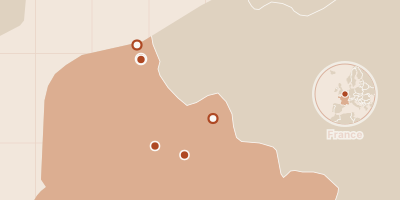
GamesSpeculative

Steins;Gate: Okabe's Akihabara

On 28 July 2010 Okabe Rintaro and Mayuri Shiina walk into the Radio Kaikan for a conference, and Okabe finds Kurisu Makise lying in a pool of blood. A text message sent moments later reaches his friend Daru a week early, and the PhoneWave in their Akihabara lab turns out to send mail into the past. The route follows the real streets behind the visual novel and anime: the station exit, the Radio Kaikan hall where the story starts, the lab above a television repair shop, Mayuri's maid café, Ruka's shrine and the gyudon shop where the lab members eat. The old Radio Kaikan was demolished in 2011, so the present building is a 2014 replacement.

6 locations5/6 visitable
GamesFictional

Uncharted 2 and 3: From Istanbul to the Empty Quarter

Two Naughty Dog adventures, two treasure hunts: Nathan Drake chases Marco Polo's Cintamani Stone from an Istanbul museum through Borneo and Nepal to the legend of Shambhala, then follows Francis Drake's secret to a lost city in the Arabian sands. The route follows both games in order. The legendary cities are invented or borrowed, and the game rarely names a real site, so every pin marks the country, city or region behind the chapter.

10 locations0/10 visitable
GamesApproximate

Ghost Recon Wildlands: The Real Bolivia

Ubisoft sent a team of developers across Bolivia in 2012 and built a cartel-ridden version of the country from what they saw. The game's story is fiction, and Bolivia's government complained about it in 2017. This route follows the real landmarks the game's map recreates: La Paz, the Yungas Road, the Uyuni train cemetery, Laguna Colorada and the silver mines of Potosí. All pins are approximate, since the game's world is fictionalised.

5 locations3/5 visitable
GamesFictional

Days Gone: Oregon After the Collapse

Two years after a pandemic turns millions of people into feral Freakers, outlaw biker Deacon St. John rides central Oregon as a drifter and bounty hunter. He believes his wife Sarah died when a NERO helicopter lifted her out of the outbreak — until he learns she was moved to a military outpost at Crater Lake. Days Gone's Oregon is a compressed, renamed version of the real high desert: Bend becomes Farewell, Black Butte Ranch becomes Iron Butte Ranch, and the militia holds Crater Lake. The route follows Deacon's ride from the opening evacuation to the volcanic lake where the story ends, through the hot springs, small towns and logging country that Bend Studio used as its model.

8 locations7/8 visitable
GamesApproximate

1979 Revolution: Tehran, Black Friday

In September 1978, an 18-year-old photographer named Reza Shirazi comes home to Tehran and is pulled into the last days before Black Friday. The developers built the game from interviews with forty Iranians who lived through the revolution and from photographs by Michel Setboun; the streets, the cinema hideout and the prison are real places, filled with a fictional cast. This route follows the game's 1978 story in order, from a Hasanabad rooftop to the shooting at Jaleh Square, then ends in the Evin Prison interrogation that frames the whole game. It is a route through the city the game recreates, not a walking itinerary.

6 locations0/6 visitable
GamesApproximate

Age of Empires II: Joan of Arc, Vaucouleurs to Rouen

Age of Empires II follows Joan of Arc from a French army camp at Vaucouleurs to the stake at Rouen. The designers said they deferred to history wherever it did not interfere with gameplay, and the campaign's spine — Orléans, Patay, Reims, Paris — is close to the record. But the game also bends the story, placing Joan at a battle she missed and turning a failed assault on Paris into a betrayal. This route follows the campaign's stops in order and sets each one beside what the sources say happened there.

8 locations7/8 visitable
GamesApproximate

Mafia: Definitive Edition: The Real Chicago Behind Lost Heaven

Lost Heaven, Illinois, never existed. The game's studio built it as a 1930s Chicago: an American city split by rivers, its downtown a wall of new skyscrapers, its West Side holding Italian and Chinese neighborhoods, its fortunes made on Prohibition bootlegging. The studio called Chicago of the 1920s and 1930s its real-world inspiration. This route follows six real Chicago places that stand behind Lost Heaven's geography and mood: the river at Wolf Point, the elevated Loop, the Board of Trade, Taylor Street, Chinatown and a jazz club with Prohibition history. The pins mark real Chicago sites, not in-game locations; Lost Heaven is fictional and the game maps no district one-to-one onto the city.

6 locations6/6 visitable
GamesApproximate

Driver: Miami to San Francisco

The Driver series began in 1999 as a car-chase game and grew into a tour of real cities: Miami, Los Angeles and New York in the first game, Havana, Las Vegas and Rio de Janeiro in Driver 2, Nice and Istanbul in Driver 3, and a fictionalised San Francisco in the 2011 sequel. Tanner's undercover work runs from a Miami parking garage to a presidential car, a Rio climax beneath Christ the Redeemer and the Golden Gate Bridge. This route follows the series city by city, from Ocean Drive's Art Deco hotels to the Las Vegas Strip and the Bosphorus. Some stops are city-level pins because the games recreate whole urban areas rather than single buildings; only Christ the Redeemer and the Golden Gate Bridge are pinned exactly.

9 locations9/9 visitable
GamesFictional

Life is Strange and True Colors: Arcadia Bay to Haven Springs

Life is Strange is set on the Oregon coast and True Colors in Colorado: Arcadia Bay draws on Astoria and Garibaldi, Haven Springs on Idaho Springs and Georgetown. Max Caulfield comes home to a missing girl and a storm only she can see; Alex Chen arrives to meet the brother she barely knows, then stays to solve his death. The route follows the games in order, from Cape Meares and the Oregon towns behind Arcadia Bay to Idaho Springs, Georgetown, Nederland and Marble, the Colorado towns behind Haven Springs.

7 locations7/7 visitable
GamesApproximate

Lost Judgment: Isezaki Ijincho and the Real Yokohama

In December 2021 private detective Takayuki Yagami comes to Isezaki Ijincho, a recreation of Yokohama's Isezakichō, to investigate bullying at Seiryo High School. The case grows into a murder inquiry that pulls him through the shopping street, Chinatown and the waterfront. The route follows the game's Yokohama from Kannai Station, where Yagami and Masaharu Kaito arrive, along Isezaki Road, through the Chinatown meeting that starts the case, to Hamakita Park (the real Yamashita Park) and the Basha-kaidō drone races. The model blends Sakuragichō and Hinodechō with Isezakichō, so the map is no scale copy.

5 locations5/5 visitable
GamesApproximate

The Crew Motorfest and Test Drive Unlimited: Oʻahu Recreated

Test Drive Unlimited sent players around Oʻahu's 1,000 miles of roads in 2006; The Crew Motorfest returned to a scaled-down island in 2023, with a car-culture festival at its centre. Both treat the island as a stage, one for a free-roam lifestyle racer and the other for a themed racing playground. This route follows a road-trip loop from Honolulu Airport through Waikiki, Diamond Head, Hanauma Bay and the North Shore to Haleʻiwa, then back south to Pearl Harbor. Pins mark the real places; the games shrink the island and invent some of the roads in between.

7 locations5/7 visitable
GamesFictional

Horizon: Aloy's American West

Horizon Zero Dawn and Forbidden West cross the American West from Colorado Springs and Denver to Yellowstone and drowned San Francisco. A thousand years after the old world fell to Faro's machines, Nora outcast Aloy travels to uncover what destroyed it. This route follows both Horizon games from the red rocks above Colorado Springs to the drowned streets of San Francisco, pairing each stop with the real landmark behind it. Guerrilla compresses the map — in-game locations are not exactly where they are in the real world — so the pins mark real stand-ins, not exact game coordinates.

9 locations9/9 visitable
GamesFictional

Ghostwire: Tokyo: Shibuya Behind the Fog

Akito wakes after a traffic crash in a Shibuya emptied by a masked occultist's fog, sharing his body with the spirit KK and able to see the Marebito that now fill the streets. Tango Gameworks built the district as a condensed, walkable stage rather than a straight copy, keeping landmarks, borrowing back streets and folding in a few districts from elsewhere in Tokyo. The route follows the game from the scramble crossing and the station through Center Gai, Dōgenzaka and the 109 stand-in, then north to a borrowed Yanaka Ginza and across town to the Tokyo Tower finale. Pins mark the real places; the game's map moves some of them closer together.

8 locations8/8 visitable
GamesFictional

Firewatch: A Summer in the Shoshone

In the spring of 1989, Henry leaves Boulder for a summer job as a fire lookout in Wyoming's Shoshone National Forest. His only company is Delilah, the voice on the other end of a walkie-talkie, until fireworks at a lake, a ransacked tower and a fenced research camp turn the job into a mystery. The route follows the game's places and the real Wyoming behind them: the bar where Henry meets Julia, the Cody rodeo the characters talk about, the Shoshone forest still marked by the 1988 Yellowstone fires, and stand-ins for the fictional Two Forks tower, Jonesy Lake, Wapiti Station, Cave 452 and Thorofare Lookout.

8 locations6/8 visitable
GamesExact

The Saboteur: Occupied Paris

Sean Devlin, an Irish race car driver, joins the French Resistance after the Nazis murder his best friend and turn occupied Paris black and white. Pandemic Studios' 2009 open-world game sends him across the city's landmarks on a campaign of sabotage and revenge, hunting the SS commander Kurt Dierker. The five stops follow the landmarks the story uses, from the Arc de Triomphe and the Champs-Élysées to Notre-Dame, the Catacombs and the Eiffel Tower. Each carries the real occupation history of the site between 1940 and 1944, and what a visitor finds there today.

5 locations5/5 visitable
GamesFictional

inFAMOUS 2: The Real New Orleans Behind New Marais

inFAMOUS 2 builds New Marais from real New Orleans: the French Quarter, Bayou St. John, Oak Alley, Fort Jackson and the Lower Ninth Ward. Cole MacGrath flees ruined Empire City to a Louisiana city ruled by the demagogue Joseph Bertrand and needs a scientist, a device and power cores to beat the Beast. New Marais is Sucker Punch's New Orleans: a fictional city assembled from the French Quarter, above-ground cemeteries, plantation houses, a Civil War fort, the bayous and the flooded districts left by a hurricane. This route follows Cole's story through seven of those stand-ins, from the swamp where he lands to the cathedral tower where the game ends.

7 locations6/7 visitable
GamesApproximate

Call of Duty: Black Ops Cold War: From Amsterdam to Solovetsky

In January 1981 a CIA team led by Russell Adler hunts Perseus, a Soviet spy Adler believed dead. The trail runs from an Amsterdam bar and a Vietnam flashback to East Berlin, the KGB's Lubyanka and a Cuban firefight, before reaching the Solovetsky Islands. The route follows the campaign's real places in mission order and keeps the game's story apart from the real history of each place. A final stop marks the alternate ending at Duga.

7 locations4/7 visitable
GamesFictional

Deus Ex: Mankind Divided: Dubai, Prague and London

Deus Ex: Mankind Divided opens in a half-built Dubai hotel, moves to a near-future Prague, and ends at a London summit. The game's city is a fiction: Prague is compressed into three invented districts, while Dubai's hotel and London's Apex Centre do not exist. But each stop stands on a real place, and this route follows the story from Dubai to the Vltava and the Thames, using the real cities, the real model for Golem City and the real Alpine range as anchors. The six stops follow the main mission order, from the Dubai prologue through Prague, Golem City and the Swiss Alps to the London finale.

6 locations6/6 visitable
GamesApproximate

Arma 3: The Island Behind Altis

In August 2010 a Bohemia Interactive team went to Lemnos to gather references, and came back with the material for Altis, the island where Arma 3 is set. Two years later two of the studio's developers were arrested on the same island and held for 129 days on suspicion of spying. After the arrest the game's main island, until then called Limnos, was renamed Altis; Stratis kept its name. The route follows the real island from Myrina and its castle, past a church with no roof and a miniature desert, to the airport and the old Allied base at Moudros, then across the water to Agios Efstratios. Arma 3's war is set in 2034–2035; the harbours, theatre and dunes are not.

8 locations8/8 visitable
GamesFictional

Like a Dragon: Infinite Wealth: Waikiki to Chinatown

Like a Dragon: Infinite Wealth sends Ichiban Kasuga to Honolulu. The developers rebuilt a compressed stretch of the city, from the sand of Aloha Beach to the markets of Chinatown, mixing real streets, shops and landmarks with renamed and invented ones. This route follows that Honolulu from Waikiki into downtown: Waikiki Beach, the International Market Place, the Ala Wai Canal bridge, Ala Moana Center, Iolani Palace and Chinatown. Names and distances have changed — Anaconda Shopping Center stands in for Ala Moana, Aloha Beach for Waikiki — but most of the streets and buildings are recognisable. It is a tour of a real city as a game remembers it.

6 locations6/6 visitable
MoviesFictional

Haikyu!!: Karasuno's Real Places

Haikyu!! is set in Miyagi Prefecture, but its creator Haruichi Furudate grew up in Karumai, a small town in Iwate, and much of the manga's school and streetscape is drawn from it. Fans turned the town into a pilgrimage stop, and a town-made walking map marks the spots that "look just like" the story. This route follows the real places behind Karasuno in story order: the electronics shop where Hinata first sees volleyball on television, the gymnasium where he loses to Kageyama and vows revenge, the school that became Karasuno High, the shop where coach Ukai minds the counter, the running-course slope, the supermarket behind Shimada Mart, the Sendai arena that hosts the Miyagi qualifiers, the junior high whose staircase became Shinzen High, and the diner behind the Karasuno canteen.

9 locations8/9 visitable
BooksApproximate

Wolf Hall: From Putney to the Tower

Thomas Cromwell rises from a Putney childhood to become Henry VIII's most trusted minister, then falls in the same Tudor politics he mastered. Hilary Mantel's trilogy follows him from Cardinal Wolsey's household through the Reformation, Anne Boleyn's rise and execution, and his own last years. This route traces the places that anchor the story: Cromwell's birthplace and London house, Wolsey's palaces at York Place and Esher, the abbey where Wolsey died, Westminster Abbey for Anne's coronation, the Seymour seat that gives the novels their title, Hampton Court, and the Tower. The 2015 television adaptation used Dover Castle for the Tower of London and Penshurst Place for Whitehall.

9 locations7/9 visitable
BooksFictional

The Lightning Thief: From Long Island to Olympus

Percy Jackson is a twelve-year-old boy in New York City who has just learned that the Greek gods are real — and that Zeus's master bolt is missing. With Annabeth and Grover, he has ten days to cross the country, find the bolt and reach the Underworld beneath Los Angeles before a war breaks out on Olympus. Rick Riordan's 2005 novel turns real American landmarks into monster stops: the Metropolitan Museum of Art, a Montauk beach, the Gateway Arch, a Denver water park, a Las Vegas casino that eats time, the Santa Monica Pier and the Empire State Building. A Disney+ series adapted the story from December 2023 to January 2024.

8 locations8/8 visitable
HistoryApproximate

Killers of the Flower Moon: Osage County's Reign of Terror

In the 1920s the Osage Nation drew oil wealth from beneath its Oklahoma land, and newspapers called the Osage the richest nation or social group on earth, man for man. Then they began to die — shot, poisoned, killed by a bomb in Fairfax — while local courts and guardians controlled the money. This route follows the documented places of the Osage murders, from Mollie Kyle's Gray Horse and Pawhuska's Million Dollar Elm to the Fairfax bombing, a lawyer's body beside the railroad, and the trials at Guthrie and Oklahoma City. It ends at the Osage Nation Museum, which keeps the record in the tribe's own voice. Scorsese's 2023 film was shot in many of the same towns.

7 locations4/7 visitable
MoviesFictional

The Banshees of Inisherin: Achill and Inishmore

The Banshees of Inisherin's island is fictional, but the film was shot on two real ones: Inishmore, where Pádraic's cottage and the cliffs stand in for it, and Achill, where the pub, the shop, the lake and Colm's house were found. In April 1923, Colm stops speaking to his oldest friend, Pádraic. This route follows the film's story from Pádraic's cottage to Colm's beach. Because Inisherin does not exist, every pin marks a real filming location; the sets at Cloughmore and Purteen are gone, and Colm's cottage is a private home to be seen from outside.

8 locations6/8 visitable
MoviesApproximate

Perfect Days: Hirayama's Tokyo

Wim Wenders' Perfect Days follows Hirayama, a Tokyo toilet cleaner who keeps his days exactly the same: the same overalls, the same cassette tapes, the same sandwich under the trees. The city changes around him; he notices the light through the leaves. This route follows the film's real Tokyo, from the old apartment east of the Sumida to four of the Tokyo Toilet project's designer facilities, the shrine bench where he eats lunch, the sento and Asakusa bar that fill his evenings, and the bridge where the story ends.

9 locations9/9 visitable
HistoryApproximate

Shōgun: The Real History Behind the Series

In 1600 an English pilot came ashore in Japan. FX's Shōgun renames the players — John Blackthorne is William Adams, Lord Toranaga is Tokugawa Ieyasu, Lady Mariko is Hosokawa Gracia — and moves the shipwreck from Usuki to the Izu village of Ajiro. This route follows the documented places behind the drama, from the real landing at Usuki and the regents' court at Osaka Castle to the mansion where Gracia died, Adams's shipyard at Itō, his house in Nihonbashi and his grave at Hirado. The 2024 series was filmed in British Columbia.

6 locations6/6 visitable
MoviesSpeculative

The Last Kingdom: Uhtred's England

Where The Last Kingdom is set: Bamburgh Castle in Northumberland, Viking York, the Somerset marshes at Athelney and the battlefield at Edington, the real ground of Uhtred's wars. A Saxon boy raised by Danes, he fights for Alfred and against him, and each stop is set against what history records. The television series adapts Bernard Cornwell's Saxon Stories; where a stop follows a particular novel or series, the point says so. The show was filmed mainly in Hungary, so the places below are the real settings of the events, not the filming locations.

9 locations7/9 visitable
MoviesApproximate

Babylon Berlin: Weimar Berlin, 1929–1933

Gereon Rath arrives from Cologne in 1929 to a Berlin of police headquarters, cabarets and armed conspiracies. The series follows him and Charlotte Ritter from the May Day riots through the fall of the Weimar Republic to Hitler's first weeks in power, mixing real streets with sets and stand-ins. This route visits the places the story names and the buildings that played them: the Rotes Rathaus as the police headquarters, the real Moka Efti, the Anhalter goods yard, the Hermannplatz U-Bahn, a Duisburg steelworks, the Theater am Schiffbauerdamm, Schloss Drachenburg and the Volksbühne. Some stops are exact; others are stand-ins far from Berlin.

8 locations8/8 visitable
MoviesApproximate

Wednesday: Nevermore, Jericho and the Irish Season

Wednesday Addams is sent to Nevermore Academy, a school for outcasts in the fictional Vermont town of Jericho. Netflix built that world in Romania: a castle above Bușteni, Bucharest interiors, a backlot town and a country mansion standing in for the Gates house. When season 2 moved production to Ireland in 2024, Nevermore gained a castle in County Offaly, a waterfall campsite and a Dublin cemetery. Much of the Irish shoot was based at Ashford Studios in County Wicklow. This route follows the show's geography through the real places that played it, season by season. The pins mark filming locations, not invented Vermont addresses.

8 locations6/8 visitable
MoviesExact

Goblin: A Red Door to Quebec

Goblin was filmed in Seoul, on the Jumunjin breakwater on Korea's east coast and in Quebec City, where the red door in Petit-Champlain, the Château Frontenac and the Tourny fountain appear. A Goryeo general killed by his king returns as an immortal goblin and spends 939 years looking for the bride who can pull the sword from his chest. The route follows the story from the palace set where his Goryeo past was filmed to his house in Seoul, the Gangneung breakwater where they first meet, and the old streets of Quebec City beyond a red door. It ends at the park that stands in for the Yoo family cemetery.

7 locations5/7 visitable
MoviesApproximate

Crash Landing on You: Switzerland and the Stand-In North

Crash Landing on You filmed its Swiss scenes on location at real places: Kleine Scheidegg, the piano pier on Lake Brienz, the Sigriswil gorge bridge and the First station above Grindelwald. Jeju's Ara-dong forest stands in for the North Korean DMZ, where a tornado carries the heiress Yoon Se-ri, and Ri Jeong-hyeok hides her as the two fall in love across the divided countries. This route follows the story in episode order, from Se-ri's landing in a Jeju forest to the reunion above Grindelwald. Nothing was filmed in North Korea: the Pyongyang and Kaesong stations were played by Ulaanbaatar, and the DMZ scenes by several of Jeju's oreums.

7 locations7/7 visitable
MoviesApproximate

Alice in Borderland: Shibuya, Empty and Overgrown

Alice in Borderland begins with three friends running through Shibuya and ends with Arisu and Usagi fighting for the city itself. Between those points the series empties Tokyo, then lets it grow over. This route follows the real Shibuya landmarks the characters use — the scramble crossing, the Hachikō gate, Shibuya Stream, 109 and SHIBUYA SKY — and visits the two sets where the empty and overgrown city was built, in Ashikaga and Yokohama. The story never leaves Tokyo; the production did. This route follows the Netflix series, not Haro Aso's manga, and each stop keeps the story place and its stand-in apart.

7 locations5/7 visitable
MoviesApproximate

Squid Game: Seoul and Incheon Outside the Games

Seong Gi-hun is a divorced gambler in Seoul, broke and in debt. A smiling stranger offers him a game of ddakji on a subway platform, and soon he is playing children's games for his life. The arena is fiction: the games were built as sets at the Daejeon Expo Science Park and later dismantled, and the island exteriors come from Seongapdo, a private island that cannot be visited. Everything around the arena is real — the market, the corner shop, the amusement park, the airport — and this route follows those places in story order, from a schoolyard in the first episode to a park where the Salesman starts recruiting again.

9 locations9/9 visitable
MythologySpeculative

Ilya Muromets: From Murom to Kiev

Russia's best-loved bogatyr was a peasant's son who could not walk until he was 33. Then he set out for Kiev, defended a city, killed a whistling monster in the forest and became the chief hero of Prince Vladimir's court. The route follows the epic songs known as byliny, from his village near Murom to the Kiev Pechersk Lavra, where the relics of a real monk, Ilya Pechersky, are said by some to be the hero's. Legend and history are marked apart: the pins show where tradition puts the story, not proof that it happened.

5 locations1/5 visitable
GamesApproximate

Sleeping Dogs: The Four Districts of Hong Kong

Sleeping Dogs sends an undercover cop into the Sun On Yee triad across a compact Hong Kong built from four real Island districts. The designers photographed the city for a week and then bent it to fit the story. This route visits the four districts in turn, starting with Aberdeen, where the story opens. Pins mark whole districts, not mission sites: no source ties a specific mission to a street.

4 locations1/4 visitable
GamesFictional

Mafia II: The Real Cities Behind Empire Bay

Mafia II is set in Empire Bay, a city that never existed but borrows from six real American ones. This route follows Vito's story from Sicily in 1943 to the 1951 war between mob families and the Triads. Only Sicily and a New York City stand-in are pinned; the sources tie no mission to a real place, so the remaining story stops stay unpinned.

7 locations0/7 visitable
GamesFictional

Red Dead Redemption 2: The Gang Across a Fictional America

Red Dead Redemption 2 follows the Van der Linde gang in 1899 across five invented U.S. states, with Saint Denis built on New Orleans and Guarma reached on a ship bound for Cuba. This route follows the main story from Blackwater to Saint Denis and an island beyond. Pins mark only places the sources name; the rest stay unpinned and keep their place in the sequence.

5 locations0/5 visitable
MoviesApproximate

Master and Commander: Chasing Acheron to the Galápagos

In 1805 the frigate HMS Surprise is hammered by a French privateer off Brazil, and her captain will not go home. The chase runs south round Cape Horn to the Galápagos, with a ship's surgeon who only wants to look at birds. The route follows the film's voyage, then the places where it was actually made: a giant tank in Mexico and the replica ship in San Diego. It covers the 2003 film, not Patrick O'Brian's novels, and the sea stops are left unpinned.

6 locations2/6 visitable
MoviesFictional

Vikings: The Places of Ragnar's Story

Ragnar Lothbrok goes from farmer to king in History's Vikings, a series that sprints through more than a century of Viking Age history and the sagas. This route follows the places of its events in story order, setting what the show does against what history and the sagas say. The series itself was filmed in Ireland. From a raid on Lindisfarne to Paris under siege, a snake pit near York, a Mediterranean raid, a colony in Iceland and a court in Kiev and a voyage west, with the fictional village of Kattegat left unpinned.

10 locations1/10 visitable
GamesFictional

Far Cry: The Real Places Behind Every Game

Every Far Cry game drops you into a country that does not exist, and almost every one was built from a real place. The developers camped on the savanna, sent a team to Nepal, spent two weeks in Montana and a month in Cuba. This route follows the series in release order, one stop per game. Pins mark whole countries or regions, not scenes: they show where each fictional setting came from, and one entry has no sourced real model.

7 locations0/7 visitable
MoviesApproximate

EuroTrip: From Ohio to the Vatican

A dumped teenager from Ohio crosses Europe to find his German pen pal: London, Paris, Amsterdam, Bratislava, Berlin and finally the Vatican. The joke is that nearly all of it was shot in one city, Prague, apart from a single beach scene in Rostock. Each stop pairs the story city with the real place that played it, so you can see where the fiction and the film set part ways. Story cities are approximate; the Prague filming spots are exact.

7 locations2/7 visitable
Real JourneysApproximate

Seven Years in Tibet: From Nanga Parbat to Lhasa

In 1939 the Austrian climber Heinrich Harrer went to the Himalaya, and the war turned the trip into a walk to Lhasa. Harrer's memoir Seven Years in Tibet follows his escape from a British camp in India and his walk to Lhasa, where he became tutor to the 14th Dalai Lama. This route covers six places from Nanga Parbat to the Potala Palace. The 1997 film was shot largely in Argentina, not Tibet, so none of its sets are stops here.

6 locations0/6 visitable
GamesSpeculative

Pokémon Ruby and Sapphire: Hoenn and Kyushu

Hoenn is a world of volcanoes, islands and sea routes, and the games' own region is based on Kyushu, the south-western main island of Japan. Fans and reference writers have matched its towns and landmarks to real places across the island and the seas around it. This route follows the story from Littleroot Town to the Sealed Chamber and sets each stop beside the place it is said to resemble. The region is inspired by Kyushu, not copied from it, so every pin is an outside reading of the map, not an official location.

8 locations0/8 visitable
MoviesApproximate

The Witcher: Season One from Hungary to the Canaries

Netflix's Continent was built from a patchwork of real places: a Hungarian fort, a village museum, a former monastery, Canary Islands coasts and a ruined Polish castle. This route follows season one's shoot from October 2018 to May 2019: Cintra and Marnadal in Hungary, Aretuza and Ciri's desert in the Canary Islands, and Sodden Hill at Ogrodzieniec in Poland. Filming spots only; the Continent itself is invented.

7 locations3/7 visitable
MoviesApproximate

Pirates of the Caribbean: Islands Behind the Sets

Port Royal and Tortuga were built on a quiet St Vincent bay, Cannibal Island is Dominican rainforest, and a private Bahamian cay sits behind a famous duel. This route follows the shoots from St Vincent in 2002 through Dominica in 2005 to Grand Bahama, where the ships were filmed in a hurricane season. Most pins mark areas, not exact sets; the sets themselves were built and taken down.

7 locations5/7 visitable
MythologySpeculative

The Epic of Gilgamesh: From Uruk to Dilmun

Gilgamesh, king of Uruk, goes looking for the secret of immortality. This route follows the epic from its city to the Cedar Forest and the flood hero's home, then to the Nineveh library where the tablets were found. The poem's places are legend and the tablets' places are archaeology; each stop says which, and which pins are only candidates. The Iraqi sites are not visitor destinations.

6 locations2/6 visitable
HistorySpeculative

Genghis Khan: From the Onon to Samarkand

The boy born on the Onon River became the ruler of the largest land empire in history. This route follows him from the steppe camps of Khentii, through the war that began at a border town in Kazakhstan, to the siege of Samarkand and a death in the middle of a campaign. The sources disagree on his birth year, his birthplace and his grave. Where the Secret History of the Mongols gives a legend and other sources give the record, the stops say which is which.

8 locations6/8 visitable
MythologySpeculative

The Trojan War: From Aulis to Ithaca

Homer's Trojan War on the map: Mycenae, Aulis, where the fleet waited, the hill of Hisarlik, now identified with Troy, and the Scamander plain, then Pylos and Ithaca from the Odyssey. Each stop is told from Homer, with archaeology kept apart. The route follows the epic from the fleet at Aulis to the plain of the Scamander, then the Odyssey's road home via Pylos and Ithaca. Many identifications here are traditional or disputed, and the pins show it.

6 locations3/6 visitable
HistoryApproximate

The Fall of Constantinople, 1453: From the Bosphorus to Hagia Sophia

The fall of Constantinople in 1453, from Rumeli Hisarı on the Bosphorus and the chain across the Golden Horn to Galata hill and Hagia Sophia. Mehmed II's huge cannons and ships hauled over land took the city on 29 May. This route follows the siege in order: the fortress on the Bosphorus, the chain across the Golden Horn and the ships that bypassed it, the land-wall gates, and Hagia Sophia. Exact positions of some events are not recorded, so several pins are approximate.

6 locations0/6 visitable
HistoryApproximate

Harriet Tubman: Maryland to St. Catharines

Harriet Tubman escaped slavery in 1849 and then went back to Maryland about 13 times, bringing out some 70 people. Her work depended on a chain of Quakers, free Black ministers and abolitionists who hid and moved people north. The route follows that chain from the Eastern Shore through Wilmington and Philadelphia to Niagara and Salem Chapel in St. Catharines, then to her farm at Auburn. Real routes were kept secret, so most pins are approximate.

8 locations3/8 visitable
Real JourneysSpeculative

Chkalov's Transpolar Flight: Moscow to Vancouver

On 18 June 1937 three Soviet airmen took off from Moscow in a single-engine plane and landed in Washington State more than 63 hours later, having flown over the North Pole. It was the first non-stop flight from the Soviet Union to the United States. The route follows the crew from the airfield near Shchyolkovo to the landing at Pearson Field, then to the general's table, the White House and the monument that still stands by the runway. The path over the Arctic is shown only as a symbolic pin.

6 locations1/6 visitable
Real JourneysApproximate

Jack London in the Klondike: Dyea to Dawson

At 21, Jack London sailed north in July 1897 to join the Klondike gold rush. He came home without gold but with scurvy and the stories that made his name: The Call of the Wild, "To Build a Fire" and more. This route follows him from the beach at Dyea over the Chilkoot Pass, down the lakes and rapids of the Yukon, through a winter at the Stewart River to Dawson City, where his cabin still stands.

7 locations5/7 visitable
BooksApproximate

The Old Man and the Sea: Hemingway's Havana and Cojímar

Hemingway wrote his last great novella in Cuba, about a fisherman and one enormous marlin. The places around it are real: the hotel room where he first lived, the bar he loved, the house where he wrote, and the fishing village next door. This route follows the writer's Cuba from Old Havana to the harbour of Cojímar, where the Pilar was moored. The novella itself is under copyright, so the story is kept to its outline.

5 locations5/5 visitable
MythologySpeculative

The Brothers Grimm: The German Fairy Tale Route

The German Fairy Tale Route runs from Hanau, where the Brothers Grimm were born, to Sababurg, nicknamed Sleeping Beauty Castle, the Pied Piper's Hamelin and the Musicians' Statue in Bremen. The brothers grew up poor, studied law and became librarians. The route follows the Fairy Tale Route from Hanau, where they were born, through the places they lived and worked, to Sleeping Beauty's castle and the Pied Piper's Hamelin, ending in Bremen with the animals' statue. The tale places are traditional associations, not the Grimms' own claims.

8 locations3/8 visitable
MythologySpeculative

The Kalevala: Lönnrot's Trips and the Places of the Runes

Finland's national epic was gathered, not invented: a country doctor named Elias Lönnrot walked into the forests of Karelia and wrote down what the old singers recited. The route follows his collecting trips from 1832 to 1834, from Viena Karelia to his home at Kajaani and the first draft at Kuhmo, then visits three places the runes name: the Imatra rapids, the island of Saari and the Kemi river. The poem's geography is loose, so the last two pins are marked as guesses.

7 locations3/7 visitable
HistoryApproximate

Luther and the Reformation: From Eisleben to the Wartburg

A boy born in Eisleben becomes a monk, a professor and the man who defied an emperor. Along the way he vows in a thunderstorm, challenges the church over indulgences, is spirited away in disguise and ends his life where it began. The route follows Luther through seven places in Germany: his birth house, the Erfurt monastery, the Wittenberg church doors, the Diet of Worms, the Wartburg, his Wittenberg home and the house where he died. The Worms pin is approximate, and the Castle Church doors story is tradition.

7 locations7/7 visitable
HistoryApproximate

Yermak: The Conquest of Siberia, 1581-85

A few hundred Cossacks, a Stroganov fortress on the Kama and a khan's capital on the Irtysh: in four years Yermak turned a raid into the Russian entry into Siberia. The route follows the campaign from Orel-gorodok over the Urals to the battle at Chuvash Cape, the fall of Qashliq, Yermak's death at the Vagay and the founding of Tobolsk. Dates differ between chronicles and modern sources, and the sources mark the death site and the legends as uncertain; the notes at each stop say which.

6 locations3/6 visitable
Real JourneysApproximate

Nansen and the Fram: Drifting Across the Arctic

In 1893 Fridtjof Nansen froze a purpose-built ship into the Arctic ice on purpose. His bet was that the pack would carry it across the top of the world, and the sceptics called it self-destruction. This route follows the voyage from Vardø to the pack ice, the drift, the sledge dash to 86°14′N, a hard winter in a stone hut and a lucky meeting at Cape Flora, ending at the museum where the ship rests. Ocean and ice stops have no map pin.

8 locations2/8 visitable
MoviesApproximate

Parasite: Bong Joon-ho's Seoul

Parasite's Seoul is a city of stairs: Dwaeji Super in Ahyeon-dong, Sky Pizza in Noryangjin, the road to the Parks' villa in Seongbuk and the Jahamun Tunnel. The Kims' semi-basement was a set in Goyang, since demolished. The route runs from a corner store in Ahyeon-dong to the Jahamun Tunnel and the Goyang flood set. Both family homes were sets, so the houses themselves are not on the map.

6 locations4/6 visitable
BooksSpeculative

The Name of the Rose: In Search of the Abbey

In 1327 a Franciscan detective and his young novice arrive at a Benedictine abbey in northern Italy, and monks begin to die. Umberto Eco's abbey is invented, but it was assembled from real places, and Jean-Jacques Annaud's 1986 film built another one from sets and a German monastery. This route follows the borrowed pieces of the book, from the Sacra di San Michele to the portal at Moissac, then the places that played the abbey on screen. Pins for the book's models are traditional identifications, not locations named in the novel.

7 locations5/7 visitable
HistoryExact

The Siege of Leningrad: The Road of Life, 1941–44

Cut off from the rest of the country, Leningrad lived through the winter of 1941–42 on 125 grams of bread a day, half of it sawdust. This route follows the siege through the places that carried the city through: a fortress island, an ice road, a seed bank, a diary, a symphony. It runs from the first day of the encirclement to the memorials that came after, and keeps to documented facts. Several stops are memorials: please visit with respect.

7 locations6/7 visitable
Real JourneysSpeculative

Saint-Exupéry and the Aéropostale: From Toulouse to the Desert

Before The Little Prince, Antoine de Saint-Exupéry flew the mail. He flew the Aéropostale line from Toulouse, ran the Cape Juby airfield, directed an airline in Buenos Aires and survived a crash in the Sahara that later fed his most famous book. The route follows his life in the air, from the take-off strip at Montaudran to the sea off Marseille where his plane was found. The Sahara crash site is only an educated guess.

5 locations3/5 visitable
GamesFictional

Uncharted 4 and The Lost Legacy: Highlands, Madagascar and the Hoysala Temples

Two Naughty Dog adventures, two treasure hunts: the Drake brothers chase a pirate hoard from a hidden cathedral in the Scottish Highlands to the fabled pirate utopia of Libertalia, and Chloe Frazer and Nadine Ross follow a trail of Hindu temples through India's Western Ghats to the Tusk of Ganesh. The route follows both games in order. Madagascar and Karnataka have real pirate coves and real Hoysala temples behind the fiction, but the games' exact settings are invented, so every pin marks the nearest real place.

5 locations2/5 visitable
MoviesApproximate

Moscow Does Not Believe in Tears: Katya's Moscow, 1958–1978

Three provincial girls, a dormitory and a city that does not believe in tears: the Oscar-winning Soviet melodrama follows Katerina from a borrowed high-rise flat in 1958 to the director's chair twenty years later. The route visits the places the film was shot or set, from the Kudrinskaya tower and Gogol Boulevard to the Klin factory and the round house of the final credits. Most pins mark the shooting location, not a scene's exact spot.

5 locations2/5 visitable
BooksSpeculative

The Divine Comedy: Dante's Florence, Exile and Ravenna

Dante wrote the Divine Comedy while banished from Florence. This route follows both the man and the people he put in the poem who were real: Francesca, Ugolino and Pia. It runs from the Baptistery and the sentence of 1302, through the places tied to the poem's souls and the court of Verona, to Ravenna, where he died in 1321, and the empty tomb Florence built for him.

9 locations5/9 visitable
BooksSpeculative

Dickens's London: Oliver Twist and Great Expectations

Two Dickens novels, one city of thieves' dens, prisons and cramped lodgings. Oliver Twist is dragged into Fagin's gang in the lanes of Holborn, while Pip of Great Expectations arrives from the Kent marshes expecting a soft white city and finds filth. The route follows Oliver and Nancy from Saffron Hill to London Bridge, Jacob's Island and Newgate, then Pip from Cooling churchyard through Rochester to Little Britain and Barnard's Inn. Several places are traditional models rather than named settings, and each pin says so.

8 locations5/8 visitable
MythologySpeculative

Sadko: From Novgorod to the Sea Tsar

Sadko is a poor gusli player from Novgorod whose music wins the favour of the Sea Tsar, a golden fish and a fortune, until the sea demands payment. The story is best known abroad through Rimsky-Korsakov's opera. The route follows the tale through the real geography it grew from: the merchants' market, Lake Ilmen, the Volkhov trade route, the river's source, and the Novgorod church of the man Sadko may be based on. None of the places is named exactly in the tale, so all pins are approximate.

5 locations0/5 visitable
Real JourneysApproximate

Miklouho-Maclay: The Maclay Coast of New Guinea

A Russian student expelled from university in 1864 ends up living among people in north-eastern New Guinea who had never seen a European. Nikolai Miklouho-Maclay was a zoologist and anthropologist, an early follower of Darwin who refuted the view that human races were different species. The route follows him from Haeckel's Jena and the Canary Islands to Astrolabe Bay, the Sydney research station he founded, and his grave in St Petersburg. Most pins are approximate: the sources name regions, not camps.

6 locations2/6 visitable
MoviesApproximate

Seventeen Moments of Spring: Berlin and Bern on Soviet Film Sets

Seventeen Moments of Spring sets Stierlitz in Berlin, but much was shot elsewhere: a Moscow park as the Bavarian Forest, Riga's old town and Meissen as Bern, hills near Tbilisi as the Alps. This route follows the story through the places that played its settings, from a Moscow-region park posing as the Bavarian Forest to Riga, Meissen and the hills of Georgia standing in for Bern and the Alps. Every pin marks a stand-in, not a place from the plot.

7 locations0/7 visitable
BooksSpeculative

The Brontës' Yorkshire: Haworth and the Moors

Charlotte and Emily Brontë grew up in a parsonage on the edge of the Pennine moors, and the landscape of both novels still runs through the places they knew: a harsh school, a house with a famous library, a ruined farm on the heights. The route starts at the Haworth parsonage, goes to the school behind Lowood, then up to the farms said to lie behind Thrushcross Grange and Wuthering Heights, and ends in Derbyshire at the hall behind Thornfield. Most identifications are traditional, not proven, and each pin says so.

5 locations3/5 visitable
HistoryApproximate

The Romanovs' Last Journey: Tsarskoye Selo to Yekaterinburg

The Romanovs' last journey runs from the Alexander Palace at Tsarskoye Selo to the governor's mansion in Tobolsk and the Ipatiev House in Yekaterinburg, then to Ganina Yama and Porosyonkov Log. Sixteen months after Nicholas II's abdication, none of the family was alive. The route follows that road from the Alexander Palace through the governor's house in Tobolsk to Yekaterinburg and the forest sites nearby, where the story ended and where it was later argued over. It is told plainly, and the final stops are places of mourning for many visitors.

5 locations4/5 visitable
Real JourneysApproximate

Dersu Uzala: Arsenyev's Ussuri Taiga

In the early 1900s a Russian army surveyor, Vladimir Arsenyev, mapped the wild Ussuri taiga with the help of Dersu Uzala, an indigenous hunter who read the forest better than any map. Arsenyev's memoir became a classic, and Akira Kurosawa turned it into an Oscar-winning film in 1975. The route follows the story from Vladivostok to Lake Khanka and the Sikhote-Alin, then to Khabarovsk, Dersu's lost grave and the film's shooting base. Pins mark regions and towns, not exact campsites.

6 locations1/6 visitable
GamesApproximate

Metro Exodus: From Moscow to Lake Baikal

In 2035 Artyom leaves the Moscow Metro on a stolen train, the Aurora, and finds that Russia beyond the city is still alive. The sequel to Metro 2033 turns a Moscow underground story into a rail journey across the whole country. The route follows the Volga, the Ark at Yamantau, the Caspian and Novosibirsk to Lake Baikal. The game's places are invented versions of real ones, so every pin is an area, not a level.

6 locations0/6 visitable
GamesApproximate

Assassin's Creed Mirage: Basim's Baghdad, 861

Assassin's Creed Mirage is set in 9th-century Baghdad, with the Round City and the House of Wisdom, and stops at Anbar, Alamut and al-Ula. Street thief Basim Ibn Ishaq becomes a Hidden One hunting the Order of the Ancients amid the Anarchy at Samarra. The route follows him from the ruined town of Anbar to the mountain fortress of Alamut, through the districts of Baghdad and on to the oasis of al-Ula. Little of the Round City survives and the House of Wisdom is gone, so those pins are approximate; the Iraqi stops are for reading, not visiting.

5 locations2/5 visitable
MoviesApproximate

White Sun of the Desert: From Dagestan to Merv

White Sun of the Desert was filmed on Dagestan's Sarykum dune, the Caspian shore near Makhachkala, Turkmenistan's Karakum sands near Mary and at ancient Merv. Red Army soldier Sukhov only wants to go home to his wife, but the desert keeps handing him other people's problems. The route follows the shoot in two expeditions: the Caspian shore and the Sarykum dune in Dagestan, then the Karakum sands and the ruins of Merv in Turkmenistan. Several stops are approximate, because the film's village was a temporary set.

5 locations1/5 visitable
BooksFictional

And Quiet Flows the Don: Sholokhov's Cossack Stanitsas

Grigory Melekhov loves another man's wife, goes to war, and changes sides in the Civil War four times. Sholokhov's novel of the Don Cossacks grew out of the Upper Don, and its landscape is still there. The route moves from the invented hamlet of Tatarsky to Vyoshenskaya, the stanitsa of the 1919 uprising, then to the villages where Sholokhov lived and wrote. Tatarsky and the monument are marked approximately.

5 locations4/5 visitable
BooksFictional

Eugene Onegin: Pushkin's Petersburg, Moscow and Mikhailovskoye

Pushkin's novel in verse follows a bored St. Petersburg dandy who inherits a country estate, rejects a girl's love letter, kills his friend in a duel, and years later finds her transformed into the star of Petersburg society. The route runs from the capital's garden walks to the road into Moscow and the exile estate where he wrote part of the book. Most places in the verse are glimpsed rather than described, so several pins are approximate or stand-ins.

5 locations5/5 visitable
Real JourneysApproximate

As I Walked Out One Midsummer Morning: Spain 1935

In the summer of 1935 the young Laurie Lee left London for Spain with a violin and a single Spanish phrase. For a year he walked and played his way from Galicia to the Andalusian coast, sleeping under the open sky or in cheap posadas, welcomed even by the poorest villagers. The route follows his memoir from Vigo through Zamora, Toledo, Tarifa and Málaga to Almuñécar, where he was rescued by a British destroyer as the Spanish Civil War began. Pins mark towns, not the roads he actually walked.

6 locations0/6 visitable
Real JourneysApproximate

Michael Palin: Around the World in 80 Days, 1988

Michael Palin's Around the World in 80 Days (BBC, 1988) followed Phileas Fogg with no aircraft, from London's Reform Club to Venice, the Pyramids, Dubai, Hong Kong and Aspen. It ran from 25 September to 12 December and ended at a locked door in Pall Mall. The route follows nine moments from his own day-by-day captions and diary excerpts: Venice, the Pyramids, a dhow from Dubai to Bombay, Hong Kong, a train to Shanghai, the Pacific, an Aspen balloon and a locked door in Pall Mall. Pins mark cities and landmarks; the real line of travel ran between them.

9 locations4/9 visitable
BooksApproximate

The Great Railway Bazaar: By Train Through Asia

In 1973 Paul Theroux set out from London Victoria on a four-month railway loop through Europe, the Middle East, the Indian subcontinent and Southeast Asia, then came back on the Trans-Siberian Railway. His travelogue, published in 1975, became a classic of the genre. This route follows episodes the book's reviewers single out, from the Direct-Orient Express to Istanbul, Calcutta, Burma, Vietnam and Tokyo. The book's own text could not be checked, so some pins mark a city's station rather than a scene, and some places are not safe to visit now.

9 locations6/9 visitable
Real JourneysApproximate

In Patagonia: Chatwin's Road South to the Sloth Cave

In 1974 Bruce Chatwin set out for Patagonia to find his own "piece of brontosaurus": a scrap of skin sent to his grandmother by her cousin, Charley Milward the sailor. Six months of travel became In Patagonia, the book that made his name. This route follows the quest from a natural history museum in La Plata through the Welsh coast, Butch Cassidy's cabin and Milward's house in Punta Arenas, to the cave where the skin was found. Chatwin's tales were not always literal, so most pins mark areas, not scenes.

5 locations3/5 visitable
Real JourneysApproximate

Long Way Round: London to New York

In the spring of 2004 Ewan McGregor and Charley Boorman set out from London on motorcycles, heading east for New York with cinematographer Claudio von Planta. The ride ran from 14 April to 29 July and crossed twelve countries and 18,887 miles. The route follows the highlights: a church built of bones in the Czech Republic, a UNICEF project in Mongolia, the mud of the Zilov Gap, the Road of Bones to Magadan, Mount Rushmore and the ride into New York. Pins mark places and areas; the real line of travel ran between them.

7 locations3/7 visitable
MoviesExact

Bridgerton: From Bath to London

Bridgerton is set in London, but most of its streets are in Bath, its parks are in Wiltshire and its family home is in Greenwich. This route follows the filming locations from the Royal Crescent and Lady Danbury's house in Bath, through London and Kent, to the country houses that played Clyvedon and Aubrey Hall in the first two seasons.

9 locations4/9 visitable
MoviesApproximate

Peaky Blinders: Birmingham and Liverpool

Peaky Blinders mostly filmed its 1919 Birmingham on Liverpool's Powis Street, the Worth Valley Railway and Bradford's Little Germany. Tommy Shelby's gang rules Small Heath. The route follows the story from Small Heath, through the Liverpool street that played Watery Lane, a Yorkshire railway, Aunt Polly's village and the Black Country, to Bradford's warehouses, Tommy's country house and the beach where series 4 ends. Most pins mark stand-ins, labelled as such.

8 locations7/8 visitable
HistorySpeculative

Amelia Earhart: The Last Flight, 1937

Amelia Earhart's last flight, 1937: from Oakland and Pearl Harbor to Miami, Lae in New Guinea and Howland Island, which she never reached, and on to Nikumaroro, where one theory says she came down. A crash in Hawaii and a lost radio signal made it one of history's great mysteries. The route follows both attempts, from Oakland and Pearl Harbor to Miami, Lae and Howland Island, and ends at Nikumaroro, where one theory says she and her navigator came down. That final stop is only a hypothesis.

6 locations1/6 visitable
Real JourneysApproximate

Alexandra David-Néel: To Lhasa, 1924

Disguised as a beggar, a Belgian-French explorer walked into the forbidden city of Lhasa among pilgrims. Alexandra David-Néel and her adopted son Yongden stayed two months in 1924, then slipped away before the governor could act. The route follows her from Kumbum, where she studied for years, across the Kyi to the Potala and the Monlam crowds, then on to Samye, Tsetang and Gyantse. Pins are area-level, and critics have disputed her account since 1972.

7 locations4/7 visitable
Real JourneysApproximate

Burton and Speke: The Search for the Nile

In 1857 two British officers set out from Zanzibar to find the Great Lakes rumoured to lie in the centre of the continent and, they hoped, the source of the Nile. They found two lakes, and then fell out over what they had found. The route runs from a failed Somali expedition through Zanzibar, Kazeh and Ujiji to Lake Victoria, then on to Speke's Ripon Falls and the Bath debate that never happened. All pins are approximate, as the sources name regions and towns rather than exact spots.

7 locations6/7 visitable
Real JourneysSpeculative

Cabeza de Vaca: Across North America, 1528–36

A failed Spanish expedition to Florida left four survivors, and one of them, Álvar Núñez Cabeza de Vaca, walked and traded his way across the continent over roughly eight years before meeting Spaniards again in Mexico. He wrote his account from memory. The route runs from Spain through Cuba, Florida and the Texas coast to Culiacán and Mexico City. Most stops are approximate, and the middle of the journey is not traced because historians cannot fix his route.

7 locations5/7 visitable
MoviesApproximate

Lawrence of Arabia: Wadi Rum, Seville and Almería

David Lean's 1962 epic follows T. E. Lawrence through the Arab Revolt, but most of its Arabia was built in Spain. Seville played Cairo, Jerusalem and Damascus, while Almería and a beach near Carboneras supplied the desert and a whole replica of Aqaba. The route follows the story's order and keeps history apart from the film's shooting locations. Stops say plainly whether they show what happened in 1917 or where the cameras stood.

7 locations4/7 visitable
MoviesApproximate

The Bourne Trilogy: From Zurich to Tangier

The Bourne Trilogy: Zurich's safe deposit box, the Paris car chase and Tangier's medina. A man with no memory is hunted by a CIA programme that wants him gone. The route follows the three films in order, from Zurich and Paris through Mykonos, Berlin and Moscow to London and Tangier. Several cities were stand-ins for others, so the pins mark the story's places or honest approximations.

7 locations4/7 visitable
BooksFictional

Heidi: From Maienfeld to Frankfurt

Heidi is set in Maienfeld, Switzerland: Johanna Spyri's 1881 novel opens on the village footpath, climbs to the alm above it, and sends the orphan to a grand house in Frankfurt, where homesickness makes her sleepwalk until Klara visits the mountain. The route runs from Ragaz, where Spyri wrote the book, through Maienfeld and the alm above it to Frankfurt and the tourist Heididorf. Spyri never names the exact hamlet or house, so most pins mark an area or a tradition.

6 locations5/6 visitable
BooksFictional

Anne of Green Gables: Montgomery's Prince Edward Island

Anne of Green Gables is set on Prince Edward Island: Avonlea is based on Cavendish, Green Gables is an 1830s farmhouse there, and at sixteen Anne goes to Queen's Academy in Charlottetown. Lucy Maud Montgomery's 1908 novel, much loved in Japan as Red-haired Anne, sends a talkative orphan to a farm by mistake. The route follows the book's real island: the village behind fictional Bolingbroke, the lake Anne renames, Green Gables itself, the woods she fears, her Charlottetown college and the window where it was written. Avonlea and the Cuthberts are invented; the pins mark the real places that inspired them.

6 locations3/6 visitable
Real JourneysSpeculative

Orellana: Down the Amazon, 1541–42

A search for the Land of Cinnamon turned into the first descent of the Amazon from the Andes to the sea. Francisco de Orellana, with the friar Gaspar de Carvajal as chronicler, followed unmapped rivers, fought off warriors on the banks and gave the river the name it still carries. The route runs from Quito to the Napo, the Rio Negro, the Amazon's mouth and the pearl island of Cubagua. River stops are approximate, and dates are as the sources give them, in the Julian calendar still in use then.

7 locations3/7 visitable
Real JourneysApproximate

Przhevalsky: Expeditions Across Central Asia

Nikolay Przhevalsky made one expedition to the Ussuri region and four to Central Asia, crossing the Gobi, reaching the wandering lake of Lop Nur and getting within 260 km of Lhasa. He died at Karakol on Lake Issyk-Kul, on the eve of a fifth journey. This route follows six stops from those journeys and his years between them. They were separate expeditions rather than one trip, so the markers are not joined. Dates are years only.

6 locations2/6 visitable
Real JourneysApproximate

Krusenstern and Lisyansky: The First Russian Circumnavigation

In August 1803 two small Russian sloops sailed from Kronstadt on the first Russian voyage round the world. Adam Johann von Krusenstern led the expedition on the Nadezhda, and Yuri Lisyansky captained the Neva; the Neva was back almost three years later. This route follows seven turning points, from the Marquesas and Kamchatka to the Tlingit fort at Sitka, the closed door of Nagasaki and the tea trade at Canton. The two ships often sailed apart, so the stops are markers, not one line. Day dates follow the main source, which gives the outward voyage in the modern (New Style) calendar; Russian logs of the time used the Old Style, so the homecoming in 1806 is given by season only. Pins mark towns and bays, not exact anchorages.

7 locations0/7 visitable
Real JourneysApproximate

Vitus Bering: The Kamchatka Expeditions

Vitus Bering's Kamchatka expeditions went from Saint Petersburg through Tobolsk and Okhotsk to the Bering Strait and Bering Island. In 1725 the Russian naval captain set out across a continent to find out whether Asia and America were joined. The route follows seven places from the Tsar's order in Saint Petersburg to Bering's death on an uninhabited island in 1741. The stops are not one continuous line, so they are shown as separate markers. Dates are Old Style (Julian), as Russian records of the time kept them; the modern calendar runs 11 days ahead.

7 locations0/7 visitable
BooksApproximate

Perfume: Grenouille's Paris, Cantal and Grasse

Patrick Süskind's Perfume follows Jean-Baptiste Grenouille, born in Paris in 1738, with a gift for scent and no scent of his own. His path runs from the Innocents cemetery to a mountain cave, and then to Grasse, where his craft turns murderous. The route follows the book from Paris to the Plomb du Cantal, Montpellier and Grasse, and ends in Barcelona, where Tom Tykwer's film rebuilt Paris. Only a few places are named exactly; the rest are approximate.

6 locations5/6 visitable
BooksApproximate

My Brilliant Friend: Ferrante's Naples and Ischia

Two girls grow up in a poor Naples neighbourhood in the 1950s, one pushed on by school, the other by sheer brilliance. Elena Ferrante's four Neapolitan Novels follow their friendship from a doll thrown down a cellar chute to a package in the mail in 2010. The route runs from the district of the first book through Ischia, Pisa, San Giovanni a Teduccio and Florence to Turin. The books never name the streets, so most pins mark areas, not buildings.

6 locations1/6 visitable
BooksFictional

The Girl with the Dragon Tattoo: Larsson's Stockholm

Stieg Larsson's Millennium trilogy is a Stockholm novel before it is a thriller: journalist Mikael Blomkvist and hacker Lisbeth Salander live, drink and work on Södermalm, the island district where much of the action takes place. This route walks the real addresses behind the books, from Blomkvist's home on Bellmansgatan to Lisbeth's penthouse on Fiskargatan, and ends at the City Museum that runs the official tour. Some addresses are private homes, so most are seen from the street.

8 locations5/8 visitable
BooksApproximate

Twilight: Forks and Volterra

Bella Swan moves to the rainiest corner of Washington and falls for a vampire. Stephenie Meyer picked the town of Forks by searching for rainy places, and the story then carries Bella and Edward from the Olympic Peninsula to the clock tower of Volterra in Tuscany. The route follows the first two novels from Forks through La Push and Port Angeles to Volterra, and ends in Montepulciano, the town that played Volterra in the film. The pins mark towns, not buildings.

5 locations5/5 visitable
Real JourneysApproximate

Inō Tadataka: Surveying Japan on Foot

Inō Tadataka measured Japan on foot, from his brewer's house in Sawara and the Tomioka Hachiman shrine in Fukagawa to Mount Hakodate and Nihonbashi. In ten surveys from 1800 he and his team paced the country's coasts, and maps based on his work were still in use in 1924. The route follows his life in places: the brewer's house at Sawara, the shrine where he prayed before the first survey, Mount Hakodate and the far end of that journey in Hokkaido, Nihonbashi, his grave and the shrine that honours him. The surveys were separate expeditions, so the stops are not one connected walk.

7 locations6/7 visitable
Real JourneysApproximate

Hasekura Tsunenaga: From Japan to Rome and Back

In 1613 a samurai from Sendai set out to Mexico in a galleon built for the mission to meet the King of Spain and the Pope. Hasekura Tsunenaga's embassy took seven years, crossed Mexico and the ocean, and came home to a Japan that was closing its doors to Christianity. The route follows him from the port of Tsukinoura through Acapulco, Mexico City, Havana, Madrid, Saint-Tropez and Rome, then back via Manila to Nagasaki. Japanese dates are given in the Gregorian calendar. Most pins mark towns or harbours, not documented buildings.

9 locations2/9 visitable
Real JourneysApproximate

Vasco da Gama: Lisbon to Calicut, 1497–99

In July 1497 four ships left Lisbon to find a sea route to India. Vasco da Gama's fleet crossed the open South Atlantic, rounded the Cape, worked its way up the African coast, and reached Calicut on 20 May 1498. The voyage ended with two ships and over half the men lost. The route follows the voyage from the Restelo shore in Lisbon to Calicut, then home via Anjediva and the Azores. Landing sites are mostly debated or only broadly known, so most pins are approximate. Dates are as the sources give them, in the Julian calendar then in use.

9 locations5/9 visitable
Real JourneysApproximate

Unbeaten Tracks in Japan: Isabella Bird, 1878

In 1878 Isabella Bird, then 46, travelled from Tokyo to Hokkaido and described the journey in letters to her sister, published as Unbeaten Tracks in Japan. The route follows her dated letters from the landing at Yokohama through Nikkō and the northern river towns to an Ainu village in Hokkaido. Town pins are approximate; the inns and houses she slept in are not located.

7 locations2/7 visitable
MoviesFictional

The Melancholy of Haruhi Suzumiya: Nishinomiya Pilgrimage

Haruhi Suzumiya never names its city: it is Nishinomiya in Hyogo, with North High on Nishinomiya Kita High School, the SOS Brigade's café on Coffee-ya Dream, stops at Kōyōen and Mount Kabuto. The story follows Kyon and a classmate's club for aliens, time travellers and espers. The route visits the real places that served as models: the school, two stations, a riverside park, a mountain and Koshien Stadium. Story place names are altered, so most pins mark a model, not a set.

6 locations5/6 visitable
MoviesApproximate

Detective Conan: Hokuei, Tottori's Conan Town

Detective Conan is the story of a teenage detective shrunk to a child's size, and its author comes from a small coastal town in Tottori, Japan. Gosho Aoyama was born in Daiei, now part of Hokuei, and the town has turned itself into Conan Town. The route visits the birthplace, the Conan-themed station, the bridge, the manga museum and the airport that carries Conan's name. The sources do not tie any story scene to these places, so the stops mark the town's own tributes.

5 locations4/5 visitable
MoviesApproximate

One Piece: The Straw Hat Statues of Kumamoto

After the 2016 earthquakes, Kumamoto Prefecture and One Piece creator Eiichiro Oda, who comes from the prefecture, answered with ten bronze statues of the Straw Hat Pirates, set up in towns across the region. The route visits them in the order they were unveiled, from Luffy at the prefectural office in 2018 to Jinbe by the sea in 2022, and tells why each crew member was sent where. The statues are real places to visit; the "Hino Country" story around them is the project's own.

10 locations10/10 visitable
MoviesApproximate

Attack on Titan: Hita, Isayama's Hometown

Attack on Titan is set behind three great walls, but its author comes from a real mountain town in Ōita, Japan. Hajime Isayama grew up in Ōyama, now part of Hita, and used the landscape around it as the model for his world. The route follows the town from his birthplace to the 2014 event that made him Tourism Ambassador, and then to the statues of Eren, Mikasa, Armin and Levi that Hita set up in 2020 and 2021. The sources do not tie the series to any single real wall, so the stops mark the town's own tributes.

4 locations2/4 visitable
MythologySpeculative

The Golem of Prague: Legend and History

A rabbi shapes a figure from river clay and a slip of paper gives it life. The Golem of Prague is among the best-known legends of the city, yet historians find it first told in the 19th century, long after the real Rabbi Loew died in 1609. The route follows the legend from the Vltava to the Old New Synagogue and a modern television tower, and sets it beside what the sources show: an emperor's audience, a tomb and a 1915 novel.

6 locations2/6 visitable
Real JourneysSpeculative

Goethe's Italian Journey: From Carlsbad to Sicily

In September 1786 Goethe slipped away from Carlsbad at 3 in the morning, telling none of his friends, and headed for Italy. He was arrested for drawing a castle, met the ancient world at Verona, and shared a house in Rome with a painter. The route follows his diary from Carlsbad over the Brenner and the Italian lakeshore to Verona, Venice and Rome, then to Vesuvius and Sicily. Some stops are towns or mountains rather than single buildings; the pin accuracy says which.

9 locations4/9 visitable
Real JourneysApproximate

Humboldt in the Americas: 1799–1804

Alexander von Humboldt in the Americas, 1799–1804: Cumaná in Venezuela, the electric eels of Calabozo, Chimborazo in Ecuador, Callao in Peru, the silver mine at Guanajuato and Jefferson's White House. He and Aimé Bonpland spent five years measuring, collecting and climbing. This route follows eight stops from the landing at Cumaná to Washington in 1804. Several pins are approximate because the sources name a region or river rather than one spot.

8 locations4/8 visitable
HistoryApproximate

Hidalgo's Revolt: The Road to Mexican Independence

Miguel Hidalgo's revolt began Mexico's war of independence in Dolores on 16 September 1810. The route runs from the conspirators' house in Querétaro through the Alhóndiga at Guanajuato and the near-miss at Mexico City to the execution in Chihuahua. The route follows it from the plot in Querétaro and the Cry of Dolores through the storming of the Alhóndiga in Guanajuato, the near-miss at Mexico City and the defeat at Calderón Bridge, to the ambush in Coahuila and the execution in Chihuahua. Violence is part of the story and is named plainly.

8 locations5/8 visitable
HistoryApproximate

Sekigahara: The Rise of the Tokugawa, 1600

In the autumn of 1600 two armies met at Sekigahara to decide who would hold power after Toyotomi Hideyoshi. One day in the fog gave Tokugawa Ieyasu a decisive victory and put him on the road to the shogunate. The route follows the campaign from the siege of Fushimi to the castles of Mino, the field of Sekigahara, the fall of Mitsunari's Sawayama and his burial in Kyoto, and ends at Edo Castle in 1603. Dates inside Japan's old calendar are labelled as such.

7 locations4/7 visitable
HistoryApproximate

Suvorov's Swiss Campaign: Over the Alps, 1799

In September 1799 the Russian field marshal Suvorov led his army into Switzerland to join the Allied forces, only to find his allies failing him. He fought through the Alps, crossed high passes and ended in Chur. The route follows the march from Taverne to Chur. Dates are Gregorian (New Style), and pins mark villages or passes rather than battlefields.

8 locations1/8 visitable
HistoryApproximate

Peter the Great's Grand Embassy: Riga to Moscow

In March 1697 a great Russian embassy left Moscow for Europe, and the tsar went with it incognito as "Peter Mikhailov", though at 2.03 metres he was one of the tallest men around. He worked in shipyards, studied gunnery and tried to broaden the Holy League against the Ottoman Empire. The route follows the journey stop by stop: Riga and Königsberg, the Dutch shipyards, London and Deptford, then Vienna and the meeting with Augustus II at Rava-Ruska. Dates follow each source: the Dutch article uses the Gregorian calendar, the English and Russian sources the Old Style, so the labels say which.

8 locations1/8 visitable
BooksApproximate

The Hunchback of Notre-Dame: Hugo's Medieval Paris

On 6 January 1482, a poet, a gypsy dancer, a deaf bellringer and a tormented priest cross paths in the Paris of Victor Hugo's imagination. It is a city of crowds, bonfires, gibbets and a cathedral that is almost a character in its own right. This route follows the story from the Palais de Justice to the square where punishments were held, the beggars' court, the Seine bridge, Notre-Dame itself and the hilltop gibbet. Much of medieval Paris is gone, so most pins mark an area rather than a surviving building.

6 locations3/6 visitable
BooksSpeculative

Frankenstein: Geneva, Ingolstadt and the Alps

Victor Frankenstein grows up on the shore of Lake Geneva, builds his creature in the university town of Ingolstadt, and spends the rest of the book running from it, across a glacier above Chamonix, to a rock in the Orkneys and back to the lake. Mary Shelley's novel is a chain of scenes scattered over several countries rather than one trip. This route visits six of them in story order, quoting the novel's Project Gutenberg text. The novel names towns and a glacier but rarely a building, so most pins mark a town or area.

6 locations4/6 visitable
BooksApproximate

Kidnapped: David Balfour Across the Highlands

A seventeen-year-old heir is sold to a brig bound for the colonies, wrecked off Mull, and thrown into the heather beside a fugitive named Alan. Stevenson's chase carries them from the Firth of Forth through Appin and the Highlands to the bridge at Stirling. The route follows David's journey in chapter order, from the Queensferry inn where he is handed over to the old bridge where the pair cross the Forth. Several scenes rest on real events, such as the Appin murder and Cluny MacPherson's hiding place.

6 locations1/6 visitable
BooksApproximate

Michael Strogoff: Moscow to Irkutsk

Jules Verne sends a Czar's courier 3,400 miles across Russia: from a night fête in Moscow, through the Urals and the Tartar invasion, to besieged Irkutsk. Michael Strogoff carries one letter, a false name and a promise to the Czar. The route follows the book from the Kremlin through Nizhny Novgorod, the Urals, Tomsk, Krasnoyarsk and Lake Baikal to Irkutsk. Verne names towns rather than buildings, so every pin is approximate.

7 locations3/7 visitable
BooksApproximate

Anna Karenina: Moscow, Petersburg and Italy

Tolstoy's novel begins on a Moscow railway platform and ends on another. Between them Levin finds Kitty on a skating pond, Anna meets Vronsky off a train, and the lovers' story runs through snowstorms, a racecourse and a spa town before they flee to Italy. The nine stops follow the novel's order across Russia, Germany and Italy. Tolstoy rarely names the buildings, so most pins mark the station or town the scene points to.

9 locations5/9 visitable
MythologySpeculative

The Butterfly Lovers: From Shangyu to Ningbo

The Butterfly Lovers runs from Zhu Yingtai's home in Shangyu and the school in Hangzhou to Liang Shanbo's temple and tomb in Ningbo. The girl who studied disguised as a boy is betrothed to another man; when Liang dies, the earth opens at his grave and the two fly away as butterflies. The route follows the tale from the heroine's home in Shangyu, to the school in Hangzhou, to the Ningbo temple and tomb, then to a rival claim in Yixing and a statue in Verona. Every Chinese site is local tradition rather than proven history.

6 locations4/6 visitable
MythologyApproximate

Legend of the White Snake: West Lake to Jinshan

Legend of the White Snake begins on Mount Emei and moves to Hangzhou's West Lake, Jinshan Temple in Zhenjiang and Leifeng Pagoda. Two snake spirits take human form and an abbot tries to separate them. The route follows the popular opera version from the legend's mountain origin, through Hangzhou's West Lake and the flooded temple at Jinshan, to Broken Bridge and the pagoda where the White Snake ends up imprisoned. The tale exists in many versions; this route follows the standard opera telling.

5 locations4/5 visitable
HistoryApproximate

The Grand Canal: Qianlong's Southern Tours

In 1751 the Qianlong Emperor left Beijing for the first of six tours south to Jiangnan, the last in 1784. Much of the way ran along the Grand Canal, and the tours took in the dikes of the Huai, the cities of Jiangnan and the holy sites of Shandong. This route follows the first two tours. In 1751: the Hongze Lake embankment, West Lake and Mount Tai. In 1757: Yangzhou, Suzhou and Qufu. Dates follow the Chinese lunar calendar used in the court records.

6 locations4/6 visitable
HistoryApproximate

The First Opium War: Canton to Nanjing

Lin Zexu's crackdown on the opium trade in Canton in 1839 set off a war that ended three years later with a treaty signed on a British warship in the Yangtze. The route follows it from the Pearl River to Nanjing. Seven stops cover the confiscation, the destruction of the opium at Humen, the clashes at Chuenpi and Dinghai, the raising of the flag at Hong Kong, the fall of Zhenjiang and the treaty talks at Jinghai Temple. Several places have changed beyond recognition, which the notes mark.

7 locations6/7 visitable
HistoryApproximate

Su Shi: From Meishan to the Last Exile

A poet who nearly lost his head for his verses, Su Shi (Su Dongpo) was banished to Huangzhou, Huizhou and Hainan, and wrote some of his best work in exile. The route follows his life in order, from his family home in Sichuan through the 1079 trial, three places of banishment, and his death at Changzhou in 1101. Several stops are rebuilt memorials or city-level markers, and each says so.

7 locations5/7 visitable
Real JourneysSpeculative

Zheng He's Treasure Voyages: Nanjing to East Africa

Between 1405 and 1433 the Ming court sent a fleet from Nanjing across the South China Sea and the Indian Ocean, seven times, under the admiral Zheng He. It came home with ambassadors and exotic animals. This route follows the sequence from the shipyard in Nanjing through Java, Malacca, Ceylon, Calicut and Hormuz to Malindi in East Africa, and ends at his empty tomb. Most ports are approximate pins, and later temple traditions are marked as such.

8 locations6/8 visitable
HistorySpeculative

Qin Shi Huang: Capital, Mountain, Wall and Tomb

Qin Shi Huang's China: his capital Xianyang, Mount Tai, where he proclaimed the empire's unity, the Lingqu Canal near Guilin, and his tomb at Mount Li with the Terracotta Army. He unified the warring states in 221 BC; some of what is told about him is legend. This route visits seven places tied to him, from Xianyang to the Terracotta Army. Stops marked as legend or speculative (the elixir quest on Zhifu Island, the lost course of the Qin wall) are kept apart from sites that archaeology has confirmed.

7 locations5/7 visitable
MoviesApproximate

Bruce Lee's Hong Kong: Streets, Sets and Memorials

Bruce Lee was born in San Francisco, but Hong Kong was the city that shaped him: a Nathan Road childhood, Wing Chun lessons with Ip Man, and the film studios that made him a star. This route follows his documented life and the places where his films and legacy meet. It runs from a Kowloon flat and school days, through a surviving Enter the Dragon location and the hospital where he died, to the statue and museum that remember him. Where accounts differ, the stop says so.

9 locations4/9 visitable
MoviesApproximate

Wong Kar-wai's Hong Kong: Chungking Express to Kai Tak

Two love stories shot in guerrilla style across Hong Kong in 1994: a policeman who buys cans of pineapple while he waits for a month to end, and a girl at a fast-food counter who sneaks into a policeman's flat. The route follows the plot from a Tsim Sha Tsui nightclub to a block of guesthouses, then across the harbour to Lan Kwai Fong and the Mid-Levels escalator, and ends at Kai Tak, the old airport in Fallen Angels. Chungking Express stops are filming sites; the Midnight Express pin is approximate.

5 locations3/5 visitable
MoviesFictional

Avatar: Zhangjiajie's Floating Mountains

Avatar's floating Hallelujah Mountains draw on Wulingyuan and Tianzi Mountain in Hunan, and on Huangshan, though the film was made largely on a Los Angeles stage in Playa Vista. Cameron named Huangshan, Hunan netizens insisted on Zhangjiajie, and the only walkable Pandora is at Florida's Animal Kingdom. Expect inspiration rather than filming locations: the film was made largely on stages, so the Chinese pins are stand-ins and credited influences.

6 locations5/6 visitable
MoviesApproximate

Crouching Tiger, Hidden Dragon: From Xinjiang to the Wudang Bridge

Crouching Tiger, Hidden Dragon moves from the Karamay Ghost City in Xinjiang to Hongcun and Nanping in Anhui and the Anji bamboo forest, with Mount Cangyan playing Wudang. Ang Lee's wuxia romance follows a retired swordsman, a runaway governor's daughter and a stolen sword. This route follows the story through the real locations behind it: a desert ghost city, two Anhui villages, the Anji bamboo forest, and Cangyan Mountain, which plays the fictional Wudang. The real Mount Wudang sits in the story, but the film was not shot there.

6 locations6/6 visitable
BooksFictional

Jin Yong's Wuxia World: Haining to Mount Hua

Jin Yong, the grand master of martial arts fiction, was born in Haining, Zhejiang. This route follows him out of the family house, to the tide he loved, and then across China to the places his heroes fight: a lake in Jiaxing, an island off Zhoushan, the mountains and monastery of Hua, Shaolin and Wudang, and a cell under Hangzhou's West Lake. The real landmarks are documented; the sects, manors and duels set at them are fiction. Each stop says which is which, and where a pin marks the real place, it is not a scene.

8 locations8/8 visitable
BooksSpeculative

Water Margin: From Longhu to Liangshan

Water Margin follows 108 spirits freed from a sealed hall on Longhu Mountain as they become the outlaws of Liangshan Marsh, with stops at Mount Wutai and the Xunyang Tower. A real Song Jiang appears in the Song History; the marsh silted up centuries ago. Each stop is a scene from the novel, set beside what is documented: a real Song Jiang appears in the Song History, and the real Liangshan Marsh silted up centuries ago. Places tied to the story only by later tradition are marked.

7 locations7/7 visitable
BooksSpeculative

Journey to the West: Where the Monkey King Walks

Sun Wukong is born from a stone on a flowery mountain and later guards a monk on the long road west to fetch the sutras. The novel is set on the road to India, but its geography is almost entirely fantasy. This route follows five episodes in the novel's order and pins the real places that share their names or were later tied to them. Some are named in the text; Huaguo Shan and the Flaming Mountains are linked only by later tradition.

5 locations5/5 visitable
BooksSpeculative

Romance of the Three Kingdoms: Red Cliffs, Jingzhou, Chengdu

Oath brothers, a hermit strategist, a bridge held by one man and a battle on the Yangtze: the classic novel turns the fall of the Han dynasty into a saga of loyalty and cunning. This route follows Liu Bei from a peach garden to his deathbed. The novel is fiction built on the Records of the Three Kingdoms. Each stop says what the novel tells, what the record says, and which places are linked to the story only by later tradition, such as the Zhuozhou temple and the disputed Red Cliffs.

7 locations6/7 visitable
GamesFictional

Genshin Impact: The Real China Behind Liyue

Genshin Impact's Liyue is a fantasy nation, but its cliffs, pools and harbour were built from real Chinese places. The route follows the landscapes its developers named as models, from Yangshuo and Huanglong to Zhangjiajie, Fenghuang and Huangshan. Three of them, Zhangjiajie, Huanglong and Guilin, also hosted official in-park collaborations in 2020. The pins mark the real models, not game locations.

7 locations7/7 visitable
GamesExact

Black Myth: Wukong: The Temples of Shanxi

Game Science scanned real Chinese temples, pagodas and statues to build Black Myth: Wukong, and most of the sites on its list of filming locations are in Shanxi: 27 of 36. This route visits seven of them, from the cliff-hung temple near Datong to a tower in Yongji. Each is tied to the game by Wikipedia or a published location guide, but the game does not say which scene copies which site.

7 locations7/7 visitable
MythologySpeculative

The Kojiki: Izumo, Takachiho and Ise

The Kojiki, Japan's oldest surviving book, sets its myths in real places: Izumo, which yielded the land, the cave at Takachiho where Amaterasu hid, Kirishima, one candidate for her grandson's descent, and Ise, said to keep her mirror. This route follows that story to seven places, from Izumo to Takachiho, Kirishima and Ise. The myth is what the text tells; the shrine foundings and excavations are documented history, and each stop keeps the two apart. Several sites are traditional identifications that rival places also claim.

7 locations7/7 visitable
Real JourneysExact

Shikoku Pilgrimage: Seven of the 88 Temples

Walking the island of Shikoku from temple to temple, in the footsteps of the monk Kūkai, is one of Japan's oldest pilgrimages. This route visits seven of the 88 temples, from Temple 1 in Tokushima to the finish at Temple 88, passing the four provinces, Kūkai's birthplace and the highest temple. The legends here are temple tradition, not proven history.

7 locations7/7 visitable
Real JourneysApproximate

Kumano Kodō: To the Three Grand Shrines

Japan's Kumano Kodō runs from Takijiri-oji through Chikatsuyu to Kumano Hongū Taisha, then by boat to Shingū and on to Nachi's stone steps and falls. For over a thousand years emperors, samurai and commoners walked these trails to the three grand shrines; Go-Shirakawa made the trip 34 times. This route follows the Nakahechi from Takijiri-oji through Chikatsuyu and Hongū, by river to Shingū, then to Nachi's stone steps and waterfall. Some stops are pinned to the area rather than a surveyed spot.

8 locations8/8 visitable
HistoryExact

Hiroshima and Nagasaki: August 1945

On 6 August 1945 an atomic bomb was dropped on Hiroshima; three days later, another on Nagasaki. This route follows the two days on the ground, from the bridge that served as the aiming point to the places that survived or were rebuilt. It starts in Hiroshima at Aioi Bridge, the hypocenter and the Dome, then moves to Nagasaki's hypocenter, cathedral and shrine, and ends with the two museums and parks built in 1955. Death tolls are estimates and are given as the ranges researchers publish.

8 locations8/8 visitable
HistoryApproximate

Commodore Perry's Black Ships: Naha to Shimoda

In July 1853 four black warships anchored off Uraga and ended more than two centuries of Japanese seclusion. Within a year, Commodore Matthew Perry had delivered a president's letter, signed a treaty and opened two ports. The route follows his two voyages: from the Ryukyu court at Shuri to Uraga, Kurihama, the treaty at Yokohama and the temples of Shimoda. Perry also visited Hakodate in 1854, but that stop is not included.

6 locations5/6 visitable
HistoryApproximate

The Genpei War: From Uji to Dan-no-ura

Between 1180 and 1185 Japan's two great warrior clans, Taira and Minamoto, fought over the realm, and the war ended with a child emperor, a fleet and the tide at Dan-no-ura. It was the war that led to the first shogun. This route visits seven battlefield sites in date order, from the bridge at Uji to the Kanmon Straits. Documented events are kept apart from the Heike Monogatari's legends, which the text attributes to the tale. Most battle areas are approximate.

7 locations4/7 visitable
Real JourneysApproximate

The Tōkaidō: Hiroshige's Road from Edo to Kyoto

In 1832 the printmaker Hiroshige travelled the Tōkaidō, the road from Edo to Kyoto, and made it into The Fifty-three Stations of the Tōkaidō. This route follows seven of his prints, from the bridge where the road began to the bridge where it ended. Each stop pairs a print with what is there today: a rebuilt checkpoint, a long river bridge, a shrine, a preserved post town. Scholars debate whether Hiroshige saw every station himself, so the pins mark the places, not his exact viewpoints.

7 locations7/7 visitable
HistoryApproximate

The 47 Rōnin: From Akō to Sengaku-ji

In April 1701 a lord drew a blade inside Edo Castle, and two years later forty-seven of his leaderless samurai stormed the mansion of the man he had attacked. The documented story runs from a corridor in Edo, through a surrendered castle and a quiet retreat near Kyoto, to a night raid and a temple cemetery in Tokyo. The route sticks to dated events and places. The legend of Chūshingura, the later play, is kept to the final stop, where it is set apart from what happened.

7 locations4/7 visitable
BooksSpeculative

The Tale of Genji: From Kyoto to Suma and Uji

Murasaki Shikibu's eleventh-century novel follows Prince Genji from the capital to exile on the Suma shore and, in its last ten chapters, to Uji. Many of its places are real shrines and temples that visitors can still enter. The route runs by chapter, from Kitayama to Uji, then to the temples tied to the author. Chapters are fiction; the Ishiyama-dera writing story is tradition, and Rozan-ji is one scholar's identification.

8 locations7/8 visitable
GamesApproximate

Like a Dragon: Ishin! — Ryōma's Kyoto

In Ishin!, Sakamoto Ryōma flees Tosa as a murder suspect, hides in Kyoto under the name Saitō Hajime and joins the Shinsengumi to find the masked killer of his adoptive father. The game is fiction built on real history: its Ryōma, its plot and its twists belong to the game, while the Teradaya attack and the Ōmiya killing really happened. The route follows the story from Kōchi Castle through the Shinsengumi's Mibu, Gion and Fushimi to the Ōmiya Inn, and each stop says what is the game and what is the record.

5 locations5/5 visitable
GamesApproximate

The World Ends with You: Shibuya

Neku Sakuraba wakes in the Shibuya crowd with no memory and is pulled into the Reapers' Game, a week-long contest of missions that decides whether the dead live on or vanish. Square Enix's 2007 Nintendo DS cult classic turned the district into its whole stage, keeping the landmarks and changing the shop names. The route follows Neku from the scramble crossing to Hachikō, the ramen shop on Dōgenzaka, the Cat Street café, the hidden Shibuya River and the walk back through Udagawa. In-game places are mostly stand-ins, so pins are approximate except two icons.

6 locations6/6 visitable
MoviesFictional

Godzilla: From Odo Island to Tokyo Station

Two Godzillas, sixty years apart, wreck the same city. In 1954 he comes out of Tokyo Bay at Shinagawa and walks into Ginza; in Shin Godzilla (2016) he lands at Kamata, mutates at Kitashinagawa and is finally frozen beside Tokyo Station. The route follows the 1954 film first, then Shin Godzilla, using the places named in each story. Where a scene was shot elsewhere, the stop says so.

9 locations4/9 visitable
MoviesApproximate

Jujutsu Kaisen: The Real Shibuya of the Shibuya Incident

In Jujutsu Kaisen, 31 October 2018 turns Shibuya Station into a sealed trap, and the fighting that follows is the best-known arc of the series. The places in the story are real ones, from the station's lowest platform to Aoyama Cemetery. This route follows the Shibuya Incident through the real district: the cemetery, Hikarie, the station, Meiji-jingumae, Mark City and the Scramble Crossing. Several scenes are only tied to a building or an area, so those stops are approximate.

6 locations6/6 visitable
MoviesFictional

Sailor Moon: Azabu-Jūban and the Hikawa Shrine

Sailor Moon is a fantasy about moon princesses and magical warriors, but its home ground is a real Tokyo neighbourhood. Author Naoko Takeuchi had lived in Azabu-Jūban, and apart from the fantasy elements most places in the story are modelled on real ones nearby. This route visits five of them: the shopping street, a park under a highway, two shrines that stand in for the Hikawa Shrine of the story, and Tokyo Tower. The manga and the older anime sometimes used different real models, and the two shrine pins mark real stand-ins for the story's invented Hikawa Shrine.

5 locations5/5 visitable
MoviesApproximate

Hosoda's Real Places: Ueda and Kamiichi

Two Mamoru Hosoda films are built on places from his own life. Summer Wars is set in Ueda, Nagano; Wolf Children draws on Kamiichi, Hosoda's home town in Toyama, and the hills around it. The route visits Ueda Station and the castle gate seen in Summer Wars, then Hitotsubashi University, a farmhouse in Kamiichi and a school in Namerikawa from Wolf Children. The Kamiichi pin marks the district, not the house.

5 locations3/5 visitable
MoviesApproximate

Girls und Panzer: Ōarai, the Tank Town

Girls und Panzer sends high-school girls into tank tournaments, and its home port is a real Japanese town. Ōarai in Ibaraki appears in the series so faithfully that fans flocked to it as soon as the anime aired. This route follows the story through six places: the harbour of the school ship, the mall and the inn of the episode 4 street battle, the station where the tank trains roll in, and the shrine steps and coast of the film's exhibition match. The series does not name every street, so some pins are approximate.

6 locations6/6 visitable
MoviesFictional

Bocchi the Rock!: Shimokitazawa and Beyond

Hitori Goto is a guitarist who loves music and can hardly talk to anyone. Her band, Kessoku Band, plays at a small live house in Shimokitazawa, and the story stays close to real music towns in Tokyo and Kanagawa. This route follows the band from the stage that inspired STARRY to Hitori's home station and a summer day on Enoshima. Two venues are invented and modelled on real live houses; the pins mark those models.

6 locations3/6 visitable
MoviesApproximate

Makoto Shinkai: The Garden of Words and 5 Centimeters per Second

Two Makoto Shinkai films, two love stories that never quite meet: a rainy-morning friendship in a Tokyo garden, and a boy and girl pulled apart across Japan, from a snowbound station in Tochigi to a rocket island in the south. The route starts with The Garden of Words in Shinjuku Gyoen, then follows 5 Centimeters per Second through its three episodes: Tokyo and Iwafune, Tanegashima, and Tokyo again. Each stop names its film.

6 locations2/6 visitable
MoviesFictional

Love Live! Sunshine!!: Numazu and Uchiura

Love Live! Sunshine!! is set in a real corner of Shizuoka: the port city of Numazu and the coastal town of Uchiura, where the heroines come from. The route follows the story from the cape-top school and the family inn to Awashima island, the station, the aquarium park and the city school of the film. Some places are real and appear as themselves; the school, the inn and the film's school are invented, and their pins mark the real buildings they are modelled on.

6 locations3/6 visitable
MoviesApproximate

Laid-Back Camp: Yamanashi Campsites Around Fuji

Yurucamp (ゆるキャン△) sends a handful of schoolgirls camping around Mount Fuji, and most of what they visit is real. This route follows eight places from the series, from Lake Motosu to the Mizugaki area. Campsite and shop names are often changed on screen, so each stop names the real place it is modelled on.

8 locations8/8 visitable
MoviesApproximate

Hyouka: Takayama and Hida on Screen

The anime Hyouka is set in a fictional town, but its backdrops are real streets in Takayama, in the mountains of Gifu. The author's home town became the model, and the local tourism board publishes an official pilgrimage model course. This route follows six places from the opening title to the final episode: the river and morning market, the school-route crossing, the Old Town, the library, the hill shrine and the festival shrine outside town. Where the story renames a place, the pin marks the real one.

6 locations6/6 visitable
MythologyApproximate

El Dorado: Lake Guatavita and the Legend

El Dorado is Lake Guatavita, 57 km northeast of Bogotá, where legend sets the gilded zipa's raft, with stops at Funza, Sogamoso and the Gold Museum. The ritual was written down generations after the conquest; the gold and the draining are history. The route follows both threads, and each stop says which is which: Quesada's march in 1537, the lake itself, the drainage, a rival lake, the cave where a raft turned up in 1969 and the Bogotá museum that keeps it.

7 locations3/7 visitable
HistoryExact

Frida Kahlo and Diego Rivera: Their Mexico City

Frida Kahlo and Diego Rivera's Mexico City: the Casa Azul in Coyoacán, where she was born, his murals in the National Palace and their studios in San Ángel. The two painters married in 1929 and made art in the city for decades. The route runs from Frida's Blue House through Rivera's murals, the twin studio houses in San Ángel and the Trotsky house nearby, to the museum pyramid Diego built for his collection.

7 locations6/7 visitable
Real JourneysApproximate

Hiram Bingham: To Machu Picchu, 1911

In July 1911 a Yale lecturer went looking for the last capital of the Incas and found Machu Picchu instead, guided by a Peruvian innkeeper and a farmer's young son. The route follows the Yale Peruvian Expedition from Cusco down the Urubamba to the ruins, then on to Vitcos and Espíritu Pampa, where the real answer sat unrecognised. The city had already been visited locally, and Bingham's conclusion about it proved mistaken.

6 locations2/6 visitable
HistoryApproximate

Bolívar's 1819 Campaign: Across the Andes to Boyacá

In 1819 Bolívar led an army from the flooded Llanos over the Páramo de Pisba, a pass 3,960 metres high that had been left unguarded because it seemed impassable. Weeks later he won at Boyacá and entered Santa Fe. The route follows him from the Congress of Angostura through the freezing crossing, the standoff at Gámeza and the lancers' charge at Vargas Swamp to the Boyacá bridge and the capital. Several stops are approximate, since the sources name regions rather than exact spots.

8 locations3/8 visitable
HistoryApproximate

San Martín: Across the Andes, 1817

In January 1817 General José de San Martín led an army out of Mendoza and over the Andes to free Chile from Spanish rule. The crossing took 21 days, and the feat has been compared to Hannibal's and Napoleon's crossings of the Alps. The route follows the campaign from the hill monument in Mendoza and the El Plumerillo camp, over the two passes the columns used, to the victories at Chacabuco and Maipú. The mountain stops are pinned approximately; the passes are long, and the army's exact tracks are not.

6 locations2/6 visitable
HistoryApproximate

Pizarro: Tumbes, Cajamarca and Cusco

In November 1532 Francisco Pizarro reached Cajamarca with 110 foot soldiers and 67 cavalry. Within a day he had captured the Inca emperor Atahualpa, and a year later the Spanish entered Cusco, the Inca capital. The route follows Pizarro from his first landfall at Tumbes in 1528 through the first Spanish town in Peru and the Ransom Room in Cajamarca to the Sun Temple in Cusco and, finally, Lima, the city he founded and where he was killed. The conquest is told from the places where it happened; the first two pins are only approximate.

5 locations2/5 visitable
HistoryApproximate

Cortés: Veracruz to Tenochtitlan, 1519-1521

In April 1519 Cortés landed on the coast of Veracruz; in August 1521 the Aztec capital fell. In between came alliances, a massacre, a night of disaster on a causeway and an eight-month siege. The route follows the campaign from Villa Rica to Tlatelolco and sets the Spanish accounts of Cortés and Díaz beside Tlaxcalan and Aztec ones where they are known. Where the accounts conflict, the stop says so.

8 locations5/8 visitable
HistorySpeculative

Columbus's First Voyage: Palos to San Salvador and Back

In August 1492 three small ships slipped down the Río Tinto from Palos with a plan to reach the Indies by sailing west. By mid-March 1493 Columbus was back in Palos without his flagship, which had been wrecked off Hispaniola, but with captives, samples of gold and plants unknown in Europe. The route follows the voyage in order: the friary where the plan found friends, a stopover in the Canaries, the first landfall in the Bahamas, the wrecked flagship and the fort of La Navidad, a storm-driven stop in Lisbon, the return to Palos and the report to the monarchs in Barcelona. The landfall island and the fort site are both debated, and the pins say so.

7 locations0/7 visitable
Real JourneysExact

The Camino de Santiago: The French Way

The French Way is the most popular route of the ancient pilgrimage to Santiago de Compostela, It starts at Saint-Jean-Pied-de-Port, crosses the Pyrenees, and from Roncesvalles on the Spanish side still runs about 780 kilometres west to Galicia. It is on the UNESCO World Heritage List. This route follows it through seven landmarks: a mountain gate, a village of legend, a pilgrims' bridge, a great cathedral, a knights' tournament, a Galician hilltop and the tomb of St James.

7 locations7/7 visitable
MoviesSpeculative

Coco: The Places Behind Santa Cecilia

Pixar's Coco follows the boy Miguel from his shoemaking family's town of Santa Cecilia into the Land of the Dead on the Day of the Dead. Neither world exists on a map, but the filmmakers drew on real Mexican villages, families and festivals, and Mexican guides have since linked more places to it. This route follows five of those places in the order the story needs them. Almost every link is an inspiration, not a filming location, and the pins say so.

5 locations5/5 visitable
MoviesApproximate

Roma: Cleo's Mexico City, 1970–71

In Alfonso Cuarón's Roma, a live-in maid named Cleo moves through a year of heartbreak in Mexico City's Colonia Roma, from her employers' house on Tepeji Street to the street violence of 10 June 1971 and a rescue on the beach at Tuxpan. Cuarón built the story from his own childhood memories. The route follows the film in order across five places: the house, the Teatro Metropólitan, a rebuilt cinema corner, the Corpus Christi massacre site and the beach. Several were rebuilt or filmed elsewhere, so the pins are marked approximate.

5 locations2/5 visitable
MoviesApproximate

Leone's Westerns: Tabernas and Cabo de Gata

Sergio Leone's "spaghetti westerns" put the American West in southern Spain. Their Almería desert towns and the sets built for those films still stand. The route follows the desert and the white village of Los Albaricoques through three Leone films: A Fistful of Dollars, For a Few Dollars More and Once Upon a Time in the West. One stop lies over the border in Granada province.

5 locations4/5 visitable
MoviesApproximate

Almodóvar: Madrid and La Mancha on Screen

Pedro Almodóvar has shot the majority of his films in Madrid, and Madrid's tourism office lists the exact streets, bars and squares where his scenes happened. The route follows eight filming spots in order of release, from the El Rastro bar of Labyrinth of Passion in 1982 to the Comendadoras square of Parallel Mothers in 2021, with one detour to Almagro in La Mancha for Volver.

8 locations6/8 visitable
HistorySpeculative

Lorca's Granada: From Fuente Vaqueros to Víznar

Federico García Lorca was born in a farming village in the Granada vega and wrote his rural plays in the family's summer house on the city's edge. In August 1936, weeks into the Civil War, he was arrested in Granada and killed near Víznar. The route follows his life from the birthplace to the orchard house, then the last days in 1936 and the memorials in the hills. The exact place of his death and grave is still disputed, and the final stops are marked as approximate or speculative.

6 locations3/6 visitable
BooksApproximate

Tales of the Alhambra: Washington Irving's Granada

Washington Irving came to Granada in 1829 and ended up living in a palace of the Moorish kings. With a 17-year-old local guide named Mateo Ximenes at his elbow, he gathered the legends that became Tales of the Alhambra in 1832. This route follows the book through six places: the gate with the magic hand and key, Irving's rooms, the Hall of Ambassadors, the Court of Lions, the Generalife and the Tower of the Princesses. Several tales are legend as much as history, so the pins mark the places where Irving tells them.

6 locations6/6 visitable
BooksFictional

La Regenta: Oviedo as Vetusta

Clarín's novel hides Oviedo behind the name Vetusta, a provincial capital of gossip, piety and boredom where Ana Ozores, the Regenta, is slowly worn down. It begins with the Magistral watching the town through a telescope and ends with Ana fainting in his chapel. The route follows seven scenes from the tower to the duel and the confessional, and ends at the modern statue of Ana. Spanish guides tie some scenes to real Oviedo; where they do not, the pin is approximate or absent.

7 locations5/7 visitable
BooksFictional

Hopscotch: Cortázar's Paris and Buenos Aires

Horacio Oliveira, in Paris, spends his nights walking the city with the Maga and the Club de la Serpiente, until a baby's death breaks the group apart. Then the novel moves to Buenos Aires: a circus, a psychiatric clinic and a window over a courtyard. The route follows the book's real Paris places, from the Pont des Arts to the Montparnasse cemetery, then its Buenos Aires scenes. Most Paris stops come from the Rutas Cervantes literary route; the Buenos Aires ones are invented and unpinned.

8 locations2/8 visitable
BooksFictional

Borges's Buenos Aires: Palermo, the Library and the Aleph

Jorge Luis Borges is the writer who turned a library into a metaphor for the universe, yet his own life ran through very real places in Buenos Aires: a poor Palermo childhood, a basement library job, and eighteen years as director of the National Library. This route follows him from his birthplace barrio and a famous café to the two library buildings he knew, with one fictional stop: the Calle Garay house where "The Aleph" sees everything at once.

6 locations3/6 visitable
BooksSpeculative

One Hundred Years of Solitude: Aracataca and the Banana Coast

Macondo is not on any map, but its author grew up on Colombia's Caribbean coast. Gabriel García Márquez was raised in Aracataca by grandparents who treated the extraordinary as perfectly natural, and that deadpan voice became the novel. The route runs from Riohacha, where the Buendías begin, through the marsh and sierra country around Macondo to the railway, the banana company and the massacre, and ends in Mexico City, where the book was written. Macondo itself is fictional, so its stops are real stand-ins.

6 locations2/6 visitable
BooksApproximate

Lazarillo de Tormes: Salamanca to Toledo

Lazarillo de Tormes follows a hungry boy serving cruel masters across Spain: the stone bull on Salamanca's Roman bridge, the grapes of Almorox, revenge at Escalona, a squire's empty house in Toledo. It is told in his own sly voice. This route follows his early years: the stone bull, the grapes at Almorox, the revenge at Escalona, the miser priest at Maqueda and the squire's empty house in Toledo. Most places are named only as towns, so most pins are approximate.

6 locations6/6 visitable
BooksSpeculative

The Song of My Cid: From Burgos to Valencia

Spain's oldest surviving epic poem follows Rodrigo Díaz, the Cid, from a humiliating exile out of Castile to the conquest of Valencia, and then to a trial in Toledo after his sons-in-law abandon his daughters. The route runs from Vivar and Burgos through Cardeña and Valencia to Corpes and Toledo. The poem and the historical Cid differ in many details, and the site of Corpes is disputed.

6 locations4/6 visitable
MythologySpeculative

Kitezh: The Invisible City of Lake Svetloyar

The legend of Kitezh, the Russian Atlantis, says the city sank into Lake Svetloyar rather than fall to the Mongols. The route also visits Gorodets on the Volga, said to be Little Kitezh, and Kideksha near Suzdal, the name's folk origin. On calm days, they say, its bells can still be heard. The route follows the story from the folk etymology of the name, through the town said to be Little Kitezh and the forests of the Kerzhenets, to the lake itself and the St Petersburg stage where the opera first sounded. Kitezh is a legend: the places are traditional identifications, not proof.

5 locations3/5 visitable
GamesApproximate

S.T.A.L.K.E.R.: The Chernobyl Zone and Pripyat

The S.T.A.L.K.E.R. games send scavengers called stalkers through the Zone, a radioactive wasteland built from the real Chernobyl exclusion zone. The developers copied bridges, railways and buildings from photographs and visits, then bent the geography for gameplay. This route goes from the edge of the Zone to the reactor, setting each game location beside its real counterpart. The real zone is restricted and trespassers are prosecuted, so this is a map to read, not a trip to plan.

6 locations0/6 visitable
GamesSpeculative

Metro 2033: Down the Moscow Metro

Twenty years after a nuclear war, the survivors of Moscow live in the Metro, and a young man named Artyom must carry a warning from his home station across the whole network. The novel and the game built on it use real station names, so you can follow Artyom's trip on an ordinary city map. The route runs from VDNKh in the north through Kitay-gorod, Paveletskaya and Kievskaya to the Ostankino Tower. The book and the game differ in places; where they do, the text says so. The library stop is a likely match, not a named place.

6 locations5/6 visitable
MoviesApproximate

Doctor Zhivago (1965): Lean's Russia in Spain and Finland

The novel was banned in the Soviet Union, so David Lean could not shoot his epic there. Instead he built Moscow in a field outside Madrid, turned the pine woods of Soria into the Urals and sent a second crew to the snows of Finland. The route follows the story in order, from the dam of the frame story to the ice palace at Varykino, and shows where each scene was really filmed. Most pins mark general areas, not exact camera spots.

7 locations1/7 visitable
MoviesApproximate

Stalker: Tarkovsky's Zone Near Tallinn

Andrei Tarkovsky's Zone, a fenced-off wilderness where a guide takes a writer and a professor toward a Room said to grant wishes, was largely shot around Tallinn, Estonia, among abandoned hydropower plants, a power station and an old chemical works. This route follows the film's story through those places: the factory and power plant seen before the Zone, the gate, the river plants where the journey was shot, a highway bridge and the power station that smokes behind the final homecoming. Exact spots are often unrecorded, so most pins are approximate.

6 locations2/6 visitable
MoviesExact

Sherlock Holmes and Dr. Watson: Riga as Victorian London

Vasily Livanov and Vitaly Solomin's Soviet Holmes and Watson were made when filming abroad was impossible, so a Riga lane became Baker Street, a Petersburg station became Victoria and a waterfall in Abkhazia became the Reichenbach Falls. The route follows the Lenfilm television films of 1979 to 1986 from the Riga street with the screen 221b to Peterhof, Saint Petersburg, the Gega Waterfall and Tallinn.

6 locations5/6 visitable
MoviesApproximate

The Diamond Arm: Baku as the Soviet Abroad

Gaidai's 1968 comedy The Diamond Arm films Istanbul in Baku's Icheri Sheher and Shirvanshahs' Palace, and its home town in Sochi and Adler. One watermelon rind, one "Damn it!", and the economist wears a smugglers' plaster cast full of jewels. The route follows the film across its filming sites: the old streets and palace of Baku that play Istanbul, then the southern coast and a Moscow wasteland that play the heroes' home town. Only the Baku and Kiselyov Rock stops are pinned to a specific place; the rest are approximate.

6 locations2/6 visitable
MoviesApproximate

Brother and Brother 2: Danila from St Petersburg to Chicago

Danila Bagrov comes home from the First Chechen War, goes to look for his older brother in Saint Petersburg and ends up a hitman by accident. In the sequel he is in Moscow and then Chicago, chasing the men who threaten a dead friend's twin brother. The route follows Danila through Vitebsky Station, the Adamini House, a market and a cemetery in Petersburg, then Moscow and the American stops. Several stops are filming locations standing in for the story's places.

9 locations7/9 visitable
MoviesExact

Walking the Streets of Moscow: One Day Across the City

Walking the Streets of Moscow was shot across Moscow itself: Chistoprudny Boulevard, Krivoarbatsky Lane, GUM and Red Square, Gorky Park. Georgiy Daneliya's 1964 comedy follows one day in the lives of Kolya, a night-shift metro builder who cannot stop helping people, and Volodya, a writer just arrived from Siberia. The route follows the film in order through seven places, from Chistoprudny Boulevard to Universitet station. Some scenes were shot in a different street from the one the story names, and the text says where.

7 locations7/7 visitable
MoviesApproximate

The Irony of Fate: Moscow to Leningrad and Back

On New Year's Eve a Moscow surgeon goes to the bathhouse with his friends, wakes up in Leningrad and walks into a flat that looks exactly like his own. The Soviet classic that Russia still watches every 31 December starts as a joke about identical buildings and ends as a love story. The route follows Zhenya's night from his new flat and the banya to the Leningrad airport, the identical building, and the station, then back to Moscow. The caveat: both the "Leningrad" and the "Moscow" houses were shot in the same Moscow district, and the story's street had been renamed years before.

6 locations2/6 visitable
HistoryApproximate

Napoleon's Retreat from Moscow: Maloyaroslavets to the Berezina

On 19 October 1812 the Grande Armée walked out of Moscow after five weeks of occupation. Six weeks later, what was left of it scrambled across the Berezina on two hastily built bridges. In between lay a blocked road, a burning town, a depleted depot, a blizzard and a river full of ice. The route follows six places on that march, from the mined Kremlin through Maloyaroslavets, Vyazma, Smolensk and Krasny to the crossing at Studienka. Most pins mark a town or village, not a battlefield.

6 locations3/6 visitable
HistoryApproximate

The Dyatlov Pass Incident: Sverdlovsk to Kholat Syakhl

In January 1959 a group of ten experienced hikers from the Ural Polytechnical Institute set out on a ski trek into the northern Urals. Nine never came back: they cut their way out of their tent on a mountain slope one February night and died in the snow, and the cause is still discussed. This route follows the group from the institute in Sverdlovsk by train and lorry to the last village, then up to the mountain and the pass now named after them, and ends with the survivor's memorial. It sticks to the record; the explanations are left to the reader. The exact tent site is approximate.

6 locations1/6 visitable
HistoryApproximate

Gagarin's Flight: Baikonur to Engels, 1961

In 1961 Yuri Gagarin trained at Moscow's Khodynka Airfield, launched from Baikonur and came down near Engels. Less than two hours in space made the pilot a worldwide celebrity; his capsule is kept in a museum in Korolev City. This route follows Yuri Gagarin from the training ground at Moscow's Khodynka Airfield to the launch pad at Baikonur, the field in the Saratov region where he came down, the Kremlin ceremony and the museum that keeps his capsule. The museum pin marks the Energia company site rather than the museum itself.

5 locations1/5 visitable
Real JourneysApproximate

Afanasy Nikitin: Journey Beyond Three Seas

In 1466 or 1468 a merchant from Tver set out down the Volga to trade around the Caspian Sea. He was robbed on the way, crossed Persia, sailed from Hormuz to India and wrote down what he saw in A Journey Beyond the Three Seas. This route follows him from Tver through Derbent, Hormuz and the coast of India to Bidar, and home to Caffa on the Black Sea. Dates are debated, and most stops are marked by area only because his notes name towns rather than buildings.

7 locations2/7 visitable
HistoryApproximate

Tolstoy's Last Journey: Yasnaya Polyana to Astapovo

Tolstoy's Last Journey follows the flight of November 1910: at 82 he left Yasnaya Polyana in secret, passed through Optina Monastery and Shamordino Convent, and died at Astapovo station ten days later. It covers six stops in the Tula, Kaluga and Lipetsk regions. Three stops are approximate: two railway stations pinned by map search, and Astapovo, pinned on its village.

6 locations4/6 visitable
Real JourneysApproximate

Chekhov's Journey to Sakhalin, 1890

In the spring of 1890 the playwright and doctor Anton Chekhov left Moscow, crossed Siberia and sailed to Sakhalin, a convict island north of Japan, to count its inhabitants one by one. He kept the plan secret until January, travelled 82 days across Siberia, and came home months later by sea. The route follows his way from his Moscow house through Tomsk, Irkutsk and the Amur to the penal posts of Sakhalin and back to Vladivostok. Several pins mark whole towns, because Chekhov's lodgings are not recorded.

7 locations3/7 visitable
BooksFictional

The Captain's Daughter: Orenburg to Moscow

Pushkin's only completed novel follows Pyotr Grinev, a young officer sent to a log-fenced fortress on the Orenburg steppe, where he falls in love with the captain's daughter Masha and crosses paths with Pugachev, the rebel who claims to be Emperor Peter III. The book is a romanticized account of Pugachev's Rebellion of 1773-1774, not a record of it. The route follows the novel from besieged Orenburg through the Belogorsk fortress, Berda, Kazan, Tsarskoye Selo and Moscow. Each stop separates what Pushkin invented from what history records; Belogorsk exists only on the page, with the real fortress of Tatishchevo as its stand-in.

6 locations3/6 visitable
BooksSpeculative

Gogol's Petersburg: Nevsky Prospekt, The Nose, The Overcoat

In Gogol's Petersburg nothing is what it seems: the grandest street is a liar, a nose walks about in a state councillor's uniform, and a dead clerk tears coats off passers-by. Three of his stories share one city, and most of their stops can still be walked. The route runs along Nevsky Prospekt and its neighbouring streets, from the painter's and the lieutenant's chases in Nevsky Prospekt, through The Nose's barber, cathedral, bridge, garden and shop, to the Kalinkin Bridge where the ghost of The Overcoat is said to prowl. A few stops are approximate, since Gogol seldom gives house numbers.

8 locations8/8 visitable
BooksSpeculative

A Hero of Our Time: Lermontov's Caucasus

Grigory Pechorin, bored and brilliant, drifts through the Caucasus leaving damage behind him: a smuggler's hut at Taman, the spa season at Pyatigorsk and Kislovodsk, and a duel on a cliff ledge. Lermontov wrote five linked tales and was himself killed in a duel at Pyatigorsk in 1841. The route follows the book's order, from a snowy pass and a seaport to the spring, the harp pavilion and the rock gate where Pechorin plays his games, ending on Mashuk where the author met his own fate. Some pins mark real places that only stand in for the novel's.

7 locations4/7 visitable
BooksFictional

The Twelve Chairs: Bender's Road to the Caucasus

The Twelve Chairs crosses the Soviet Union: Moscow's Prague restaurant, the Proval cave in Pyatigorsk, the Darial Gorge and Yalta. A former nobleman and a con man chase twelve dining chairs; Syzran and Kozmodemyansk are candidate models for the invented Stargorod and Vasyuki. The route marks six stops; Stargorod and Vasyuki are invented, so their pins are only candidate stand-ins.

6 locations1/6 visitable
MoviesFictional

Sound! Euphonium: A Band Season in Uji

Sound! Euphonium follows the Kitauji High School concert band, and its story is set in Uji, Kyoto. The route follows Kumiko's commute on the Keihan Uji Line, crosses Uji Bridge, joins the Agata Festival and climbs Daikichiyama for the view of town. The school itself is fictional, so the route pins a real station in its place.

5 locations3/5 visitable
MoviesApproximate

Initial D: Gunma's Mountain Passes

Takumi Fujiwara delivers tofu every morning in his father's old Toyota AE86, and without knowing it he becomes the fastest downhill driver in Gunma. Shuichi Shigeno's street racing manga sends him against rival teams from mountain after mountain. Some names are fictionalized, but all of the locations in the series are based on actual places in Japan. The route follows them from Mount Haruna, the real Akina, to Akagi, Myōgi and Irohazaka, then returns to the lake and to the museum that keeps the tofu shop's storefront.

6 locations4/6 visitable
MoviesApproximate

Anohana: Chichibu, Where the Friends Meet Again

Anohana is set in real Chichibu, Saitama: Hitsujiyama Park, the old Chichibu Bridge, Jōrinji Temple and Muku Shrine. Six childhood friends drift apart after Menma dies, then her ghost asks Jinta to grant a wish, and they gather again in their hometown. The town is real, and the route follows the places the anime shows: the hill and overlook of Hitsujiyama Park, a road beside the railway, two bridges over the Arakawa, the temple where the friends keep gathering, and the festival scaffold where their homemade firework is launched. The secret base itself has no real-life twin.

6 locations6/6 visitable
MoviesApproximate

Weathering with You: Rainy Tokyo, Yoyogi to Shinjuku

It rains on Tokyo all summer, and runaway Hodaka Morishima meets Hina Amano, a girl who can pray the sky clear. Makoto Shinkai's film follows them through real corners of the city: a McDonald's in Kabukichō, a rooftop shrine on an abandoned building, a hillside flat, a fireworks festival and a jewellery shop at Shinjuku Station. Seven stops run from Hodaka's home island to Lumine Shinjuku. Several pins mark a district rather than a spot, and Yoyogi Kaikan was demolished in 2019–20, so that stop is a memory.

7 locations5/7 visitable
MoviesFictional

Neon Genesis Evangelion: Hakone as Tokyo-3

Tokyo-3 is the fortress city of Neon Genesis Evangelion, home of NERV and the battleground against its monstrous enemies. It is fictional, but the series places it on the north shore of Lake Ashi near Sengokuhara, in Hakone, and the town has leaned into the connection ever since. The route follows five real places where the series' scenes and stand-ins meet Hakone, from the Sengokuhara plain to the lake where Tokyo-3 drowns. The city never existed, so each pin marks a real stand-in.

5 locations5/5 visitable
MoviesFictional

Slam Dunk: The Shōnan Coast

Slam Dunk follows Hanamichi Sakuragi, who joins the Shohoku High School basketball team to impress a girl and turns out to be a natural. Its Shōnan coast is real: a railway crossing from the anime opening, a seaside station renamed for a rival school, and the beach where the film ends. The route runs from the Kamakurakōkōmae crossing to Kugenuma Beach in Fujisawa, with the model for Ryonan High School and the Hiratsuka gymnasium on the way.

5 locations2/5 visitable
MoviesApproximate

Kingdom of Heaven: Balian's Holy Land and Its Sets

Ridley Scott's 2005 epic follows Balian, a French blacksmith turned Baron of Ibelin, from his village to Messina, Jerusalem, Kerak, the desert defeat at Hattin and the siege that ends the film. Every stop pairs a scene with the place where it was shot, or with the real place the scene stands for. The film was made in Spain and Morocco, not the Holy Land, so the route moves between sets and history. Where the film departs from the record, the stop says so: the historical Balian was a prominent lord of the Kingdom of Jerusalem, not a French artisan.

8 locations5/8 visitable
GamesApproximate

Nioh: From the Tower to Osaka Castle

Nioh plays out its dark-fantasy 1600 on real ground: the Tower of London, Kyoto, Sekigahara and Osaka Castle. William Adams, a blond outsider, escapes England and becomes Ieyasu's ally against demons and the alchemist Edward Kelley in Japan's civil wars. The route follows the main campaign and its last two expansions: the Tower of London, Kyoto, Sekigahara, then the Sanada-maru, Tennōji and Osaka Castle. The game is fantasy, so the map shows where its history happened, not where it was filmed or modelled.

6 locations6/6 visitable
GamesFictional

Hitman: The Real Places Behind the Missions

Agent 47 has killed his way across the world in the Hitman trilogy, from a Paris fashion show to a skyscraper in Dubai. Behind the levels stand real cities, a real tower and a few real places that inspired invented ones. This route follows nine missions from the 2016 game to Hitman 3. Most venues are fictional, so the pins mark the city or the real place the designers named as a model, and each stop says which.

9 locations3/9 visitable
GamesSpeculative

Rise of the Ronin: Yokohama to the Fall of the Shogunate

Team Ninja's open-world samurai game drops a masterless Blade Twin into the last years of the shogunate. Between 1858 and 1868 the story runs from Yokohama's foreign quarter through the killing of a Chief Minister to Kyoto's Shinsengumi and a plot to burn Edo. This route follows the game's main story through seven places, from the port to the capital, pairing each scene with the real site that history ties to it. Where the game names only a district, the pin marks the nearest well-known landmark.

7 locations5/7 visitable
GamesSpeculative

Assassin's Creed: The Holy Land of the Third Crusade

Assassin's Creed (2007) recreates the Holy Land of 1191: Masyaf, Damascus, Acre and Jerusalem, with Solomon's Temple and Richard's camp at Arsuf. Altaïr loses his rank after a botched mission and wins it back one target at a time: nine men in three cities, all secretly Templars. The route follows the story from the Temple in Jerusalem to the Assassins' fortress of Masyaf, through Damascus, Acre and Jerusalem, to a duel in King Richard's camp. The game's cities are rebuilt for play, so every pin marks the real place the scene is anchored to.

6 locations2/6 visitable
MythologySpeculative

Beowulf: Lejre and the Scandinavian Setting

The Old English poem Beowulf is set in Denmark and Sweden, and a surprising number of its kings, battles and halls turn up in Scandinavian sources and in the ground. Follow the hero from his Geatish homeland to Hrothgar's hall, then to the raid in Frisia, the royal mounds at Uppsala, and the English ship burial and library shelf where the poem survived. Most identifications here are traditional rather than proven, and the pins say so.

6 locations3/6 visitable
MythologySpeculative

Fionn mac Cumhaill: From the Boyne to the Giant's Causeway

Fionn mac Cumhaill is the hero of Irish legend who gained all knowledge by burning his thumb on a salmon, saved Tara from a fire-breather and, in folk tales, built the Giant's Causeway to reach a Scottish rival. His stories are tied to real hills, rivers and rocks, many of them still named for him. The route follows his legend from the Boyne of his boyhood through Tara, the Hill of Allen, Slieve Gullion and Benbulben, then to the tall tales of Lough Neagh, the Causeway and Fingal's Cave. Nothing here is history: pins mark where tradition places each tale.

8 locations5/8 visitable
MythologySpeculative

Tristan and Iseult: From Cornwall to Brittany

A Cornish knight fetches an Irish princess for his uncle the king, and a love potion on the ship ruins everything. Tristan and Iseult is a medieval legend told in many versions since the 12th century, and every retelling sets it on a slightly different map. This route follows the lovers from Tristan's drowned homeland to Dublin, Cornwall and Brittany, ending on the island that carries his name. Almost every site is a tradition rather than a fact, so each pin says how sure it is.

7 locations3/7 visitable
MythologySpeculative

The Nibelungenlied: From Worms to the Danube

The Nibelungenlied on the map: Xanten, Siegfried's home; Worms, where two queens quarrel at the cathedral door; and the Danube towns of Tulln and Pöchlarn. It tells of a dragon-slayer's hoard, a murder at a spring and a revenge thirteen years in the making. This route follows the story from Siegfried's home in Xanten to Worms, to the Odenwald, and then east along the Danube to Tulln and Pöchlarn. Several sites are local traditions, not proof; the poem itself is vague about most places.

6 locations5/6 visitable
MythologySpeculative

Njáls saga: Gunnar, Njáll and the Burning

Njáls saga is set in real places in south Iceland: Gunnar meets his wife at Þingvellir, makes his last stand at Hlíðarendi, and Njáll's farm at Bergþórshvoll burns. Two friends, one famed for strength and one for wisdom, are dragged by a chain of insults and killings towards a night of fire. The route runs from the national assembly at Þingvellir, where Gunnar meets his future wife, through Gunnar's farm at Hlíðarendi, an ice-bank leap on the Markarfljót and the Law Rock, to Njáll's farm at Bergþórshvoll. The saga names the farms, but not every exact spot, so some pins mark the area.

5 locations3/5 visitable
MythologyApproximate

Labours of Heracles: Six Tasks in the Peloponnese

Heracles' first six labours are set across the Peloponnese: Tiryns, Nemea and its lion, Lerna and its Hydra, Ceryneia, Erymanthos and Elis. He must kill a lion no arrow pierces and a many-headed Hydra, and clean a stable of thirty years' dung. This route follows the first six labours in their traditional order, from the fortress of Tiryns through Nemea, Lerna, Ceryneia, Erymanthos and Elis to Lake Stymphalia. The myth rarely names an exact spot, so most pins mark the place the tale is tied to, not a cave or a lair.

7 locations4/7 visitable
HistoryApproximate

The Great Fire of London: Pudding Lane to Pye Corner

A baker's oven in Pudding Lane, a gale from the east and a city of timber and pitch: in four days in September 1666 the fire destroyed medieval London, including Old St Paul's. Samuel Pepys watched it from the Tower, from the river and from a church tower, and wrote it all down. The route follows the fire from its first spark on Sunday morning to its end on Wednesday, then to the Monument and the Golden Boy that remember it. Where the sources give only an area, such as the refugee camps at Moorfields, the pin marks it loosely.

9 locations9/9 visitable
HistoryApproximate

The Spanish Armada, 1588: From the Lizard to Streedagh

In the summer of 1588 a Spanish fleet appeared off Cornwall with a plan to join Parma's army. Beacons carried the news to London, the English fleet came out of Plymouth, and within weeks fireships, a day of heavy gunnery and autumn storms had ended the plan. The route follows the campaign through seven places, from the first sighting to a beach in County Sligo where three ships broke up. Most of the fighting was at sea, so the pins mark the nearest coast landmark, and the story of Drake and his game of bowls at Plymouth is labelled as legend.

7 locations5/7 visitable
HistoryApproximate

The Pony Express: St. Joseph to Sacramento

For eighteen months in 1860 and 1861, relays of light riders on fast horses carried letters 1,900 miles from the Missouri River to California. It took about ten days, was never profitable, and was made obsolete by the telegraph within a year and a half — yet it became one of the great legends of the Old West. The route follows the mail west through eight places: the stables where the first rider set out, a surviving station in Kansas, Fort Kearny, Julesburg, the plains where Mark Twain saw a rider flash past his stagecoach, Utah, the Nevada desert and the terminus in Sacramento. Where legend (Buffalo Bill, Twain's eight days) outruns the record, the text says so.

8 locations8/8 visitable
HistoryApproximate

Selma to Montgomery: The 1965 Voting Rights March

In early 1965 Black residents of Selma, Alabama, backed by the Southern Christian Leadership Conference and SNCC, pressed for the right to vote. After a state trooper shot Jimmie Lee Jackson in nearby Marion, activists called for a march to the state capital. Troopers stopped the first attempt on the Edmund Pettus Bridge on 7 March; the third march, under federal protection, reached Montgomery on 25 March. The route follows the marchers from Marion to Selma's Brown Chapel and the bridge, across Lowndes County's muddy campsites and the City of St. Jude to the steps of the Alabama State Capitol. The Voting Rights Act followed that summer. The farm campsites are not pinned exactly.

6 locations6/6 visitable
HistoryApproximate

Lincoln's Assassination: Booth's Flight

On the night of 14 April 1865 John Wilkes Booth shot President Abraham Lincoln at Ford's Theatre in Washington and escaped on horseback. Lincoln died the next morning in a house across the street; Booth was hunted down twelve days later in a Virginia barn, in what was then the largest manhunt in US history. The route follows both threads in turn: the theater and the room where Lincoln died, then Booth's road south through the Navy Yard Bridge, a Maryland tavern, a doctor's farmhouse and a swamp, to the farm where it ended.

7 locations4/7 visitable
HistorySpeculative

Paul Revere's Midnight Ride: Boston to Concord

On the night of 18 April 1775 Paul Revere was rowed across the Charles River, got a horse in Charlestown and rode west to warn John Hancock and Samuel Adams that British troops were on the move. He left three accounts of that night, and this route follows them rather than the poem. It runs through nine places, from his house in North Square and the lanterns at Old North Church to the pasture in Lincoln where a British patrol stopped him, and on to Concord, which Samuel Prescott reached without him. Where a spot is only traditional, the stop says so.

9 locations7/9 visitable
Real JourneysApproximate

The Innocents Abroad: Twain's Quaker City Cruise

In June 1867 the steamship Quaker City left New York on what Mark Twain called his "Great Pleasure Excursion", a chartered trip to Europe and the Holy Land. A newspaper, the Alta California, paid for his place in exchange for fifty articles, and those letters grew into The Innocents Abroad. This route follows eight stops: the Wall Street pier, the Azores, Tangier, Milan, Athens, a palace garden near Yalta, Jerusalem and the Sphinx. Each is told through Twain's own scenes, from donkey rides and hotel bills to the places that stopped his jokes. Where he does not name a spot, the pin marks the nearest known place.

8 locations7/8 visitable
Real JourneysApproximate

Apollo 11: From Pad 39A to the Pacific

On 16 July 1969 a Saturn V lifted the Apollo 11 crew off a Florida launch pad; eight days later their capsule dropped into the Pacific. In between, the first people walked on another world while an estimated 600 million watched on Earth. The route follows the mission through six stops: the launch pad in Florida, Mission Control in Houston, Tranquility Base on the Moon, the Australian dish that carried the moonwalk pictures, the splashdown and the capsule's museum home. The Moon stop has no pin because the map shows Earth only; its lunar coordinates are given in the text.

6 locations3/6 visitable
Real JourneysApproximate

Patrick Leigh Fermor: On Foot to Constantinople

In December 1933, eighteen-year-old Patrick Leigh Fermor set off from the Hook of Holland to walk to Constantinople, carrying a few clothes, some letters of introduction, an anthology of English verse and a volume of Horace. He slept in barns and shepherds' huts, but gentry and aristocracy kept inviting him into their country houses. He wrote the journey up decades later in A Time of Gifts, Between the Woods and the Water and The Broken Road. The route follows him through ten places the sources let us pin, from the Hook and a Stuttgart apartment to Melk, Vienna, Prague, the bridge into Hungary, an island on the Danube that now lies under water, Plovdiv and Istanbul. Many pins are approximate: the sources name a town, not the exact spot where he stood.

10 locations6/10 visitable
Real JourneysApproximate

Wild: Mojave to the Bridge of the Gods

In June 1995 Cheryl Strayed, 26 and with no hiking experience, set out alone to walk 1,100 miles of the Pacific Crest Trail. Her memoir Wild reached No. 1 on the New York Times Best Seller list, and Reese Witherspoon played her in the 2014 film. This route follows the hike north from the Mojave Desert to the Columbia River, using the memoir's outline and the film's best-known scenes. The film compresses and dramatises, so stops drawn from it say so, and pins mark areas rather than campsites.

7 locations6/7 visitable
Real JourneysApproximate

Travels with Charley: Around America in 1960

In 1960 the novelist John Steinbeck fitted a pickup truck with a camper shell, named it Rocinante and set out from Long Island with his poodle, Charley. He wanted to see his country because he made his living writing about it, and his main question was what Americans are like today. This route follows eight stops of the outer loop, from Sag Harbor through Maine, Niagara Falls and Minnesota to Montana, Yellowstone and Steinbeck's native Salinas Valley, then down to New Orleans. The book is a novelist's account: it has been challenged as partly fictionalised, so read the encounters as stories and the places as real.

8 locations6/8 visitable
Real JourneysApproximate

Livingstone and Stanley: From Zanzibar to Ujiji

On 10 November 1871, on the shore of Lake Tanganyika, the journalist Henry M. Stanley took off his hat in front of a crowd and said, as he tells it in his own book, "Dr. Livingstone, I presume?" The explorer many thought dead had been found, after nearly eight months on the road from the coast. The route follows Stanley's account, How I Found Livingstone, over eight stops: from Zanzibar and Bagamoyo through Mpwapwa, Tabora and the Malagarasi to Ujiji, then up the lake to Mugere and back to the parting at Tabora. Stanley's camps are rarely identifiable today, so every pin is approximate.

8 locations3/8 visitable
Real JourneysApproximate

Hillary and Tenzing: The Road to Everest, 1953

At 11:30 a.m. on 29 May 1953 Edmund Hillary and Tenzing Norgay stood on the summit of Mount Everest, the first people confirmed to have done so. They were part of a British expedition led by Colonel John Hunt, which in the end amounted to over four hundred men, including twenty Sherpa guides and 362 porters. The route follows that expedition from winter training in Wales through Kathmandu, Thyangboche, Base Camp, the Khumbu Icefall, the Western Cwm and the South Col to the summit, then to the telegraph runner's stop at Namche Bazaar. Pins above Base Camp mark the terrain, not the exact camps of 1953.

9 locations4/9 visitable
BooksFictional

Norwegian Wood: Murakami's Tokyo

Toru Watanabe, a drama student in late-1960s Tokyo, looks back on the years he spent between two women: Naoko, the fragile girlfriend of his dead best friend, and Midori, a classmate who is everything Naoko is not. Haruki Murakami's 1987 novel made him a superstar in Japan. The route follows Watanabe across the city: his dormitory, a long Sunday walk by the moat, Naoko's apartment in Kokubunji, the campus, the streetcar to Midori's neighbourhood, a house at the edge of Kichijōji and the platform at Ueno. Murakami drew on his own student years, but the novel's dormitory and university are invented, so those two pins mark real stand-ins.

7 locations5/7 visitable
BooksFictional

The Master and Margarita: Bulgakov's Moscow

A stranger who looks foreign joins two writers at Patriarch's Ponds, predicts a death, and Moscow's strangest spring begins. In Bulgakov's novel the devil, as Woland, visits Soviet Moscow with a retinue that includes the cat Behemoth and the henchman Azazello, while Margarita bargains with him for the Master. The route follows the Moscow chapters in order: the ponds where it all starts, a writers' club, a haunted flat, a stage show, a flight of revenge, a ball, a terrace beside the Kremlin and a farewell on the Sparrow Hills. Several places are invented or only inspired by real ones, and each stop says which.

8 locations4/8 visitable
BooksSpeculative

Crime and Punishment: Raskolnikov's St Petersburg

Raskolnikov's St Petersburg on a map: his garret, the pawnbroker's house, Sennaya Square, the canal and the bridges of the Neva. On an exceptionally hot July evening he counts exactly 730 steps to her door, and Dostoevsky hid many addresses behind initials such as "S. Place" and "K. bridge". This route follows Raskolnikov and Svidrigailov from the garret to the police office. The garret, the pawnbroker's house and the police office are researchers' identifications rather than facts, and are marked as such.

7 locations5/7 visitable
BooksFictional

War and Peace: Austerlitz, Borodino, Moscow

War and Peace travels from the Rostovs' house on Moscow's Povarskaya and Bald Hills, modelled on Yasnaya Polyana, through Schöngrabern and Austerlitz to Borodino, Fili and Poklonnaya Hill in 1812. Prince Andrew falls under the lofty sky at Austerlitz; Pierre, a civilian in a white hat, climbs the Raevsky redoubt. The route follows the book from a Moscow house and a country estate through Schöngrabern and Austerlitz to 1812: Borodino, the council at Fili and Napoleon waiting on Poklonnaya Hill. Some stops are real places Tolstoy wrote about, others are real stand-ins for places that exist only in the novel; each says which. Dates follow the modern calendar, with Tolstoy's Old Style date noted where it differs.

8 locations6/8 visitable
Real JourneysApproximate

Amundsen and Scott: The Race to the South Pole

In 1910 two expeditions set out for the bottom of the world. Roald Amundsen's Norwegians, masters of skis and sled dogs, reached the South Pole on 14 December 1911. Robert Falcon Scott's party arrived on 17 January 1912, 34 days later, to find a Norwegian tent already standing. Amundsen sent his news from Hobart; Scott's party of five died on the return journey. The route follows both men from Cardiff and Madeira to their bases, up their two glaciers, to the Pole and to the endings: Amundsen's cables from Hobart and Scott's last camp. Antarctic pins mark glaciers and bays, not camps, and the ice has moved since.

10 locations1/10 visitable
Real JourneysApproximate

Captain Cook's First Voyage: Round the World in the Endeavour

On 26 August 1768 the Endeavour left Plymouth with 94 people aboard, bound for Tahiti to watch Venus cross the Sun. Almost three years later she anchored off the Kent coast again, having reached New Zealand and the east coast of Australia, and with many of her people lost to disease on the way home. The route follows James Cook's own journal and modern accounts through ten stops, from the anchorage at Plymouth to the Great Barrier Reef and Batavia. Dates follow modern accounts, which sometimes differ by a day from the journal.

10 locations7/10 visitable
Real JourneysApproximate

Lewis and Clark: Up the Missouri to the Pacific

In May 1804 William Clark and about 30 others left a winter camp on the Mississippi and turned up the Missouri, the first stage of an expedition sent to cross the newly acquired western part of the country. Captains Meriwether Lewis and Clark kept journals, and many of their entries are quoted here in their own spelling. The route follows them from Camp Dubois past a sergeant's grave, a tense standoff with the Teton Sioux, a winter at Fort Mandan, the Great Falls, the Continental Divide and the snowbound Lolo Trail to the Pacific, then home by way of Clark's signature on Pompeys Pillar. Where a camp is lost to the river or to time, the pin marks the nearest place you can visit.

11 locations10/11 visitable
Real JourneysSpeculative

Marco Polo: From Venice to the Great Khan and Back

The Travels of Marco Polo runs from Venice and Acre to Kublai Khan's Xanadu, then south to Hangzhou and home again. In 1271 a seventeen-year-old Venetian set out with his father and uncle and did not come home for 24 years. The route follows the book from Venice and Acre to the Persian Gulf, across the Pamir highlands and the desert to Kublai's summer and winter capitals, south to Hangzhou and the port of Zayton, and home again. Some of the roads are reconstructed by scholars, and Polo sometimes exaggerates, so each stop notes where the evidence is thin.

12 locations9/12 visitable
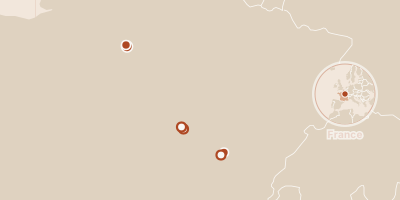
BooksExact

A Moveable Feast: Hemingway's Paris Years

Hemingway wrote A Moveable Feast about his poor, happy early years in 1920s Paris, working from notebooks he had left in trunks at the Ritz in 1928. It was published in 1964, after his death. This route walks the memoir's Paris: the flat on the rue du Cardinal-Lemoine, Gertrude Stein's salon, Sylvia Beach's bookshop, the cafés of Montparnasse and Saint-Germain, and the Ritz where the notebooks resurfaced. Hemingway himself said the book may be read as imagination, so treat its scenes as a memory, not a record.

8 locations5/8 visitable
BooksFictional

Adventures of Huckleberry Finn: Down the Mississippi

Huck Finn fakes his own murder and, with Jim, who has run away from slavery, takes a raft down the Mississippi. Their goal is Cairo, where Jim would be a free man the minute he saw it. They miss it in the fog and drift on into slave country, past a feud, two con men and a farm with the book's last twist. Twain built St. Petersburg from his boyhood town of Hannibal. Most places in the novel are invented, so each pin marks a real landmark or stand-in, and the Grangerfords' country and Bricksville stay off the map.

7 locations4/7 visitable
BooksFictional

Moby-Dick: From New Bedford to the Pequod

Before the white whale there is a cold December and a wrong turn at the docks. Ishmael arrives in New Bedford to find the Nantucket packet gone, rents half a bed at the Spouter-Inn, sits through a sermon on Jonah, crosses to Nantucket and signs aboard the Pequod, which leaves on Christmas Day. New Bedford had overtaken Nantucket as the country's top whaling port by 1840, yet Ishmael is set on sailing from the island. The route follows his first chapters. The inn, the Try Pots and the Pequod are invented, so their pins mark real places that stand in for them; the chapel is real.

6 locations6/6 visitable
BooksFictional

The Alchemist: From Andalusia to the Pyramids

Santiago, a shepherd boy from Andalusia, keeps dreaming of treasure at the Egyptian pyramids. A fortune-teller and a mysterious old king send him across the strait to Africa, where he is robbed in Tangier, falls in love at an oasis and crosses a desert of warring tribes. Paulo Coelho's 1988 fable has sold more than 150 million copies. The route follows the boy from a ruined church to the Giza plateau and back again. The book keeps its geography loose, so most pins mark the best-known place for a scene rather than a spot the author names.

7 locations3/7 visitable
MoviesApproximate

Thelma & Louise: The Road to the Grand Canyon

Thelma & Louise runs from Arkansas to the Grand Canyon, but it was filmed in California and Utah, around Long Beach, Los Angeles, Arches and Dead Horse Point. One violent night at a roadhouse bar turns a weekend trip into a run for Mexico. This route follows the story in film order through six real places: a Long Beach bar, a Los Angeles motel, a Colorado general store, the desert at Arches, the ghost town of Cisco and the cliff edge at Dead Horse Point. Almost all of them stand in for somewhere else, and each stop says where.

6 locations5/6 visitable
MoviesApproximate

Vertigo: Hitchcock's San Francisco

A retired detective with a fear of heights is hired to follow a friend's wife around San Francisco, because her husband fears she is possessed by Carlotta Valdes, a woman who died in 1857. Hitchcock's 1958 thriller was shot on location in San Francisco, at Mission San Juan Bautista, in Big Basin Redwoods State Park, at Cypress Point on 17-Mile Drive and at Paramount Studios in Hollywood. This route follows the story in film order through nine places: a vanished restaurant, a Nob Hill apartment block, a mission cemetery and an art museum, a fort under the Golden Gate Bridge, a coastal kiss, a mission bell tower and a hotel with a green neon sign.

9 locations7/9 visitable
MoviesApproximate

The Talented Mr. Ripley: Ischia to Venice

Where The Talented Mr. Ripley was filmed: Ischia Ponte and Procida stand in for Mongibello, Anzio plays San Remo, and Marge voices her suspicions at Caffè Florian in Venice. Tom Ripley is paid $1,000 to bring Dickie Greenleaf home, and a seaside friendship becomes a trail of lies and killings. The route follows the film's order through Ischia and Procida, Anzio, Naples, Rome and Venice. Many places play other places: Ischia and Procida stand in for the fictional village of Mongibello, Anzio plays San Remo, and the "Roman" opera house is in Naples.

8 locations8/8 visitable
MoviesApproximate

Monty Python and the Holy Grail: The Castles of Camelot

When the National Trust withdrew filming permission, Monty Python's Grail quest leaned on Doune Castle in Scotland for Camelot, Castle Anthrax and most other castles, with Kidwelly Castle in South Wales for the opening shot and Bodiam Castle in East Sussex for the Swamp Castle exterior. King Arthur sets out across Britain in AD 932 to find knights and, in the end, the Holy Grail. This route follows the quest in film order through six locations: the castle of the opening shot in Wales, Doune Castle in Scotland standing in for the rest, a moated castle in East Sussex for one establishing shot, a mine, a glen and the island tower that ends the film.

6 locations5/6 visitable
MoviesApproximate

Paddington: From the Station to the Museum

A young bear stows away from Peru, turns up at Paddington station and is taken in by the Brown family. Paul King's 2014 film follows him through a cosy London of antique shops and a gentlemen's club, while a taxidermist closes in. Most of it was shot on real London streets. This route runs from the station to Primrose Hill, Portobello Road, Pall Mall and the Natural History Museum, with one caveat: the film's station front door is borrowed from Marylebone.

6 locations4/6 visitable
MoviesApproximate

Before Midnight: A Greek Summer in Messenia

Jesse and Céline are now a couple with twin daughters, on a summer holiday in southern Greece. Before Midnight, the third and final film of Richard Linklater's Before trilogy, was shot in 15 days on the Peloponnese coast and turns one last night into a long, honest argument about love. The route follows the film from an airport farewell to a writer's house, a castle, a harbour town and a resort hotel. The filmmakers have named few exact addresses, so the Pylos and hotel stops are approximate.

5 locations5/5 visitable
MoviesApproximate

Before Sunset: Paris in Real Time

Nine years after a night in Vienna, Jesse is on a book tour in Europe when Céline walks into his reading in a Paris bookshop. He has an hour before his flight, and they spend it wandering the city. Richard Linklater's 2004 film plays in real time: the story lasts about as long as the film, roughly eighty minutes. It was shot in 15 days across Paris, and its locations jump about more than the dialogue admits. This route follows the film's order from the Left Bank bookshop through the Marais and the east of the city to the Seine and a gated courtyard in the Faubourg Saint-Antoine.

7 locations6/7 visitable
MoviesApproximate

Midnight in Paris: Gil's Paris, Then and Now

Gil Pender is a screenwriter with a nostalgia problem, in Paris with a fiancée and her wealthy parents. Every night at midnight a 1920s car pulls up and carries him back to the 1920s, among the Fitzgeralds, Hemingway and the surrealists. By day he is stuck in 2010. This route follows the film from Monet's garden at Giverny to Pont Alexandre III, with the stops placed from a film-locations guide: where the 1920s scenes are shot you can still sit, eat and shop today. The party and flea-market scenes are approximate.

9 locations8/9 visitable
GamesApproximate

Call of Duty: WWII — Normandy to the Rhine

Private First Class Ronald "Red" Daniels lands on Omaha Beach on D-Day with the 1st Infantry Division and fights his way into Germany with one squad, until a friend is captured and the search for him ends at a concentration camp. Call of Duty: WWII is a 2017 game by Sledgehammer Games, and its campaign is set among real battles. The route follows the missions in order: Omaha Beach, Marigny, Aachen, the Hürtgen Forest, the Ardennes, the bridge at Remagen and Berga, with the real battle each one echoes. Pins mark battle areas, not a mission's exact street.

7 locations3/7 visitable
GamesFictional

Battlefield 1: From Suez to Monte Grappa

Battlefield 1 sends its soldiers across the Western Front, the Italian Front, Gallipoli and Arabia. This route follows the War Stories and multiplayer maps that go with them, from the Suez Canal in 1915 to Monte Grappa in October 1918. Stops run in the order of the real battles, not the game's menu. The maps are the game's own reconstructions, so each pin marks the real ground behind a level, and one stop is a village the game invented.

7 locations2/7 visitable
GamesApproximate

Kingdom Come: Deliverance II — Kuttenberg and the Bohemian Paradise

Kingdom Come: Deliverance II is set in Bohemia, 1403, from Trosky Castle to Kuttenberg, today Kutná Hora. Henry of Skalitz and Sir Hans Capon ride to Trosky, and the civil war drags them through the Bohemian Paradise to the silver city; the 2025 sequel by Warhorse Studios rebuilds both maps from real castles, villages and streets. The route follows the story from Trosky to the siege of Suchdol. The game's version of each place is a 1403 reconstruction, so look for the castle ruins and rebuilt keeps rather than the exact buildings Henry sees. The first game's story ends just before it, so this route picks up at Trosky.

7 locations5/7 visitable
GamesApproximate

Forza Horizon 5: Mexico in Seven Stops

Forza Horizon 5 drops the Horizon Festival into a fictionalised Mexico, on a map 50% larger than Forza Horizon 4's. Creative director Mike Brown calls Mexico almost the whole world in one country: snowy peaks, tropical jungles, epic canyons, beautiful beaches, ancient architecture and modern cities. This route visits seven real places the game recreates, from a sea arch at the tip of Baja to a canyon with a train, and says what the game does at each. The map is a condensed Mexico, so the pins mark the real sites, not their positions in the game.

7 locations6/7 visitable
GamesFictional

Shenmue I & II: From Yokosuka to Guilin

In 1986 the teenage martial artist Ryo Hazuki comes home to the family dojo in Yokosuka and watches his father, Iwao, die at the hands of Lan Di. Swearing revenge, Ryo follows the killer to Hong Kong in 1987 and on to the mountains of Guilin, and the two games turn that trail into one long walk through a living town, a harbor, a crowded Hong Kong district and a walled city. The route follows Shenmue and Shenmue II in seven stops. Dobuita Street and Kowloon Walled City are real places the game draws on, the dojo and Bailu Village are invented, and every stop says how closely its pin matches the game.

7 locations3/7 visitable
GamesSpeculative

Pokémon Red and Blue: Kanto in the Real World

The Kanto of Pokémon Red and Blue is based on the real Kantō region of Japan: fans match Pallet Town to Machida, Vermilion City to Yokohama, Celadon City to Shinjuku and Lavender Town to Narita. You start in a quiet town, beat eight gym leaders and take on Team Rocket. This route follows the game's journey from Pallet Town to the final gym and sets each stop beside the real place it is said to resemble. The game's Kanto is inspired by the real one, not a copy of it, so every pin is an outside reading of the map, not an official location.

10 locations4/10 visitable
MoviesExact

Crazy Rich Asians: From Newton to the Supertrees

Rachel Chu, a Chinese American economics professor, flies to Singapore with her boyfriend Nick for his best friend's wedding and learns that Nick's family is among the richest in the country. Jon M. Chu's 2018 film follows her from the airport to a mahjong table where she faces down his mother. This route visits nine places from the film, in story order. Several of the story's places were filmed in Malaysia instead of Singapore: the Young family estate in Kuala Lumpur, the island parties on Langkawi and the mahjong parlor in Penang.

9 locations9/9 visitable
MoviesSpeculative

Studio Ghibli: The Real Places Behind Eight Films

Studio Ghibli's worlds feel lived-in because Miyazaki went to look at real places: a Welsh mining museum for the village in Castle in the Sky, Visby for the town of Kiki's Delivery Service, the harbour of Tomonoura before Ponyo. Other links are only rumoured, and he has denied at least one, the town of Jiufen in Taiwan for Spirited Away. This route follows eight films in release order, from 1986 to 2008, and pairs each with the real place reported as its inspiration. Only some of these identifications come from Miyazaki himself, so every stop says whose claim it is, and none of them is a filming location.

8 locations8/8 visitable
MoviesSpeculative

Suzume: From Miyazaki to Tōhoku

A schoolgirl in Kyushu follows a stranger into an abandoned resort, opens a door that was meant to stay shut, and ends up chasing a cat across Japan, closing doors as she goes. Her last door stands in the hometown she lost to the 2011 tsunami. The route follows her path in story order: Nichinan harbour, the Bungo-Mori roundhouse, Yawatahama port, a Kobe mountain, Ochanomizu and Hijiri Bridge in Tokyo, then Miyako and Orikasa Station in Iwate. The film is animated, so most pins mark places that Wikipedia says its scenes were modelled on, and the Kobe amusement park is disputed.

8 locations8/8 visitable
MoviesApproximate

Lost in Translation: Tokyo and Kyoto

Bob is a fading American movie star in Tokyo to advertise whiskey; Charlotte is a disillusioned recent graduate, married for two years. Both are far from home, and they find each other at the Park Hyatt Tokyo. The route follows their story in the film's order: the neon streets of Shinjuku, the hotel, Shibuya Crossing and a karaoke room, then Charlotte's day trip to Kyoto Station, Nanzen-ji and Heian Shrine. Coppola shot for just 27 days, many of its locations in real places of business and public areas. The karaoke branch is pinned approximately.

7 locations6/7 visitable
MoviesApproximate

The White Lotus Season 3: Samui, Phuket and Bangkok

Where The White Lotus season 3 was filmed: its Thai resort is stitched from the Four Seasons on Ko Samui, the Anantara Mai Khao and the Rosewood in Phuket, and Frank's scenes in Bangkok at the Mandarin Oriental. It opens with gunshots and a body in a lake, then rewinds a week. This route visits six real places in story order, from the Four Seasons on Ko Samui to a Bangkok hotel and a Muay Thai stadium. The on-screen resort was stitched together from several hotels, so no single place is the White Lotus.

6 locations2/6 visitable
MoviesExact

Money Heist: Madrid's Mint and Bank of Spain

A man known as the Professor recruits eight robbers named after cities, puts them in red jumpsuits and Salvador Dalí masks, and sends them into the Royal Mint of Spain. Two heists later, the target is the Bank of Spain. Neither building is what it seems: the Mint is the headquarters of Spain's national research council, and the bank is a government ministry. The route follows the Madrid places where the series was filmed, in story order, from a farm estate in Torrelodones to a staircase in the Casino de Madrid.

7 locations2/7 visitable
MoviesApproximate

The Sopranos: Tony's New Jersey

Tony Soprano's mob is a New Jersey one, and the series made a point of it: the majority of its exterior scenes were filmed on location in the state, with most interiors built at Silvercup Studios in New York. The route follows the opening titles from the Pulaski Skyway to the Soprano house, then the pork store, the Great Falls, the Bada Bing, the Pine Barrens and the diner of the finale. The Pine Barrens episode was filmed in New York, and the house is a private home, so its pin marks only the borough.

7 locations4/7 visitable
MoviesApproximate

Twin Peaks: From the Falls to the Double R

Twin Peaks is set five miles from the Canadian border, but its exteriors come from the Snoqualmie Valley, all around 25–30 miles from Seattle. David Lynch and Mark Frost found the places they had written into the pilot in Snoqualmie, North Bend and Fall City. This route follows the series through five of them: the falls from the opening titles, the road with the welcome sign, the hotel, the sheriff's station and the diner. Most interiors were built on sets in a San Fernando Valley warehouse, so these stops are exteriors, and the Reinig Road pin marks the road, not one spot.

5 locations4/5 visitable
MoviesApproximate

House of the Dragon: Cornwall to Spain

HBO's Game of Thrones prequel was filmed primarily in the United Kingdom, and its Velaryon world is Cornish: the island seat of Driftmark is a tidal island, and the Stepstones war camp is a cove on the Lizard peninsula. For the capital and the free city of Pentos, the crew went to western and southern Spain. The route follows the story from the Stepstones war (season 1, episode 3) through the Driftmark episodes to King's Landing in season 2. Sources do not name the exact streets used in Cáceres, so that pin marks the old town.

6 locations4/6 visitable
MoviesApproximate

Downton Abbey: From Highclere to the Royal Parade

Downton Abbey is set on a fictional Yorkshire estate between 1912 and 1925, but its great house stands in Hampshire and its village in Oxfordshire. This route follows the story, from the Titanic news of series 1 to the royal visit of the 2019 film, to the real places behind it. It takes in Highclere Castle, Bampton's church and library, a prison in Lincoln, castles in Scotland and Northumberland, the Ealing stage where the kitchen was built, and the film's parade village and York streets. Lacock's pin marks the village, as the sources name no exact spot.

9 locations8/9 visitable
Real JourneysSpeculative

Magellan and Elcano: The First Circumnavigation

On 20 September 1519 five ships and about 270 men sailed from Spain to find a western sea road to the Spice Islands. Magellan died in the Philippines, but Juan Sebastián Elcano brought the Victoria home three years later with eighteen survivors and 26 tons of spices, having sailed all the way around the world. The route follows the voyage from the mouth of the Guadalquivir past Port St. Julian, through the strait and across the Pacific to the Moluccas, then home past the Cape of Good Hope. Anchorages are often unrecorded, so most pins mark the nearest known place; the dates come from Pigafetta's journal and modern accounts.

12 locations7/12 visitable
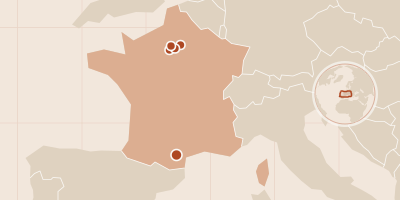
HistorySpeculative

Vlad the Impaler: The Real Dracula

Vlad III ruled Wallachia in three separate reigns and earned his nickname from impalement, his favorite method of execution. His patronymic, Dracula, is thought to have inspired the name of Bram Stoker's vampire, but the man himself spent his life between the Ottoman sultans and the king of Hungary. Nine places follow his life in order, from the Transylvanian house named as his birthplace to the battlefield near Snagov: hostage years, exile, raids, a war with the sultan and a long imprisonment. Bran Castle is left out on purpose, since it is often, but incorrectly, said to have been his home.

9 locations4/9 visitable
HistoryApproximate

Vesuvius AD 79: Pliny's Bay of Naples

In AD 79 a mountain above the Bay of Naples blew apart. Pliny the Younger watched from Misenum across the water, lost his uncle, the admiral Pliny the Elder, to the eruption, and years later described it for the historian Tacitus in two letters: the only eyewitness account that survives. The route follows the eruption in the order of its events, from the mountain's first column to Pompeii, Herculaneum, the beach at Stabiae and back to Misenum. Pliny's letters never mention Pompeii or Herculaneum, so those stops come from archaeology. The traditional date is 24 August, but newer evidence points to the autumn.

6 locations5/6 visitable
HistoryApproximate

1066: Stamford Bridge to Hastings

1066 in three battles: Fulford and Stamford Bridge in the north, then Pevensey, Hastings and Battle in the south, with Westminster at both ends. Edward the Confessor died childless that January; by Christmas Day Harold Godwinson had fallen and William of Normandy was crowned. The route follows the crown from Westminster to the Yorkshire landing of Harald Hardrada, Fulford and Stamford Bridge, then to Pevensey, Hastings and the field at Battle, and back to Westminster on Christmas Day. The exact ground of several battles is debated, so those pins mark the best-known sites.

9 locations8/9 visitable
HistoryApproximate

Joan of Arc: From Domrémy to Rouen

Joan of Arc’s road runs from her family’s house in Domrémy, through Vaucouleurs, Chinon, Orléans and Reims, to Rouen, where she was burned in 1431. A peasant girl, she persuaded a doubting captain and then a doubting prince to give her an army, lifted the siege of Orléans in 1429 and stood beside Charles at his coronation. The route follows her through nine places, from her family's house in Domrémy to the square in Rouen where she was burned. Where a building was rebuilt or the exact spot is unrecorded, the stop says so.

9 locations5/9 visitable
HistoryApproximate

Napoleon's Hundred Days: From Elba to Waterloo

On 26 February 1815 Napoleon slipped away from Elba with some 1,000 men. Within a month he was back in the Tuileries, and by mid-July he had surrendered to the Royal Navy. The route follows him stop by stop: his villa on Elba, the landing at Golfe-Juan, the meeting at Laffrey and the entry into Grenoble on the Route Napoléon, the Tuileries, the farms of Hougoumont and La Haye Sainte at Waterloo, then Malmaison and Île d'Aix, where his journey ended. The pins at Golfe-Juan and Grenoble mark the towns, not exact spots.

9 locations7/9 visitable
MythologySpeculative

Robin Hood: From Barnsdale to Kirklees

Robin Hood is known from medieval ballads, and the oldest of them are set as much in Yorkshire's Barnsdale and in Nottingham as in Sherwood. This route follows A Gest of Robyn Hode and its companions, from the Sorrowful Knight's first dinner in the greenwood to Robin's death at the priory. None of these places can be proved: every identification is a tradition, and the legend is not history. Each stop names the ballad that tells its episode and says how firmly the place is tied to it.

9 locations5/9 visitable
MythologySpeculative

King Arthur: From Merlin's Dragons to Avalon

King Arthur's legend has no single home: he is conceived at Tintagel and holds court at Caerleon, Cadbury Castle is claimed as Camelot and Glastonbury is linked to Avalon. The route follows Geoffrey of Monmouth, Malory and others from Merlin's dragons to the sword returned to the water. Every pin marks a real place that tradition has attached to an episode, not a site proven by history, and each stop says where the link is doubted.

9 locations5/9 visitable
BooksApproximate

Pride and Prejudice: Longbourn to Pemberley

Netherfield Park is let at last, and Austen's novel follows Elizabeth Bennet from her family's village to a Kent parsonage and on to Derbyshire. The houses of the book are described rather than mapped, so this route follows the real places where the 2005 film and the 1995 BBC series found them. Nine stops follow the story in order, from Longbourn to the inn at Lambton. Each pin is a real filming site standing in for a place in the book; only Gracechurch Street is the real London street the novel itself names.

9 locations5/9 visitable
BooksFictional

The Great Gatsby: From the Eggs to the Plaza

Fitzgerald set The Great Gatsby on two invented peninsulas, West Egg and East Egg, but he built them from the Long Island he knew in Great Neck, where he lived from October 1922. Behind the glamour sit a dump, a station and a hotel suite that were all real. This route follows Nick from the Eggs through the valley of ashes, Penn Station, the Queensboro Bridge and the Plaza Hotel. The Eggs, the valley and Gatsby's house are invented, so their pins mark the real places the novel is read against.

7 locations4/7 visitable
BooksApproximate

Murder on the Orient Express: From Aleppo to the Snowdrift

Murder on the Orient Express runs from Aleppo through Istanbul and Belgrade to a snowdrift near Vinkovci. Poirot's train is stuck there with a murdered man aboard and the killer still on it. The route follows the story from Aleppo station through Istanbul, where Poirot gets his telegram and his berth, and Belgrade to the snowdrift near Vinkovci. It ends with the 1932 kidnapping that gave Christie her plot. Most pins are indicative: the novel names few exact places.

6 locations1/6 visitable
BooksApproximate

Death on the Nile: Aswan, Abu Simbel and Karnak

Agatha Christie's 1937 mystery puts Hercule Poirot on holiday in Aswan, waiting to board the Nile steamer Karnak. Among his fellow passengers are a jilted woman stalking her ex-fiancé's honeymoon, her former friend the heiress, and a boulder that comes uncomfortably close to the bride. The route follows the steamer from Aswan to Wadi Halfa and ends at Karnak, where the 1978 film moves the falling stone. The novel itself puts that scene at Abu Simbel.

5 locations4/5 visitable
BooksFictional

The Hound of the Baskervilles: Across Dartmoor

The Hound of the Baskervilles takes Sherlock Holmes across Dartmoor: Cabell's tomb at Buckfastleigh, the ten-thirty train from Paddington, Princetown's prison and Hound Tor. A spectral hound stalks the moor. The route runs from the grave that may have inspired the legend and the ten-thirty train from Paddington to the convict prison at Princetown, the mire, the tors and the Stapletons' house. Baskerville Hall and Merripit House exist only in the book, so their pins mark a stand-in or nothing at all.

7 locations5/7 visitable
BooksApproximate

Les Misérables: From Digne to the Barricades

Les Misérables on a map: Jean Valjean's road from the bishop's house at Digne to Montreuil-sur-Mer, the Thénardiers' inn at Montfermeil, Marius's bench in the Luxembourg, the barricade of June 1832 and the sewers and bridges of Paris. Victor Hugo's 1862 novel follows the convict from the night a bishop's kindness turns him towards good to the street fighting in the capital. Hugo hid two of the towns behind initials and the wine-shop barricade has been built over, so only the Luxembourg Garden is pinned exactly; the other stops mark real places standing in for the book's.

7 locations6/7 visitable
BooksApproximate

The Count of Monte Cristo: From Marseille to Paris

The Count of Monte Cristo on a map: from Notre-Dame de la Garde in Marseille to the Château d'If, the island of Monte Cristo and its treasure, Rome's catacombs and the Paris of the count's revenge. A young sailor is arrested at his own engagement party, escapes in a dead man's burial sack and comes back as a count to settle accounts. Most of the stops can be visited; the island of Monte Cristo is a nature reserve with a years-long waiting list, and several scenes happen in places Dumas invented, so those pins mark the real landmark nearby.

9 locations6/9 visitable
BooksApproximate

The Three Musketeers: Meung, Paris and La Rochelle

In April 1625 an eighteen-year-old Gascon rides into the market town of Meung on a yellow pony, bound for Paris and the King's Musketeers. Dumas's novel follows D'Artagnan from that first quarrel through duels, a secret night in the Louvre, a bet made during a siege and a midnight ending on a river bank. The route runs from the Loire to Paris, on to La Rochelle and Portsmouth, and back to the banks of the Lys. The streets, squares and palaces are real; most inns, houses and bastions are Dumas's, so several pins mark a town or a street rather than a building.

8 locations4/8 visitable
GamesApproximate

Ghost of Yōtei: Ezo in 1603

Ghost of Yōtei follows Atsu, a wandering mercenary who returns to Ezo — modern-day Hokkaido — in 1603 to hunt down the Yōtei Six, the band led by the samurai lord Nariaki Saito who slaughtered her family sixteen years earlier. Her revenge carries her across an island modelled on Hokkaido, from the grasslands at Mount Yōtei's foot to the frozen north and the Matsumae clan's castle in the south. This route follows the game's regions and their real counterparts: the Yotei Grasslands around Lake Shikotsu, the Ishikari Plain, the Ainu country of the Nayoro Wilds, the Kitsune's Teshio Ridge, and the Tokachi Range, with Mount Yōtei and Matsumae Castle as its fixed points.

7 locations3/7 visitable
GamesApproximate

Assassin's Creed Shadows: Naoe's Revenge in Kansai

In 1581 the African slave Diogo comes to Kyoto with a Jesuit delegation and is handed to the warlord Oda Nobunaga, who renames him Yasuke and makes him a samurai. That year Nobunaga's army crushes the ninja province of Iga, where the young shinobi Naoe loses her father and inherits his Hidden Blade. From there the two hunt the same conspiracy across Kansai: the port of Sakai, the temple at Honnō-ji where Nobunaga dies, a kofun in Settsu, the castle of Shōryūji at Yamazaki, the shrines of Yamato, and the Templar recruiting ground of Kii. Most stops are real castles, temples and tombs that the game rebuilds.

8 locations8/8 visitable
GamesApproximate

Assassin's Creed Revelations: Ezio in Constantinople

Ezio Auditore da Firenze comes to Constantinople in 1511, an old Assassin chasing five keys that unlock a library sealed beneath Masyaf by Altaïr two and a half centuries earlier. The keys lie scattered across an Ottoman capital caught between the succession claims of the princes Ahmet and Selim, with Byzantine Templars working against the city; the search runs from the Galata Tower and Hagia Sophia to the palace at Topkapı, out to the Maiden's Tower in the Bosphorus and, at the end, into a stronghold of the Byzantine Templars under Cappadocia. This route starts at Masyaf in Syria and follows Ezio through the real Istanbul of the game, the tower, church, palace and islet that can still be visited, before ending underground in Cappadocia.

6 locations5/6 visitable
GamesApproximate

Assassin's Creed III: The American Revolution

Assassin's Creed III crosses the American Revolution from London's Covent Garden opera house to Boston's Old State House, Bunker Hill and the Battery in Manhattan. In 1754 the Templar Haytham Kenway carries a stolen key to the colonies; his son Connor becomes the Assassin who hunts him through the war. Assassin's Creed III builds its America from real maps, and almost every stop can still be walked: the opera house in Covent Garden, the Old State House and Boston Harbor, the green at Lexington and the bridge at Concord, the Bunker Hill battlefield, the Valley Forge encampment, the Monmouth battlefield, and the Battery at the foot of Manhattan, where the war ends.

9 locations9/9 visitable
GamesFictional

Watch Dogs 2: Hacking the Bay Area

Watch Dogs 2 recreates the Bay Area: San Francisco, Oakland, Marin County and Silicon Valley, from Coit Tower and the Golden Gate Bridge to Alcatraz and a parody of the Googleplex, where the hacker Marcus Holloway and his crew DedSec set out to bring down the Blume corporation's surveillance network. This route follows the places where the story's operations happen, from Coit Tower and Embarcadero Center to Sutro Tower, the Googleplex, Ubisoft's own studio, the Golden Gate Bridge and Alcatraz.

7 locations3/7 visitable
GamesApproximate

L.A. Noire: 1947 Los Angeles, Street by Street

L.A. Noire rebuilds Los Angeles in 1947 with fanatical care: the studio mapped the real streets, modelled building interiors on the originals, and filled the map with the city's landmarks. Detective Cole Phelps drives that recreation through traffic, homicide, vice and arson cases, and much of the city he moves through is still standing. This tour follows the real places behind the game's map, from Union Station and Bunker Hill to Wilshire's art deco and the Hollywood movie palaces, then down to the river where the story ends. Every pin marks a real site the game put on its streets.

8 locations8/8 visitable
MoviesExact

Stranger Things: Hawkins in Georgia

Stranger Things' Hawkins, Indiana, is really small-town Georgia: the town square in Jackson, a shuttered psychiatric hospital near Atlanta, a dead shopping mall in Duluth. The stand-ins also include a mansion in Rome and a Vilnius prison playing Kamchatka; in the story, a boy vanishes and a girl walks out of the woods. This route follows the real stand-ins, from the laboratory where the story begins to the quarry, the school, the Starcourt Mall, the mansion that became the Creel House, and the Vilnius prison that stood in for Kamchatka.

8 locations3/8 visitable
MoviesApproximate

Emily in Paris: Emily's Paris and Rome

Emily, a young marketing executive, is posted to Paris to give a French agency a social-media voice, and the show follows her across the city: the little square where she lives, her office by the Palais-Royal, a Left Bank café and the gardens and monuments she drifts through. In its fourth season the story reaches Rome, where Marcello shows her the Colosseum and the Trevi Fountain. This route gathers the places that define Emily's Paris, from the Place de l'Estrapade — where her apartment faces Gabriel's restaurant across the square — to the Café de Flore, the Jardin du Luxembourg, the Palais Garnier, Montmartre's Sacré-Cœur and the French Open at Stade Roland Garros. It ends in Rome, at the two sights that seal her move to Italy.

9 locations9/9 visitable
MoviesApproximate

Mission: Impossible – Dead Reckoning: Chasing the Key

Mission: Impossible – Dead Reckoning Part One sends Ethan Hunt across the Empty Quarter, Abu Dhabi, Rome and Venice for a two-piece key, with a cliff jump at Hellesylt and a train sequence doubled on a Yorkshire railway and in a Peak District quarry. The rogue AI Entity wants it too. Almost every stop is a real place: the desert and airport in the Emirates, a car chase through Rome, a party at the Doge's Palace, a cliff jump at Hellesylt in Norway, and the Alpine train sequence doubled on a Yorkshire heritage railway and in a Peak District quarry.

7 locations5/7 visitable
MoviesFictional

Tenet: From the Kyiv Opera to Stalsk-12

A CIA officer called the Protagonist joins Tenet, a secret organisation fighting a war across time. Inverted bullets and a Russian oligarch named Sator pull him from a Kyiv opera house to Mumbai, Oslo, the Amalfi Coast and Tallinn, chasing a device sent back from the future. This route follows the film's real locations: Tallinn's Linnahall standing in for the Kyiv opera house, Colaba in Mumbai, the Oslo freeport sequence, the gardens of Villa Cimbrone above Amalfi, the Tallinn streets of the car chase and the California ghost town used for Stalsk-12. The Oslo Freeport and Stalsk-12 are fictional, so their pins mark the real places the film points to.

6 locations4/6 visitable
MoviesApproximate

No Time to Die: From Matera to Safin's Island

Bond's final outing opens beside a lake in Norway and closes on an island in the Faroe Islands, with a long detour through southern Italy and a retirement in Jamaica in between. The story's geography is real: Matera's cave lanes, a bridge over the Gravina gorge, a railway station at Sapri, a waterfront house at Port Antonio, the Atlantic Ocean Road and the cliffs of Kalsoy. The route follows the film's order — the frozen-lake flashback, the grave and the bridge, the Matera car chase, the farewell at Sapri, five quiet years in Jamaica and the 'Cuban' harbour that is really Port Antonio, then the Norway drive and the villain's island in the Faroe Islands. The beach house in Jamaica and the lake house in Norway were sets, both since dismantled.

8 locations6/8 visitable
MoviesApproximate

Oppenheimer: From Cambridge to Trinity

J. Robert Oppenheimer studies in Cambridge and Göttingen, builds a physics school at Berkeley, and is handed the one job nobody else wants: build the atomic bomb before the Nazis do. Christopher Nolan's Oppenheimer (2023) follows him from the Cavendish Laboratory to a secret mesa in New Mexico, through the Trinity test and the political fallout that ends his career. This route follows the film's real places — Cambridge, Göttingen, LeConte Hall, Los Alamos, Trinity, the White House, the Institute for Advanced Study and the room where his security clearance was revoked. The film's own stand-ins, from Ghost Ranch to Kerckhoff Hall, Belen and Alhambra, are noted at each stop.

8 locations7/8 visitable
MoviesExact

The Dark Knight: Chicago as Gotham and Hong Kong

Gotham is Chicago. The film shot most of Batman's city on real streets and buildings in the Loop, dressing them up as Gotham, then flew the crew to Hong Kong for its one overseas detour. This route follows The Dark Knight in order, from the bank heist that opens it to the rooftop where Batman and the Joker have their last fight. Along the way: the disused post office that doubled as a bank, the glass office where Wayne holds a fundraiser, the financial street of the convoy chase, the hospital the Joker destroys, an old Chicago bar, the pier where two ferries wait, and Hong Kong's International Finance Centre.

8 locations6/8 visitable
MoviesExact

Ghostbusters: From the Library to Spook Central

In 1984 Ghostbusters turned real New York addresses into a haunted city: the New York Public Library's marble reading room, the Hook & Ladder 8 firehouse in Tribeca and 55 Central Park West, the apartment block that becomes Spook Central. The Sedgewick Hotel was filmed at the Millennium Biltmore in downtown Los Angeles. Most of the exterior landmarks survive and can be visited, though the Sedgewick Hotel's interiors were filmed on the other side of the country, at a grand downtown Los Angeles hotel. This route follows the film's story from the first library ghost to the rooftop battle with Gozer.

6 locations5/6 visitable
MoviesApproximate

Back to the Future: Hill Valley in Los Angeles

Hill Valley is fictional, but almost all of it is Los Angeles. The 1985 film sends Marty McFly thirty years back to a small California town, and the filmmakers built its square on a studio backlot and dressed real malls, schools, churches and houses around the city as Hill Valley. This route follows the story from the Twin Pines Mall car park in City of Industry through 1955 and back to the McFly home in Arleta. Each stop is a real place that played a piece of Hill Valley; the private homes are seen from the street only.

8 locations5/8 visitable
MoviesApproximate

Forrest Gump: Savannah to Monument Valley

A feather drifts down onto a bench in Savannah, and a man starts to talk. His life unrolls across half a century of American history, from an Alabama childhood to the jungles of Vietnam, the Lincoln Memorial, the Watergate and a bayou shrimp boat. This route follows the film in order, from the bench on Chippewa Square to the lighthouse in Maine and the desert where the running finally stops. It marks the real locations and the real stand-ins, since the fictional town of Greenbow and the Vietnam jungle were both played by South Carolina.

9 locations7/9 visitable
MoviesApproximate

Amélie: Montmartre and Beyond

A shy waitress at a Montmartre café staffed and frequented by eccentrics finds a metal box of childhood memorabilia hidden behind a bathroom tile and gets drawn into the lives around her: practical jokes on the nasty greengrocer Collignon, street scenes described aloud to a blind man, and a dropped photo album belonging to Nino, a collector of discarded photo-booth pictures. The route follows her Paris from the café on Rue Lepic to the photo booths of the Gare de l'Est and the blue arrows on the steps of the Sacré-Cœur, taking in skipping stones on the Canal Saint-Martin and a surge of love on the Pont des Arts along the way. Nearly every stop is a real place you can visit.

7 locations6/7 visitable
GamesApproximate

Forza Horizon 4: A Britain Road Trip

Forza Horizon 4, released on 2 October 2018, turns Great Britain into one giant racetrack: an open world with condensed representations of Edinburgh, the Scottish Highlands, the Lake District and the Cotswolds, where seasons change every week and Derwentwater freezes hard enough to drive across. Microsoft counted 24 million players by November 2020, and Polygon found the game world a theme-park version of England where everything has "the faint whiff of an idealised 1950s about it, a place of ordered pub gardens and rosebushes". This route drives the real Britain behind the game, north to south: Edinburgh's Old Town, Bamburgh Castle on its coastal crag, three Lake District stops at Derwentwater, Ambleside and Tarn Hows, and the honey-coloured village of Broadway in the Cotswolds. Every stop can be visited today.

6 locations6/6 visitable
GamesSpeculative

Pokémon X and Y: The France Behind Kalos

Kalos is Metropolitan France turned into a star-shaped Pokémon region. Lumiose City is inspired by Paris, its Prism Tower by the Eiffel Tower and its art museum by the Louvre; the Battle Château recalls Chenonceau on the Loire, the palais Chaydeuvre is the château de Versailles, and the stones outside Geosenge Town are the Carnac stones. The games never confirm their models — these are fan and encyclopaedia identifications — so every pin on this route is speculative. The route follows the story across the real France behind Kalos: the town where the adventure begins, Lumiose's iron tower, two châteaux and a royal palace, a coastal aquarium, the island tower where Mega Evolution is learned, the cathedral clock behind Anistar's sundial, the Breton megalith field where Team Flare hides its ultimate weapon, and an abandoned mine where the legendary Zygarde sleeps.

9 locations9/9 visitable
GamesSpeculative

Pokémon Sword and Shield: The Britain Behind Galar

The Galar region is Britain played back as a game: a fictional land inspired by the United Kingdom, dotted with landmarks that recall Bath and York, crowned by a London of clock towers and football-stadium gyms. Eight gym cities, eight badges, and then the Champion's Cup in Wyndon, where Leon waits and the Darkest Day breaks. This route walks the real Britain behind that map, south to north and then beyond: a chalk giant, a lighthouse, Roman baths, a minster, a national stadium and a clock tower, plus the two downloadable lands, the Isle of Man and the snows of Scotland. Every identification is a fan or developer reading, never confirmed in the games, so every pin here is speculative.

8 locations8/8 visitable
GamesApproximate

Assassin's Creed Brotherhood: The Borgias' Rome

December 1499: Cesare Borgia's army has struck the Auditore villa at Monteriggioni, killing Mario and seizing the Apple of Eden. Assassin's Creed Brotherhood sends Ezio to Rome, the center of Templar power, to take the fight to the Borgia-led Templars, and the hunt for the Apple runs from St Peter's Basilica to a temple hidden underneath the Colosseum. This route follows Ezio from the villa at Monteriggioni through Borgia Rome — the Castel Sant'Angelo fortress, the Pantheon, St Peter's and the Colosseum — to Viana in Navarre, Spain, where his fight with Cesare ends on the battlements. Every stop is a real place you can visit.

6 locations6/6 visitable
GamesApproximate

Assassin's Creed Syndicate: Victorian London

In 1868, at the onset of the Second Industrial Revolution, twin Assassins Jacob and Evie Frye come to a London controlled by the Templars under Crawford Starrick, and set out to take the city back: building their street gang, the Rooks, across an open world of seven Victorian boroughs. Jacob works through Starrick's lieutenants while Evie hunts a Piece of Eden, the Shroud, from St Paul's to the Tower to a vault under Buckingham Palace. This route follows both threads across the capital, then jumps forward: to Whitechapel in 1888, where Evie hunts Jack the Ripper in the expansion, and to Tower Bridge in 1916, where Jacob's granddaughter Lydia clears a German spy nest at Churchill's request. Every stop is a real building or district you can walk to.

6 locations4/6 visitable
GamesFictional

GTA Vice City: The Real Miami Behind Vice City

Vice City is Miami with the labels peeled off. The 2002 game, set in 1986, follows gangster Tommy Vercetti's rise to power after prison, from an ambushed drug deal to the takeover of a drug lord's mansion. The developers built the world from extensive field research in Miami, and the plot draws on the city's real Cubans, Haitians and biker gangs. This route pins six real places behind the fiction: the port of the opening ambush, the Ocean Drive strip behind Ocean Beach, Little Havana and Little Haiti with their warring gangs, Downtown's biker ground, and the private island behind the Starfish Island mansion. Every pin marks the real stand-in, and each stop names the game location it doubles for. One caveat: Vice City itself is fictional, so expect the flavour of 1980s Miami rather than a street-by-street copy.

6 locations5/6 visitable
MoviesApproximate

The White Lotus: A Sicilian Week of Suspicion

The second season of The White Lotus moves to a luxury resort in Sicily, following the staff and wealthy guests through a week of sightseeing days, villa parties and opera nights. Guests explore Taormina's Greek theatre, Daphne drags Harper down to Baroque Noto, and Tanya falls in with a wealthy Brit whose Palermo villa hides an ugly twist. This route visits the real filming locations in episode order, from the San Domenico Palace hotel to the island beach of the finale. The show swaps two villas across the island: its Noto palace is really Villa Tasca outside Palermo, and Quentin's Palermo villa is Villa Elena near Noto.

7 locations1/7 visitable
MoviesExact

Sherlock: 221B and London

The BBC's Sherlock Holmes and his flatmate, army doctor John Watson, solve crimes in present-day London, from a killer's phone traced to their own doorstep to a dominatrix with compromising photographs and a criminal who cracks the Crown Jewels from his mobile. Six stops follow the first three series in order: the 221B front door on North Gower Street, the Baker Street museum, a summons to Buckingham Palace, Moriarty's Tower heist, the hospital rooftop finale and a bomb under Parliament. Most stops are London landmarks you can see from the street; the 221B door is a private house, and the palace, Tower, hospital and Parliament appear as the show's story settings.

6 locations2/6 visitable
MoviesExact

Notting Hill: From Portobello Road to the Savoy

A famous American actress walks into a Notting Hill travel bookshop, and its shy owner falls for her: that is the whole of Notting Hill, and somehow it is enough. Hugh Grant stammers, Julia Roberts glows, and London plays itself, from the market street of Portobello Road to a midnight garden and a press conference at the Savoy. The route follows the film in story order, from the bookshop at 142 Portobello Road and the blue door at 280 Westbourne Park Road to the Ritz, a birthday party, the private garden, the Henry James set at Kenwood House and the Savoy finale. The flat interiors were studio sets and the garden is private, so some pins are for looking rather than entering.

7 locations5/7 visitable
MoviesApproximate

Mamma Mia!: From Skiathos Harbour to the Wedding Chapel

Mamma Mia! sets fictional Kalokairi on Skopelos and Skiathos: the town below Villa Donna, the Old Port, Glysteri's rock jump and the wedding chapel of Agios Ioannis Prodromos. Sophie has secretly invited three possible fathers to her wedding. Five stops on the real islands behind Kalokairi, where principal photography took place from August to September 2007: the town below the villa's hill, the Skiathos harbour where two of the men arrive in identical cabs, the cove of the diary reading and the rock jump, the main beach set with its vanished bar and jetty, and the rock-top chapel of the wedding. One caveat: there is no Villa Donna to visit — the hotel was a Pinewood set.

5 locations5/5 visitable
MoviesApproximate

The Sound of Music: Salzburg and the Salzkammergut

The 1965 film of Maria von Trapp's life was shot on real locations around Salzburg between March and September 1964, and almost all of them can still be visited. This route follows Maria from the mountain meadow and her abbey through the fountains and gardens of the song sequences to the villa terrace, the wedding church and the festival hall where the family sings its way to freedom. The stops run in story order, from the Bavarian opening to the festival escape. One caveat: the famous cemetery hiding place never existed; it was a Hollywood studio set modelled on St Peter's Graveyard.

8 locations8/8 visitable
MoviesApproximate

Gladiator: From Germania to the Colosseum

Where Gladiator was filmed: the Germania battle in a Surrey wood near Farnham, Maximus' farm in Tuscany's Val d'Orcia, the slave market at Ait Ben Haddou in Morocco and Rome's Colosseum rebuilt on Malta's Fort Ricasoli. In 180 AD the general Maximus refuses his loyalty to the new emperor Commodus, loses everything and fights his way back as a gladiator. The route follows the shoot between January and May 1999: the Surrey wood where the Germania battle burned, the Val d'Orcia valley of Maximus' farm, the Moroccan ksar that played Zuccabar and the one-third Colosseum replica built on Malta's Fort Ricasoli — ending at the real Colosseum, where the story's final duel is set.

5 locations4/5 visitable
BooksApproximate

Sherlock Holmes: Baker Street and the Canon

A chance meeting at the Criterion Bar sends an army doctor just back from Afghanistan to a laboratory at St Bartholomew's Hospital, where a stranger grips his hand and observes: "You have been in Afghanistan, I perceive." Within days Dr Watson has moved into 221B Baker Street, the address where many of the stories begin, and off runs the canon: four novels and 56 short stories, all but one set between 1880 and 1914. This route walks Holmes's London in the order the stories appeared: the Criterion where Watson met Stamford, the hospital of the famous first deduction, the Baker Street rooms that did not exist when Doyle wrote and are now a museum, Scotland Yard's Victorian headquarters on the Embankment, a society church where a bride vanishes, a silent club on Pall Mall, and the Underground station where a body fell from a train roof.

7 locations7/7 visitable
MoviesApproximate

Inception: From Paris to the Snow Fortress

Inception filmed the folding bridge sequence on Paris's Bir-Hakeim bridge, used Tangier standing in for Mombasa, and shot in downtown Los Angeles and at Alberta's temporarily closed Fortress Mountain ski resort. Dom Cobb recruits a forger, a chemist and an architecture student to implant an idea and leads them down through layered dreams to an alpine fortress. This route follows the 2009 shoot across four countries: the Paris bridge that folds, a fictional bistro corner, Tangier standing in for Mombasa, two Los Angeles action sites and the closed Alberta ski resort that became the snow fortress. Two stops look different today: the bistro was a temporary set and the Heim Bridge has been replaced.

6 locations1/6 visitable
MoviesApproximate

Dune: The Deserts Behind Arrakis

Dune turns real places into its planets: Norway's Stadlandet is Caladan, Jordan's Wadi Rum and Abu Dhabi's Liwa Oasis share Arrakis, Budapest's Origo Studios build Arrakeen and Italy's Brion tomb becomes the emperor's court. Paul Atreides leaves Caladan for the desert planet, the sole source of spice, then forces Emperor Shaddam to come to Arrakis with Irulan and his Sardaukar soldiers. This route links the five key locations: Stadlandet standing in for Caladan, Wadi Rum and the Liwa Oasis sharing Arrakis, Origo Studios staging Arrakeen and the ornithopters, and the Brion tomb doubling as the imperial court. Part One shot from March to July 2019 in Hungary, Jordan, Norway and the Emirates; Part Two followed from July to December 2022, adding Italy and Namibia to the itinerary.

5 locations3/5 visitable
GamesApproximate

The Last of Us Part II: Three Days in Seattle

Tommy sets out for Seattle to hunt Abby, and Ellie and Dina follow him into a ruined city where the WLF militia and a cult, the Seraphites, fight for control. The Last of Us Part II plays the same three days twice: first as Ellie, then as Abby. The city is the real one: Naughty Dog chose Seattle for its hills and varied weather, and its artists travelled there to study the architecture, vegetation and topography. This route follows both runs. Ellie's: the synagogue they call the Dome, the Pinnacle Theatre, the convention centre and its stalkers, the hospital and the aquarium. Abby's: the stadium she lives in, the Great Wheel of her memories, the Chinatown Gate and the Space Needle seen from the island. Many of the game's buildings carry new names; each stop names the real one behind it.

9 locations9/9 visitable
GamesFictional

Assassin's Creed IV Black Flag: Nassau and the Observatory

Assassin's Creed IV Black Flag sets its pirate Caribbean in Havana, Nassau, Kingston and Port Royal. Edward Kenway steals a dead Assassin's name, takes the Jackdaw, builds a brotherhood in Nassau, loses his friends and chases the Observatory, a device that can watch anyone on earth. Black Flag sets all of it in real ports — Havana, Nassau, Kingston, Port Royal — and then leaves the Caribbean for the Maya ruins of Tulum, an island in the Gulf of Guinea and a final scene in London. The route follows Edward from the harbour where Torres's plot starts, through the pirate republic and the governor who ends it, to the Kingston house where Mary Read drops the disguise, the jail at Port Royal, Príncipe, where the Sage is waiting, and Covent Garden. Most stops mark a real landmark in the town the game rebuilds.

8 locations7/8 visitable
GamesApproximate

Assassin's Creed Valhalla: Chasing the Order in England

Assassin's Creed Valhalla brings the Viking Eivor and their clan to Anglo-Saxon England, where Hytham asks for help ridding the land of the Order of the Ancients. Following tip-offs from an informant who signs himself the "Poor Fellow-Soldier of Christ", Eivor hunts Order members from Grantebridge to Jorvik and Wincestre. The route visits the real places behind the game's: Cambridge, where the jarlskona Soma takes back her town; York, the capital of Viking Britain; the docks of Repton, where the Great Heathen Army wintered; Alfred's Winchester; the battle at Chippenham in 878; and Athelney, where the informant's identity is finally revealed. All six can be visited today.

6 locations6/6 visitable
MoviesFictional

Jurassic Park: From Kauaʻi to Kualoa Ranch

Jurassic Park (1993) invents a dinosaur theme park on an island that does not exist, then shoots almost all of it on one small Hawaiian island, Kauaʻi. On 11 September 1992, the last scheduled day of the Kauaʻi shoot, Hurricane Iniki passed directly over the island and pushed one famous sequence to a ranch on Oʻahu. Nine stops follow the film in story order: the garden of the opening attack, the stream that played a Dominican amber mine, the Kapaʻa waterfront that played a Costa Rica café, the falls every visitor flies past, the estate where the visitor centre façade stood, the gates below Mount Waiʻaleʻale, the canyon of the dead fence, the Gallimimus stampede at Kualoa Ranch and the garden where Grant finds the nest. Filming on Kauaʻi began on 24 August 1992.

9 locations5/9 visitable
GamesFictional

GTA IV: The Real New York Behind Liberty City

Liberty City is New York with the labels peeled off. Grand Theft Auto IV rebuilds four of the boroughs, borrows New Jersey for the state across the river, and copies in the Statue of Liberty, the Coney Island Cyclone, the Manhattan Bridge, Times Square and the Empire State Building — then renames nearly all of them, so the game's Liberty statue holds a takeaway coffee instead of a torch. The story is set in 2008, the year the game arrived. This route pins nine real places behind those names: the triumphal arch at Brooklyn's Grand Army Plaza, the wooden Cyclone at Coney Island, the Manhattan Bridge as the Algonquin Bridge, Brighton Beach as Hove Beach, the surviving 1964 World's Fair site in Queens, and three Manhattan landmarks — Middle Park, Star Junction and the Rotterdam Tower. Each stop names the in-game location it stands in for. One caveat: Rockstar deliberately avoided a precise recreation of New York, so expect the landmarks, not the street plan.

9 locations9/9 visitable
MoviesApproximate

Casino Royale: Prague to the Grand Canal

Daniel Craig's first Bond bleeds, loses at cards and gets his boss a dressing-down, and the film's geography plays tricks of its own: Montenegro is a Czech spa town, Madagascar is an abandoned building site in Nassau, and the House of Commons is a monastery library in Prague. The route follows the film from the black-and-white opening in a Prague office block to the digger chase on a Bahamian building site, a Paradise Island resort, the casino and hotel of Karlovy Vary, the Lake Como villa where Bond recovers from poison, the Venetian palazzo that sinks with Vesper inside, and the Lake Como house where Bond finally gives his name. Two stops are hotels and one is a monastery library you can walk into; the digger site is now inside a military base.

9 locations5/9 visitable
MoviesApproximate

Indiana Jones and the Last Crusade: From Utah to the Grail

Indiana Jones and the Last Crusade (1989) sends Indy from a Boy Scout outing in the Utah desert to the rock-cut façade of Petra, chasing the Holy Grail and his missing father. Three trials guard the cup at the end. The film borrows its scenery from half of Europe, the Middle East and the American West. Nine stops, most of them still standing: the Arches canyons of the opening, the church façade in Venice's Campo San Barnaba that plays the library, an Eifel castle dressed as Brunwald, a San Francisco building that played Berlin's Tempelhof airport, the Almería beach where Henry brings down a fighter with an umbrella, a Granada station playing Alexandretta, the Tabernas tank chase, the Treasury that fronts the Grail's temple, and the Texas sunset the film ends on. Dates are story time; filming ran from May 1988 to early 1989.

9 locations8/9 visitable
MoviesExact

Angels & Demons: The Path of Illumination

Angels & Demons, Ron Howard's 2009 film, is set across Rome: the Pantheon, Santa Maria del Popolo, Piazza Navona and Castel Sant'Angelo. Four cardinals are kidnapped, one dies each hour on the Path of Illumination, and Robert Langdon must stop antimatter from destroying the Vatican at midnight. This route follows Ron Howard's 2009 film rather than Dan Brown's novel: the Pantheon and Raphael's tomb, the Chigi Chapel in Santa Maria del Popolo, the obelisk in St Peter's Square, Bernini's Ecstasy of Saint Teresa, the Fountain of the Four Rivers, the assassin's lair at Castel Sant'Angelo, and the midnight finale beneath St Peter's. All of it still stands; the caveat is that Rome's diocese refused the crew access to the churches, so several interiors in the film are studio sets.

7 locations7/7 visitable
MoviesExact

Game of Thrones: Spain and Morocco

The journey south ran through Morocco first. For the third season the Atlantic ramparts of Essaouira stood in for Astapor, the slaver city where Daenerys buys an army of eunuch soldiers, and the earthen ksar of Aït Benhaddou stood in for Yunkai, whose two hundred thousand slaves she promises to free. When the story turned to Dorne, Spain answered: the Alcázar of Seville became the Water Gardens of House Martell, and the bullring at Osuna the fighting pits of Meereen. Six stops in the order the episodes aired — two in Morocco, four in Spain. The last two are the biggest set-pieces of the sixth and seventh seasons: Girona's cathedral and steps as the Sept of Baelor, and the Roman ruins at Itálica as the ruined Dragonpit.

6 locations6/6 visitable
MoviesApproximate

Star Wars: Beyond Tatooine

Tatooine is the Star Wars desert everyone knows, but the films kept finding other corners of the Earth for their galaxy: redwoods in northern California, a villa on Lake Como, a plaza in Seville, the desert around an oasis in Abu Dhabi, a monastery island off County Kerry and the largest salt flat in the world, in Bolivia. This route follows the shooting in the order the films were made, from the Endor forest of Return of the Jedi to the Crait battle of The Last Jedi. Two stops mark an area rather than a spot: the Endor scenes were partly shot on private land, and no source names the stretch of desert that stood in for Jakku.

6 locations5/6 visitable
MoviesApproximate

Game of Thrones: Winterfell and the Wall in Northern Ireland

Much of Game of Thrones' North was filmed in Northern Ireland. Winterfell, its godswood, Castle Black, the Kingsroad and a fishing harbour that played Pyke were all real ground dressed as Westeros, and a basalt hillside above a small Antrim village hosts the first execution of the series. The route runs in the order the episodes aired: the deserter's beheading above Cairncastle and the Winterfell of Castle Ward, then the quarry that held Castle Black and the Wall, the godswood, the Kingsroad beech avenue and the harbour where Theon Greyjoy comes home. The last stop is the Moneyglass estate, where a bigger Winterfell was built for the second season and used again for the eighth season's battle. Almost everything here is exterior: Winterfell's great hall was a soundstage set.

7 locations4/7 visitable
BooksSpeculative

Don Quixote: La Mancha's Windmills to Barcelona

A gentleman of La Mancha, a head full of chivalry books, a plain full of mills: this route follows Don Quixote from the village argued to be his to the strand of Barcelona, keeping the order of the book. It begins with the village whose name the narrator refuses to give, the inn where a landlord reading from his account book dubs him a knight, and the ridge of mills that shivered his lance to pieces. In Part II it follows him to Dulcinea's town by night, the cave where he sleeps an hour and believes three days have passed, the lakes of Ruidera, and finally Barcelona, where galley crews salute him three times and a bachelor from his own village unhorses him. Which mills he charged, and where the inn of that first night stood, are guesses: Campo de Criptana and Puerto Lápice are the usual answers.

7 locations5/7 visitable
BooksSpeculative

Ulysses: One Day in Dublin

James Joyce's Ulysses is one ordinary day, 16 June 1904, in Dublin, told in eighteen episodes through Leopold Bloom, a Jewish advertisement canvasser, and Stephen Dedalus, who starts the day in a tower by the sea. This route walks the day in the order the novel runs it: from the Martello tower at Sandycove where it opens to Howth Head, where Molly Bloom's memory ends it with a yes. Almost every stop is a place you can still stand in: the tower where Joyce stayed in 1904, the strand Stephen walks, the street of the chemist's where Bloom buys soap, the cemetery of the funeral, the pub where he eats his sandwich, the library where he passes between Stephen and Mulligan, the quay of the Ormond Hotel and the maternity hospital. The last stop is a recollection rather than a setting: the novel never says where on Howth Head the two of them lay.

9 locations8/9 visitable
HistoryApproximate

D-Day: The Five Normandy Beaches

Just after midnight on 6 June 1944, gliders landed beside a canal bridge at Bénouville, and by mid-morning Allied troops were ashore on five code-named beaches — Utah, Omaha, Gold, Juno and Sword — along the Normandy coast. This route visits the places where that day was won and lost, and what stands there today. It starts with the glider coup de main at Pegasus Bridge, then runs along the coast from west to east: the museum built on the sand at Utah, the Rangers' climb at Pointe du Hoc, the American cemetery above Omaha, the concrete of the Mulberry harbour at Arromanches, the Canadian centre behind Juno and the Grand Bunker above Sword.

7 locations7/7 visitable
MoviesApproximate

Outlander: Claire's Scotland

Outlander's Scotland: the standing stones of Craigh na Dun near Kinloch Rannoch, Doune as Castle Leoch, Culross as Cranesmuir and Culloden moor. Claire, a twentieth-century nurse, touches a stone and wakes in 1743; a highlander knocks out the officer chasing her, and she marries Jamie Fraser to stay out of his reach. They start near Kinloch Rannoch, where the production found its Craigh na Dun, then move to the real castles and villages playing Castle Leoch, Fort William, Cranesmuir and Lallybroch, and to a Fife castle standing in for a French abbey. The last stop is Culloden, the moor where Claire and Jamie say goodbye in the second-season finale. One caveat: the standing stones on screen are a built set. The Bronze Age Clava Cairns near Inverness that fans often visit are said to have inspired them, but they are not where the circle was filmed.

7 locations6/7 visitable
HistoryApproximate

Titanic: From Belfast to Halifax

Belfast built her, Southampton sailed her, and two tender ports filled her up before the Atlantic took her. This route follows the whole last leg of Titanic's maiden voyage in order — from the Belfast slipway where 100,000 people watched her leave the ways to the Halifax cemetery where 121 of her dead are buried. Six stops: the shipyard that became a museum, the Southampton quayside and its memorial to the engineers who stayed at their posts, the two Channel ports where tenders ferried passengers out to a ship too big to come alongside, the wreck on the seabed at 12,500 feet, and the graves at Fairview Lawn. Only the wreck is out of reach; every other stop can be walked today.

6 locations5/6 visitable
MoviesApproximate

Game of Thrones: King's Landing in Dubrovnik

After a first season in Malta, the show crossed the Adriatic to a walled city. Dubrovnik's two-kilometre ramparts, the fortress above its western gate and its late-medieval streets played King's Landing for everything the effects departments could not invent: the name-day combats, the riot at the gate, Cersei's walk of atonement. Eight stops run in the order the episodes aired — Lovrijenac and the Pile Gate in the second season, the Rector's Palace when Dubrovnik doubled as Qarth, the Red Keep's gardens at Trsteno and the Meereen stand-in at Klis in the third and fourth, and the Jesuit stairs where the fifth-season finale was shot in October 2014. Only the exteriors live here: the Red Keep and the Sept of Baelor were computer-generated.

8 locations8/8 visitable
MoviesFictional

La La Land: Mia and Seb's Los Angeles

A jazz pianist and an aspiring actress argue through the windows of their cars in a Los Angeles traffic jam, and the city itself becomes the romance: a night on a funicular, a broken projector, a kiss in a planetarium. Damien Chazelle shot La La Land in 40 days across Los Angeles in the summer of 2015, and most of the places the couple reaches for are still there. This route follows Mia and Sebastian from the freeway ramps where they shout at each other to the jazz bar Seb finally gets to open — the 105/110 connector ramps, the Burbank café on the Warner lot, the Lighthouse Café and the pier beside it, the Rialto in South Pasadena, Griffith Observatory and Angels Flight. The film rarely names its own locations, so a few pins mark the real building that stood in for the one on screen.

9 locations5/9 visitable
MoviesFictional

Your Name: Tokyo, Lake Suwa and the Suga Shrine Steps

Taki, a Tokyo schoolboy who waits tables in Shinjuku, keeps waking up in the body of Mitsuha, a shrine maiden in a mountain town who has never left it. They leave notes on each other's skin, fall for each other from a distance — and then the switching stops dead. Taki rides west with two friends to find the town he can only draw from memory, and finds it gone: a fragment of a comet took Itomori and five hundred people three years before his visit. The town was invented, but the film stands on real ground: the Shinjuku where Taki lives and works, the Hida valley that lent Itomori its backdrop, the lake generally credited with the crater pool, and the stone staircase where the story ends. One caveat: Itomori was never filmed, so its crater is the one stop here without a pin.

6 locations5/6 visitable
MoviesApproximate

Call Me by Your Name: From the Perlmans' Villa to the Serio Falls

In the summer of 1983 a seventeen-year-old boy and a twenty-four-year-old American share a house in rural Lombardy: Elio Perlman, who reads too much and plays the piano too well, and Oliver, the graduate student his father hired for the summer. One long, hot, awkward season, and neither of them handles it gracefully. It ends with a telephone call and a boy by a fireplace; it was shot, almost scene by scene, in real places you can still stand in. This route follows the filming from the Perlmans' villa at Moscazzano through Crema's piazza, a Roman villa on Lake Garda and a war memorial at Pandino, out to the meadow at Capralba where Elio makes his move, and then north for the last three days in Bergamo — the country's tallest waterfall, a pensione in the upper town, a drunken night outside Santa Maria Maggiore, and the small station south of Crema that stands in for Clusone. Principal photography ran from 9 May to the end of June 2016, and the villa is a private home, so a few stops are best seen from the street.

9 locations8/9 visitable
MoviesApproximate

The Godfather: From Staten Island to Sicily

The Godfather was filmed on Staten Island, on Mott Street and in Sicily, where Savoca and Forza d'Agrò play Corleone. Michael is pulled into the family war, flees to Sicily, loses Apollonia to a car bomb and settles every score during his nephew's baptism. Coppola shot the film on real locations around New York City and Sicily: the Staten Island house that played the compound, the Mott Street block of the Genco Olive Oil front, the villages of Savoca and Forza d'Agrò that play Corleone, the bar and church of Michael's courtship, the villa of the bombing, and the Little Italy cathedral of the baptism climax.

7 locations5/7 visitable
MoviesExact

Harry Potter: From Diagon Alley to Glenfinnan

Before Hogwarts there is London: a market alley off Gracechurch Street, a barrier between platforms, a staircase in Oxford, a castle in Northumberland and a steam train crossing a Highland viaduct. This route visits six real places that built the Harry Potter films, shot from September 2000 to March 2001 and returned to in the sequels. You start where Harry buys his school supplies, run through the wall at King's Cross, climb the stairs down which McGonagall comes to meet him, wake in the hospital wing, take your first flying lesson at Alnwick and ride out over Glenfinnan — six real places, each tied to the scene it created.

6 locations4/6 visitable
GamesFictional

Persona 5: The Phantom Thieves' Tokyo

Persona 5's Tokyo is real: its map uses Sangenjaya, Shibuya, Shinjuku, Akihabara and Odaiba, alongside the Metaverse where the Phantom Thieves enter Palaces. A student framed for an assault is put on probation, moves into a Tokyo neighbourhood that does not exist, and ends the school year as one of the Thieves. This route picks five stops out of that year: Sojiro's Café Leblanc above Sangen-jaya Station, the Shibuya counter where the Thieves buy their equipment, Shinjuku's bar street and a fortune-teller's stand, the Akihabara arcade where a schoolboy holds a high score, and Odaiba, where the palace of Persona 5 Royal rises. Leblanc, the Crossroads Bar and the Gigolo Arcade are invented; the neighbourhoods around them are not.

5 locations5/5 visitable
GamesFictional

Assassin's Creed Unity: Revolutionary Paris

Arno Dorian is a nobleman who walks into a trap: framed for the murder of the man who adopted him, he spends the opening hours of Unity's Paris of 1789 in a prison cell, and walks out of it an Assassin. From there he is off across the capital hunting the true powers behind the Revolution, while Napoleon, Robespierre and an Apple of Eden keep arriving before he can finish the job. Unity rebuilds late 18th-century Paris at roughly 1:1 scale across seven districts, plus Versailles, so almost every stop here is a building you can walk to: the Bastille site, the Assassins' hideout under the Île Saint-Louis, Notre-Dame's towers, the storming of the Tuileries, the execution square that is now the Place de la Concorde, Robespierre at the Hôtel de Ville, and — with the Dead Kings expansion — a Precursor temple under the basilica at Saint-Denis. Two stops are places the game invented rather than built: that hideout and that temple.

9 locations8/9 visitable
MoviesExact

The Da Vinci Code: Paris to Rosslyn

Ron Howard's 2006 thriller, based on Dan Brown's 2003 novel, sends symbologist Robert Langdon and cryptologist Sophie Neveu from a murdered curator in the Louvre on a quest for the legendary Holy Grail — through a Paris church, a London Templar church and Newton's tomb to a Scottish chapel. The route follows the film's trail in story order, from the Vitruvian-Man murder and the Saint-Sulpice marker to the Temple Church dead end, the APPLE cryptex at Westminster Abbey and the 'neath-the-rose finale at Rosslyn Chapel. Note the abbey scenes were filmed at Lincoln and Winchester cathedrals.

5 locations5/5 visitable
MoviesApproximate

Roman Holiday: A Princess in Rome

Crown Princess Ann, on a goodwill tour of Rome, slips out of her embassy for one night of ordinary life. Reporter Joe Bradley finds her asleep in the street, recognises her from a newspaper photograph, and secretly guides her through the city to land an exclusive — a day of ice cream, a Vespa and the Mouth of Truth that turns into something neither of them planned. William Wyler's 1953 comedy was shot almost entirely in Rome. The route follows Ann and Joe through the real locations: the palace that played the embassy, Joe's flat on Via Margutta, the Trevi and the barber by the Spanish Steps, the Colosseum, the Bocca della Verità, the riverside dance beside Castel Sant'Angelo and the closing press conference at Palazzo Colonna.

9 locations8/9 visitable
MoviesApproximate

Star Wars: Tatooine in Tunisia

In March 1976 a film crew came to southern Tunisia and turned it into another planet. George Lucas had selected Tunisia to provide the desert planet setting for Star Wars, and filming in Tunisia began on March 22, 1976: a troglodyte hotel became the Lars homestead, the salt flats became a moisture farm, and the streets of Ajim on Djerba became the Mos Eisley spaceport. When the prequels called, the crews came back: locations at Onk Jemal in Tozeur, Ksar Ouled Soltane and Ksar Hadada were used for Tatooine scenes in the 1998 shoot, from the Boonta Eve podrace track to the slave quarters where the boy Anakin lived. Abandoned sets for the filming have been left in the desert but can be visited — this route links all eight sites, from the droids' landing dunes to the granary-courtyard slave quarters.

8 locations3/8 visitable
GamesFictional

Yakuza / Like a Dragon: Kamurocho, Sotenbori and Ijincho

Kazuma Kiryu's Kamurocho feels like a real Tokyo night out because it nearly is: Sega modelled it on Kabukicho, then did the same with Dotonbori, Shinsekai, Yokohama and the port town of Onomichi. Every district in the series is based on its real location as it looked in the year its game came out, and later games remodel them again. This route walks the six real stand-ins behind the fiction in the order the games introduced them: Kabukicho's sleepless streets, the theater square, Dotonbori's neon canal, Shinsekai's tower, Onomichi's temple slopes and Yokohama's Isezaki Mall. All six are ordinary public places you can visit today.

6 locations6/6 visitable
GamesFictional

Marvel's Spider-Man: Peter Parker's New York

Insomniac's Spider-Man games hand you a fictionalized modern-day New York and tell you to swing it. The first game maps Manhattan, from a sorcerer's doorstep in Greenwich Village to the square where a virus breaks out; the sequel adds Brooklyn and Queens, where Peter comes home to his late aunt's house and takes his friends to the amusements. This tour follows that arc in seven stops: a fictional mansion, three skyscrapers, an outbreak square, a Queens street and a Brooklyn funfair. Every pin marks the real place behind the mission, and almost all of them can be visited on one long subway day.

7 locations7/7 visitable
GamesFictional

The Last of Us: Joel and Ellie Across America

A smuggler named Joel is hired to carry fourteen-year-old Ellie — possibly immune to the fungus that ended the world — across a ruined America, from the Boston quarantine zone to a hospital in Salt Lake City. What starts as a delivery job becomes the closest thing either of them has left to family, ending in a hospital corridor with an impossible choice. This route follows their road west in story order: outbreak night in Austin, the Boston handoff, Bill's trapped town, the Pittsburgh ambush, Tommy's dam settlement at Jackson, the deserted university in Colorado and the Salt Lake City hospital. The cities are real but the story sites are placed approximately, with real landmarks as pins.

7 locations7/7 visitable
GamesFictional

GTA V: The Real Los Angeles Behind Los Santos

Los Santos feels like Los Angeles because it is Los Angeles, compressed. Grand Theft Auto V squeezes the city's most famous miles into one playable map, from a hillside sign to a Venice boardwalk. This tour visits seven real stand-ins behind the fiction: the hillside sign, a movie palace, a luxury shopping street, an observatory, a pier, a beach and a towered folk-art park. Every pin marks the real place, and each stop names the game location it doubles for. Expect crowds at the beach and on Hollywood Boulevard, and quiet at the towers.

7 locations7/7 visitable
GamesApproximate

Assassin's Creed Odyssey: A Mercenary's Greece

Greece, 431 BC: Athens and Sparta are tearing the Greek world apart, and you are a Spartan mercenary caught between them. Assassin's Creed Odyssey sends you across the Aegean with a broken spear and an eagle at your side, hunting your lost family and the masked Cult of Kosmos that destroyed it. This route follows the Eagle Bearer's trail from the hot gates of Thermopylae to the oracle at Delphi, the Acropolis of Athens, the sanctuary at Olympia, warrior Sparta and finally Mount Taygetos. Every stop is a real place you can visit, recreated in the game's vast open world.

6 locations6/6 visitable
BooksApproximate

Three Men in a Boat: Kingston to Oxford

Jerome K. Jerome's 1889 comic novel sends three friends, J., George and Harris, and the dog Montmorency up the Thames in a rowing skiff, from Kingston to Oxford, camping out for a fortnight. What follows is one of the funniest books ever written about getting nowhere fast: a hedge maze with a guide who cannot find the exit, a punt run down at sunset, a dog who treats every cat as a personal enemy, and a provision-buying procession that staggers the whole town. The route follows the boat in the book's own order: Kingston's back streets, Hampton Court's maze, the lock opposite Weybridge where George joins them, the island where King John is said to have signed the Charter, tea below Cookham, a night in Marlow, Henley before the regatta, the old walls of Wallingford, and the difficult last mile into Oxford.

9 locations8/9 visitable
MoviesApproximate

Pachinko: From Yeongdo to Osaka

Sunja grows up in her mother's boarding house on Yeongdo, an island in the harbour of Busan, under Japanese rule. Pregnant by a married man, she marries a gentle minister instead and leaves with him for Osaka, where Koreans live poor and despised in a neighbourhood called Ikaino. The Apple TV+ series (2022–2024), based on Min Jin Lee's 2017 novel, follows four generations of her family from 1915 to 1989. The route follows the family through real places in Korea and Japan, in story order. Homes, shops and offices in the series are fictional, so the pins mark the neighbourhoods and cities where the story is set, not filming locations.

7 locations3/7 visitable
MoviesExact

The Last Emperor: Puyi's China

Puyi became emperor of China at the age of two, lost the throne at six, and spent the rest of his life being used by others: as a puppet emperor for Japan in Manchuria, then as a war criminal re-educated in a Communist prison, and finally as an ordinary citizen working in a Beijing garden. Bernardo Bertolucci's 1987 epic, which won all nine Oscars it was nominated for, was the first Western feature film allowed to shoot inside the Forbidden City. The route visits the real places of Puyi's life, most of them museums today. The film compresses and softens his story, and some of its scenes were shot in Italy.

6 locations5/6 visitable
MoviesApproximate

The Secret Life of Walter Mitty in Iceland

The Secret Life of Walter Mitty goes from the Time-Life Building in New York to Iceland, where Stykkishólmur doubles for Greenland, Seyðisfjörður hosts the longboard descent and Skógafoss stands in for the Himalayas. Ben Stiller's 2013 film follows a photo editor chasing a missing negative. This route starts at Life's real Manhattan home and then follows Walter through the Icelandic towns, harbour, mountain road, volcano and waterfall that stand in for Greenland and Afghanistan. The places are real; which country they play is not.

6 locations5/6 visitable
MoviesApproximate

Lion: Saroo's Long Way Home

In about 1986 a boy of five or six fell asleep on an empty train in central India and woke up nearly 1,500 kilometres away in Calcutta, unable to name his home town. Adopted by a couple in Tasmania, Saroo Brierley found his way back 25 years later by tracing railway lines on Google Earth. His memoir A Long Way Home became the 2016 film Lion, with Dev Patel as the grown-up Saroo and Nicole Kidman as his adoptive mother. The route follows the real journey, which the film tells closely, from Khandwa station to Burhanpur, Howrah and Hobart, and back to Khandwa. Family homes are private and not pinned.

7 locations2/7 visitable
MoviesApproximate

Skyfall: From Istanbul to the Highlands

Bond is shot off a train in Turkey and left for dead, while a former agent with a grudge against M attacks MI6 from within. Sam Mendes's 2012 film — the 23rd Bond and the highest-grossing of them all — was shot between November 2011 and May 2012 in London, Turkey and Scotland, with much of "Shanghai" and "Macau" faked in England. The route follows the story from the rooftops of the Grand Bazaar to the railway viaduct where Bond falls, a beach bar in Fethiye, MI6's real headquarters, a Turner in the National Gallery, an abandoned Japanese island, a disused Tube platform and the glen where Bond takes M home. Skyfall Lodge itself was a set in Surrey.

8 locations6/8 visitable
MoviesExact

In Bruges: A Hitman's Tour of Bruges

After a job goes horribly wrong in London, two Irish hitmen are ordered to lie low in Bruges and wait for a phone call. Ken finds the city beautiful; Ray is bored rigid and says so at every turn. Martin McDonagh's 2008 dark comedy was shot entirely on location in the city in February and March 2007. This route follows Ken and Ray through the medieval centre: their hotel, the Belfry, a church with a relic, Bosch's vision of hell in the Groeninge Museum, a park, the Lake of Love and the street where the story ends. One scene was shot in a stand-in church, and the top of the tower was a studio set.

8 locations7/8 visitable
MythologySpeculative

The Táin: Queen Medb's Raid on Cooley

One night at Cruachan, Queen Medb of Connacht and her husband Ailill compare their riches and find them equal in all but one thing: Ailill owns a magnificent white-horned bull. Medb sets out to take an even finer one, the Brown Bull of Cooley, from Ulster, whose warriors are all laid low by an ancient curse. Only the seventeen-year-old Cú Chulainn stands in her way, holding off her army ford by ford, one champion a day. The Táin Bó Cúailnge, "the Cattle Raid of Cooley", is the centrepiece of Ireland's Ulster Cycle, preserved in manuscripts from the 12th century on. Its storytellers loved explaining place-names, and many of its places are real and visitable. This route follows the raid from Connacht to Cooley and the bull's last journey home. Quotations are from Joseph Dunn's 1914 translation.

5 locations5/5 visitable
MythologySpeculative

The Mahabharata: The Pandavas' Road to Kurukshetra

Tradition links the Mahabharata to northern India: the Kuru court at Hastinapur near Meerut, Kampil for Draupadi's contest, Delhi's Purana Qila as Indraprastha, and Jyotisar, where Krishna speaks the Bhagavad Gita. The five Pandava brothers survive a murder plot, lose everything in a rigged dice game and meet their hundred cousins in an eighteen-day war at Kurukshetra. Northern India is dotted with places that tradition links to the story, several of them with real Iron Age remains. This route follows the Pandavas through those traditional sites. They are identifications of faith and local memory; archaeology has found ancient towns, but not the epic's events.

6 locations6/6 visitable
MythologySpeculative

The Ramayana: Rama's Exile to Lanka

On the eve of his coronation, Prince Rama of Ayodhya is sent into the forest for fourteen years, so that his stepmother's son can rule. His wife Sita and brother Lakshmana go with him. In the forest Sita is carried off by Ravana, the demon king of Lanka, and Rama, helped by Hanuman and an army of vanaras, monkey-like forest people, crosses the sea to win her back. The Sanskrit epic attributed to Valmiki runs to some 24,000 verses and is still retold, staged and worshipped across South and Southeast Asia. For centuries pilgrims have tied its episodes to real places, from Ayodhya to the hills of Sri Lanka. This route follows those traditional identifications, which are matters of faith and local memory rather than archaeology. Most of the stops are living temples.

7 locations7/7 visitable
MythologySpeculative

Jason and the Argonauts: To the Golden Fleece

King Pelias sends his nephew Jason to fetch the Golden Fleece from Colchis, at the far end of the Black Sea, hoping he will never come back. Jason builds the Argo, gathers the greatest heroes of his day, Heracles among them, and sails east. Apollonius of Rhodes told the voyage in his Argonautica in the 3rd century BC, and he filled it with real coasts, harbours and local legends. This route follows the outward voyage to Colchis. The way home is left out: ancient writers sent the Argo back by wildly different routes, up rivers into the Adriatic and even across Libya. The heroes and the fleece are myth; the shores, islands and ancient cities are real. Quotations are from R. C. Seaton's 1912 translation.

8 locations8/8 visitable
MythologySpeculative

Aeneas: From Troy to Latium

Troy has fallen. Aeneas, a Trojan prince, carries his old father out of the burning city and sets sail with the survivors to find the new homeland the gods have promised them. Virgil's Aeneid, written for Augustus in the 20s BC, follows years of wrong turns, storms and prophecies until the exiles land in Italy, where their descendants will one day found Rome. This route follows the voyage in the order it happens, which is not the order Virgil tells it: the poem opens in Carthage and lets Aeneas recount the earlier wanderings to Queen Dido. Every stop is a real ancient site, most now open as archaeological parks; Aeneas himself belongs to legend. Quotations are from John Dryden's 1697 translation.

9 locations8/9 visitable
GamesApproximate

Valiant Hearts: The Western Front

In August 1914 France expels its German residents, and Karl is torn from his French wife Marie and their baby on a farm near Saint-Mihiel and drafted into the German army. Marie's father Emile is called up on the other side. Ubisoft Montpellier's hand-drawn 2014 game, made for the war's centenary, follows them, an American volunteer called Freddie, a Belgian nurse, Anna, and Walt the medic dog across four years of the Western Front. The heroes are invented, but the battles are not, and every chapter is full of real objects and short historical notes. This route visits the places the story passes through, from the Marne in 1914 to the Chemin des Dames in 1917. Most are now memorials, museums or preserved battlefields.

8 locations8/8 visitable
GamesApproximate

Indiana Jones and the Great Circle: Around the World in 1937

In Indiana Jones and the Great Circle (MachineGames, 2024), set in 1937, the trail of a stolen mummified cat runs from the Vatican and Giza to Shanghai and Sukhothai. Indy races the Nazi archaeologist Emmerich Voss around this "Great Circle" of sacred sites — a story Todd Howard conceived for the game. The circle and its secret are pure adventure fiction, but its stops are real: the Vatican, Giza, wartime Shanghai, the ruined Thai capital of Sukhothai and the ziggurat of Ur. The designers rebuilt them from books and photographs as they would have looked in the 1930s. This route follows the main story.

6 locations3/6 visitable
GamesApproximate

Assassin's Creed Origins: Bayek's Egypt

Egypt, 49 BC. Bayek, the last Medjay protector of the Siwa Oasis, loses his son to a band of masked men, and his hunt for them leads him into the war between Cleopatra and her brother Ptolemy XIII, and to the arrival of Julius Caesar. Ubisoft's 2017 game ends with Bayek and his wife Aya founding the secret brotherhood that the whole series grows from. The studio worked with Egyptologists and historians, enlarged cities for a sense of "pharaonic scale", and later added a combat-free Discovery Tour. This route follows the main story through the real places it uses, from the oracle at Siwa to the spot in Rome where Caesar died. Bayek and the secret orders are fiction; the queen, the generals and the murders mostly are not.

7 locations5/7 visitable
GamesApproximate

Ghost of Tsushima — The Real Island Behind the Game

In November 1274 a Mongol and Korean fleet landed on Tsushima, a mountainous Japanese island halfway to Korea, and overwhelmed its few defenders. Sucker Punch's 2020 game drops a fictional samurai, Jin Sakai, into that invasion: he survives the massacre on the beach and turns into "the Ghost", a guerrilla who breaks the samurai code to drive the invaders out. The designers visited Tsushima twice but did not copy it one to one. This route visits the real places behind the game's opening battle, its castle and its shrines, most of them featured in the island's own guide for players. Jin, his clan and his battles are fiction; the landing, the fortress and the mountains are not.

6 locations5/6 visitable
GamesApproximate

Kingdom Come: Deliverance — Medieval Bohemia in Real Life

Bohemia, 1403. King Wenceslaus IV has been kidnapped by his half-brother Sigismund, whose mercenaries burn the silver-mining village of Skalitz. Henry, the blacksmith's son, survives, and the rest of the 2018 role-playing game by Prague's Warhorse Studios follows his hunt for justice and his father's sword across a small stretch of the Sázava valley in Central Bohemia. Almost every place in the game is real and still on the map: Stříbrná Skalice, the ruins of Talmberk, the town of Rataje with its castle Pirkštejn, the monastery at Sázava. Many of the lords Henry serves were real people too. The route follows the main story; the sequel's opening at Trosky closes it.

7 locations5/7 visitable
GamesApproximate

Fallout: New Vegas — The Real Mojave

Fallout: New Vegas rebuilds the real Mojave: Goodsprings, Primm, Nipton, Searchlight, Boulder City and Hoover Dam are all on its map. In 2281 a courier carrying a platinum poker chip is shot and left in a shallow grave, survives and hunts the man who did it, into a war for the desert between the New California Republic, Caesar's Legion and Mr. House. The designers built the map from US Geological Survey data and photographs of the real desert, so the game's road south from Goodsprings and back up to Las Vegas runs through real towns. The route follows that road. The towns' massacres, radiation and battles are fiction; their saloons, roller coasters and dam are not.

7 locations7/7 visitable
Real JourneysApproximate

Che Guevara and Alberto Granado: The 1952 Journey

The Motorcycle Diaries follows Ernesto Guevara and Alberto Granado's 1952 journey from Buenos Aires across South America — Valparaíso, the Chuquicamata copper mine, Machu Picchu, the San Pablo leper colony on the Amazon — to Caracas. Their overloaded Norton died in Chile; the poverty they saw on the way changed Guevara. Guevara's diary of the trip, published decades later as The Motorcycle Diaries, records how poverty, exploited miners and the lepers they worked with changed him; within a few years he was "Che", a leader of the Cuban Revolution. The route follows the journey from both men's accounts as summarised by historians.

7 locations5/7 visitable
Real JourneysApproximate

Kon-Tiki: Across the Pacific by Raft

In April 1947 the Norwegian Thor Heyerdahl and five companions pushed off from Peru on a raft of nine balsa logs, built in the style of old Spanish drawings of South American rafts. They meant to prove that ancient people could have drifted from South America to Polynesia. After 101 days and almost 7,000 kilometres on the open Pacific, they crashed onto a coral reef in the Tuamotus — and all six walked ashore. The voyage became a bestselling book and an Oscar-winning documentary. Heyerdahl's theory, though, has not survived: archaeology, language and genetics show that Polynesians came from the west, from Island Southeast Asia, as master navigators. The route follows the raft from Callao to Tahiti.

4 locations1/4 visitable
Real JourneysApproximate

Ida Pfeiffer's First Journey Around the World

Ida Pfeiffer's 1846–1848 journey around the world passed through Hamburg, the Brazilian forest, Tahiti and Baghdad, as her own book A Woman's Journey Round the World recounts. A 48-year-old Viennese widow with little money, she travelled mostly alone by cargo ship, horseback and caravan, and came home to a Vienna in revolution. The route follows her first world journey in order, from her own book, A Woman's Journey Round the World: Hamburg, the Brazilian forest, Cape Horn and Valparaíso, Tahiti, Canton, Baghdad, Persia and home. There are no visitor tips for Iraq or Iran.

9 locations7/9 visitable
Real JourneysApproximate

Xuanzang: West From Chang'an

Xuanzang's search for the original Buddhist scriptures runs from Chang'an across the Taklamakan's edge, the Tian Shan and the Hindu Kush to the Buddhas of Bamiyan, then on to Taxila, Kashmir and Nalanda. The monk left in 629 despite a Tang ban on foreign travel, and his record inspired Journey to the West. His travel record, the Great Tang Records on the Western Regions, is still a key source for the history of Central Asia and India, and his journey inspired the classic novel Journey to the West. The route follows him there and back. There are no travel tips for Afghanistan.

8 locations5/8 visitable
Real JourneysApproximate

Darwin and the Voyage of the Beagle

In December 1831 a 22-year-old Cambridge graduate with a passion for beetles and rocks sailed from Plymouth as an unpaid naturalist on HMS Beagle, a ten-gun survey brig. The voyage was meant to take two years and took five. Charles Darwin came home with crates of fossils, skins and notebooks — and with questions about the islands that would lead him, two decades later, to On the Origin of Species. The route follows the ship around the world in order, using Darwin's own Journal of Researches for dates and details: the volcanic Cape Verde islands, the Brazilian forest, the fossil beds of Argentina, Tierra del Fuego, a great Chilean earthquake, the Galápagos, Cape Town and home to Falmouth.

9 locations4/9 visitable
Real JourneysApproximate

Ibn Battuta: From Tangier to China

In June 1325 a 21-year-old law student left Tangier to make the pilgrimage to Mecca. He did not come home for 24 years. Ibn Battuta crossed the Islamic world and beyond — Arabia, East Africa, Anatolia, Central Asia, India, the Maldives, Sumatra and China — earning his keep as a judge and a guest of sultans, marrying and divorcing along the way. By some estimates he covered about 117,000 kilometres, more than any traveller before the age of steam. Back in Morocco he dictated his memories, the Rihla, to a scholar who polished them and borrowed passages from older books, so not every scene was his own. The route picks out nine stops in the order he reached them; it is not one continuous road. There are no travel tips for Mecca or Mali.

9 locations7/9 visitable
Real JourneysApproximate

Tracks: Robyn Davidson Across Australia

In 1977 Robyn Davidson, then in her twenties, walked about 2,700 kilometres from Alice Springs to the Indian Ocean with four camels and her dog, crossing some of the emptiest desert on earth. She had spent two years in Alice Springs learning to train wild camels. She had no plan to write about it, but a National Geographic article and photographs by Rick Smolan made her famous, and her 1980 book Tracks became a classic, filmed in 2013. The route follows her line west across the Northern Territory and Western Australia in order. Much of it crosses Aboriginal land, where she travelled with a Pitjantjatjara elder, Mr Eddie; pins mark communities and stations, not sacred sites.

7 locations4/7 visitable
Real JourneysApproximate

Bashō's Narrow Road to the Deep North

In spring 1689 the poet Matsuo Bashō gave up his hut in Edo and set off on foot with his friend and disciple Kawai Sora into Oku, the remote north of Japan. For about 156 days and some 2,400 kilometres they walked to the places the old poets had made famous — a barrier gate, a bay of pine islands, a battlefield, a mountain temple — and Bashō answered them with haiku. The travel diary he made of it, Oku no Hosomichi, published in 1702, is one of the classics of Japanese literature, and its stops are still pilgrimage sites. Bashō polished the facts for art; Sora's own diary shows where. Dates follow the old lunar calendar, so they are given here by season.

9 locations9/9 visitable
HistoryApproximate

The First Crusade: Road to Jerusalem

In November 1095 Pope Urban II, answering a Byzantine emperor's plea for help against the Seljuk Turks, called western Christians to an armed pilgrimage to Jerusalem. Tens of thousands answered — knights, foot soldiers and poor pilgrims. Their armies took separate roads to Constantinople, then marched together across Anatolia and Syria. Almost four years after the call, they stormed Jerusalem and massacred much of its population. The route follows the main armies in order, from Clermont to Jerusalem, using the participants' own chronicles as summarised by modern historians. Violence against Jews in the Rhineland and against the people of the cities on the way is part of the story and is named plainly. There are no travel tips for Syria or the Lebanese border area.

8 locations3/8 visitable
HistoryApproximate

The Indian Rebellion of 1857: The Revolt Spreads

On a Sunday evening in May 1857 Indian soldiers of the East India Company's army mutinied at Meerut and rode for Delhi. Within weeks much of northern India was in revolt — soldiers, princes dispossessed by the Company, and villagers with their own grievances. It took the British more than a year to crush it, and afterwards the Company itself was abolished and India placed under the Crown. The rebellion goes by many names, from the Sepoy Mutiny to the First War of Independence. It was not one army on one road but a chain of uprisings, and the route visits its main centres in order: Meerut, Delhi, Kanpur, Lucknow, Jhansi, Kalpi and Gwalior. Both sides committed atrocities against civilians, and the texts name them plainly.

7 locations6/7 visitable
HistoryApproximate

The Long March: Retreat Across China

In October 1934 the Chinese Communists' main army, beaten by Chiang Kai-shek's Nationalists, broke out of its base in Jiangxi and fled west. A year and some 9,000 kilometres later, after river crossings under fire, snow passes and a high-altitude swamp, a few thousand survivors reached northern Shaanxi. On the way, Mao Zedong rose to lead the party, and the retreat became its founding legend. The route follows the Central Red Army, the best-known of several Long March columns, in date order. Official histories have polished some episodes, and historians still argue about how much fighting there was at Luding Bridge; the texts note where accounts disagree. Most stops now have memorials and museums.

8 locations5/8 visitable
HistorySpeculative

Mansa Musa's Hajj: Gold Across the Sahara

In 1324 Mansa Musa, ruler of the Mali Empire, set out on the pilgrimage to Mecca with a caravan so rich in gold that Cairo talked about it for years. Arab chroniclers wrote of thousands of servants carrying gold bars and camels loaded with gold dust; historians today treat those numbers as a way of saying "more than anyone could imagine", not as a count. The Catalan Atlas of 1375 still shows him enthroned in the Sahara, holding up a piece of gold. The route keeps to the places the sources actually record: the royal city of Mali, the camp below the pyramids, Cairo, Mecca, and Gao and Timbuktu on the way home. The road across the desert is not documented, so it is not drawn. The route offers no travel advice for Mali.

6 locations1/6 visitable
HistoryExact

The Boshin War: Kyoto to Hakodate

The Boshin War ran from Kyoto to Hakodate in eighteen months: the battlefield at Toba, Edo Castle, the hill of Ueno, Aizu's castle and Goryōkaku. In January 1868 the young emperor was declared ruler in fact as well as name, ending more than 250 years of Tokugawa rule, and the last shogun's supporters fought on until a breakaway republic made its last stand. The route follows that war in six places, all of them visitable: the battlefield at Toba, Edo Castle, the hill of Ueno, Aizu's castle and the hill where its teenage soldiers died, and Goryōkaku. Dates are given in the Western calendar, converted from the Japanese lunar dates used at the time.

6 locations6/6 visitable
HistorySpeculative

The Haitian Revolution: From Bois Caïman to Independence

In 1791 Saint-Domingue was France's richest colony, a sugar and coffee economy worked by hundreds of thousands of enslaved Africans under brutal conditions. Thirteen years later it was Haiti, the first nation born from a successful slave revolt and the first independent Black-led state in the Americas. The cost was enormous: some 200,000 Black Haitians died, and tens of thousands of French and British soldiers, most of them from yellow fever. The route follows the turning points, from the ceremony that tradition places at Bois Caïman to the declaration at Gonaïves, with a detour to the French mountain fortress where Toussaint Louverture died. Fighting was savage on all sides, and the texts say so plainly. The route offers no travel advice for Haiti.

7 locations1/7 visitable
HistoryApproximate

Gandhi's Salt March

On 12 March 1930 Mahatma Gandhi, aged 60, walked out of his ashram in Ahmedabad with 78 followers, heading for the sea. His target was the British monopoly on salt, a tax that touched every Indian household. Twenty-four days and about 385 kilometres later, on a beach at Dandi, he picked up a lump of salty mud and broke the law — and millions followed. The route follows the march south through Gujarat in its real order, with the dates from the day-by-day itinerary: the ashram, the first night's halt, the Kheda country, Borsad, Surat and Dandi, where a memorial now stands. The final stop covers what came next: Gandhi's arrest and the beatings at the Dharasana salt works that shocked the world.

7 locations2/7 visitable
HistoryExact

The Revolutions of 1989: Gdańsk to Bucharest

In 1989 communist rule in Central and Eastern Europe came apart in a few months — through round-table talks in Poland, a picnic on the Hungarian border, candlelit marches in Leipzig, a muddled press conference in Berlin, students in Prague and a bloody uprising in Romania. Each country had its own causes, but every crack made the next one easier. The route visits the exact places where it happened, most of them marked today by a memorial, a museum or a plaque: the shipyard gate where Solidarity was born, the palace of the Round Table, the old border road near Sopron, the church in Leipzig, the bridge at Bornholmer Straße, a street corner in Prague, a pastor's flat in Timișoara and the balcony in Bucharest.

8 locations8/8 visitable
MoviesApproximate

The Grand Budapest Hotel: Zubrowka in Saxony

The Grand Budapest Hotel's imaginary republic of Zubrowka is built from real Saxony: Görlitz's Art Nouveau department store as the lobby, Hainewalde and Waldenburg castles, Osterstein in Zwickau and Dresden's Zwinger. In Wes Anderson's comedy the concierge M. Gustave and his lobby boy Zero are caught up in a murder, a stolen painting and a war. This route visits the real buildings: an empty Art Nouveau department store that became the hotel lobby, a shuttered concert hall, two castles that make up Madame D.'s estate, a former prison, the most beautiful dairy shop in the world and Dresden's baroque Zwinger. Zubrowka is fictional; these are the filming locations.

8 locations6/8 visitable
BooksFictional

Exit West: Through the Doors

Exit West sends Saeed and Nadia through magic doors from a city at war to a tent camp on Mykonos, an empty mansion in Kensington, London, and Marin County, north of San Francisco. Mohsin Hamid's 2017 novel skips the refugees' dangerous journeys and keeps only the arrivals. The doors are magic, but Hamid calls the book "geographically autobiographical": every stop is a place he has lived in or loved. The home city is never named, though he says it was based in many ways on Lahore, so that pin is speculative.

5 locations2/5 visitable
BooksFictional

The Thirty-Nine Steps: Hannay on the Run

John Buchan's The Thirty-Nine Steps sends Richard Hannay from a flat behind London's Langham Place onto the 7.10 from St Pancras and north to Galloway's Cairnsmore of Fleet and the spa town of Moffat, while a German spy ring hunts him. Hannay has three weeks to survive before he can warn the government. The title comes from a real stair in Broadstairs: 78 steps, not 39. This is John Buchan's 1915 novel, not Hitchcock's very different film. London, St Pancras, Cairnsmore of Fleet and Moffat are named in the book; Hannay's hiding places on the moors and the Kent resort of Bradgate are not real, but the steps that gave the book its title are.

7 locations4/7 visitable
BooksApproximate

The Shadow of the Wind: Zafón's Barcelona

Barcelona, 1945. A bookseller leads his ten-year-old son Daniel through a dark alley off the Ramblas to the Cemetery of Forgotten Books, a secret library where every child may adopt one book. Daniel chooses a novel by Julián Carax — and discovers that someone has spent years hunting down and burning every other copy. Carlos Ruiz Zafón's 2001 bestseller is a love letter to the old city, and its mystery runs through real streets: the Ramblas, the Gothic Quarter, the Ribera, Tibidabo and Montjuïc. The library, the bookshop, the hospice and the Aldaya mansion are invented, so those pins mark the streets where Zafón put them; the café, squares and castle are real and open to visitors.

8 locations8/8 visitable
BooksApproximate

Americanah: Lagos, America, Lagos Again

Ifemelu and Obinze fall in love at secondary school in Lagos, in a Nigeria under military rule where everyone seems to be planning to leave. She gets a scholarship to Philadelphia; he, refused an American visa after 9/11, ends up working illegally in London. Over thirteen years in the United States Ifemelu discovers that she has become "black" — and writes a hit blog about it — before deciding to go home. Chimamanda Ngozi Adichie's 2013 novel moves between real cities on three continents, and the route follows it in story order rather than in the book's flashback structure. Homes, salons and the university in Philadelphia are not identified, so most pins mark the city or campus.

9 locations1/9 visitable
BooksApproximate

The Kite Runner: Kabul, Exile, Return

In 1970s Kabul, Amir, the son of a rich merchant, and Hassan, the son of his father's Hazara servant, grow up as near-brothers and fly fighting kites together. In the winter of 1975 Amir wins the city's kite tournament — and fails Hassan at the moment Hassan needs him most. War sends Amir into exile in California; a phone call from Peshawar a quarter of a century later sends him back into Taliban Kabul to make amends. Khaled Hosseini's 2003 debut follows real places in Afghanistan, Pakistan and California. Homes and alleys in the story are not identified, so those pins mark neighbourhoods; the route offers no travel advice for Afghanistan or Peshawar.

7 locations2/7 visitable
BooksApproximate

Journey to the Centre of the Earth: Hamburg to Stromboli

In May 1863 a Hamburg professor of mineralogy decodes a 300-year-old note in runes: go down the crater of Snæfell in Iceland and you will reach the centre of the Earth. Within days he drags his reluctant nephew Axel north by train, steamer and schooner, hires a silent Icelandic guide named Hans and climbs into the volcano. Verne sets up the impossible with a timetable you could almost follow today — Altona station, Kiel, Copenhagen, Reykjavík, the hamlet of Stapi below the glacier. What happens underground is pure fiction, but the way out is real: three months later the travellers are spat out of Stromboli, an island volcano off Sicily, more than 3,000 km from where they went in.

7 locations6/7 visitable
BooksFictional

Dracula: From Transylvania to Whitby

Dracula crosses Transylvania's Borgo Pass and Whitby's harbour, steps and churchyard, then Purfleet on the Thames and London Zoo. A young English solicitor becomes the Count's prisoner; Dracula ships himself to England in fifty boxes of earth and is hunted back to his mountains by Van Helsing's band. Stoker never visited Transylvania; he built its geography from books and maps, and the English half from places he knew. The route follows the novel's diaries and letters stop by stop: the inn at Bistritz, the Borgo Pass, the Black Sea port of Varna, the harbour, steps and churchyard of Whitby, Purfleet on the Thames, London Zoo and the final race up the Danube at Galatz.

9 locations5/9 visitable
BooksApproximate

The Sun Also Rises: Paris to Pamplona

Jake Barnes, an American newspaperman wounded in the war, spends his Paris nights in the cafés of Montparnasse with Lady Brett Ashley — the woman he loves and cannot have. Then the whole crowd heads south: trout fishing in the Pyrenees, then a week of San Fermín in Pamplona, where drink, jealousy and a nineteen-year-old matador break everything open. Hemingway built the novel from his own trips of 1924 and 1925, and almost every stop can still be visited: the café on the Boulevard du Montparnasse, the inn at Burguete, the arcade café on Pamplona's main square, the bullring, the beach at San Sebastián and the Madrid restaurant where the book's last meal is eaten.

9 locations8/9 visitable
MoviesExact

Before Sunrise: One Night in Vienna

On 16 June 1994 an American, Jesse, and a French student, Céline, meet on a train from Budapest. He talks her into getting off with him in Vienna, and with no money for a hotel they walk the city all night, talking about love, death and everything else until his flight leaves in the morning. Richard Linklater's 1995 film was shot entirely in Vienna and began a trilogy that continued in Before Sunset and Before Midnight. The film strings its locations together as if they were a single walk; in reality they are scattered across the city, from the outer districts to the Danube. This route visits them in the order of the night.

9 locations9/9 visitable
MoviesExact

Breaking Bad: Albuquerque on Screen

Breaking Bad was both set and filmed in Albuquerque, New Mexico, and its car wash, motels, diners and Los Pollos Hermanos became as recognisable as the cast. Walter White, a high school chemistry teacher with stage-three lung cancer, starts cooking methamphetamine with a former student, Jesse Pinkman; Vince Gilligan's series ran on AMC from 2008 to 2013, 62 episodes in all. This route visits seven places from the series and its film sequel, El Camino. Almost all of them are working businesses. The White and Pinkman houses are people's real homes and are deliberately left off the map.

7 locations7/7 visitable
MoviesApproximate

The Lord of the Rings: Middle-earth in New Zealand

Peter Jackson shot all three Lord of the Rings films at once, in 438 days between October 1999 and December 2000, at more than 150 locations across New Zealand's North and South Islands. Farmland became the Shire, a regional park became Rivendell, a lonely hill in Canterbury became the capital of Rohan, and a volcano in Tongariro National Park stood in for Mount Doom. This route follows Frodo's story through eight of those places, most of them easy to visit. Some sets were rebuilt for visitors; others were removed and the land returned to how it was. The mountains of Tongariro are sacred to local Māori, so please admire the summits from below.

8 locations8/8 visitable
BooksApproximate

Around the World in Eighty Days: Fogg's Wager

On the evening of 2 October 1872, the punctual and unflappable Phileas Fogg bets his fellow members of the Reform Club £20,000 — half his fortune — that he can go around the world in eighty days, and leaves that same night with his new French valet, Passepartout. On his heels comes Detective Fix, convinced that Fogg is a bank robber on the run. Jules Verne's novel appeared in 1872, when the opening of the Suez Canal and new railways across India and America had made such a race against the timetable just about possible. The route follows the journey eastward in the novel's own dates, from Pall Mall back to Pall Mall.

9 locations7/9 visitable
BooksApproximate

Mrs Dalloway: A June Day in London

Mrs Dalloway unfolds in one June day across Westminster, St James's Park, Piccadilly's Hatchards bookshop and Regent's Park. Big Ben marks the hours for Clarissa, preparing her party, and for Septimus, a war veteran; the two never meet. This route follows the characters through the London they walk, almost all of it still standing. The Dalloways' house, the florist and the doctors are fictional.

9 locations9/9 visitable
Real JourneysApproximate

Endurance: Shackleton's Rescue Journey

Ernest Shackleton set out in 1914 to cross Antarctica on foot. He never even landed. His ship, Endurance, was trapped in the pack ice of the Weddell Sea, drifted for ten months and was crushed and sunk, leaving 28 men on the ice with three lifeboats. What followed — months on drifting floes, a landing on Elephant Island, an 800-mile voyage in an open boat and a march across the mountains of South Georgia — ended with every one of them coming home alive. The route follows that escape from South Georgia to the wreck and back, with dates from Shackleton's own account, South. Most of these places can only be reached by expedition ship.

7 locations2/7 visitable
Real JourneysApproximate

Nellie Bly: Around the World in Seventy-Two Days

Nellie Bly's 1889 record run began at a Hoboken pier, detoured to Jules Verne's house in Amiens, and crossed America by special train from San Francisco. The New York World reporter set out to turn Around the World in Eighty Days into fact and beat Phileas Fogg's record in 72 days, 6 hours and 11 minutes. The route follows her book of 1890, stop by stop, with the dates from her own record. She went east by steamer and train, through the Suez Canal and the British ports of Asia.

9 locations9/9 visitable
HistoryApproximate

Freedom Riders: Washington to Jackson, 1961

In 1961 the Freedom Riders took two buses from Washington, D.C. through Rock Hill, Anniston, Birmingham and Montgomery to Jackson, Mississippi, to test the Supreme Court's ruling against segregated bus terminals. In Alabama a mob burned a bus while police looked away; hundreds more riders ended up in Mississippi's jails and Parchman Farm. The route follows the rides through the places where it happened, several of them now museums and part of a National Monument.

8 locations7/8 visitable
HistorySpeculative

Hannibal's Alpine Crossing

In 218 BC the Carthaginian general Hannibal set out from Spain to attack Rome by the one route the Romans never expected: overland, across the Pyrenees, the Rhône and the Alps, with tens of thousands of soldiers, horses and 37 war elephants. Five months later he came down into the plain of the Po with a battered but unbeaten army, and within weeks had won his first two victories in Italy. The route follows the march as told by the Greek historian Polybius, who wrote about seventy years later and walked the Alpine route himself. Nobody knows for certain where Hannibal crossed the Rhône or which pass he used, so several pins are marked speculative.

8 locations8/8 visitable
MythologySpeculative

Theseus on the Road to Athens

Before the Minotaur, there was the road. Theseus grew up in Troezen, never knowing his father; when he was old enough to lift a great stone and take the sword and sandals hidden beneath it, he set out to find him in Athens. The safe way was by sea. He chose the coast road round the Saronic Gulf instead, which was infested with bandits, and dealt with each one in the way they had treated travellers. The route follows the six labours of that journey as Plutarch tells them in his Life of Theseus, written around AD 100 from much older tales. The places are real; the giants and robbers belong to myth, and several sites are traditional guesses.

8 locations8/8 visitable
GamesApproximate

The Oregon Trail: The Game and the Real Trail

The Oregon Trail follows real landmarks of the 2,170-mile trail: Independence, Missouri, Chimney Rock in Nebraska, Independence Rock in Wyoming and Oregon City at the end. Three student teachers in Minneapolis wrote it in 1971; the 1985 Apple II version, set in 1848, made buying oxen, fording rivers and dying of dysentery a classroom staple, and the series has sold more than 65 million copies. The route follows the game's stops from Missouri to the Willamette Valley, with what stands at each place today.

8 locations8/8 visitable
MythologySpeculative

Odysseus Across the Wine-Dark Sea

After ten years at Troy, Odysseus sets sail for his island home of Ithaca and takes another ten to get there: blown off course, he meets a man-eating Cyclops, a witch who turns his crew into pigs, the Sirens, Scylla and Charybdis and a nymph who will not let him go, losing every ship and every companion on the way. Homer's Odyssey, composed around the late 8th century BC, has been read as a map for as long as it has been read. Already in antiquity the poem's places were linked to real coasts, mostly around Sicily and southern Italy. Those identifications are traditions, not facts, and the ancient geographer Eratosthenes doubted them all — so most pins here are marked speculative.

9 locations9/9 visitable
GamesExact

Assassin's Creed II: Ezio's Renaissance Italy

Florence, 1476: young Ezio Auditore watches his father and brothers hanged on false charges, and spends the next quarter-century hunting the men responsible across Tuscany, Romagna and Venice, all the way to the Vatican. Ubisoft's 2009 game rebuilt Renaissance Italy for climbing and running across rooftops, and mixed its invented feud between Assassins and Templars with real people — the Medici and Pazzi, Leonardo da Vinci, Caterina Sforza and the Borgia pope. The route visits the real buildings and towns of the game. The Auditore family and their villa are fictional; most of the events around them are invented or rearranged from history.

7 locations7/7 visitable
Real JourneysApproximate

The Odyssey of Christopher McCandless

Into the Wild tells the true story of Christopher McCandless: he graduated from Emory University in Atlanta in 1990, paddled the Colorado River into Mexico, worked in Carthage, South Dakota, and in April 1992 walked onto the Stampede Trail outside Healy, Alaska. He died in an abandoned bus that August, aged 24. Jon Krakauer wrote the book in 1996; Sean Penn filmed it in 2007. The route follows his documented trail. The Stampede Trail is dangerous, and this route is not an invitation to retrace the last part of it.

8 locations4/8 visitable
HistorySpeculative

Alexander the Great: Across the Known World

Alexander the Great's route runs from Troy and the Granicus in Turkey to Tyre, Alexandria and Persepolis, and on to the Jhelum in the Punjab. He crossed into Asia at 22, and eleven years later died in Babylon at 32, his empire stretching from Greece to India. The route follows the campaign through its turning points, with Arrian's Anabasis, written four centuries later from earlier accounts, as the main guide. Several battlefields can only be placed approximately; their pins are marked as such.

9 locations4/9 visitable
BooksApproximate

On the Road: Kerouac's American Journey

Between 1947 and 1950 Sal Paradise, a young writer from New Jersey, crosses America again and again — hitchhiking, by bus and in borrowed cars — usually in pursuit of his wild, magnetic friend Dean Moriarty. Jack Kerouac typed the story on a continuous scroll of paper in three weeks in April 1951, and it was published in 1957. Sal is Kerouac, Dean is Neal Cassady, and most of the trips really happened. The route picks out the places the novel names, from a rainy false start on the Hudson to Mexico City and back to a New York street corner. The novel gives towns and streets rather than addresses, so most pins mark areas, not doors.

9 locations8/9 visitable